


08 Aug Tamil Nadu releases English report on Union-State Relations for public access
✎ The Tamil Nadu government’s open-access policy for the Union-State Relations report exemplifies the constitutional principle of federalism and the imperative of transparency in intergovernmental relations.
Subject Relevance — Where This Topic Fits
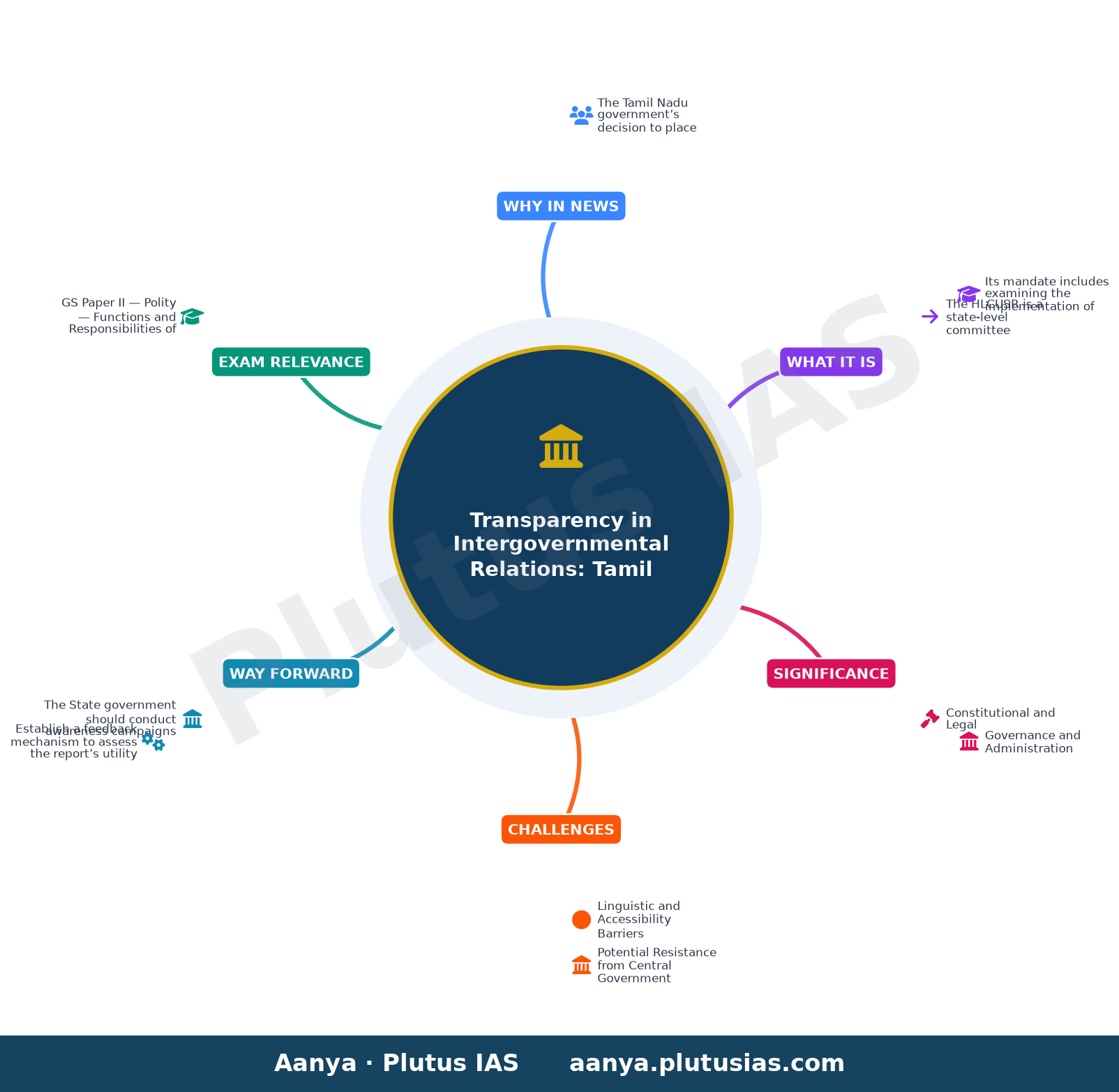
- GS Paper II — Polity — Functions and Responsibilities of the Union and the States, Issues and Challenges Pertaining to the Federal Structure
- Prelims: Federalism, Union-State Relations, Intergovernmental Coordination, Constitutional Provisions (Article 263), Public Accountability, Open Data Policy
- Essay: Federalism in India: Challenges and Opportunities, Transparency and Governance: The Role of Open Data in Democratic Accountability
Quick Revision: The Tamil Nadu government’s open-access policy for the Union-State Relations report exemplifies the constitutional principle of federalism and the imperative of transparency in intergovernmental relations.
Why is this in the news?
The Tamil Nadu government’s decision to place the English version of Part I of the Union-State Relations report in the public domain underscores a commitment to transparency in intergovernmental relations. This move, formalised through a Government Order on July 30, 2026, aligns with broader demands for open governance and follows the earlier release of the Tamil version. The directive to cancel exclusive copyright for the English report further reinforces the principle of accessible public information, particularly in the context of federalism and cooperative governance.
Background
- The High-Level Committee on Union-State Relations (HLCUSR) was constituted by the Tamil Nadu government on April 15, 2025, under the leadership of retired Supreme Court judge Justice Kurian Joseph.
- The committee was tasked with examining the distribution of powers and responsibilities between the Union and State governments, with a focus on fiscal, administrative, and legislative federalism.
- Part I of the committee’s report was submitted to the then Chief Minister M.K. Stalin on February 16, 2026, and tabled in the Assembly on February 18, 2026.
- The Tamil Nadu government had initially released the Tamil version of Part I in the public domain, prompting requests for the English version to ensure wider accessibility.
- The decision to host the English report on the official portal (hlcusr.tn.gov.in) reflects a shift towards open data policies, enhancing transparency in governance.
- The cancellation of exclusive copyright for the English version aligns with constitutional principles of public accountability and the Right to Information (RTI) framework.
What is the High-Level Committee on Union-State Relations (HLCUSR)?
- The HLCUSR is a state-level committee constituted to analyse and recommend measures for improving the efficacy of Union-State relations in India.
- Its mandate includes examining the implementation of constitutional provisions related to federalism, such as Article 263 (Provisions with respect to an Inter-State Council).
- The committee assesses fiscal federalism, including the distribution of financial resources between the Union and States under the Finance Commission recommendations.
- It evaluates administrative federalism, focusing on the delegation of powers and the role of All-India Services in state administration.
- The HLCUSR also examines legislative federalism, including the scope of concurrent and state subjects under the Seventh Schedule of the Constitution.
- The committee’s reports are intended to provide policy inputs for state governments to engage more effectively with the Union government on matters of shared jurisdiction.
- The HLCUSR operates under the administrative supervision of the state’s Public Department, ensuring alignment with state policy objectives.
- The committee’s recommendations are non-binding but serve as advisory inputs for legislative and executive actions.
Key Features
| Feature | Significance |
|---|---|
| Public release of English version of Part I of Union-State Relations report | Enhances transparency in intergovernmental relations by ensuring equal access to policy documents across linguistic demographics. |
| Cancellation of exclusive copyright for the English version | Facilitates unrestricted dissemination of the report, aligning with principles of open governance and democratic accountability. |
| Hosting on dedicated government portal (hlcusr.tn.gov.in) | Provides a centralized, accessible repository for stakeholders, including researchers, policymakers, and the public. |
| Constitutional mandate for transparency in governance | Reflects the State’s commitment to Article 370(3) of the Constitution, which empowers States to ensure transparency in administrative processes. |
| Multi-lingual accessibility of policy documents | Supports inclusivity by catering to non-Tamil-speaking stakeholders, including central government officials and national-level researchers. |
Why it Matters
Constitutional and Legal
- Reinforces the principle of cooperative federalism by enabling States to proactively share policy documents with the Union government and the public.
- Demonstrates adherence to the constitutional duty of transparency under Article 370(3), which vests States with the authority to determine the scope and dissemination of official reports.
- Aligns with the Supreme Court’s emphasis on the right to information (Article 19(1)(a)) as a cornerstone of participatory democracy.
Governance and Administration
- Sets a precedent for other States to adopt similar practices in intergovernmental reporting, fostering uniformity in transparency norms.
- Enhances the credibility of State-level committees by subjecting their reports to public scrutiny, thereby improving policy formulation and implementation.
- Facilitates evidence-based research by researchers and think tanks, enabling a more informed discourse on Union-State relations.
Political and Social
- Strengthens democratic accountability by ensuring that policy documents are accessible to all citizens, regardless of linguistic barriers.
- Underscores the State’s commitment to inclusive governance, particularly for stakeholders who rely on English-language documentation.
- May influence national-level discussions on federalism, particularly in the context of the 16th Finance Commission’s evolving terms of reference.
Challenges
1. Linguistic and Accessibility Barriers
- Despite the English version being released, rural and non-English-speaking populations may still face challenges in accessing or comprehending the report.
- The digital divide could limit the reach of the report, particularly among marginalized communities with limited internet access.
UPSC Link: GS-II: Federalism and Challenges
2. Potential Resistance from Central Government
- The Union government may view the proactive release of the report as an encroachment on its prerogative to determine the pace of policy disclosures.
- Historical tensions between Tamil Nadu and the Union government on issues of autonomy could exacerbate such resistance.
UPSC Link: GS-II: Centre-State Relations
3. Ensuring Sustained Transparency
- The State must ensure that future reports are released in a timely manner and in multiple languages to maintain consistency in transparency norms.
- There is a risk of selective disclosure if subsequent reports are not subjected to the same standards of public accessibility.
UPSC Link: GS-II: Good Governance and Transparency
Challenges — UPSC Perspective
| Issue | Concern |
|---|---|
| Digital accessibility gaps | Limited internet penetration in rural Tamil Nadu may hinder public access to the report. |
| Linguistic exclusivity | Non-English speakers may struggle to engage with the report, undermining its inclusivity. |
| Central government response | Potential pushback from the Union government on the grounds of procedural propriety or national security. |
| Sustainability of transparency | Risk of ad-hoc or delayed releases of future reports, diluting the impact of this initiative. |
| Policy implementation challenges | Ensuring that the report’s recommendations are translated into actionable reforms by the State government. |
Way Forward
- The State government should conduct awareness campaigns in regional languages to ensure that the report reaches all demographic segments.
- Establish a feedback mechanism to assess the report’s utility and identify gaps in accessibility or comprehension.
- Collaborate with civil society organizations and academia to disseminate the report’s findings and gather inputs for future reports.
- Ensure that subsequent parts of the Union-State Relations report are released in both Tamil and English simultaneously.
- Monitor the Union government’s response and proactively engage in dialogue to address any concerns regarding the report’s contents.
- Integrate the report’s recommendations into the State’s annual policy agenda to demonstrate tangible outcomes from the transparency initiative.
- Expand the scope of the High-Level Committee to include representatives from marginalized communities for broader stakeholder representation.
UPSC Value Addition
Keywords for Mains Answer-Writing
Union-State Relations · High-Level Committee on Union-State Relations · Justice Kurian Joseph · Inter-State Council · Federalism in India · Constitutional provisions on Centre-State relations · Public domain access to government reports · DMK government initiatives · Transparency in governance · Constitutional governance · Federal disputes resolution · Administrative reforms in Tamil Nadu · Public accountability mechanisms · Government Order (GO) on transparency · Supreme Court judgments on Centre-State relations
Constitutional & Policy Linkages
- Article 19(1)(a): Right to Information and Freedom of Speech
- Article 262: Adjudication of disputes relating to inter-State rivers
Concept Flow
Formation of High-Level Committee on Union-State Relations by Tamil Nadu government (April 2025) → Submission of Part I of the report to the Chief Minister (February 2026) → Tabled in the State Assembly (February 2026) → Decision to release English version in public domain (July 2026) → Cancellation of exclusive copyright for English version (July 2026) → Hosting on official portal for public access (August 2026) → Potential national-level impact on federalism discourse
Prelims Practice Questions
Q1. Consider the following statements regarding the High-Level Committee on Union-State Relations constituted by the Tamil Nadu government:
1. The committee was headed by a retired Chief Justice of India.
2. The committee submitted Part I of its report to the then Chief Minister M.K. Stalin on February 16, 2026.
3. The committee included a former Vice-Chairman of the Tamil Nadu State Planning Commission as a member.
How many of the above statements are correct?
- Only one
- Only two
- All three
- None
Answer: All three — Statement 1 is incorrect: The committee was headed by retired Supreme Court judge Justice Kurian Joseph, not a Chief Justice of India. Statements 2 and 3 are correct as per the report submission date and the composition of the committee.
Q2. Assertion (A): The Tamil Nadu government directed the High-Level Committee on Union-State Relations to cancel the exclusive copyright for the English version of Part I of its report.
Reason (R): This directive was issued to ensure transparency and public access to the report, similar to the Tamil version.
Options:
A) Both A and R are true, and R is the correct explanation of A.
B) Both A and R are true, but R is not the correct explanation of A.
C) A is true, but R is false.
D) A is false, but R is true.
Answer: ? — Both Assertion (A) and Reason (R) are true, and Reason (R) correctly explains Assertion (A). The cancellation of exclusive copyright was indeed aimed at ensuring transparency and public access to the report.
Q3. Match the following pairs related to Union-State Relations in India:
Column I (Committee/Body) Column II (Purpose)
A. Sarkaria Commission 1. To examine Centre-State relations and suggest reforms
B. Punchhi Commission 2. To study the functioning of the Inter-State Council
C. Inter-State Council 3. To address issues of Centre-State financial relations
D. National Development Council 4. To promote coordination between Centre and States
Options:
A) A-1, B-2, C-4, D-3
B) A-2, B-1, C-3, D-4
C) A-3, B-4, C-1, D-2
D) A-4, B-3, C-2, D-1
- A
- B
- C
- D
Answer: A — The correct matches are: A (Sarkaria Commission) – 1, B (Punchhi Commission) – 2, C (Inter-State Council) – 4, D (National Development Council) – 3. The Sarkaria Commission examined Centre-State relations, the Punchhi Commission studied the Inter-State Council, the Inter-State Council promotes coordination, and the National Development Council addresses Centre-State financial relations.
Mains Practice Question
✍ Critically examine the significance of the Tamil Nadu government’s decision to make the English version of Part I of the Union-State Relations report accessible in the public domain. How does this initiative align with the broader principles of federalism and transparency in Indian governance? (15 Marks)
Approach: MODEL-ANSWER SKELETON:
1. **Context and Background**: Briefly introduce the High-Level Committee on Union-State Relations, its composition (Justice Kurian Joseph, K. Ashok Vardhan Shetty, M. Naganathan), and the report’s submission to the then Chief Minister M.K. Stalin on February 16, 2026.
2. **Principles of Federalism**: Discuss the constitutional framework of Centre-State relations (Articles 256-263, 269-270, 280) and the importance of cooperative federalism. Highlight the role of committees like the Sarkaria Commission (1983) and Punchhi Commission (2007) in examining Centre-State relations.
3. **Transparency and Accountability**: Explain how the decision to host the English version of the report in the public domain aligns with the Right to Information (RTI) Act, 2005, and the principles of open governance. Discuss the cancellation of exclusive copyright as a step toward democratizing access to policy documents.
4. **Comparative Analysis**: Compare this initiative with other states’ approaches to Centre-State relations (e.g., Kerala’s interventions in GST disputes, West Bengal’s opposition to NIA). Highlight Tamil Nadu’s proactive stance in addressing federal disputes.
5. **Challenges and Criticisms**: Acknowledge potential challenges, such as the risk of misinterpretation of the report’s findings or the lack of immediate policy implementation. Discuss the role of the judiciary (e.g., Supreme Court judgments in State of West Bengal v. Union of India, 1963) in resolving Centre-State disputes.
6. **Conclusion**: Summarize the significance of the initiative in fostering trust between the Centre and States, enhancing democratic accountability, and strengthening federalism. Conclude with a balanced view on its potential long-term impact.
Source: The Hindu
Generated by AanyaAi for educational purpose.

- बिहार सरकार का बड़ा फैसला: कारोबार शुरू करने में होगी आसानी, जानिए कैसे मिलेगा फायदा - September 23, 2026
- Bihar Launches Single Window Portal for 62 Business Services: UPSC & PCS Guide - September 23, 2026
- ग्रीनलैंड समझौता: अमेरिका को मिले अतिरिक्त रक्षा क्षेत्र, जानिए पूरा मामला - September 23, 2026

No Comments