


08 Aug UPSC Alert: Kannur’s Mangrove Land Acquisition Stuck for 24 Years
Mangrove landsMangrove coverPolicy implementation✎ The prolonged delay in acquiring privately owned mangrove lands in Kannur underscores the need for expedited implementation of conservation policies, balancing ecological imperatives with socio-economic justice under the Forest…
Subject Relevance — Where This Topic Fits
- GS Paper III — Environment and Ecology (Conservation of Biodiversity, Wetlands, and Mangroves) | GS Paper III — Forest Rights and Land Acquisition Issues | GS Paper II — Centre-State Relations and Implementation of Environmental Agreements
- Prelims: Mangrove conservation, Wetland (Conservation and Management) Rules 2017, Forest Rights Act 2006, Rebuild Kerala Initiative, Centre-State land transfer agreements, Notified forests, Biodiversity hotspots, Coastal Regulation Zone (CRZ) norms
- Essay: The interplay of ecological conservation and socio-economic justice in land acquisition policies, Balancing development imperatives with environmental sustainability: Lessons from Kerala’s mangrove crisis
Quick Revision: The prolonged delay in acquiring privately owned mangrove lands in Kannur underscores the need for expedited implementation of conservation policies, balancing ecological imperatives with socio-economic justice under the Forest Rights Act and Coastal Regulation Zone norms.
Why is this in the news?
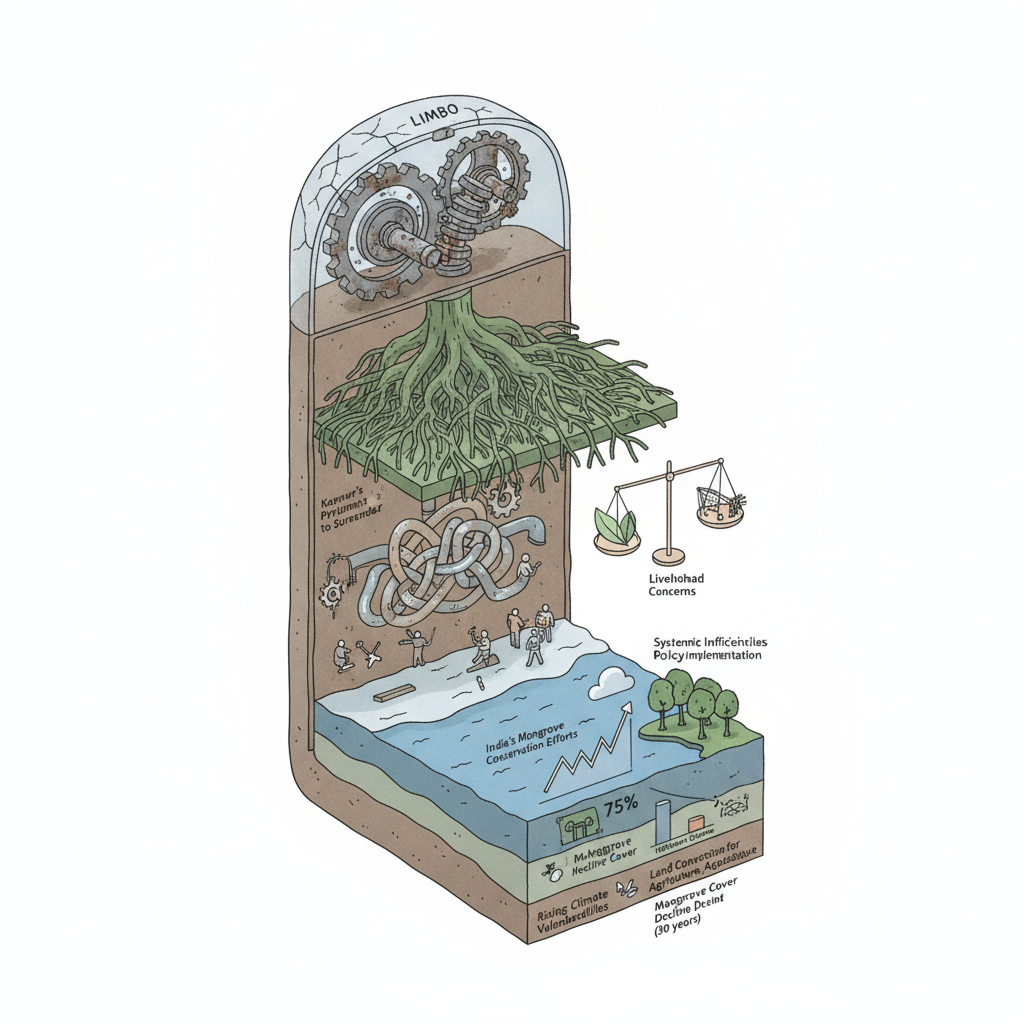
The proposal to acquire privately owned mangrove lands in Kannur district, Kerala, has remained pending for over two decades despite farmers’ willingness to surrender their land for conservation. The delay highlights systemic inefficiencies in policy implementation, the challenges of balancing ecological preservation with livelihood concerns, and the broader implications for India’s mangrove conservation efforts amid rising climate vulnerabilities.
Background
- Kannur district in Kerala accounts for nearly 75% of the state’s mangrove cover, with 1,670 hectares of mangroves, of which only 100 hectares are under government ownership as notified reserve forests.
- Over the past 30 years, Kannur’s mangrove cover has declined from 24 sq. km to 12.47 sq. km, primarily due to anthropogenic pressures such as land conversion for agriculture, aquaculture, and infrastructure development.
- The issue traces back to a 2002 agreement between the Kerala government and the Union Ministry of Environment and Forests (MoEF) to acquire 496 hectares of privately owned mangrove land and transfer it to the Centre in exchange for 7,693.2257 hectares of forest land for rehabilitating landless tribal families in six districts.
- Under the Rebuild Kerala Initiative, the state government accorded administrative sanction for acquiring 1,200 hectares of mangrove land across Kerala, with 284 landowners in Kannur volunteering to surrender their land, but the acquisition process has not commenced.
What are Mangroves and Why are They Ecologically Critical?
- Mangroves are salt-tolerant plant communities found in tropical and subtropical intertidal coastal zones, serving as a unique ecosystem bridge between land and sea.
- They provide critical ecosystem services, including coastal protection from storms, cyclones, and tsunamis, thereby reducing the impact of natural disasters on human settlements.
- Mangroves act as carbon sinks, sequestering up to four times more carbon per hectare than tropical rainforests, thus playing a pivotal role in climate change mitigation.
- They support biodiversity by providing habitat for a wide range of species, including fish, crustaceans, birds, and mammals, many of which are endangered or migratory.
- Mangroves contribute to livelihoods through fisheries, timber, and non-timber forest products, supporting millions of coastal communities globally.
- They regulate water quality by filtering pollutants and excess nutrients from runoff before they enter marine ecosystems, thereby preventing eutrophication.
- Mangroves are highly vulnerable to anthropogenic pressures, including deforestation for aquaculture, agriculture, urbanisation, and industrial development, as well as climate change impacts such as sea-level rise and increased storm intensity.
- India hosts approximately 5% of the world’s mangrove cover, with Sundarbans (West Bengal) and Bhitarkanika (Odisha) being the most prominent, while Kerala’s mangroves, though limited in extent, are ecologically significant for the Western Ghats biodiversity hotspot.
Key Features
| Feature | Significance |
|---|---|
| Private ownership of mangroves in Kannur | Constitutes 496 hectares (75% of Kerala’s mangrove cover) but remains unprotected due to lack of legal status, leading to degradation and livelihood conflicts. |
| Proposal for land acquisition by Forest Department | Aims to transfer privately owned mangroves to government control for conservation, pending State government approval since 2002. |
| Rebuild Kerala Initiative (2018-2020) | Provided administrative sanction for acquiring 1,200 hectares of mangrove land across Kerala, with 284 landowners in Kannur agreeing to surrender their holdings. |
| Policy paralysis in implementation | Despite consent from landowners, the acquisition process has stalled for over two decades, leaving conservation efforts and livelihoods in limbo. |
| Indiscriminate mangrove destruction | Over the past 30 years, mangrove cover in Kannur has halved from 24 sq. km to 12.47 sq. km, driven by unregulated land use and lack of enforcement. |
Why it Matters
Ecological Significance
- Mangroves act as natural barriers against cyclones and coastal erosion, critical for Kerala’s densely populated coastal districts like Kannur.
- They serve as carbon sinks, mitigating climate change impacts through sequestration of 3-5 times more carbon per hectare than terrestrial forests.
- Provide habitat for endangered species such as the Malabar civet and Olive ridley turtles, contributing to biodiversity conservation.
- Support fisheries by serving as nurseries for juvenile marine species, sustaining livelihoods of local fishing communities.
Economic Significance
- Mangroves underpin coastal tourism, particularly in Kerala’s backwaters and estuaries, generating revenue through eco-tourism and homestays.
- Their degradation threatens the livelihoods of 284 landowners and 19 initial volunteers who depend on these lands for subsistence or income.
- Failure to conserve mangroves risks long-term economic losses in fisheries, agriculture, and disaster resilience sectors.
Legal and Governance Significance
- The 2002 agreement between the State and Union Environment Ministry highlights the Centre-State coordination required for mangrove conservation under the Forest (Conservation) Act, 1980.
- The Rebuild Kerala Initiative demonstrates State-led efforts to align conservation with post-disaster rehabilitation, though implementation gaps persist.
- The absence of legal protection for privately owned mangroves creates regulatory vacuums, enabling unchecked land-use changes.
Challenges
1. Policy and Implementation Paralysis
- The 2002 agreement remains unimplemented despite its ecological and legal rationale, reflecting bureaucratic inertia and inter-departmental coordination failures.
- Administrative sanction under the Rebuild Kerala Initiative (2018-2020) did not translate into action, with landowners waiting over five years for compensation or land-use rights resolution.
- Successive governments have failed to prioritise mangrove conservation, treating it as a low-priority issue despite its high ecological and economic stakes.
UPSC Link: Forest Conservation Act, 1980
2. Livelihood and Compensation Dilemma
- Landowners who voluntarily surrendered land face economic hardship due to restricted land-use rights, with no clear timeline for compensation or alternative livelihood support.
- The lack of a structured compensation mechanism disincentivises conservation, as landowners cannot develop or cultivate their land while waiting for acquisition.
- Farmers’ representatives argue that society benefits from conservation, but landowners bear the opportunity cost without adequate state support.
UPSC Link: Forest Rights Act, 2006
3. Regulatory and Enforcement Gaps
- Indiscriminate destruction of mangroves continues due to weak enforcement of the Coastal Regulation Zone (CRZ) Notification, 2019, and the Kerala Conservation of Paddy Land and Wetland Act, 2008.
- The absence of a dedicated mangrove conservation policy in Kerala leaves privately owned mangroves vulnerable to conversion for agriculture, aquaculture, or infrastructure.
- Delays in notifying mangrove areas as reserve forests under the Kerala Forest Act, 1961, exacerbate the problem.
UPSC Link: CRZ Notification, 2019
4. Ecological Degradation and Biodiversity Loss
- The 50% reduction in mangrove cover over 30 years (24 sq. km to 12.47 sq. km) indicates systemic failure in conservation efforts, threatening ecosystem services.
- Loss of mangroves disrupts coastal hydrology, increases salinity intrusion, and reduces resilience to climate-induced disasters such as cyclones and sea-level rise.
- Degradation of mangroves undermines the survival of endemic and migratory species, including the Malabar civet and Olive ridley turtles.
UPSC Link: National Biodiversity Action Plan
5. Centre-State Coordination Failures
- The 2002 agreement between the State and Union Ministry of Environment and Forests highlights the need for Centre-State collaboration in land acquisition and conservation, but implementation remains stalled.
- Divergent priorities between the State (rehabilitation of landless tribal families) and the Centre (conservation of mangroves) have led to policy misalignment and delays.
- The lack of a unified national mangrove conservation policy complicates State-level initiatives, as seen in Kerala’s case.
UPSC Link: Forest (Conservation) Act, 1980
Challenges — UPSC Perspective
| Issue | Concern |
|---|---|
| Delay in land acquisition | Landowners face economic uncertainty and restricted land-use rights, while conservation efforts remain stalled. |
| Weak enforcement of CRZ and wetland laws | Indiscriminate destruction of mangroves continues due to poor monitoring and penalties. |
| Lack of compensation mechanism | Landowners bear the opportunity cost of conservation without adequate state support. |
| Policy misalignment between Centre and State | Divergent priorities hinder implementation of conservation agreements. |
| Biodiversity loss and ecological degradation | Reduction in mangrove cover threatens ecosystem services and climate resilience. |
| Absence of dedicated mangrove policy | Privately owned mangroves lack legal protection, enabling conversion for other uses. |
Government Initiatives — Must-Memorise for Prelims
- Rebuild Kerala Initiative (2018-2020)
Way Forward
- Constitute a high-powered inter-departmental committee under the Forest (Conservation) Act, 1980, to expedite the implementation of the 2002 agreement with the Union Ministry of Environment and Forests.
- Formulate a State-specific Mangrove Conservation Policy, integrating provisions for private land acquisition, compensation, and livelihood support under the Forest Rights Act, 2006.
- Strengthen enforcement of the CRZ Notification, 2019, and Kerala Conservation of Paddy Land and Wetland Act, 2008, through regular monitoring and strict penalties for violations.
- Establish a transparent compensation mechanism for landowners, including cash transfers, alternative livelihood support, or land-use rights in designated conservation areas.
- Launch a public awareness campaign to educate stakeholders on the ecological and economic benefits of mangrove conservation, leveraging local institutions such as panchayats and NGOs.
- Integrate mangrove conservation into climate adaptation plans under the National Action Plan on Climate Change (NAPCC) and State Action Plans, ensuring funding and technical support.
- Conduct a comprehensive ecological assessment of remaining mangrove patches in Kannur to identify critical areas for immediate protection and restoration.
- Collaborate with academic institutions and research organisations to develop community-based conservation models, ensuring local participation and ownership.
UPSC Value Addition
Keywords for Mains Answer-Writing
Mangrove conservation in India · Private land acquisition for conservation · Kannur mangroves · Forest Rights Act 2006 · Environmental policy paralysis · Public good vs private property rights · Kerala Forest Department · Indiscriminate mangrove destruction · Rebuild Kerala Initiative · Union Ministry of Environment, Forest and Climate Change
Concept Flow
Decline in mangrove cover due to unregulated land use and weak enforcement → Policy paralysis in land acquisition and conservation → Livelihood crises for landowners and ecological degradation → Weakened coastal resilience and biodiversity loss → Urgent need for Centre-State coordination and structured compensation mechanisms → Formulation of State-specific mangrove conservation policy → Implementation of conservation measures and livelihood support → Restoration of ecological balance and climate resilience.
Prelims Practice Questions
Q1. Consider the following statements regarding mangroves in India:
1. Mangroves are primarily found in the Sundarbans and Andaman & Nicobar Islands.
2. The Forest Rights Act, 2006, recognises the rights of traditional forest dwellers over forest land, including mangroves.
3. The Union Ministry of Environment, Forest and Climate Change is the nodal agency for mangrove conservation in India.
How many of the above statements are correct?
- Only one
- Only two
- All three
- None
Answer: All three — Statement 1 is incorrect as mangroves are found in multiple coastal states, including Kerala. Statements 2 and 3 are correct as the Forest Rights Act recognises traditional rights and the Union Ministry is the nodal agency for conservation.
Q2. Assertion (A): The acquisition of privately owned mangrove land for conservation purposes is exempt from the provisions of the Right to Fair Compensation and Transparency in Land Acquisition, Rehabilitation and Resettlement Act, 2013.
Reason (R): Mangrove conservation is considered a matter of public good and environmental necessity, overriding private property rights.
Options:
A. Both A and R are true, and R is the correct explanation of A.
B. Both A and R are true, but R is not the correct explanation of A.
C. A is true, but R is false.
D. A is false, but R is true.
- A
- B
- C
- D
Answer: D — Assertion (A) is false as the LARR Act, 2013 applies to all land acquisitions, including those for conservation. Reason (R) is true as conservation is a public good, but it does not explain the exemption claim in A.
Q3. Which of the following is NOT a primary threat to mangrove ecosystems in India as highlighted in recent studies?
- Indiscriminate land conversion for agriculture
- Unregulated coastal development
- Over-exploitation of mangrove resources
- Declining sea levels due to climate change
Answer: Declining sea levels due to climate change — While all options are threats, declining sea levels are not a primary threat; rather, rising sea levels pose a risk to mangroves. The other three are well-documented threats.
Mains Practice Question
✍ The conservation of mangroves in India often necessitates the acquisition of privately owned land for the public good. Critically examine the legal, ethical, and administrative challenges in implementing such acquisitions, with particular reference to the case of Kannur’s mangroves. (15 Marks)
Approach: Introduction: Define mangroves, their ecological significance, and the legal framework for their conservation (e.g., Forest Conservation Act, 1980; Environment Protection Act, 1986; and the Forest Rights Act, 2006). Legal Challenges: Discuss the conflict between private property rights (Article 300A of the Constitution) and the state’s power to acquire land for public good. Highlight the procedural delays and the lack of a dedicated law for mangrove conservation. Ethical Dimensions: Analyse the ethical dilemma of balancing individual livelihoods (e.g., farmers depending on mangrove-adjacent lands) with the broader public good of conservation. Reference the case of Kannur’s farmers waiting for years for compensation. Administrative Issues: Examine the policy paralysis in Kerala, including the stalled acquisition process under the Rebuild Kerala Initiative and the 2002 agreement with the Union Ministry of Environment, Forest and Climate Change. Discuss the role of the Forest Department and the State government. Comparative Perspective: Compare India’s approach with international models (e.g., Australia’s mangrove conservation policies or the U.S. Coastal Zone Management Act) to highlight gaps. Conclusion: Suggest reforms, such as expedited land acquisition processes, fair compensation mechanisms, and community-based conservation models, to resolve the impasse.
Source: The Hindu
Generated by AanyaAi for educational purpose.

- आरबीआई ने सरकारी प्रतिभूतियों की ओएमओ बिक्री की घोषणा, जानिए पूरा विवरण - September 23, 2026
- RBI to Sell ₹25,000 Crore Govt Securities via OMO on Sept 28, 2026 - September 23, 2026
- भारत-श्रीलंका नौसैनिक अभ्यास ‘स्लाईनेक्स-26’: विशाखापत्तनम में संपन्न, जानें प्रमुख बिंदु - September 23, 2026

No Comments