


08 Aug Centre Reaffirms Stand on Mekedatu Dam in Lok Sabha: UPSC Polity Analysis
Mekedatu dam projectCauvery disputeCauvery Water Disputes TribunalInter-state riverRiparian statesCWDT final award✎ The Mekedatu dam project is legally permissible under the Cauvery Water Disputes Tribunal Award and the Supreme Court’s 2018 judgment, but its implementation is contested due to potential violations of the regulated flow regime…
Subject Relevance — Where This Topic Fits
- GS Paper II — Polity and Governance: Inter-State Relations | GS Paper II — Governance: Dispute Resolution Mechanisms | GS Paper III — Environment and Ecology: Water Resources Management | GS Paper III — Economy: Infrastructure and Regional Development
- Prelims: Cauvery Water Disputes Tribunal (CWDT), Inter-State Water Disputes Act, 1956, Supreme Court’s Cauvery Water Disputes Tribunal Award (2018), Riparian Principle, National Water Policy (2012), River Basin Management, Inter-State River Water Disputes (Amendment) Act, 2019, Karnataka Cauvery Neeravari Nigam Limited (KNNL), Tamil Nadu Public Works Department (PWD)
- Essay: Federalism in India: Cooperative or Competitive?, Balancing Development and Environmental Sustainability: The Case of River Interlinking Projects
Quick Revision: The Mekedatu dam project is legally permissible under the Cauvery Water Disputes Tribunal Award and the Supreme Court’s 2018 judgment, but its implementation is contested due to potential violations of the regulated flow regime and inter-state equity principles.
Why is this in the news?
The Union government defended the proposed Mekedatu dam project in Karnataka, asserting that the Supreme Court’s 2018 judgment on the Cauvery dispute does not mandate prior consent from riparian states for such projects. This stance has reignited the long-standing inter-state conflict between Karnataka and Tamil Nadu, with Tamil Nadu’s Chief Minister formally requesting the withdrawal of the Centre’s reply, citing potential violations of the Cauvery Water Disputes Tribunal Award’s regulated flow regime.
Background
- The Cauvery river basin is a classic example of an inter-state river dispute, governed by the Cauvery Water Disputes Tribunal (CWDT) established under the Inter-State Water Disputes Act, 1956.
- The CWDT, after prolonged deliberations, delivered its final award in 2007, allocating specific water shares to Karnataka, Tamil Nadu, Kerala, and Puducherry, and prescribing a regulated flow regime to ensure equitable distribution.
- The Supreme Court, in its 2018 judgment, upheld the CWDT’s award while modifying certain aspects, including the quantum of water to be released by Karnataka to Tamil Nadu during distress years.
- The proposed Mekedatu dam, located near the Karnataka-Tamil Nadu border, is intended to supply drinking water to Bengaluru and generate hydroelectric power, but Tamil Nadu contends it may disrupt the regulated flow regime and reduce water availability in the Cauvery delta.
- Karnataka has argued that the project is essential for meeting urban water demands and is legally permissible under the CWDT award, while Tamil Nadu has consistently opposed it, citing potential adverse impacts on agriculture and livelihoods.
- The dispute has historical roots, with multiple rounds of negotiations, Supreme Court interventions, and political tensions between the two states over the past decades.
What is the Mekedatu Dam Project?
- The Mekedatu dam is a proposed multi-purpose project across the Cauvery river, located approximately 40 km from Bengaluru in Karnataka.
- The primary objectives of the project include augmenting drinking water supply to Bengaluru, generating hydroelectric power (about 400 MW), and providing irrigation benefits to surrounding areas.
- The project envisages a reservoir with a storage capacity of 67.16 TMC (thousand million cubic feet) and a dam height of 67 meters, with an estimated cost of ₹9,000 crore.
- Karnataka has asserted that the project is in conformity with the Cauvery Water Disputes Tribunal Award and does not require prior consent from Tamil Nadu or other riparian states, as per the Supreme Court’s 2018 judgment.
- The project has been under consideration since 2013, with environmental clearance obtained in 2020, but its implementation has been stalled due to opposition from Tamil Nadu and legal challenges.
- Tamil Nadu has contended that the project violates the principle of prior consent for upper riparian states and may disrupt the regulated flow regime, thereby affecting agricultural productivity in the Cauvery delta.
- The dispute also raises broader questions about the interpretation of inter-state water-sharing agreements and the balance between developmental needs and environmental sustainability.
- The project has become a symbol of the broader challenges in managing inter-state river basins in India, where federalism, equity, and ecological concerns often intersect.
Key Features
| Feature | Significance |
|---|---|
| Supreme Court Judgment (2018) on Cauvery dispute | Establishes the legal framework for inter-State water sharing, citing the Cauvery Water Disputes Tribunal’s final award and clarifying that Karnataka is not required to seek consent from other riparian States for structural interventions. |
| Union Government’s Stand in Lok Sabha | Reiterates the 2018 judgment’s position, asserting that the Mekedatu project does not violate constitutional or legal provisions regarding inter-State water rights. |
| Cauvery Water Disputes Tribunal (CWDT) Award | Provides the regulatory regime for Cauvery water allocation, including scheduled deliveries to lower riparian States, and prohibits upper riparian States from actions that disrupt this regime. |
| Mekedatu Project Proposal | Proposed dam by Karnataka to meet Bengaluru’s drinking water needs, located upstream on the Cauvery, raising concerns in Tamil Nadu about water availability and flow regulation. |
| Tamil Nadu’s Objection | Argues that the project must be evaluated for consistency with the CWDT Award, as it has the potential to alter the regulated flow regime and affect scheduled deliveries to Tamil Nadu. |
Why it Matters
Inter-State Water Governance
- The Mekedatu dispute exemplifies the constitutional challenge of balancing developmental needs with inter-State water rights, as enshrined in Article 262 and the Inter-State Water Disputes Act, 1956.
- The 2018 Supreme Court judgment reinforces the supremacy of the CWDT Award in resolving inter-State water conflicts, limiting unilateral actions by upper riparian States.
- The dispute highlights the need for institutional mechanisms to address emerging water demands without undermining established legal frameworks.
Federalism and Centre-State Relations
- The Union government’s reiteration of its stand underscores the Centre’s role in mediating inter-State disputes, particularly where constitutional provisions are invoked.
- The conflict between Karnataka and Tamil Nadu tests the Centre’s ability to balance developmental aspirations with constitutional obligations to lower riparian States.
- The Supreme Court’s intervention in the Cauvery dispute reflects the judiciary’s role as the final arbiter in federal water disputes.
Environmental and Agricultural Impact
- The Mekedatu project raises concerns about its impact on the Cauvery delta’s agricultural productivity and drinking water security in Tamil Nadu, a region heavily dependent on Cauvery waters.
- The CWDT Award’s emphasis on scheduled deliveries underscores the agricultural and livelihood stakes for lower riparian States, particularly during lean monsoon seasons.
- The project’s potential to alter flow regimes could exacerbate water scarcity in Tamil Nadu, a state already vulnerable to climate variability.
Challenges
1. Legal and Constitutional Challenges
- The Union government’s stand relies on the 2018 Supreme Court judgment, which may be interpreted differently by Tamil Nadu, leading to prolonged legal disputes.
- The CWDT Award’s prohibition on actions affecting scheduled deliveries creates a conflict between Karnataka’s developmental needs and Tamil Nadu’s water rights.
- The absence of a clear mechanism for post-award modifications to the CWDT Award complicates resolution of emerging disputes.
UPSC Link: GS-II: Federalism, Inter-State Relations
2. Political and Diplomatic Challenges
- The dispute risks straining Centre-State relations, particularly with Tamil Nadu’s political leadership demanding withdrawal of the Union’s stand.
- The project’s timing, amid electoral cycles in both States, could politicise the issue, complicating negotiations.
- The absence of a structured dialogue mechanism between Karnataka and Tamil Nadu exacerbates mistrust and delays resolution.
UPSC Link: GS-II: Centre-State Relations
3. Environmental and Socio-Economic Challenges
- The project’s impact on the Cauvery delta’s ecology and agriculture requires rigorous environmental impact assessments, which are often contentious.
- The diversion of Cauvery waters for Bengaluru’s supply could reduce flows to Tamil Nadu’s agricultural and domestic sectors, raising equity concerns.
- Climate change-induced variability in monsoon patterns further complicates water allocation, necessitating adaptive governance frameworks.
UPSC Link: GS-III: Environmental Governance
Challenges — UPSC Perspective
| Issue | Concern |
|---|---|
| Legal Ambiguity in CWDT Award Interpretation | Tamil Nadu argues that the Award prohibits any action affecting scheduled deliveries, while Karnataka contends that structural interventions are permissible under the 2018 judgment. |
| Centre’s Neutrality vs. Federal Obligations | The Union government’s reiteration of the 2018 judgment may be perceived as favouring Karnataka, undermining its role as a neutral arbiter. |
| Agricultural and Livelihood Impact on Tamil Nadu | Reduced Cauvery flows could devastate the delta’s agriculture, a critical sector for Tamil Nadu’s economy and food security. |
| Environmental Degradation Risks | The project’s construction and operation may disrupt riverine ecosystems, including biodiversity hotspots and groundwater recharge zones. |
| Politicisation of Water Governance | The dispute risks becoming a tool for electoral mobilisation, delaying pragmatic solutions. |
| Lack of Adaptive Governance Mechanisms | Existing frameworks do not account for climate change or evolving water demands, necessitating reforms. |
Way Forward
- Constitute a high-powered inter-State committee under the Inter-State Water Disputes Act, 1956, to reassess the Mekedatu project’s compliance with the CWDT Award and its environmental impact.
- Initiate a joint technical study by the Central Water Commission and State agencies to model the project’s impact on Cauvery flows and delta ecosystems.
- Explore alternative water supply solutions for Bengaluru, such as wastewater recycling, rainwater harvesting, and inter-basin transfers, to reduce dependence on Cauvery waters.
- Strengthen the Cauvery Management Board (CMB) to monitor real-time water flows and enforce the CWDT Award, ensuring transparency and accountability.
- Foster structured dialogue between Karnataka and Tamil Nadu through the Cauvery Supervisory Committee, with participation from farmers’ organisations and environmental groups.
- Develop a climate-resilient water governance framework that integrates adaptive management strategies to address future variability in monsoon patterns.
- Conduct public consultations in both States to address concerns of farmers, environmentalists, and local communities, ensuring inclusive decision-making.
UPSC Value Addition
Keywords for Mains Answer-Writing
Inter-State Water Disputes · Cauvery Water Disputes Tribunal (CWDT) · Mekedatu Project · Riparian Rights · Supreme Court Judgment on Cauvery (2018) · Inter-State Water Sharing Mechanisms · Federalism in Water Governance · Constitutional Provisions on Water (Article 262) · Upper and Lower Riparian States · Environmental and Ecological Concerns in Dam Projects · Role of Union Government in Inter-State Water Disputes · Legal and Political Dimensions of Mekedatu Dam
Constitutional & Policy Linkages
- Article 262: Inter-State Water Disputes
- Article 254: Inconsistency between State and Union laws
- Seventh Schedule: Entry 56 (Union List – Regulation and development of inter-State rivers)
Concept Flow
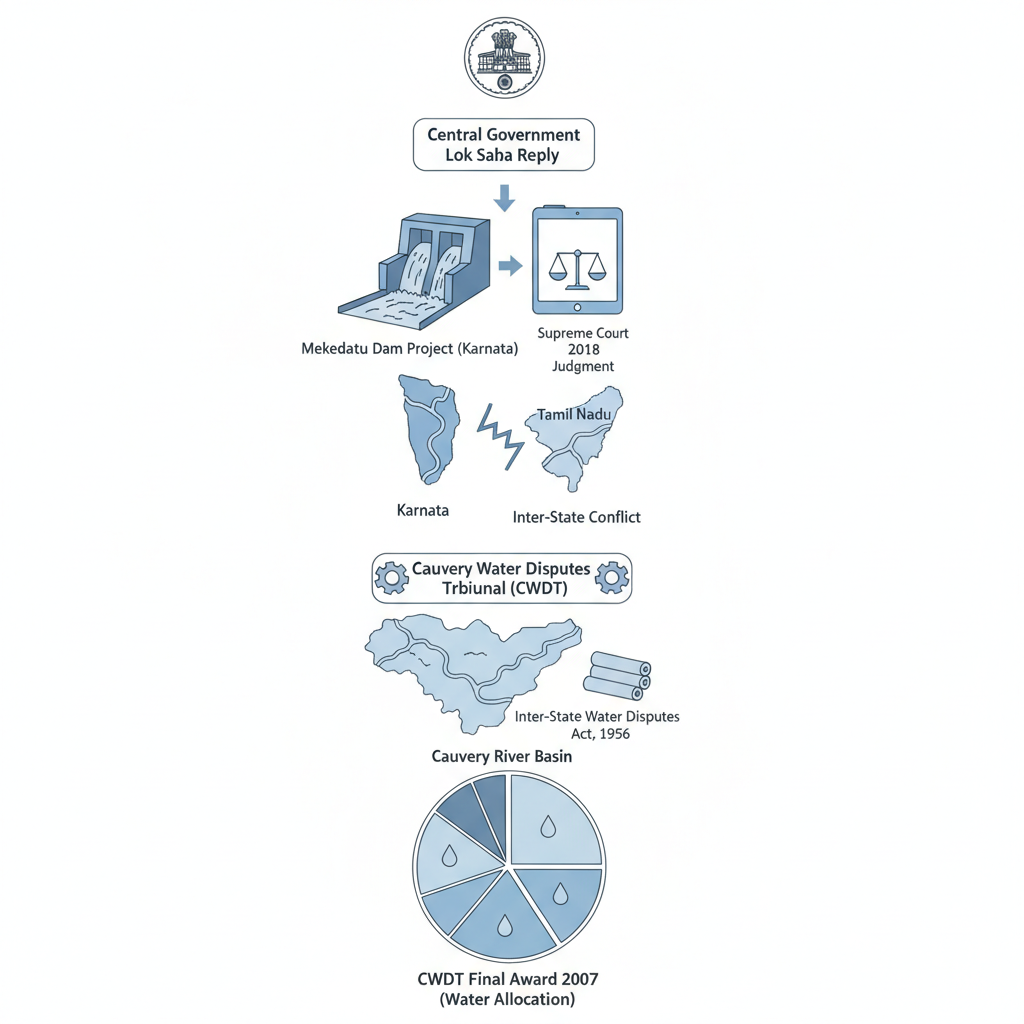
Cauvery Water Disputes Tribunal (CWDT) Award (2007) → Establishes regulated flow regime and scheduled deliveries. → Supreme Court Judgment (2018) → Clarifies legal framework, citing CWDT Award and limiting unilateral actions. → Karnataka’s Mekedatu Project Proposal → Developmental initiative to meet Bengaluru’s water needs. → Tamil Nadu’s Objection → Argues project violates CWDT Award by altering flow regime. → Union Government’s Stand → Reiterates 2018 judgment, asserting no consent required from riparian States. → Centre-State Conflict → Tamil Nadu demands withdrawal of Union’s stand, escalating political tensions. → Legal and Environmental Challenges → Prolonged disputes, environmental risks, and socio-economic impacts.
Prelims Practice Questions
Q1. Consider the following statements regarding the Mekedatu dam project:
1. The project is proposed by Karnataka to meet Bengaluru’s drinking water needs.
2. The Union government has cited the Supreme Court’s 2018 judgment on the Cauvery dispute to assert that Karnataka does not require consent from Tamil Nadu for the project.
3. The Cauvery Water Disputes Tribunal (CWDT) Award explicitly prohibits any upper riparian State from taking actions affecting scheduled deliveries to lower riparian States.
How many of the above statements are correct?
- Only one
- Only two
- All three
- None
Answer: All three — Statements 1 and 2 are correct. Statement 3 is incorrect as the CWDT Award does not explicitly prohibit actions; it regulates water sharing and requires adherence to the scheduled deliveries.
Q2. Assertion (A): The Union government’s stand on the Mekedatu dam project is based on the Supreme Court’s 2018 judgment in the Cauvery dispute.
Reason (R): The judgment clarified that the Cauvery Water Disputes Tribunal Award does not mandate consent from lower riparian States for upper riparian projects.
Options:
A. Both A and R are true, and R is the correct explanation of A.
B. Both A and R are true, but R is not the correct explanation of A.
C. A is true, but R is false.
D. A is false, but R is true.
- A
- B
- C
- D
Answer: A — Both A and R are true, and R correctly explains A as the judgment cited by the Union government explicitly states that consent from lower riparian States is not required for upper riparian projects.
Q3. Match the following pairs related to inter-state water disputes in India:
Column I (State/Union Territory) | Column II (River/Dispute)
1. Karnataka | A. Krishna River
2. Tamil Nadu | B. Cauvery River
3. Maharashtra | C. Godavari River
4. Andhra Pradesh | D. Krishna-Godavari Dispute
Options:
A. 1-A, 2-B, 3-C, 4-D
B. 1-B, 2-A, 3-D, 4-C
C. 1-A, 2-B, 3-D, 4-C
D. 1-B, 2-A, 3-C, 4-D
- A
- B
- C
- D
Answer: C — 1-Karnataka is associated with the Krishna River, 2-Tamil Nadu with the Cauvery River, 3-Maharashtra with the Godavari River, and 4-Andhra Pradesh with the Krishna-Godavari Dispute.
Mains Practice Question
✍ The Union government has reiterated its stand on the Mekedatu dam project, citing the Supreme Court’s 2018 judgment in the Cauvery dispute. Critically examine the legal and constitutional framework governing inter-state water disputes in India, with particular reference to the role of the Union government and the Supreme Court. (15 Marks)
Approach: MODEL-ANSWER SKELETON:
1. **Constitutional Framework (3 Marks)**
– Article 262: Exclusive jurisdiction of Parliament to adjudicate inter-state water disputes.
– Article 262(2): Bar on courts to entertain suits or proceedings in inter-state water disputes.
– Seventh Schedule: Entry 56 (Union List) empowers Parliament to regulate inter-state rivers.
2. **Cauvery Water Disputes Tribunal (CWDT) Award (3 Marks)**
– Established under Inter-State Water Disputes Act, 1956.
– Final Award (2007) allocated Cauvery waters among Karnataka, Tamil Nadu, Kerala, and Puducherry.
– Scheduled deliveries to lower riparian States (e.g., Tamil Nadu) are legally binding.
3. **Supreme Court’s Role (3 Marks)**
– Supreme Court’s 2018 judgment in *State of Karnataka v. State of Tamil Nadu*: Clarified that the CWDT Award is binding and no state can unilaterally alter water sharing.
– Court upheld the supremacy of the Award over state actions, including dam projects.
– However, the judgment did not explicitly mandate consent from lower riparian States for upper riparian projects, as argued by the Union government in the Mekedatu case.
4. **Union Government’s Stand and Legal Gaps (3 Marks)**
– Union government’s reliance on the 2018 judgment to assert that Karnataka does not require consent from Tamil Nadu.
– Critique: The judgment does not absolve upper riparian States from the obligation to ensure that their actions do not violate the scheduled deliveries under the Award.
– Legal ambiguity: The Union government’s interpretation may undermine the federal principle and the rights of lower riparian States.
5. **Way Forward (3 Marks)**
– Need for a constitutional amendment to clarify the role of the Union government in inter-state water disputes.
– Strengthening institutional mechanisms (e.g., River Boards) for cooperative federalism.
– Emphasizing environmental and ecological considerations in dam projects, as mandated by the National Green Tribunal and other statutory bodies.
Source: The Hindu
Generated by AanyaAi for educational purpose.

- आरबीआई ने सरकारी प्रतिभूतियों की ओएमओ बिक्री की घोषणा, जानिए पूरा विवरण - September 23, 2026
- RBI to Sell ₹25,000 Crore Govt Securities via OMO on Sept 28, 2026 - September 23, 2026
- भारत-श्रीलंका नौसैनिक अभ्यास ‘स्लाईनेक्स-26’: विशाखापत्तनम में संपन्न, जानें प्रमुख बिंदु - September 23, 2026

No Comments