


08 Aug Tiger Death in Nagarjunasagar Srisailam Tiger Reserve: NTCA Investigation Ordered
✎ The National Tiger Conservation Authority (NTCA) mandates adherence to Standard Operating Procedures (SOPs) for post-mortem examinations of tiger carcasses to ensure forensic integrity and legal admissibility in wildlife crime…
Subject Relevance — Where This Topic Fits
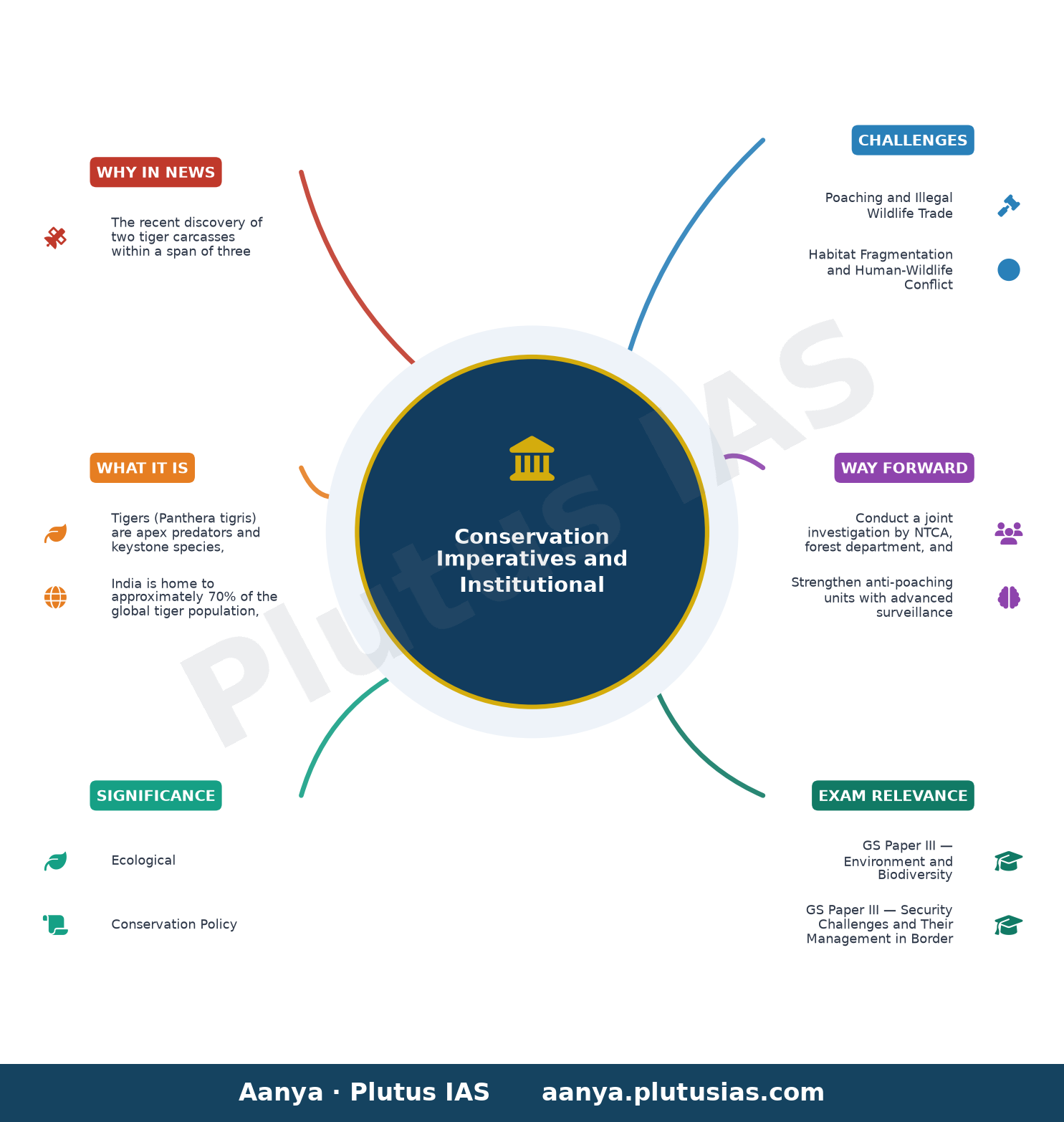
- GS Paper III — Environment and Biodiversity (Conservation, Environmental Pollution and Degradation, Environmental Impact Assessment) | GS Paper III — Security Challenges and Their Management in Border Areas (Wildlife Crime and Poaching)
- Prelims: Project Tiger, NTCA, Wildlife Protection Act 1972, Tiger Reserves, Poaching, Wildlife Crime Control Bureau, National Tiger Conservation Authority (NTCA) SOPs, Forensic Analysis in Wildlife Cases, Forest Rights Act 2006, Compensatory Afforestation Fund Management and Planning Authority (CAMPA)
- Essay: The ethical imperative of biodiversity conservation in the Anthropocene, Balancing developmental pressures with ecological sustainability: Lessons from tiger reserves
Quick Revision: The National Tiger Conservation Authority (NTCA) mandates adherence to Standard Operating Procedures (SOPs) for post-mortem examinations of tiger carcasses to ensure forensic integrity and legal admissibility in wildlife crime investigations.
Why is this in the news?
The recent discovery of two tiger carcasses within a span of three days in the Nagarjunasagar Srisailam Tiger Reserve (NSTR) has triggered urgent administrative and investigative responses from the Andhra Pradesh government. The absence of limbs and claws on one carcass, coupled with the registration of an offence under the Wildlife Protection Act 1972, underscores the need for a rigorous investigation into potential poaching or human-wildlife conflict. This incident highlights systemic vulnerabilities in wildlife protection mechanisms and raises critical questions about the efficacy of existing conservation frameworks in India’s premier tiger reserves.
Background
- The Nagarjunasagar Srisailam Tiger Reserve (NSTR), established in 1983 and notified as a Tiger Reserve under Project Tiger in 1983, is one of India’s largest tiger reserves, spanning Andhra Pradesh and Telangana, with a core area of 3,296.31 km² and a buffer of 3,045.87 km².
- Project Tiger, launched in 1973, is a centrally sponsored scheme aimed at ensuring the maintenance of viable tiger populations in designated reserves through habitat conservation, anti-poaching measures, and community engagement.
- The National Tiger Conservation Authority (NTCA), constituted under the Wildlife Protection Act 1972, serves as the apex body for tiger conservation in India, overseeing the implementation of the Project Tiger scheme and enforcing statutory provisions.
- Tiger populations in India have faced persistent threats from poaching, habitat fragmentation, prey depletion, and human-wildlife conflict, necessitating robust institutional mechanisms for their protection.
- The Wildlife Protection Act 1972 provides the legal framework for the protection of wild animals and plants, with stringent provisions against poaching, trade, and habitat destruction.
- Recent reports of tiger deaths in NSTR follow a pattern of increased wildlife crime incidents in India, as highlighted by the Wildlife Crime Control Bureau (WCCB) in its annual reports.
What is the significance of tiger conservation in India’s ecological and legal framework?
- Tigers (Panthera tigris) are apex predators and keystone species, playing a critical role in maintaining ecological balance by regulating prey populations and preserving forest health.
- India is home to approximately 70% of the global tiger population, with the latest census (2022) reporting 3,167 tigers, a testament to the success of conservation efforts under Project Tiger.
- The Wildlife Protection Act 1972 classifies tigers under Schedule I, affording them the highest legal protection, with stringent penalties for offences including poaching, trade, or habitat destruction.
- The NTCA, in collaboration with state forest departments, implements the ‘Standard Operating Procedures (SOPs)’ for tiger conservation, which include habitat monitoring, prey base assessment, and anti-poaching patrols.
- Tiger reserves in India are designated under the Wildlife Protection Act 1972 and are managed with a core-buffer strategy to minimise human interference while ensuring the viability of tiger populations.
- Poaching for skin, bones, and other body parts remains a significant threat to tigers, driven by illegal wildlife trade networks that exploit porous international borders.
- Human-wildlife conflict, often exacerbated by habitat encroachment and prey depletion, poses a dual challenge to tiger conservation, requiring community-based mitigation strategies.
- Forensic analysis, including DNA profiling and toxicology, is increasingly employed to investigate wildlife crimes and establish causal links in cases of unnatural tiger deaths.
Key Features
| Feature | Significance |
|---|---|
| Repeated tiger mortality in NSTR | Undermines conservation efforts and raises concerns about habitat security and human-wildlife conflict. |
| Absence of claws and limbs in carcass | Suggests potential poaching or illegal wildlife trade activity, warranting forensic investigation. |
| NTCA SOPs for post-mortem and sample collection | Ensures scientific rigor in determining cause of death and prevents contamination of evidence. |
| Increased patrolling and field-level vigilance | Aims to deter illegal activities and enhance real-time monitoring of tiger movements. |
| Forensic analysis of samples | Critical for identifying poisoning, disease, or other unnatural causes of death. |
Why it Matters
Ecological
- Tigers are apex predators; their decline disrupts trophic cascades, affecting prey populations and forest health.
- NSTR is a critical tiger habitat under Project Tiger; loss of individuals threatens regional biodiversity and ecological balance.
- Potential decline in tiger numbers may lead to genetic bottlenecks, reducing population resilience.
Conservation Policy
- NTCA guidelines mandate transparent investigations to prevent cover-ups and ensure accountability in wildlife crime cases.
- The Wildlife Protection Act, 1972, provides legal framework for prosecuting poachers and offenders under Sections 9 and 51.
Administrative
- Forest department’s response includes forensic analysis and increased patrolling, reflecting adherence to conservation protocols.
- Social media intervention by Deputy CM signals political commitment to wildlife protection and public accountability.
Legal
- Registration of an offence under the Wildlife Protection Act, 1972, initiates legal proceedings against suspected perpetrators.
- Forensic evidence will determine whether the case falls under poaching, poisoning, or natural causes, influencing legal outcomes.
Challenges
1. Poaching and Illegal Wildlife Trade
- Absence of claws and limbs suggests targeted poaching for body parts, a lucrative illegal trade.
- Weak enforcement of wildlife laws and inadequate patrolling enable poachers to operate undetected.
- Cross-border wildlife trafficking networks may exploit gaps in forest security.
UPSC Link: Wildlife Protection Act 1972, Schedule I species
2. Habitat Fragmentation and Human-Wildlife Conflict
- NSTR faces anthropogenic pressures from agriculture, mining, and infrastructure projects, fragmenting tiger habitats.
- Increased human encroachment leads to retaliatory killings of tigers by locals due to livestock predation or perceived threats.
- Lack of buffer zone management exacerbates conflicts between wildlife and human settlements.
UPSC Link: Project Tiger guidelines on habitat management
3. Disease and Health Monitoring
- Tigers in fragmented habitats are more susceptible to diseases due to stress and reduced genetic diversity.
- Inadequate veterinary infrastructure in forest divisions delays diagnosis and treatment of wildlife diseases.
- Emerging zoonotic diseases pose risks to both wildlife and human populations in fringe areas.
UPSC Link: National Wildlife Action Plan 2017-2031
4. Forensic and Investigative Gaps
- Delays in sample analysis or contamination of evidence may hinder accurate determination of cause of death.
- Insufficient forensic laboratories with wildlife crime expertise limit the effectiveness of investigations.
- Lack of inter-agency coordination between forest, police, and forensic teams slows down case resolution.
UPSC Link: NTCA Standard Operating Procedures for Tiger Death Investigations
5. Public Awareness and Stakeholder Engagement
- Low awareness among local communities about wildlife laws and conservation benefits reduces their participation in protection efforts.
- Misconceptions about tigers as threats to livelihoods lead to negative attitudes and resistance to conservation initiatives.
- Inadequate compensation mechanisms for human-wildlife conflict incidents discourage tolerance for wildlife.
UPSC Link: Community-based conservation under Wildlife Protection Act
Challenges — UPSC Perspective
| Issue | Concern |
|---|---|
| Poaching for body parts | Direct threat to tiger population; undermines conservation efforts and fuels illegal wildlife trade. |
| Habitat fragmentation | Reduces tiger range and increases human-wildlife conflict, leading to retaliatory killings. |
| Disease susceptibility | Higher risk of epizootics due to stress and reduced genetic diversity in isolated populations. |
| Forensic delays | Compromises evidence integrity, delaying justice and enabling repeat offences. |
| Community resistance | Lack of stakeholder buy-in reduces effectiveness of conservation policies and field actions. |
Way Forward
- Conduct a joint investigation by NTCA, forest department, and forensic teams to ensure transparency and scientific rigor.
- Strengthen anti-poaching units with advanced surveillance technologies (drones, camera traps) in high-risk zones of NSTR.
- Expand community-based conservation programs to enhance local stakeholder participation and reduce human-wildlife conflict.
- Establish a dedicated wildlife forensic laboratory in Andhra Pradesh to expedite sample analysis and evidence collection.
- Implement strict habitat management plans, including creation of buffer zones and wildlife corridors to mitigate fragmentation.
- Enhance inter-agency coordination between forest, police, and customs departments to curb illegal wildlife trade networks.
- Launch public awareness campaigns in fringe villages to educate communities about tiger ecology and conservation benefits.
- Monitor tiger populations using camera traps and GPS collaring to track movements and identify high-risk areas.
UPSC Value Addition
Keywords for Mains Answer-Writing
Project Tiger Division · Nagarjunasagar Srisailam Tiger Reserve (NSTR) · National Tiger Conservation Authority (NTCA) · Wildlife Protection Act, 1972 · Project Tiger Scheme · Tiger conservation in India · NTCA Standard Operating Procedures (SOPs) · Forensic analysis in wildlife crimes · Poaching and wildlife mortality · Biodiversity conservation governance · Andhra Pradesh Forest Department · Tiger mortality investigation protocols
Concept Flow
Anthropogenic pressures (encroachment, mining) → Habitat fragmentation in NSTR → Increased human-wildlife conflict → Retaliatory killings or poaching → Tiger mortality → Ecological imbalance → Disruption of trophic cascades → Long-term biodiversity loss
Prelims Practice Questions
Q1. Consider the following statements regarding the National Tiger Conservation Authority (NTCA):
1. NTCA is a statutory body established under the Wildlife Protection Act, 1972.
2. NTCA is mandated to approve the Tiger Conservation Plans prepared by the State Governments.
3. NTCA conducts the All India Tiger Estimation every four years.
4. NTCA has no role in the investigation of tiger deaths in India.
How many of the above statements are correct?
- Only one
- Only two
- Only three
- All
Answer: Only three — Statements 1, 2, and 3 are correct. NTCA is a statutory body under the Wildlife Protection Act, 1972, approves Tiger Conservation Plans, and conducts the All India Tiger Estimation. Statement 4 is incorrect as NTCA lays down guidelines for tiger mortality investigations.
Q2. Assertion (A): The Wildlife Protection Act, 1972, provides for the establishment of Tiger Reserves in India.
Reason (R): The Act empowers the State Governments to notify areas as Tiger Reserves after approval from the National Tiger Conservation Authority (NTCA).
- Both A and R are true, and R is the correct explanation of A.
- Both A and R are true, but R is not the correct explanation of A.
- A is true but R is false.
- A is false but R is true.
Answer: Both A and R are true, but R is not the correct explanation of A. — Both A and R are true. The Wildlife Protection Act, 1972, under Section 38V, empowers the State Governments to notify Tiger Reserves with NTCA’s approval. R correctly explains A.
Q3. Match the following Tiger Reserves in Column A with their respective States in Column B:
Column A
1. Nagarjunasagar Srisailam Tiger Reserve
2. Papikonda Tiger Reserve
3. Periyar Tiger Reserve
4. Sariska Tiger Reserve
Column B
A. Andhra Pradesh
B. Kerala
C. Rajasthan
D. Telangana
- 1-A, 2-D, 3-B, 4-C
- 1-D, 2-A, 3-B, 4-C
- 1-A, 2-B, 3-D, 4-C
- 1-C, 2-A, 3-B, 4-D
Answer: 1-A, 2-D, 3-B, 4-C — Correct matches: 1. Nagarjunasagar Srisailam Tiger Reserve (Andhra Pradesh), 2. Papikonda Tiger Reserve (Andhra Pradesh), 3. Periyar Tiger Reserve (Kerala), 4. Sariska Tiger Reserve (Rajasthan).
Mains Practice Question
✍ The recent incidents of tiger deaths in the Nagarjunasagar Srisailam Tiger Reserve (NSTR) underscore systemic challenges in India’s tiger conservation governance. Critically examine the efficacy of the legal and institutional framework for tiger conservation in India, with particular reference to the role of the National Tiger Conservation Authority (NTCA) and the State Forest Departments. Also, assess the adequacy of the Wildlife Protection Act, 1972, in addressing contemporary threats such as poaching and habitat fragmentation. (15 Marks)
Approach: MODEL-ANSWER SKELETON:
1. **Legal Framework**:
– Wildlife Protection Act, 1972: Key provisions (Sections 38V, 38Y, 9, 51) governing Tiger Reserves, offences, and penalties.
– Role of NTCA: Statutory body under the Act; functions include approval of Tiger Conservation Plans, monitoring tiger populations, and laying down investigation protocols.
– Example: NTCA SOPs for tiger mortality investigations (as seen in NSTR case).
2. **Institutional Framework**:
– Centre-State coordination: NTCA’s advisory role vs. State Forest Departments’ executive role.
– Challenges: Lack of uniformity in enforcement, delayed investigations, and inadequate patrolling (e.g., NSTR incidents).
– Reference: CAG reports highlighting lapses in tiger conservation (e.g., 2021 report on Project Tiger).
3. **Contemporary Threats**:
– Poaching: Use of snares, poisoning, and cyber-enabled wildlife crime (e.g., missing claws in NSTR tiger).
– Habitat fragmentation: Infrastructure projects (e.g., railways, highways) in tiger corridors.
– Climate change: Shifting prey-predator dynamics.
4. **Critique and Gaps**:
– Weaknesses in NTCA’s enforcement: Limited autonomy from political interference.
– State-level deficiencies: Inadequate funding, staff shortages, and corruption.
– Need for: Strengthening forensic capabilities, community-based monitoring, and inter-state coordination.
5. **Way Forward**:
– Strengthening NTCA’s investigative powers (e.g., dedicated wildlife crime cells).
– Integrating technology (drones, AI-based patrolling).
– Legal reforms: Harsher penalties for poaching and habitat destruction.
6. **Conclusion**:
– While the legal and institutional framework is robust on paper, implementation gaps persist. A multi-stakeholder approach with enhanced accountability is essential to reverse tiger mortality trends.
Source: The Hindu
Generated by AanyaAi for educational purpose.

- यूपी में पहली बार तेंदुओं का बधियाकरण: मानव-वन्यजीव संघर्ष रोकेगा अभियान - September 24, 2026
- UP’s Groundbreaking Leopard Sterilization Plan to Curb Human-Wildlife Conflict - September 24, 2026
- महाराष्ट्र में त्योहार जुलूसों पर बॉम्बे हाईकोर्ट का बड़ा फैसला: पटाखे, लेजर और संगीत पर रोक - September 24, 2026

No Comments