


08 Aug Kannada groups demand legal action against Belagavi Corporation over Mahajan Commission delay
✎ The Mahajan Commission's 1967 report, endorsed by the Karnataka State Legislature, unequivocally affirms Belagavi's status as an integral part of Karnataka, leaving no legal ambiguity for the Belagavi City Corporation to delay…
Subject Relevance — Where This Topic Fits
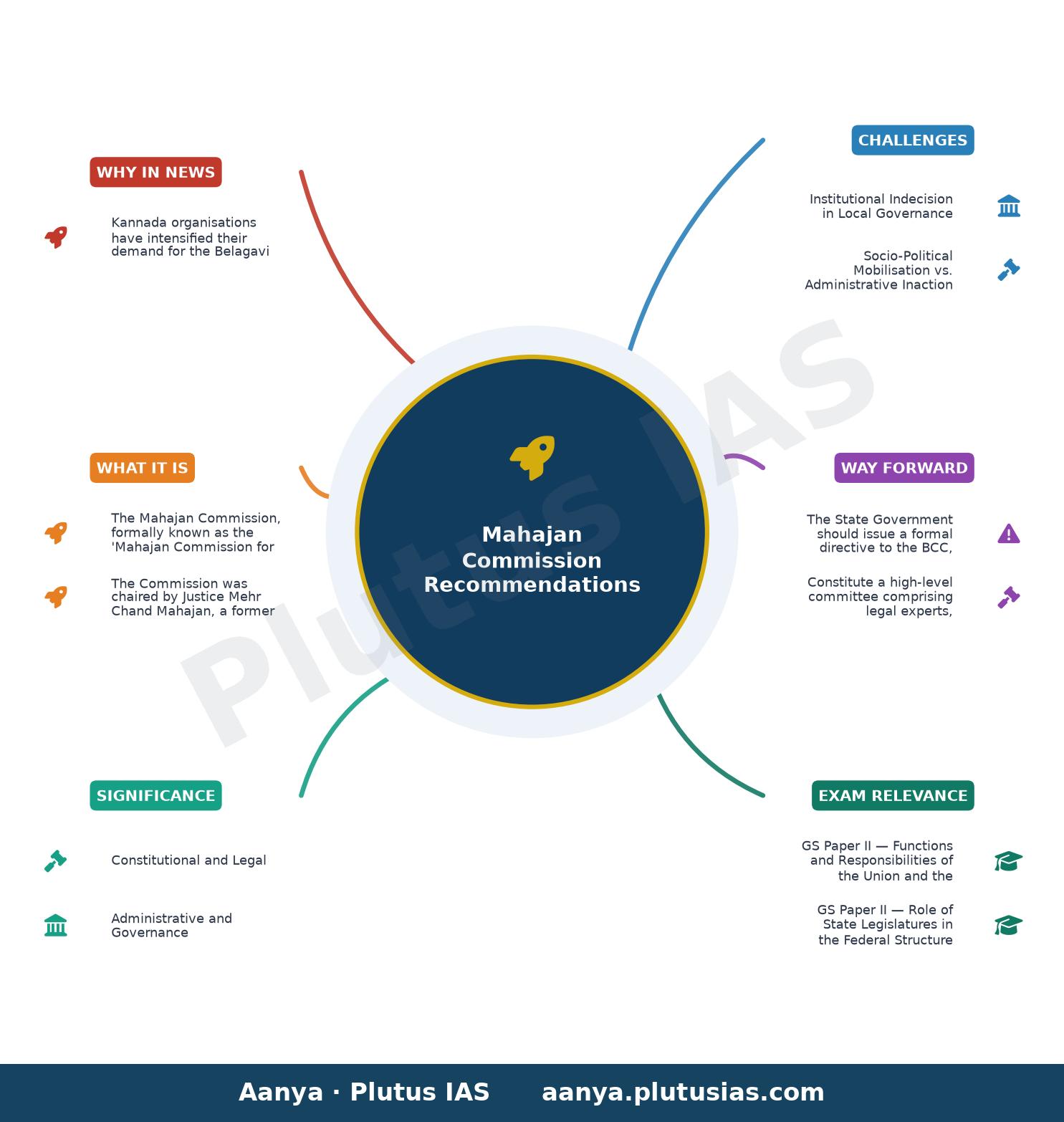
- GS Paper II — Functions and Responsibilities of the Union and the States, Issues and Challenges Pertaining to the Federal Structure | GS Paper II — Role of State Legislatures in the Federal Structure | GS Paper III — Issues Relating to Federalism and Centre-State Relations
- Prelims: Mahajan Commission, Belagavi border dispute, Article 3 of the Constitution, Urban Local Bodies (ULBs), State legislature resolutions, Constitutional status of territories, Supreme Court’s advisory jurisdiction, Karnataka State Border and River Protection Commission
- Essay: Federalism in India: Balancing Autonomy and Integration, The Role of Constitutional Bodies in Resolving Inter-State Disputes
Quick Revision: The Mahajan Commission’s 1967 report, endorsed by the Karnataka State Legislature, unequivocally affirms Belagavi’s status as an integral part of Karnataka, leaving no legal ambiguity for the Belagavi City Corporation to delay its resolution.
Why is this in the news?
Kannada organisations have intensified their demand for the Belagavi City Corporation (BCC) to pass a resolution affirming Belagavi as an integral part of Karnataka, citing the recommendations of the Mahajan Commission. The delay by the BCC, despite the State government’s unequivocal stance and legal opinions affirming the absence of constitutional hurdles, has escalated tensions, prompting calls for legal action or administrative intervention against the urban local body.
Background
- The Mahajan Commission, constituted in 1966 under the chairmanship of Justice M.C. Mahajan, was tasked with examining the border dispute between Karnataka and Maharashtra, particularly concerning Belagavi (then Belgaum), which was a part of the erstwhile Bombay State.
- The Commission submitted its report in 1967, recommending that Belagavi be retained within Karnataka, thereby rejecting Maharashtra’s claims over the region.
- The dispute resurfaced periodically, with Maharashtra occasionally raising claims over Belagavi, though the State government has accepted the recommendations and passed a resolution.
- The Belagavi City Corporation (BCC), as an urban local body, is constitutionally mandated under the 74th Amendment Act, 1992, to function as a self-governing entity, with its powers and functions delineated by the Karnataka Municipal Corporations Act, 1976.
- The delay by the BCC in passing a resolution affirming Belagavi’s status is seen as a dereliction of its constitutional duties, particularly in light of the State government’s clear stance and legal opinions confirming the absence of any legal impediments.
What is the Mahajan Commission and its relevance to the Belagavi dispute?
- The Mahajan Commission, formally known as the ‘Mahajan Commission for the Belgaum Border Dispute,’ was constituted by the Government of India in 1966 to resolve the inter-state border dispute between Karnataka (then Mysore) and Maharashtra (then Bombay) over Belagavi and other regions.
- The Commission was chaired by Justice Mehr Chand Mahajan, a former Chief Justice of India, and included members from both states to ensure impartiality in its deliberations.
- The Commission’s report, submitted in 1967, unequivocally recommended that Belagavi be retained within Karnataka, citing historical, linguistic, and administrative grounds, including the overwhelming Kannada-speaking population in the region.
- The recommendations of the Mahajan Commission were endorsed by the Karnataka State Legislature through a resolution, which was subsequently communicated to the Government of India for implementation.
- The Commission’s report is not legally binding but carries significant moral and political weight, as it was accepted by the State government.
- The dispute over Belagavi is emblematic of broader issues in Indian federalism, where inter-state border disputes often hinge on linguistic, cultural, and administrative considerations rather than strict constitutional interpretations.
- The Mahajan Commission’s work underscores the role of constitutional bodies in resolving inter-state disputes, a function that is now increasingly handled by the Inter-State Council and the Supreme Court under Article 131 of the Constitution.
Key Features
| Feature | Significance |
|---|---|
| Mahajan Commission Recommendations | Establishes constitutional and legal validation of Belagavi as an integral part of Karnataka, resolving historical border disputes. |
| Belagavi City Corporation (BCC) Resolution Delay | Demonstrates institutional reluctance despite clear state government endorsement, raising questions about local governance efficacy. |
| State Government’s Legal Opinion | Affirms the absence of legal impediments to passing the resolution, reinforcing the state’s constitutional position. |
| Kannada Organisations’ Protests | Highlights grassroots mobilisation to uphold linguistic and territorial integrity, reflecting socio-political sensitivities. |
| Mayor’s Referral to State Government | Exemplifies administrative indecision and procedural overreach, delaying a matter with clear legal and political consensus. |
Why it Matters
Constitutional and Legal
- The Mahajan Commission’s findings provide a definitive legal basis for Karnataka’s claim over Belagavi, resolving inter-state border disputes under Article 3 of the Constitution.
- The State Government’s repeated assertions in the legislature and legal opinions underscore the constitutional validity of the resolution, leaving no room for ambiguity.
- The BCC’s failure to act despite clear directives reflects a breakdown in the implementation of constitutional provisions at the local governance level.
Administrative and Governance
- The delay in passing the resolution highlights systemic inefficiencies in urban local bodies, particularly in addressing issues with clear legal and political backing.
- The Mayor’s referral to the State Government for a legal opinion, despite prior assurances, indicates a lack of institutional confidence and procedural redundancy.
- The State Government’s intervention, while necessary, also exposes gaps in inter-governmental coordination between state and local authorities.
Socio-Political
- Kannada organisations’ protests reflect deep-rooted linguistic and regional identity concerns, which are often intertwined with territorial integrity in Karnataka.
- The issue has become a symbol of regional assertion, with organisations demanding immediate action to uphold Karnataka’s claims over Belagavi.
- The arrests of activists during protests underscore the tension between democratic dissent and administrative inaction, raising questions about civil liberties.
Strategic and Geopolitical
- Belagavi’s location near Karnataka’s border with Maharashtra and Goa makes it a critical node in regional connectivity and security architecture.
- The resolution’s delay could embolden political narratives in neighbouring states, potentially complicating inter-state relations and border management.
Challenges
1. Institutional Indecision in Local Governance
- The BCC’s repeated failure to pass the resolution despite clear state directives highlights a lack of accountability in urban local bodies.
- Administrative overreach, such as the Mayor’s referral to the State Government for a legal opinion, delays resolutions with no legal basis for such action.
- The absence of a mechanism to enforce compliance with state government directives weakens the efficacy of local governance institutions.
UPSC Link: 73rd and 74th Constitutional Amendments Act, 1992 (Part IX and IX-A)
2. Socio-Political Mobilisation vs. Administrative Inaction
- Grassroots protests, while democratic, risk escalating into law-and-order issues, particularly when met with administrative indifference.
- The arrests of activists during protests raise concerns about the balance between public order and the right to dissent under Article 19(1)(a) of the Constitution.
- The lack of a structured dialogue mechanism between the state government and local organisations exacerbates tensions and delays resolution.
UPSC Link: Fundamental Rights (Part III) and Directive Principles of State Policy (Part IV)
3. Inter-State Border Disputes and Constitutional Ambiguities
- Despite the Mahajan Commission’s findings, the delay in implementing its recommendations underscores the challenges in resolving inter-state disputes under Article 3 of the Constitution.
- The absence of a permanent mechanism for inter-state border disputes allows political and administrative delays to persist, undermining constitutional provisions.
- The issue highlights the need for a federal framework to address border disputes efficiently, without relying solely on judicial or political interventions.
UPSC Link: Article 3 of the Constitution (Formation of new States and alteration of areas, boundaries or names of existing States)
4. Legal and Procedural Overreach
- The BCC’s reliance on legal opinions from the State Government, despite prior assurances of no legal hurdles, demonstrates procedural inefficiency and lack of clarity in governance.
- The Mayor’s failure to convene meetings or pass resolutions in a timely manner reflects a breakdown in the functioning of urban local bodies under the 74th Amendment.
UPSC Link: 74th Constitutional Amendment Act, 1992 (Urban Local Bodies)
Challenges — UPSC Perspective
| Issue | Concern |
|---|---|
| Delay in BCC Resolution | Undermines state government’s constitutional authority and local governance efficacy. |
| Administrative Indecision | Exemplified by the Mayor’s referral to the State Government for a legal opinion despite clear directives. |
| Socio-Political Tensions | Grassroots protests and arrests risk escalating into law-and-order issues. |
| Inter-State Border Disputes | Persistent ambiguity in resolving disputes despite clear legal and political consensus. |
| Procedural Inefficiency | Lack of structured dialogue and enforcement mechanisms between state and local authorities. |
Way Forward
- The State Government should issue a formal directive to the BCC, mandating the passing of the resolution within a stipulated timeframe to avoid further delays.
- Constitute a high-level committee comprising legal experts, administrators, and representatives of Kannada organisations to facilitate structured dialogue and resolution.
- Strengthen the implementation framework under the 74th Constitutional Amendment to ensure accountability and timely action by urban local bodies.
- Explore the possibility of superseding the BCC if it continues to defy state directives, in line with provisions for local governance failures under the 74th Amendment.
- Initiate a public awareness campaign to educate citizens on the Mahajan Commission’s findings and the constitutional validity of Karnataka’s claim over Belagavi.
- Establish a permanent mechanism for inter-state border disputes to prevent recurring delays and ensure timely resolution.
- Encourage the State Government to table the resolution in the State Legislature again, if necessary, to reinforce political consensus and legal backing.
UPSC Value Addition
Keywords for Mains Answer-Writing
Mahajan Commission Report · Belagavi-Karnataka border dispute · Belagavi City Corporation (BCC) · Local self-government institutions · Constitutional status of ULBs · Article 243G and 243W · Urban local bodies and federalism · Inter-state border disputes · Karnataka State Border and River Protection Commission · Legal opinion on ULB resolutions · Supersession of municipal bodies · Federalism and cooperative federalism · Constitutional morality and statutory compliance
Constitutional & Policy Linkages
- Article 3: Formation of new States and alteration of areas, boundaries or names of existing States (Empowers Parliament to alter state boundaries).
- Article 19(1)(a): Freedom of speech and expression (Balancing dissent with public order).
- 73rd and 74th Constitutional Amendments: Empowerment of local governance institutions (Panchayats and Municipalities).
Concept Flow
Historical border dispute between Karnataka and Maharashtra over Belagavi → Formation of Mahajan Commission to adjudicate the dispute → Commission’s recommendations affirming Belagavi as Karnataka’s integral part → State Government’s endorsement and legal opinion confirming no impediments → BCC’s failure to pass resolution despite directives → Kannada organisations’ protests and demands for action → State Government’s intervention and potential administrative reforms.
Prelims Practice Questions
Q1. Consider the following statements regarding the Mahajan Commission Report:
1. The Mahajan Commission was constituted to resolve the inter-state border dispute between Karnataka and Maharashtra.
2. The Commission recommended that Belagavi be declared an integral part of Karnataka.
3. The Commission’s recommendations were unanimously accepted by the State legislature of Karnataka.
4. The Union Government is legally bound to implement the Commission’s recommendations.
How many of the above statements are correct?
- Only one
- Only two
- Only three
- All four
Answer: Only three — Statements 1, 2, and 3 are correct. Statement 4 is incorrect as the Union Government is not legally bound to implement the recommendations of an inter-state commission unless ratified by Parliament or agreed upon by the states involved.
Q2. Assertion (A): The Mayor of Belagavi City Corporation (BCC) referred the matter of passing a resolution on the Mahajan Commission recommendations to the State government for a legal opinion.
Reason (R): The State government opined that there was no legal hurdle in passing such a resolution.
In the context of the above two statements, which one of the following is correct?
- Both A and R are true, and R is the correct explanation of A
- Both A and R are true, but R is not the correct explanation of A
- A is true but R is false
- A is false but R is true
Answer: A is true but R is false — Both A and R are true, but R is not the correct explanation of A. The Mayor’s reference to the State government for a legal opinion was procedural, while the State government’s opinion clarified the absence of legal hurdles.
Q3. Which of the following Articles of the Constitution of India empowers State legislatures to devolve functions and powers to Municipalities?
- Article 243G
- Article 243W
- Article 243ZD
- Article 243ZH
Answer: Article 243G — Article 243G empowers State legislatures to devolve functions and powers to Panchayats, while Article 243W empowers them to do so for Municipalities. The question pertains to Municipalities, hence Article 243W is correct.
Mains Practice Question
✍ The refusal of the Belagavi City Corporation to pass a resolution affirming the Mahajan Commission’s recommendation that Belagavi is an integral part of Karnataka raises critical questions about the constitutional and statutory obligations of urban local bodies under India’s federal structure. Critically examine the legal and constitutional framework governing the functioning of urban local bodies in this context, with particular reference to their role in inter-state border disputes. (15 Marks)
Approach: MODEL-ANSWER SKELETON:
1. **Constitutional Framework**:
– Article 243W (74th Amendment Act, 1992) and Article 243G (for Panchayats) — outline the devolution of powers to Municipalities.
– Article 280 (Finance Commission) and Article 243I (State Finance Commission) — financial autonomy of ULBs.
– Article 243ZA — elections to Municipalities.
2. **Statutory Obligations of ULBs**:
– **Mandate under State laws**: Karnataka Municipalities Act, 1964 (or relevant state-specific Act) — duties of Municipalities in civic governance.
– **Role in inter-state disputes**: ULBs are not directly involved in inter-state border disputes, but their resolutions can reflect or reinforce state policy.
– **Legal opinion and statutory compliance**: Reference to the Chief Secretary’s opinion and the absence of legal hurdles under Article 243W.
3. **Federalism and Cooperative Federalism**:
– **Inter-state relations**: Article 263 (Inter-State Council) and Article 262 (Adjudication of disputes relating to waters of inter-state rivers).
– **Role of State legislature**: The State legislature’s acceptance of the Mahajan Commission’s recommendations (e.g., through resolutions) and its binding nature on state institutions.
– **Constitutional morality**: The principle of cooperative federalism and the duty of state institutions to align with state policy.
4. **Consequences of Non-Compliance**:
– **Supersession of Municipalities**: Article 243UE — provisions for supersession of Municipalities for failure to perform duties.
– **Judicial intervention**: Writ jurisdiction under Article 226 (High Court) and Article 32 (Supreme Court) for enforcement of constitutional rights.
– **Political and administrative consequences**: Loss of trust, potential financial sanctions, and erosion of federal trust.
5. **Recent Context and Judicial Precedents**:
– **Karnataka State Border and River Protection Commission**: Role in advising the State government on border-related issues.
– **Judicial opinions**: Reference to opinions by Justice Nagamohan Das and Mohan Kataraki (Supreme Court advocate) on the absence of legal hurdles.
– **Comparative analysis**: Contrast with other states where ULBs have passed resolutions on inter-state disputes (e.g., Haryana-Punjab border issues).
6. **Balanced View**:
– **Arguments for compliance**: ULBs must align with state policy to maintain constitutional coherence and federal trust.
– **Arguments against coercion**: ULBs are autonomous bodies; excessive state interference may undermine local democracy.
– **Middle path**: State government’s role in issuing directives under Article 243W(3) to ensure compliance without undermining local autonomy.
7. **Conclusion**:
– Reiterate the constitutional and statutory obligations of ULBs in reflecting state policy.
– Emphasise the need for cooperative federalism and the consequences of non-compliance, including judicial and administrative remedies.
Source: The Hindu
Generated by AanyaAi for educational purpose.

- आरबीआई ने सरकारी प्रतिभूतियों की ओएमओ बिक्री की घोषणा, जानिए पूरा विवरण - September 23, 2026
- RBI to Sell ₹25,000 Crore Govt Securities via OMO on Sept 28, 2026 - September 23, 2026
- भारत-श्रीलंका नौसैनिक अभ्यास ‘स्लाईनेक्स-26’: विशाखापत्तनम में संपन्न, जानें प्रमुख बिंदु - September 23, 2026

No Comments