


08 Aug BJP, CPI Protests Over Karnataka’s Mekedatu Dam & Cauvery Water Release
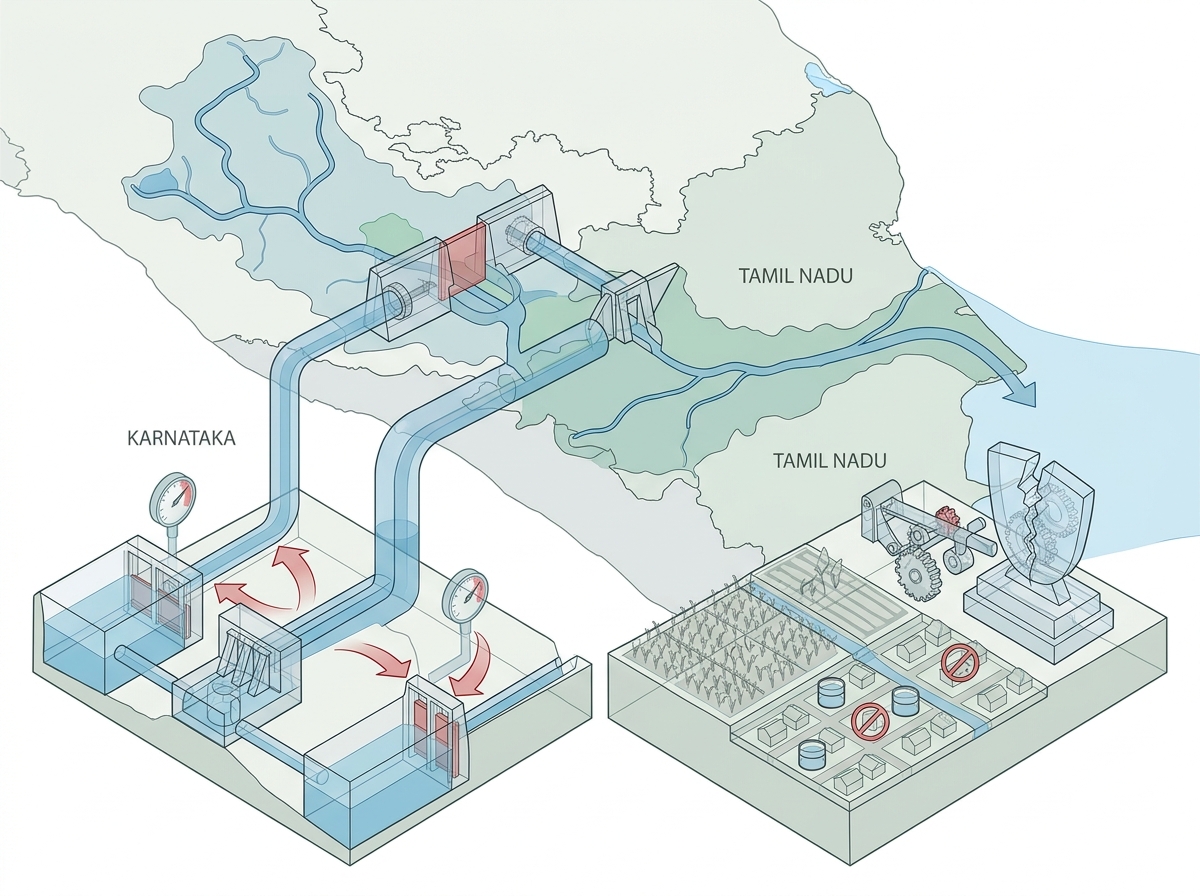
✎ The Mekedatu dam project on the Cauvery River exemplifies the complex interplay between developmental imperatives, inter-state water sharing, and judicial oversight in India's federal structure.
Subject Relevance — Where This Topic Fits
- GS Paper II — Polity and Governance (Inter-State Water Disputes) | GS Paper III — Environment and Ecology (River Water Management, Interlinking of Rivers)
Quick Revision: The Mekedatu dam project on the Cauvery River exemplifies the complex interplay between developmental imperatives, inter-state water sharing, and judicial oversight in India’s federal structure.
Why is this in the news?
The protests highlighted concerns over the non-release of Tamil Nadu’s due share of Cauvery water, threatening the standing kuruvai crop and exacerbating drinking water shortages in Tamil Nadu’s delta districts. The issue underscores the persistent inter-state water disputes in India and the challenges in implementing judicial awards and inter-state agreements.
Background
- The Cauvery River is a perennial river flowing through Karnataka, Tamil Nadu, Kerala, and Puducherry, with its basin covering approximately 81,155 square kilometres.
- The Cauvery Water Disputes Tribunal (CWDT), constituted in 1990 under the Inter-State Water Disputes Act, 1956, delivered its final award in 2007, allocating specific water shares to Karnataka, Tamil Nadu, Kerala, and Puducherry.
- Tamil Nadu and Karnataka have historically contested the implementation of the CWDT award, leading to multiple protests, legal challenges, and Supreme Court interventions.
- The Mekedatu project, proposed by Karnataka in 2017, involves constructing a dam across the Cauvery near Mekedatu in Karnataka’s Ramanagara district, primarily for drinking water supply to Bengaluru and surrounding areas.
- The Supreme Court, in its 2018 judgment, upheld the CWDT award and directed Karnataka to release 177.25 TMC of water annually to Tamil Nadu, subject to hydrological conditions.
- The Inter-State River Water Disputes (Amendment) Act, 2019, was enacted to streamline the resolution of inter-state water disputes by establishing a permanent tribunal and a dispute resolution mechanism.
What is the Mekedatu Project?
- The Mekedatu project is a proposed dam and reservoir on the Cauvery River in Karnataka’s Ramanagara district, approximately 40 km from Bengaluru.
- The primary objective of the project is to supply 4.75 TMC of drinking water annually to Bengaluru and provide 7.5 MW of hydroelectric power.
- The project is estimated to cost approximately ₹9,000 crore and is proposed to be implemented in two phases, with the first phase focusing on water supply infrastructure.
- Karnataka has argued that the project is essential for meeting the growing water demands of Bengaluru and mitigating the city’s chronic water shortages.
- Tamil Nadu has opposed the project, contending that it violates the principles of equitable water sharing as per the CWDT award and the Supreme Court’s directives.
- The project has also raised environmental concerns, including the potential impact on the Cauvery basin’s ecology and the displacement of local communities.
- The Cauvery Monitoring Committee (CMC), constituted by the Supreme Court, has been tasked with overseeing the implementation of the CWDT award and ensuring compliance with inter-state agreements.
Key Features
| Feature | Significance |
|---|---|
| Kuruvai crop cultivation | A critical agricultural season in Tamil Nadu’s delta districts, dependent on Cauvery water for irrigation; failure risks economic losses for farmers and food security disruptions. |
| Mekedatu dam project | Proposed by Karnataka for drinking water and irrigation; perceived by Tamil Nadu as a unilateral action threatening its water entitlements under the Cauvery Water Disputes Tribunal (CWDT) award. |
| Protest dynamics (BJP, CPI, DMDK) | Illustrates inter-state political mobilisation on river water disputes, reflecting regional electoral calculus and ideological postures on federalism and water governance. |
| Cauvery Water Disputes Tribunal (CWDT) award | The legally binding allocation of Cauvery waters between Karnataka and Tamil Nadu, finalised in 2007; forms the constitutional basis for inter-state water sharing disputes. |
| Delta districts of Tamil Nadu | Highly fertile and densely populated regions critically dependent on Cauvery water for agriculture, drinking supply, and livelihoods; their distress amplifies political urgency. |
Why it Matters
Inter-State Relations
- Highlights the constitutional principle of cooperative federalism in water governance, as enshrined in Article 262 and the Inter-State Water Disputes Act, 1956.
- Demonstrates the electoral sensitivity of river water disputes in southern India, where regional parties leverage water rights to mobilise voter sentiment.
- Reinforces the role of political parties in amplifying or mitigating inter-state tensions, depending on electoral alliances and ideological positions.
Agricultural Economy
- The kuruvai crop is a vital kharif season in Tamil Nadu, contributing significantly to rice production and rural incomes; water scarcity threatens agricultural output and farmer livelihoods.
- Delta districts are the granary of Tamil Nadu; disruptions in water supply can trigger migration, food inflation, and economic instability in the state.
- The protest underscores the dependency of India’s agrarian economy on predictable water allocation policies, especially in peninsular river basins.
Legal and Institutional Framework
- The CWDT award, upheld by the Supreme Court in 2018, remains the legal anchor for Cauvery water distribution; unilateral state actions risk violating constitutional provisions.
- The role of the Cauvery Management Board (CMB) and the Cauvery Water Regulation Committee (CWRC) in enforcing the award is central to dispute resolution.
- The absence of a permanent inter-state water governance mechanism exacerbates conflicts, necessitating institutional reforms for sustainable management.
Environmental and Hydrological Constraints
- The Cauvery basin faces increasing stress due to climate change, erratic monsoons, and over-extraction, compounding inter-state disputes.
- The Mekedatu project’s ecological impact, including potential reduction in downstream flow and biodiversity loss, requires rigorous environmental impact assessments.
- Sustainable water management demands integrated basin-wide planning, incorporating climate resilience and equitable distribution principles.
Political Economy of Water
- Water allocation in Cauvery reflects the broader challenge of balancing upstream and downstream interests in shared river basins.
- The protest narratives reveal competing claims of ‘historical rights’ versus ‘equitable utilisation’, a core principle under international water law.
- Electoral politics often prioritise short-term gains over long-term water security, complicating consensus-building in inter-state negotiations.
Challenges
1. Inter-State Water Governance
- Lack of a permanent institutional mechanism for real-time water allocation and dispute resolution, leading to ad-hoc political interventions.
- Politicisation of water disputes by state governments, which prioritise electoral gains over cooperative solutions.
- Inadequate enforcement of the CWDT award by the Union government, undermining the authority of judicial and quasi-judicial bodies.
UPSC Link: Article 262, Inter-State Water Disputes Act, 1956
2. Climate Change and Hydrological Uncertainty
- Increasing frequency of droughts and erratic monsoons in the Cauvery basin, reducing water availability and exacerbating disputes.
- Over-extraction of groundwater in both Karnataka and Tamil Nadu, further depleting the river’s flow and complicating water sharing.
- Need for climate-resilient water management strategies, including rainwater harvesting and aquifer recharge, to mitigate future conflicts.
UPSC Link: Climate change and water scarcity
3. Legal and Constitutional Ambiguities
- Ambiguity in the interpretation of ‘equitable utilisation’ under the CWDT award, leading to conflicting claims by riparian states.
- Limited powers of the Cauvery Management Board (CMB) to enforce water releases, resulting in non-compliance by upstream states.
- Delays in the establishment of a permanent tribunal for Cauvery, as envisaged under the Inter-State Water Disputes Act, 1956.
UPSC Link: Article 262, Cauvery Water Disputes Tribunal
4. Agricultural and Livelihood Pressures
- High dependence of delta farmers on Cauvery water for the kuruvai crop, with limited alternative irrigation sources.
- Risk of rural distress and migration due to crop failure, threatening food security and socio-economic stability in Tamil Nadu.
- Need for crop diversification and water-efficient agricultural practices to reduce dependency on Cauvery waters.
UPSC Link: Agricultural water management
5. Ecological Degradation
- Potential ecological damage from the Mekedatu dam, including reduced downstream flow and loss of biodiversity in the Cauvery delta.
- Siltation and pollution in the Cauvery basin, further reducing water quality and availability.
- Urgent need for integrated river basin management plans to balance developmental and ecological imperatives.
UPSC Link: Environmental impact of dams
Challenges — UPSC Perspective
| Issue | Concern |
|---|---|
| Politicisation of water disputes | State governments use water issues to mobilise voters, delaying cooperative solutions and exacerbating tensions. |
| Non-compliance with CWDT award | Upstream states like Karnataka often delay or deny water releases, undermining the legal framework and judicial authority. |
| Climate-induced water scarcity | Increasing droughts and erratic monsoons reduce water availability, intensifying inter-state competition. |
| Agrarian distress in delta districts | Failure of the kuruvai crop due to water scarcity threatens farmer livelihoods and food security. |
| Ecological impact of dams | Projects like Mekedatu risk reducing downstream flow and biodiversity, raising environmental concerns. |
| Institutional weaknesses in governance | Lack of a permanent tribunal and weak enforcement mechanisms hinder sustainable water management. |
Way Forward
- Strengthen the institutional framework by operationalising the Cauvery Management Board (CMB) with binding powers to enforce water releases as per the CWDT award.
- Promote climate-resilient agriculture in Tamil Nadu’s delta districts through subsidies for drought-resistant crops and water-efficient irrigation techniques.
- Constitute a permanent inter-state tribunal for Cauvery under the Inter-State Water Disputes Act, 1956, to address future disputes without judicial delays.
- Encourage basin-wide integrated water resource management (IWRM) plans, incorporating climate change projections and ecological sustainability.
- Enhance real-time water data sharing between Karnataka and Tamil Nadu via satellite monitoring and automated gauging stations to build trust and transparency.
- Launch a public awareness campaign on water conservation, targeting both agricultural and urban users to reduce over-extraction and pollution.
- Explore alternative water sources for drinking and irrigation, such as desalination plants and rainwater harvesting, to reduce dependency on Cauvery waters.
- Mandate environmental impact assessments (EIAs) for all proposed dams and projects in the Cauvery basin, with mandatory public consultations.
UPSC Value Addition
Keywords for Mains Answer-Writing
Cauvery Water Dispute · Inter-State River Water Disputes Act, 1956 · Mekedatu Project · Karnataka-Tamil Nadu relations · Inter-State Water Disputes Tribunal · River basin management · Federalism in water governance · Kuruvai crop irrigation · Constitutional provisions on water sharing (Article 262) · River water sharing mechanisms · Centre-state coordination in water disputes · Environmental impact of dams · Agricultural water allocation · Drinking water security
Constitutional & Policy Linkages
- {‘Article 262’: ‘Inter-state water disputes adjudication’}
- {‘Article 257’: ‘Control of Union over states in certain cases’}
- {‘Seventh Schedule’: ‘Union and State List (water disputes)’}
Concept Flow
Political parties in Tamil Nadu protest Karnataka’s Mekedatu dam project → Perceived threat to Cauvery water entitlements under CWDT award → Kuruvai crop and drinking water shortages in delta districts → Economic and livelihood pressures on farmers → Escalation of inter-state tensions → Need for institutional enforcement of water-sharing agreements → Call for climate-resilient and equitable water governance.
Prelims Practice Questions
Q1. Consider the following statements regarding the Cauvery Water Disputes Tribunal (CWDT):
1. The CWDT was constituted under the Inter-State River Water Disputes Act, 1956.
2. The Tribunal’s award is binding on the parties and cannot be challenged in any court.
3. The Tribunal has the power to modify its award based on changed circumstances.
How many of the above statements are correct?
- Only one
- Only two
- All three
- None
Answer: All three — Statements 1 and 3 are correct. The CWDT was constituted under the Inter-State River Water Disputes Act, 1956, and has the power to modify its award based on changed circumstances. Statement 2 is incorrect as the Tribunal’s award can be challenged in the Supreme Court under Article 136 of the Constitution.
Q2. Assertion (A): The Mekedatu Project proposed by Karnataka is a contentious issue in the Cauvery water dispute.
Reason (R): The project aims to divert water for drinking purposes, which Tamil Nadu argues will reduce its share of water for irrigation.
In the context of the above two statements, which one of the following is correct?
- Both A and R are true, and R is the correct explanation of A
- Both A and R are true, but R is not the correct explanation of A
- A is true, but R is false
- A is false, but R is true
Answer: Both A and R are true, but R is not the correct explanation of A — Both the Assertion (A) and Reason (R) are true, and the Reason (R) correctly explains the Assertion (A). The Mekedatu Project is indeed a contentious issue as it involves water diversion that Tamil Nadu fears will reduce its irrigation water share.
Q3. Which of the following constitutional provisions is directly related to the resolution of inter-state river water disputes in India?
- Article 262
- Article 253
- Article 32
- Article 300A
Answer: Article 262 — Article 262 of the Constitution provides for the adjudication of disputes relating to waters of inter-state rivers or river valleys. It empowers Parliament to exclude such disputes from the jurisdiction of courts.
Mains Practice Question
✍ The Cauvery water dispute between Karnataka and Tamil Nadu exemplifies the challenges of federal water governance in India. Critically examine the institutional mechanisms available for resolving inter-state river water disputes, with particular reference to the Cauvery case. Also, assess the role of the Supreme Court in adjudicating such disputes. (15 Marks)
Approach: MODEL-ANSWER SKELETON:
1. **Institutional Mechanisms**:
– **Inter-State River Water Disputes Act, 1956**: Outline its provisions for tribunal formation, award binding nature, and limitations (e.g., no enforcement mechanism).
– **Cauvery Water Disputes Tribunal (CWDT)**: Discuss its constitution (1990), composition, and the 2018 award (sharing formula: 377.2 TMC for Karnataka, 277.4 TMC for Tamil Nadu, 30 TMC for Kerala, 7 TMC for Puducherry).
– **Role of the Supreme Court**: Highlight its jurisdiction under Article 136 and the 2018 judgment upholding the CWDT award while allowing modifications for drinking water needs.
2. **Federalism Challenges**:
– **Constitutional Provisions**: Article 262 (exclusion of court jurisdiction) vs. Article 136 (Supreme Court’s discretionary power).
– **Centre-State Coordination**: Role of the Ministry of Jal Shakti in facilitating negotiations and implementing tribunal awards.
– **Political Economy**: Agricultural water demands (kuruvai crop in Tamil Nadu vs. drinking water in Karnataka), electoral pressures, and regional identity politics.
3. **Critique of the Framework**:
– **Delays and Enforcement**: CWDT took 28 years to deliver its award; lack of a permanent tribunal under Article 262(2) for faster resolution.
– **Supreme Court’s Intervention**: Discuss the balance between judicial activism and federalism (e.g., SC’s 2018 order directing Karnataka to release water despite protests).
– **Environmental and Social Costs**: Impact of dams (e.g., Mekedatu) on downstream states and ecological sustainability.
4. **Way Forward**:
– **Permanent Tribunal**: Proposals for a permanent tribunal under Article 262(2) to avoid ad-hoc tribunals.
– **Integrated River Basin Management**: Emphasize basin-wide planning, data transparency, and stakeholder participation.
– **Alternative Dispute Resolution**: Mediation and negotiation frameworks to reduce judicial burden.
**Balanced View**: Acknowledge the structural limitations of the current framework while arguing for reforms that balance federalism, judicial oversight, and ecological sustainability.
Source: The Hindu
Generated by AanyaAi for educational purpose.

- वस्त्र मंत्रालय ने शुरू किया ‘स्वच्छता ही सेवा 2026’ अभियान: जाने प्रमुख पहल - September 24, 2026
- Swachhata Hi Seva 2026: Textile Ministry’s Nationwide Cleanliness & Green Initiatives - September 24, 2026
- आरबीआई ने क्लेम एक्सिवा फाइनेंस पर लगाया 2.70 लाख रुपये का जुर्माना - September 24, 2026

No Comments