


08 Aug Madras HC: Community Certificate Verification Allowed Even After Retirement
✎ Fraudulent appointments based on forged caste certificates are void ab initio, and verification of community certificates can be initiated or continued even after retirement, as the constitutional duty to uphold equality in…
Subject Relevance — Where This Topic Fits
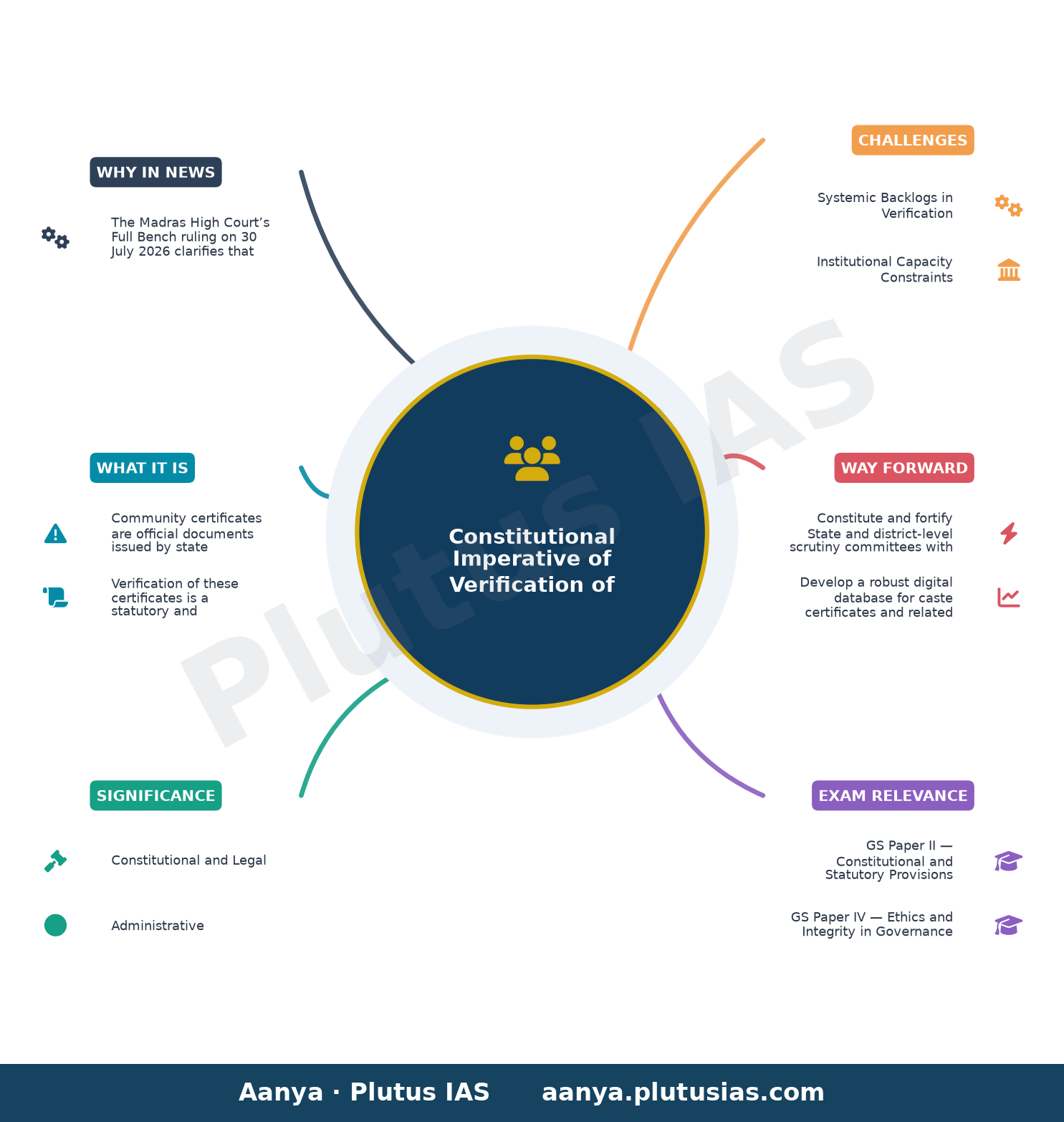
- GS Paper II — Constitutional and Statutory Provisions | GS Paper IV — Ethics and Integrity in Governance
- Prelims: Community Certificate Verification, Reservation Policy for SC/ST/OBC, Article 14 (Equality before Law), Article 16 (Equality of Opportunity in Public Employment), Supreme Court Judgment in Kumari Madhuri Patil vs Additional Commissioner, Tribal Development (1994), Full Bench of High Court, Retiral Benefits, Ante-Dated Appointment, Systemic Backlog in Verification
- Essay: The Role of Judicial Pronouncements in Upholding Constitutional Values, Administrative Integrity and Public Trust in Governance
Quick Revision: Fraudulent appointments based on forged caste certificates are void ab initio, and verification of community certificates can be initiated or continued even after retirement, as the constitutional duty to uphold equality in public employment overrides procedural delays.
Why is this in the news?
The Madras High Court’s Full Bench ruling on 30 July 2026 clarifies that the verification of community certificates for government employees is legally permissible even after retirement, reinforcing the constitutional principle that fraudulent appointments are void ab initio. This judgment resolves conflicting interpretations and underscores the state’s duty to ensure procedural fairness while eliminating systemic backlogs in caste verification processes, aligning with the Supreme Court’s directives in Kumari Madhuri Patil’s case (1994).
Background
- The issue of verifying community certificates for government employees has been a contentious one, particularly concerning reservations for Scheduled Castes (SC), Scheduled Tribes (ST), and Other Backward Classes (OBC).
- The Supreme Court, in *Kumari Madhuri Patil vs Additional Commissioner, Tribal Development* (1994), laid down a multi-point verification matrix to determine the genuineness of caste certificates, which has since been the guiding framework for state governments.
- Conflicting judgments by Division Benches of the Madras High Court created ambiguity on whether verification could proceed post-retirement, necessitating a Full Bench reference.
- The Tamil Nadu government’s failure to institutionalise timely verification mechanisms has led to systemic backlogs, prompting judicial intervention.
- Fraudulent appointments based on forged caste certificates undermine the constitutional guarantee of equality of opportunity in public employment under Article 16.
- The judgment reaffirms that retiral benefits cannot be protected if the foundational illegality of a fraudulent appointment persists.
What is the Verification of Community Certificates in Government Service?
- Community certificates are official documents issued by state governments to certify an individual’s caste status, enabling access to reservation benefits in public employment and educational institutions.
- Verification of these certificates is a statutory and constitutional obligation to prevent misuse of reservation quotas, as mandated by Articles 14, 15, and 16 of the Constitution.
- The Supreme Court, in *Kumari Madhuri Patil* (1994), established a three-tier verification process: (i) scrutiny by the issuing authority, (ii) verification by a district-level committee, and (iii) final scrutiny by a State-Level Scrutiny Committee.
- The process includes field enquiries, anthropological assessments, and cross-verification with official records to ensure authenticity.
- Verification is not limited to pre-1995 certificates; the court held that fraud has no expiry date, and older deceptions must also be investigated.
- The judgment clarifies that verification can be initiated or continued even after an employee’s retirement, as the illegality of a fraudulent appointment is not extinguished by superannuation.
- Public employers are directed to complete verification within the initial years of an employee’s service to prevent dilatory tactics and ensure timely accountability.
- Institutional strengthening of scrutiny committees with adequate manpower and experts is emphasised to eliminate systemic backlogs.
Key Features
| Feature | Significance |
|---|---|
| Full Bench ruling on post-retirement verification | Establishes that caste status verification remains legally permissible even after an employee’s retirement, reinforcing constitutional accountability. |
| Void ab initio doctrine application | Holds that appointments secured through fraudulent certificates are void from inception, rendering retiral benefits unprotected. |
| Supreme Court’s Kumari Madhuri Patil precedent (1994) | Provides the procedural framework for caste verification, applicable regardless of the certificate’s issuance or employment date. |
| Institutional strengthening directives | Mandates fortification of State and district-level scrutiny committees with manpower and anthropological experts to eliminate systemic backlogs. |
| Timely verification mandate | Directs public employers to initiate and complete verification of community certificates within the initial years of service to prevent dilatory tactics. |
Why it Matters
Constitutional and Legal
- Reinforces the principle that fraud vitiates the very foundation of government appointments, aligning with Articles 14 and 16 of the Constitution.
- Upholds the supremacy of constitutional morality over procedural delays, ensuring that justice is not defeated by technicalities.
- Clarifies the legal position on post-retirement verification, resolving conflicting judicial precedents.
Administrative
- Strengthens the institutional capacity of scrutiny committees to enforce caste verification norms rigorously.
- Reduces systemic backlogs by mandating timely verification, thereby enhancing administrative efficiency.
- Ensures consistency in the application of verification protocols across all public employers in Tamil Nadu.
Social Justice
- Protects the integrity of reservation policies by preventing misuse of community certificates.
- Upholds the rights of genuinely eligible candidates by ensuring fair and transparent verification processes.
- Promotes accountability in public employment, fostering trust in reservation systems.
Challenges
1. Systemic Backlogs in Verification
- Existence of significant delays in the verification process due to inadequate manpower and resources in scrutiny committees.
- Risk of dilatory tactics by employees to prolong verification until retirement, defeating the purpose of timely scrutiny.
UPSC Link: GS-II: Reservation Policies
2. Institutional Capacity Constraints
- Shortage of anthropological experts and trained personnel to conduct rigorous caste verification.
- Need for robust data systems to cross-reference caste certificates with historical records and community records.
UPSC Link: GS-II: Governance and Administration
3. Legal Ambiguity and Conflicting Precedents
- Prior conflicting judgments by Division Benches led to legal uncertainty regarding post-retirement verification.
- Requirement for judicial clarity to ensure uniform application of the law across jurisdictions.
UPSC Link: GS-II: Judiciary and Constitutional Framework
4. Balancing Fairness and Accountability
- Risk of harassment of employees through prolonged or unnecessary verification processes.
- Need to ensure that verification is conducted expeditiously without compromising due process.
UPSC Link: GS-II: Administrative Law
Challenges — UPSC Perspective
| Issue | Concern |
|---|---|
| Delayed verification processes | Undermines the efficacy of reservation policies and allows misuse of community certificates. |
| Inadequate institutional resources | Leads to systemic inefficiencies and prolonged backlogs in verification. |
| Conflicting judicial precedents | Creates legal uncertainty and hampers consistent enforcement of verification norms. |
| Risk of harassment | Potential misuse of verification processes to target employees unfairly. |
| Data integrity and cross-referencing | Challenges in verifying authenticity of caste certificates due to incomplete or outdated records. |
| Timely completion of verification | Ensuring verification is completed within the initial years of service to prevent dilatory tactics. |
Way Forward
- Constitute and fortify State and district-level scrutiny committees with adequate manpower, including anthropological experts, within six months.
- Develop a robust digital database for caste certificates and related records to facilitate cross-referencing and verification.
- Mandate all public employers to initiate verification of community certificates within the first two years of an employee’s service.
- Establish a grievance redressal mechanism for employees to address concerns regarding verification processes expeditiously.
- Conduct periodic training programs for scrutiny committee members on legal standards and procedural fairness in verification.
- Ensure transparency in the verification process by publishing annual reports on the status of verifications and outcomes.
- Collaborate with state archaeological and anthropological departments to validate caste claims where necessary.
- Review and update existing guidelines to align with the Full Bench ruling and Supreme Court precedents.
UPSC Value Addition
Keywords for Mains Answer-Writing
Community Certificate verification · Madras High Court Full Bench · Caste certification scrutiny · Constitutional accountability in appointments · Supreme Court directives on Madhuri Patil case · State Level Scrutiny Committee · Retirement and verification of service records · Fraudulent appointments in government service · Anthropological experts in verification · Multi-point verification matrix · Ab initio void appointments · Retiral benefits and foundational illegality
Constitutional & Policy Linkages
- Article 14: Equality before law and equal protection of laws.
- Article 16: Equality of opportunity in public employment.
- Article 46: Promotion of educational and economic interests of weaker sections.
Concept Flow
Issue of community certificate by competent authority → Employment secured based on certificate → Potential misuse or fraud → Initiation of verification process → Discovery of fraud or irregularity → Legal challenge or reference to higher judiciary → Full Bench ruling on post-retirement verification → Institutional directives for strengthening scrutiny committees → Timely completion of verification within initial years of service → Ensuring constitutional accountability and fairness.
Prelims Practice Questions
Q1. Consider the following statements regarding the verification of community certificates in government service as per the Madras High Court’s recent ruling:
1. Verification of community certificates can be initiated even after an employee’s retirement.
2. A lawful verification process initiated prior to retirement does not lapse upon superannuation.
3. The Supreme Court’s directives in Kumari Madhuri Patil’s case (1994) grant immunity to older deceptions in caste certificates.
How many of the above statements are correct?
- Only one
- Only two
- All three
- None
Answer: Only two — Statement 1 and 2 are correct as per the Madras High Court’s ruling. Statement 3 is incorrect because the Full Bench explicitly held that fraud has no expiry date and the Supreme Court’s directives do not grant immunity to older deceptions.
Q2. Assertion (A): The Madras High Court ruled that appointments obtained by fraud are ab initio void and retiral benefits flowing from such void entries cannot be protected.
Reason (R): The court held that retirement does not wash away the foundational illegality of fraudulent appointments.
In the context of the above statements, which of the following is correct?
- Both A and R are true, and R is the correct explanation of A.
- Both A and R are true, but R is not the correct explanation of A.
- A is true, but R is false.
- A is false, but R is true.
Answer: Both A and R are true, and R is the correct explanation of A. — Both Assertion (A) and Reason (R) are true, and Reason (R) correctly explains Assertion (A) as per the Madras High Court’s judgment.
Q3. Match the following provisions or directives with their respective authorities or contexts:
Column I
1. Multi-point verification matrix for caste certificates
2. State Level Scrutiny Committee
3. Fast-track inquiries post-retirement
4. Anthropological experts in verification
Column II
A. Supreme Court in Kumari Madhuri Patil’s case (1994)
B. Madras High Court Full Bench (2026)
C. Tamil Nadu government
D. District level vigilance committees
Select the correct match:
- 1-A, 2-C, 3-B, 4-D
- 1-B, 2-A, 3-C, 4-D
- 1-A, 2-D, 3-B, 4-C
- 1-C, 2-A, 3-D, 4-B
Answer: 1-A, 2-C, 3-B, 4-D — 1-A: The Supreme Court established the multi-point verification matrix in Kumari Madhuri Patil’s case (1994). 2-C: The Madras High Court directed the Tamil Nadu government to fortify the State Level Scrutiny Committee. 3-B: The Full Bench directed fast-track inquiries post-retirement. 4-D: The court directed district level vigilance committees to include anthropological experts.
Mains Practice Question
✍ The Madras High Court has recently reaffirmed that the verification of community certificates for government employees, even if initiated post-retirement, is constitutionally permissible and does not lapse upon superannuation. Critically examine the legal and constitutional principles underlying this judgment, with reference to the Supreme Court’s directives in Kumari Madhuri Patil’s case (1994) and the implications for retiral benefits. Also, discuss the institutional mechanisms prescribed by the Madras High Court to ensure strict compliance with verification norms. (15 Marks)
Approach: MODEL-ANSWER SKELETON:
1. **Constitutional and Legal Principles**:
– Ab initio void appointments: Explain the doctrine that appointments obtained by fraud are void from the inception and cannot be validated by subsequent events like retirement.
– Constitutional accountability: Highlight the principle that constitutional bodies (e.g., public employers, scrutiny committees) must ensure integrity in appointments.
– Fraud has no expiry date: Emphasise that fraudulent acts, including misrepresentation of caste status, cannot be immunised by passage of time.
2. **Supreme Court’s Directives in Kumari Madhuri Patil’s Case (1994)**:
– Multi-point verification matrix: Outline the Supreme Court’s framework for verifying caste certificates, including the role of scrutiny committees and anthropological experts.
– Institutional strengthening: Discuss the need for robust verification mechanisms to eliminate systemic backlogs and ensure compliance.
3. **Madras High Court’s Judgment (2026)**:
– Post-retirement verification: Explain the court’s reasoning that verification processes initiated before retirement must be completed even after superannuation.
– Retiral benefits: Discuss the court’s stance that retiral benefits derived from fraudulent appointments cannot be protected.
– Fast-track inquiries: Highlight the direction for expedited verification processes to prevent dilatory tactics.
4. **Institutional Mechanisms Prescribed**:
– State Level Scrutiny Committee: Discuss the court’s directive to fortify this committee with adequate manpower and anthropological experts.
– District level vigilance committees: Explain their role in ensuring strict compliance with verification norms.
– Timely initiation of verification: Emphasise the court’s direction to initiate and complete verification within the initial years of an employee’s service.
5. **Balancing Constitutional Integrity and Fairness**:
– Avoiding harassment: Discuss the court’s caution against using delayed procedures as a tool for unnecessary harassment.
– Proportionality: Highlight the need to balance constitutional integrity with fairness to avoid arbitrary or excessive verification.
6. **Conclusion**:
– Summarise the judgment’s significance in upholding constitutional accountability and integrity in government appointments.
– Note the implications for retiral benefits and the institutional mechanisms prescribed to ensure strict compliance.
Source: The Hindu
Generated by AanyaAi for educational purpose.

- AI से भारत के स्वास्थ्य सेवा अंतर को कैसे पाट सकता है? जानें पूरी रिपोर्ट - August 9, 2026
- How AI Can Transform India’s Healthcare System for UPSC Mains 2026 - August 9, 2026
- बॉम्बे हाई कोर्ट के ‘निजी वन’ फैसले का महाराष्ट्र के भूमिधारकों पर असर - August 9, 2026

No Comments