


08 Aug Tiger Deaths in Nagarjunasagar Srisailam Tiger Reserve: NTCA Investigates
✎ The NTCA’s Standard Operating Procedures (SOPs) for tiger mortality investigations mandate forensic analysis, post-mortem examination, and registration of FIRs under the Wildlife Protection Act, 1972, to ensure transparency and…
Subject Relevance — Where This Topic Fits
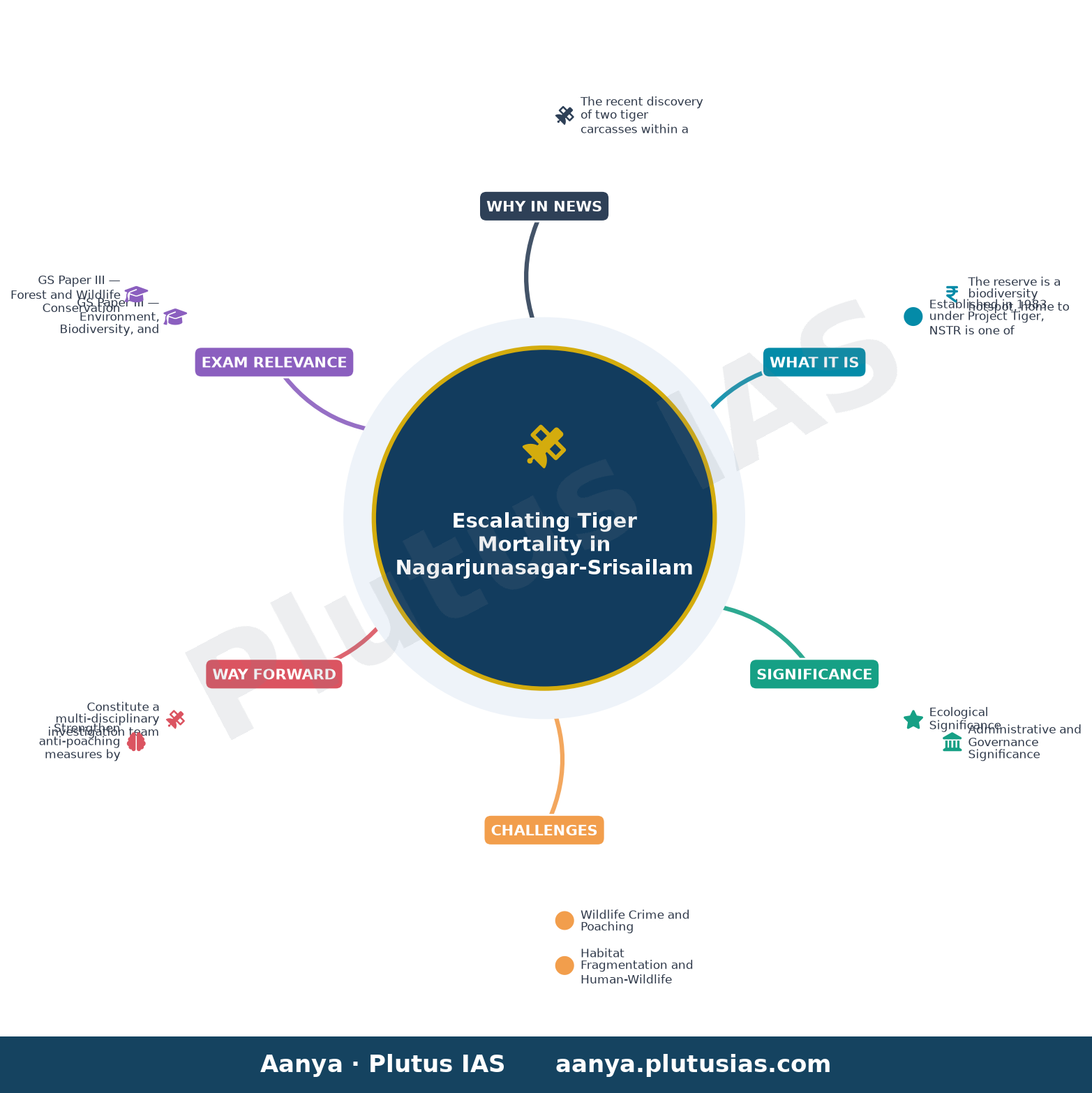
- GS Paper III — Environment, Biodiversity, and Environmental Pollution | GS Paper III — Forest and Wildlife Conservation
- Prelims: Project Tiger, Nagarjunasagar-Srisailam Tiger Reserve (NSTR), National Tiger Conservation Authority (NTCA), Wildlife Protection Act, 1972, NTCA Standard Operating Procedures (SOPs), Forensic analysis in wildlife crime, Gaur translocation, Patrolling and vigilance in tiger reserves
- Essay: The ethical imperative of biodiversity conservation in the Anthropocene, Balancing developmental pressures with ecological sustainability
Quick Revision: The NTCA’s Standard Operating Procedures (SOPs) for tiger mortality investigations mandate forensic analysis, post-mortem examination, and registration of FIRs under the Wildlife Protection Act, 1972, to ensure transparency and accountability in wildlife crime cases.
Why is this in the news?
The recent discovery of two tiger carcasses within a span of three days in the Nagarjunasagar-Srisailam Tiger Reserve (NSTR) has triggered urgent investigations under the Wildlife Protection Act, 1972. The absence of limbs and claws on one carcass raises concerns of poaching, while the Deputy Chief Minister’s directive underscores the gravity of the situation for India’s tiger conservation efforts. This incident highlights systemic vulnerabilities in wildlife protection and the need for robust enforcement of conservation protocols.
Background
- The Nagarjunasagar-Srisailam Tiger Reserve (NSTR), spanning Andhra Pradesh and Telangana, is one of India’s largest tiger reserves, notified under Project Tiger in 1983.
- The reserve faces anthropogenic pressures including encroachment, illegal mining, and human-wildlife conflict, exacerbated by developmental projects like dams and highways.
- India’s tiger population has shown a positive trend, reaching 3,167 in 2022 (All India Tiger Estimation Report), but localized declines in reserves like NSTR warrant immediate attention.
- The Wildlife Protection Act, 1972, provides the legal framework for tiger conservation, with stringent penalties for poaching, poisoning, and habitat destruction.
- The National Tiger Conservation Authority (NTCA), established in 2005, monitors tiger reserves through Standard Operating Procedures (SOPs) for mortality investigations, forensic analysis, and habitat management.
What is the Nagarjunasagar-Srisailam Tiger Reserve (NSTR)?
- Established in 1983 under Project Tiger, NSTR is one of India’s largest tiger reserves, covering 3,568 sq km across Andhra Pradesh and Telangana.
- The reserve is a biodiversity hotspot, home to tigers, leopards, sloth bears, and gaurs.
- The reserve’s terrain includes dry deciduous forests, rocky outcrops, and riverine ecosystems, with the Krishna river providing critical water sources.
- NSTR faces ecological challenges such as habitat fragmentation due to infrastructure projects, illegal grazing, and resource extraction, including timber and minor minerals.
- The reserve is also a site for ongoing translocation efforts, including the proposed introduction of gaurs from central India to augment prey base for tigers.
- Project Tiger, launched in 1973, is a centrally sponsored scheme aimed at ensuring the survival and maintenance of viable tiger populations in their natural habitats.
- The NTCA’s mandate includes conducting periodic inspections, reviewing management plans, and enforcing compliance with conservation guidelines.
Key Features
| Feature | Significance |
|---|---|
| Nagarjunasagar Srisailam Tiger Reserve (NSTR) | A critical tiger habitat (Category I) under Project Tiger, designated for the conservation of the Bengal tiger (Panthera tigris tigris) and its prey base, covering 3,728 sq km across five districts of Andhra Pradesh. |
| Project Tiger Division, Giddalur | A specialised administrative unit under the National Tiger Conservation Authority (NTCA) responsible for the protection, monitoring, and conservation of tigers and their habitats within the Giddalur forest division of NSTR. |
| NTCA Standard Operating Procedures (SOPs) for post-mortem | Mandates systematic forensic examination of tiger carcasses to determine cause of death, including tissue sampling, toxicology, and pathological analysis, ensuring scientific rigour in wildlife crime investigations. |
| Wildlife Protection Act, 1972 | Primary legislation governing the protection of wild animals and their habitats in India; provides legal framework for investigation, prosecution, and penalties in cases of wildlife crime, including poaching and poisoning. |
| Deputy Chief Minister’s directive on investigation | Demonstrates political commitment to wildlife conservation and transparency in governance, mandating a comprehensive probe into tiger deaths to ascertain natural or anthropogenic causes and prevent recurrence. |
Why it Matters
Ecological Significance
- The Nagarjunasagar Srisailam Tiger Reserve is a vital corridor for tiger movement between the Eastern and Western Ghats, supporting meta-population dynamics critical for genetic diversity and long-term survival of the species.
- Tiger mortality, especially in contiguous habitats like NSTR, disrupts ecological balance, leading to cascading effects on prey populations, vegetation structure, and overall ecosystem health.
- The reserve hosts a significant prey base, including chital, sambar, and wild boar, whose stability is essential for sustaining tiger populations and maintaining trophic balance.
- Loss of even a single tiger, particularly an adult, can reduce reproductive potential and genetic vigour, exacerbating the risk of localised extinction in fragmented landscapes.
Administrative and Governance Significance
- The incident underscores the challenges in implementing robust wildlife crime prevention mechanisms despite the existence of legal frameworks like the Wildlife Protection Act, 1972 and NTCA guidelines.
- The directive for increased patrolling and field-level vigilance reflects a reactive but necessary administrative response to mitigate immediate threats to tiger populations.
- Transparency in investigations, as mandated by the Deputy Chief Minister, is crucial for maintaining public trust and ensuring accountability in wildlife conservation efforts.
- The case highlights the need for inter-departmental coordination between forest officials, forensic teams, and law enforcement agencies to address wildlife crime effectively.
Legal and Ethical Significance
- The registration of an offence under the Wildlife Protection Act, 1972 signifies the application of legal instruments to deter poaching and other forms of wildlife crime, though enforcement remains a persistent challenge.
- Forensic analysis of tiger carcasses is ethically imperative to distinguish between natural mortality and anthropogenic causes, ensuring justice for the species and deterrence for potential offenders.
- The absence of immediate disclosure regarding the disposal of the carcass raises ethical concerns about transparency in wildlife crime investigations, which must be addressed to maintain credibility.
Challenges
1. Wildlife Crime and Poaching
- Poaching for body parts, including claws and limbs, remains a persistent threat to tiger populations, driven by illegal wildlife trade and demand in traditional medicine markets.
- The mutilation of the tiger carcass in Racherla Forest Beat suggests targeted poaching, which undermines conservation efforts and disrupts ecological stability.
- Enforcement of anti-poaching measures is hindered by limited manpower, inadequate technology, and the vast, inaccessible terrain of tiger reserves like NSTR.
- Corruption and collusion among local stakeholders can facilitate wildlife crime, necessitating stringent oversight and whistle-blower protections.
UPSC Link: GS3: Conservation, Environmental Pollution and Degradation
2. Habitat Fragmentation and Human-Wildlife Conflict
- NSTR faces increasing pressure from anthropogenic activities, including agriculture, mining, and infrastructure development, leading to habitat fragmentation and reduced carrying capacity.
- Human-wildlife conflict arises from competition for resources, particularly in buffer zones, resulting in retaliatory killings of tigers by local communities.
- Inadequate compensation mechanisms for livestock predation and crop damage exacerbate negative perceptions of tigers among local populations, undermining conservation efforts.
- Climate change-induced alterations in prey availability and water sources further strain tiger habitats, increasing vulnerability to mortality.
UPSC Link: GS3: Conservation, Environmental Pollution and Degradation
3. Forensic and Investigative Challenges
- Determining the exact cause of tiger mortality requires advanced forensic techniques, including toxicology and pathology, which may be inaccessible or delayed in remote areas like NSTR.
- The absence of a dedicated wildlife forensic laboratory in Andhra Pradesh complicates timely and accurate analysis of samples, delaying investigations.
- Chain of custody issues in sample collection and transportation can compromise the integrity of forensic evidence, leading to inconclusive or contested findings.
- Lack of standardised protocols for post-mortem examinations in some state forest departments may result in inconsistent data collection and analysis.
UPSC Link: GS3: Conservation, Environmental Pollution and Degradation
4. Institutional and Resource Constraints
- Limited financial and human resources allocated to wildlife conservation, particularly in state-managed tiger reserves, hinder effective patrolling, monitoring, and habitat management.
- Inadequate training of forest personnel in wildlife crime investigation, forensic techniques, and modern conservation tools reduces the efficacy of conservation programmes.
- Dependence on centralised funding mechanisms, such as the National Tiger Conservation Authority (NTCA), often leads to delays in disbursement and utilisation of resources.
UPSC Link: GS2: Government Policies and Interventions for Development
5. Public Awareness and Community Engagement
- Low levels of awareness among local communities about the ecological importance of tigers and the legal consequences of wildlife crime perpetuate harmful practices.
- Absence of participatory conservation models, such as eco-development committees or joint forest management, limits community buy-in and cooperative efforts in tiger protection.
- Misconceptions about tigers as threats to livelihoods, rather than ecological assets, lead to apathy or hostility towards conservation initiatives.
UPSC Link: GS3: Conservation, Environmental Pollution and Degradation
Challenges — UPSC Perspective
| Issue | Concern |
|---|---|
| Poaching and illegal wildlife trade | Targeted killing of tigers for body parts, driven by demand in illegal markets, undermines conservation efforts and disrupts ecological balance. |
| Habitat fragmentation | Anthropogenic activities fragment tiger habitats, reducing carrying capacity and increasing vulnerability to mortality and human-wildlife conflict. |
| Forensic limitations | Inadequate forensic infrastructure and delayed investigations compromise the ability to determine causes of tiger mortality accurately. |
| Institutional resource constraints | Limited funding, manpower, and training in state forest departments hinder effective conservation and crime prevention measures. |
| Community apathy and conflict | Low public awareness and negative perceptions of tigers among local communities exacerbate human-wildlife conflict and undermine conservation efforts. |
| Climate change impacts | Alterations in prey availability and water sources due to climate change strain tiger habitats and increase mortality risks. |
Way Forward
- Constitute a multi-disciplinary investigation team comprising forest officials, forensic experts, and wildlife crime specialists to conduct an impartial and transparent probe into the tiger deaths.
- Strengthen anti-poaching measures by deploying advanced surveillance technologies, such as camera traps, drones, and GPS collars, in high-risk zones of NSTR.
- Establish a dedicated wildlife forensic laboratory in Andhra Pradesh to ensure timely and accurate analysis of samples from tiger carcasses and other wildlife crimes.
- Enhance community engagement through awareness campaigns, eco-development committees, and participatory conservation models to foster positive attitudes towards tigers.
- Improve compensation mechanisms for human-wildlife conflict to reduce retaliatory killings and build local support for tiger conservation.
- Implement habitat restoration programmes, including afforestation and corridor development, to mitigate fragmentation and enhance prey base stability.
- Strengthen inter-state coordination with neighbouring tiger reserves, such as the Western Ghats and Central India, to facilitate tiger movement and genetic diversity.
- Promote research on tiger ecology, prey dynamics, and climate change impacts within NSTR to inform evidence-based conservation strategies.
UPSC Value Addition
Keywords for Mains Answer-Writing
Project Tiger · Nagarjunasagar Srisailam Tiger Reserve (NSTR) · NTCA Standard Operating Procedures (SOPs) · Wildlife Protection Act 1972 · tiger conservation challenges · poaching and wildlife crime · forensic analysis in wildlife cases · transboundary tiger corridors · National Tiger Conservation Authority (NTCA) · apex predator conservation · Andhra Pradesh forest governance · wildlife forensic science · tiger mortality investigation protocols · habitat fragmentation and tiger deaths
Concept Flow
Anthropogenic pressures (poaching, habitat fragmentation) → Decline in tiger population → Increased mortality incidents → Investigation into causes → Legal and administrative responses → Implementation of conservation measures → Long-term ecological recovery
Prelims Practice Questions
Q1. Consider the following statements regarding the National Tiger Conservation Authority (NTCA):
1. NTCA is a statutory body established under the Wildlife Protection Act, 1972.
2. NTCA is responsible for the implementation of Project Tiger.
3. NTCA’s mandate includes the establishment of Tiger Reserves in India.
4. NTCA has the power to declare any area as a Tiger Reserve without state government consent.
How many of the above statements are correct?
- Only one
- Only two
- Only three
- All four
Answer: Only three — Statements 1, 2, and 3 are correct as NTCA is a statutory body under the Wildlife Protection Act, 1972, and oversees Project Tiger and Tiger Reserve declarations. Statement 4 is incorrect as state government consent is required for declaring a Tiger Reserve.
Q2. Assertion (A): The Wildlife Protection Act, 1972, provides legal protection to all wild animals in India.
Reason (R): Schedule I species under the Act enjoy the highest level of protection, including absolute prohibition on hunting.
Options:
A. Both A and R are true, and R is the correct explanation of A.
B. Both A and R are true, but R is not the correct explanation of A.
C. A is true, but R is false.
D. A is false, but R is true.
Answer: ? — Assertion (A) is true as the Wildlife Protection Act, 1972, protects all wild animals, but Schedule I species receive the highest protection. Reason (R) correctly explains this distinction, making both A and R true with R as the correct explanation of A.
Q3. Match the following Tiger Reserves in India with their respective states:
Column I (Tiger Reserve) Column II (State)
1. Nagarjunasagar Srisailam A. Karnataka
2. Bandipur B. Madhya Pradesh
3. Kanha C. Andhra Pradesh
4. Periyar D. Kerala
Options:
A. 1-C, 2-A, 3-B, 4-D
B. 1-A, 2-B, 3-C, 4-D
C. 1-D, 2-A, 3-B, 3-C
D. 1-B, 2-A, 3-C, 4-D
Answer: ? — The correct matches are: 1. Nagarjunasagar Srisailam – C. Andhra Pradesh, 2. Bandipur – A. Karnataka, 3. Kanha – B. Madhya Pradesh, 4. Periyar – D. Kerala.
Mains Practice Question
✍ The recent deaths of tigers in the Nagarjunasagar Srisailam Tiger Reserve (NSTR) underscore the persistent challenges to apex predator conservation in India. Critically examine the institutional, legal, and ecological dimensions of tiger conservation in India, with reference to the National Tiger Conservation Authority (NTCA) protocols and the Wildlife Protection Act, 1972. Also, analyse the role of forensic science in investigating wildlife crimes and its limitations. (15 Marks)
Approach: MODEL-ANSWER SKELETON:
1. **Institutional Framework**:
– Role of NTCA as the apex body for tiger conservation under the Wildlife Protection Act, 1972.
– Functions: Project Tiger implementation, Tiger Reserve declarations, monitoring tiger populations, and investigating tiger deaths.
– NTCA SOPs for post-mortem and forensic analysis (as cited in the NSTR case).
– Critique: Gaps in inter-state coordination, funding constraints, and delays in investigations.
2. **Legal Dimensions**:
– Provisions of the Wildlife Protection Act, 1972: Schedule I protection, absolute prohibition on hunting, and penalties for poaching.
– Offences registered under the Act in the NSTR case (e.g., missing limbs/claws suggesting poaching).
– Critique: Challenges in prosecution due to weak forensic evidence, lack of witnesses, and judicial delays.
3. **Ecological and Governance Challenges**:
– Habitat fragmentation, human-wildlife conflict, and prey base depletion in NSTR.
– Role of state forest departments (e.g., Andhra Pradesh’s recent initiatives like increasing patrolling).
– Critique: Inadequate habitat management, encroachments, and anthropogenic pressures.
4. **Forensic Science in Wildlife Crime Investigation**:
– Use of forensic analysis (DNA, toxicology, ballistics) in tiger mortality cases (as per NTCA SOPs).
– Limitations: Sample degradation, lack of standardized forensic labs, and delays in results.
– Case in point: NTCA’s forensic analysis in NSTR to determine cause of death (poaching vs. natural causes).
5. **Way Forward**:
– Strengthening NTCA’s institutional capacity (e.g., dedicated forensic units, real-time monitoring).
– Enhancing inter-state collaboration for transboundary tiger corridors (e.g., linking NSTR with other reserves).
– Community engagement and awareness to reduce human-wildlife conflict.
– Strict enforcement of legal provisions and expedited judicial processes.
Balance of Views:
– Optimistic: India’s tiger population recovery (e.g., 3,167 tigers in 2022 census) due to Project Tiger.
– Pessimistic: Persistent threats (poaching, habitat loss) and systemic gaps in enforcement.
Source: The Hindu
Generated by AanyaAi for educational purpose.

- यूपी में पहली बार तेंदुओं का बधियाकरण: मानव-वन्यजीव संघर्ष रोकेगा अभियान - September 24, 2026
- UP’s Groundbreaking Leopard Sterilization Plan to Curb Human-Wildlife Conflict - September 24, 2026
- महाराष्ट्र में त्योहार जुलूसों पर बॉम्बे हाईकोर्ट का बड़ा फैसला: पटाखे, लेजर और संगीत पर रोक - September 24, 2026

No Comments