


08 Aug INL Challenges Kerala CM on PM SHRI Scheme Implementation: Centre’s Clarification
✎ The PM SHRI scheme is a voluntary upgradation programme under NEP 2020, not mandatory even after signing an MoU, and Kerala’s continued reliance on the SSK programme underscores its policy autonomy in education governance.
Subject Relevance — Where This Topic Fits
- GS Paper II — Centre-State Relations | GS Paper III — Issues relating to Development and Management of Social Sector/Services relating to Education
- Prelims: PM SHRI Scheme, National Education Policy (NEP) 2020, Samagra Shiksha Abhiyan, MoU in education governance, Kerala’s education model, LDF vs UDF policy divergence, Secularism in education policy
- Essay: Education Policy and Federalism: Balancing National Vision with State Autonomy, The Role of Ideology in Shaping Public Policy: A Case Study of NEP 2020
Quick Revision: The PM SHRI scheme is a voluntary upgradation programme under NEP 2020, not mandatory even after signing an MoU, and Kerala’s continued reliance on the SSK programme underscores its policy autonomy in education governance.
Why is this in the news?
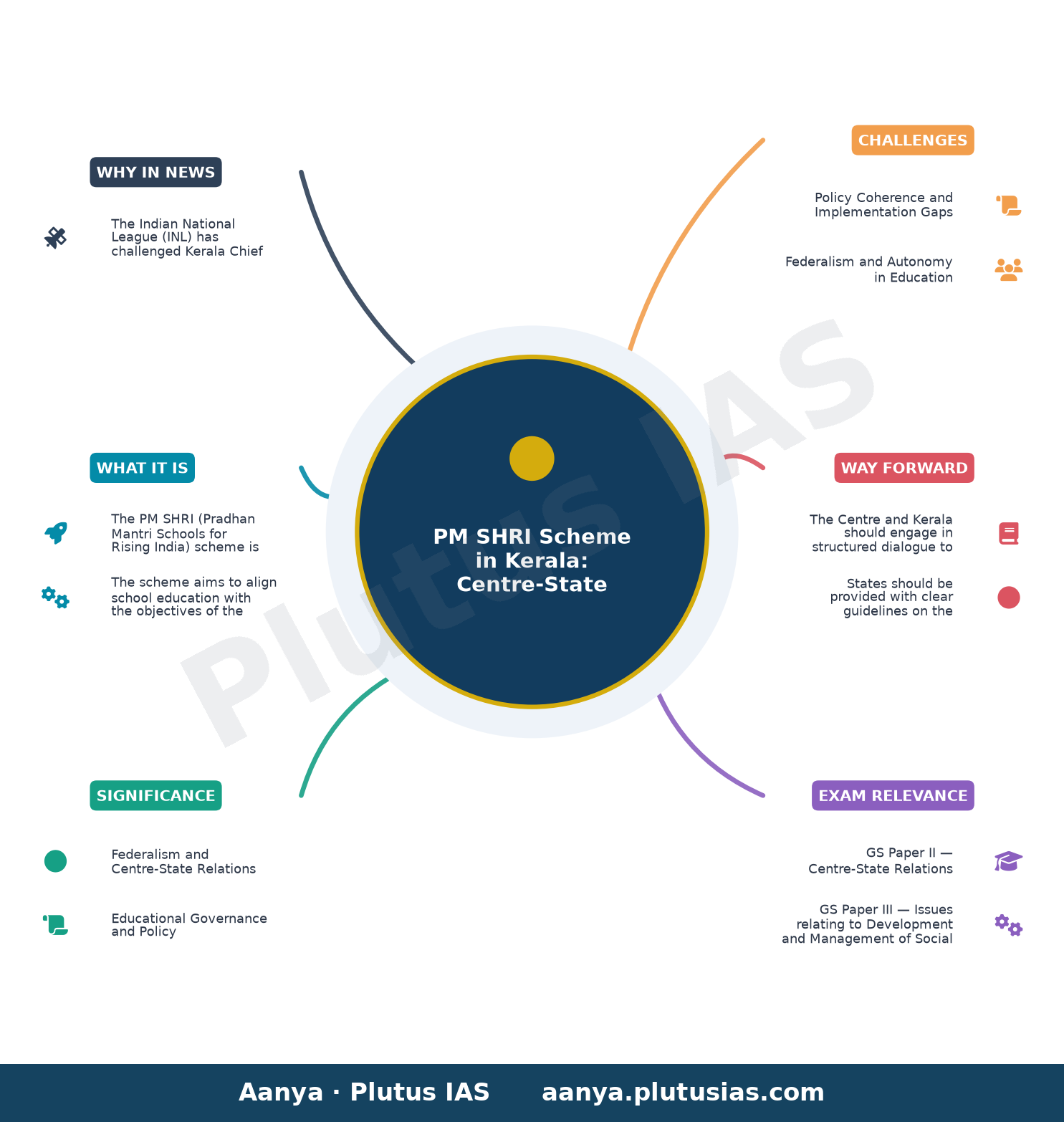
The Indian National League (INL) has challenged Kerala Chief Minister V.D. Satheesan’s assertion that the state was compelled to implement the PM SHRI (Pradhan Mantri Schools for Rising India) scheme due to an MoU signed by the previous LDF government. The Centre, through a parliamentary response, clarified that Kerala had only signed an MoU and not implemented the scheme, sparking a political and ideological debate over the state’s education policy and the implementation of the National Education Policy (NEP) 2020.
Background
- The PM SHRI scheme was launched in September 2022 under the Ministry of Education to upgrade 14,500 existing schools across India into model schools, aligning with the NEP 2020’s vision of holistic and experiential learning.
- Kerala, under the Left Democratic Front (LDF) government, signed an MoU with the Centre for the PM SHRI scheme but did not implement it, instead continuing with the Samagra Shiksha Kerala (SSK) programme, a centrally sponsored scheme for school education.
- The current United Democratic Front (UDF) government in Kerala has been accused by the INL of attempting to align the state’s education policy with the ideological framework of the Rashtriya Swayamsevak Sangh (RSS) through the NEP 2020.
- The dispute highlights the broader tension between the Centre’s push for the NEP 2020 and state governments’ autonomy in education policy, particularly in states with differing political ideologies.
- Kerala has historically been a forerunner in education, with high literacy rates and a robust public education system, making its stance on the PM SHRI scheme significant in the national discourse.
What is the PM SHRI Scheme?
- The PM SHRI (Pradhan Mantri Schools for Rising India) scheme is a centrally sponsored initiative launched in September 2022 to upgrade 14,500 existing government and government-aided schools across India into model schools.
- The scheme aims to align school education with the objectives of the National Education Policy (NEP) 2020, including experiential learning, skill development, and digital integration.
- Selected schools under the scheme will receive enhanced infrastructure, teacher training, and resources to transform them into exemplars of NEP 2020’s vision, including a focus on 21st-century skills and multidisciplinary learning.
- The scheme is implemented through a partnership between the Centre and state governments, with states required to sign an MoU to participate, but implementation remains voluntary.
- Funding for the scheme is shared between the Centre and states, with the Centre bearing 60% of the cost in non-special category states and 90% in special category states.
- The scheme is not a new school construction programme but an upgradation of existing schools to serve as model institutions for other schools to emulate.
- Kerala’s refusal to implement the scheme despite signing the MoU reflects its preference for the Samagra Shiksha Kerala (SSK) programme, which is tailored to the state’s specific educational needs.
Key Features
| Feature | Significance |
|---|---|
| PM SHRI Scheme | A centrally sponsored scheme launched in 2022 to upgrade 14,500 existing government schools across India into model schools, focusing on quality education, infrastructure, and inclusivity. |
| MoU Signing | States sign MoUs with the Centre to express intent to participate, but signing does not mandate implementation unless agreed terms are fulfilled. |
| Samagra Shiksha Kerala (SSK) | A state-run programme for universalisation of school education, receiving ₹99.27 crore in funding, distinct from PM SHRI in objectives and governance. |
| Secular Stand on Education | Kerala’s historical emphasis on secular, inclusive education policies, often contrasting with centrally driven schemes perceived as ideologically motivated. |
| National Education Policy (NEP) 2020 | A comprehensive policy framework aiming to reform India’s education system, often debated for its alignment with ideological visions. |
Why it Matters
Federalism and Centre-State Relations
- The dispute highlights tensions in fiscal federalism, where states resist centrally sponsored schemes perceived as encroaching on their educational autonomy.
- The Centre’s clarification that Kerala is not bound to implement PM SHRI underscores the voluntary nature of MoU-based schemes, despite state-level assertions to the contrary.
- Kerala’s refusal to implement PM SHRI aligns with its long-standing stance on maintaining educational sovereignty, reflecting broader debates on cooperative federalism.
Educational Governance and Policy
- The PM SHRI scheme’s implementation challenges in Kerala reflect broader issues of policy alignment between state and central governments in education.
- The distinction between PM SHRI and SSK programmes highlights the need for clarity in scheme objectives and funding mechanisms to avoid duplication or misallocation.
- Kerala’s emphasis on secular education policies contrasts with the NEP 2020’s ideological underpinnings, raising questions about policy coherence and state autonomy.
Political and Ideological Dimensions
- The INL’s allegations link the PM SHRI implementation debate to broader political narratives, including accusations of ideological imposition by the Centre.
- The Chief Minister’s stance may reflect a broader political strategy to resist perceived centralisation of educational governance, aligning with the LDF’s secular and inclusive policy framework.
- The NEP 2020’s association with the RSS, as alleged by the INL, adds a layer of ideological contestation to the educational policy discourse.
Challenges
1. Policy Coherence and Implementation Gaps
- The lack of alignment between the PM SHRI scheme and Kerala’s existing educational programmes (e.g., SSK) creates confusion in fund utilisation and programme objectives.
- States may sign MoUs without full commitment to implementation, leading to disputes over accountability and resource allocation.
- The Centre’s clarification that Kerala is not bound to implement PM SHRI highlights the need for clearer guidelines on the voluntary nature of such schemes.
UPSC Link: GS-II: Centre-State Relations
2. Federalism and Autonomy in Education
- Kerala’s resistance to PM SHRI reflects broader concerns about centralisation of educational governance, undermining state-level policy autonomy.
- The dispute raises questions about the balance between national standards and state-specific educational priorities, particularly in culturally diverse regions.
- The Centre’s clarification may not resolve the underlying tension, as states may continue to resist schemes perceived as ideologically driven or fiscally burdensome.
UPSC Link: GS-II: Federalism
3. Funding and Resource Allocation
- The allocation of ₹99.27 crore to SSK while PM SHRI remains unimplemented in Kerala raises questions about fund utilisation and programme priorities.
- States may prioritise existing programmes over centrally sponsored schemes due to better alignment with local needs or ideological preferences.
- The dispute highlights the need for transparent and predictable funding mechanisms to ensure equitable distribution of resources across states.
UPSC Link: GS-III: Resource Mobilisation
4. Ideological Contestations in Education Policy
- The NEP 2020’s perceived ideological underpinnings create polarisation in educational governance, particularly in states with distinct secular traditions.
- The INL’s allegations link the PM SHRI debate to broader ideological narratives, complicating policy implementation and intergovernmental relations.
- States may resist centrally sponsored schemes perceived as aligned with specific ideological agendas, leading to implementation delays or refusals.
UPSC Link: GS-II: Governance
5. Public Perception and Trust in Governance
- The dispute between the Centre and Kerala may erode public trust in educational governance, particularly among stakeholders like teachers, parents, and students.
- Clarifications from the Centre, such as the one on PM SHRI, may not fully address public scepticism, especially in states with strong ideological or political oppositions.
- The need for transparent communication and stakeholder engagement is critical to mitigate misinformation and build trust in policy implementation.
UPSC Link: GS-II: Governance
Challenges — UPSC Perspective
| Issue | Concern |
|---|---|
| Voluntary Nature of PM SHRI | States may sign MoUs without intending to implement the scheme, leading to disputes over accountability and resource utilisation. |
| Policy Misalignment | The PM SHRI scheme’s objectives may not align with state-level programmes like SSK, creating confusion in fund allocation and programme implementation. |
| Ideological Polarisation | The NEP 2020’s perceived ideological underpinnings may polarise educational governance, complicating policy implementation in states with distinct secular traditions. |
| Federalism Tensions | Kerala’s resistance to PM SHRI reflects broader concerns about centralisation of educational governance, undermining state-level policy autonomy. |
| Funding Disputes | The allocation of ₹99.27 crore to SSK while PM SHRI remains unimplemented raises questions about fund utilisation and programme priorities. |
| Trust Deficit in Governance | The dispute between the Centre and Kerala may erode public trust in educational governance, particularly among stakeholders like teachers and parents. |
Government Initiatives — Must-Memorise for Prelims
- PM SHRI (PM Schools for Rising India)
- Samagra Shiksha Kerala (SSK)
Way Forward
- The Centre and Kerala should engage in structured dialogue to clarify the voluntary nature of PM SHRI and address concerns about ideological imposition.
- States should be provided with clear guidelines on the distinction between MoU signing and mandatory implementation of centrally sponsored schemes.
- A joint task force comprising representatives from the Centre, state, and educational experts should be constituted to assess the feasibility and alignment of PM SHRI with state-level programmes like SSK.
- Transparent communication mechanisms should be established to ensure stakeholders (teachers, parents, students) are informed about the objectives and implementation status of educational schemes.
- The Centre should consider revisiting the funding mechanisms for PM SHRI to ensure equitable distribution and reduce the burden on states with existing programmes.
- Kerala should conduct a comprehensive review of its educational policies to ensure alignment with national standards while preserving its secular and inclusive ethos.
- Stakeholders should be encouraged to participate in policy formulation and implementation to build trust and ensure programme success.
- The Centre should publish annual reports on the implementation status of PM SHRI across states, including reasons for non-implementation and steps taken to address challenges.
UPSC Value Addition
Keywords for Mains Answer-Writing
PM SHRI Scheme · Kerala State Education Policy · Centre-State Relations in Education · National Education Policy 2020 · MoU in Centrally Sponsored Schemes · Secularism in Education · Samagra Shiksha Abhiyan · Federalism in India · Rashtriya Swayamsevak Sangh and Education · State Autonomy in Education Policy · Union Minister of State for Education · LDF vs UDF Governments in Kerala · Constitutional Provisions for Education · Article 28 and 29 of the Constitution · Devolution of Powers under Seventh Schedule
Concept Flow
Kerala signs MoU for PM SHRI under LDF government → Centre clarifies scheme is voluntary and not implemented in Kerala → INL alleges contradiction in Chief Minister’s claims → Debate on ideological alignment of NEP 2020 and PM SHRI → Tensions in Centre-State relations over educational governance → Dispute over fund utilisation (SSK vs PM SHRI) → Public trust erosion and calls for transparent communication
Prelims Practice Questions
Q1. Consider the following statements regarding the PM SHRI scheme:
1. It is a centrally sponsored scheme aimed at upgrading existing government schools.
2. The scheme mandates the signing of an MoU by State governments for participation.
3. The scheme is implemented under the aegis of the Ministry of Education.
4. The scheme has been fully implemented in all States and Union Territories.
How many of the above statements are correct?
- Only one
- Only two
- Only three
- All
Answer: All — Statements 1, 2, and 3 are correct. Statement 4 is incorrect as the scheme has not been implemented in all States, including Kerala as per the given news.
Q2. Assertion (A): The PM SHRI scheme requires States to sign an MoU with the Centre to receive funds.
Reason (R): The MoU ensures the alignment of State education policies with the National Education Policy 2020.
Options:
A. Both A and R are true, and R is the correct explanation of A.
B. Both A and R are true, but R is NOT the correct explanation of A.
C. A is true, but R is false.
D. A is false, but R is true.
Answer: ? — Both A and R are true, but R is not the correct explanation of A. The MoU is primarily for administrative and funding purposes, not necessarily for policy alignment.
Q3. Match the following schemes with their respective objectives:
Column I (Scheme) | Column II (Objective)
1. PM SHRI | A. Upgradation of government schools with NEP 2020
2. Samagra Shiksha Abhiyan | B. Holistic development of school education from pre-primary to Class 12
3. National Education Policy 2020 | C. Comprehensive framework for school education reform
4. Rashtriya Madhyamik Shiksha Abhiyan | D. Universalisation of secondary education
Options:
A. 1-A, 2-B, 3-C, 4-D
B. 1-B, 2-A, 3-D, 4-C
C. 1-C, 2-D, 3-A, 4-B
D. 1-D, 2-C, 3-B, 4-A
Answer: ? — Correct matching: 1-A (PM SHRI aims at upgrading government schools with NEP 2020), 2-B (Samagra Shiksha Abhiyan focuses on holistic development), 3-C (NEP 2020 is a comprehensive framework), 4-D (RMSA aims at universalisation of secondary education).
Mains Practice Question
✍ The Centre’s clarification that the PM SHRI scheme has not been implemented in Kerala, despite the State’s signing of an MoU, raises significant questions about the federal dynamics in education policy in India. Critically examine the implications of this episode for the principles of cooperative federalism and State autonomy in implementing centrally sponsored schemes. (15 Marks)
Approach: MODEL-ANSWER SKELETON:
1. **Introduction (2 Marks)**: Define PM SHRI scheme (Centre’s flagship initiative under NEP 2020 to upgrade 14,500 government schools) and contextualise the Kerala episode as a case study in Centre-State relations. Mention constitutional provisions (Art. 28, 29, 7th Schedule) and the doctrine of cooperative federalism.
2. **Federal Dynamics in Education Policy (5 Marks)**:
– **Cooperative Federalism**: Explain the concept (GST Council model, NITI Aayog’s role) and how education is a concurrent subject (Art. 246 read with 7th Schedule).
– **Centre’s Role**: Highlight the Centre’s power to frame policies (NEP 2020) and fund schemes (CSS like PM SHRI, Samagra Shiksha).
– **State Autonomy**: Discuss the tension between State autonomy and Centre’s conditionalities (e.g., MoU requirements, funding strings). Cite Kerala’s secular stance and its refusal to implement PM SHRI despite MoU.
3. **Legal and Political Implications (5 Marks)**:
– **MoU as a Tool**: Analyse the legal nature of MoUs in CSS (binding vs non-binding; administrative vs policy alignment).
– **Political Narrative**: Contrast LDF’s secular opposition to PM SHRI with UDF’s alleged ideological alignment with NEP 2020. Discuss the allegation of RSS influence in education policy.
– **Judicial Precedents**: Reference Supreme Court judgments on federalism (e.g., S.R. Bommai case, Union of India v. State of Kerala on GST compensation).
4. **Conclusion (3 Marks)**:
– Weigh the Centre’s need for uniformity in education policy against State’s right to dissent or delay implementation.
– Suggest reforms: clearer guidelines for MoUs, greater fiscal devolution, or a federal council for education policy.
– Conclude with a balanced view: the episode reflects both the strengths and strains of India’s federal structure.
Source: The Hindu
Generated by AanyaAi for educational purpose.

- यूपीएससी/पीसीएस: 25 सितंबर 2026 को सरकारी प्रतिभूतियों की बोली प्रक्रिया, ₹34,000 करोड़ का पुनर्प्रस्ताव - September 24, 2026
- RBI to Auction ₹34,000 Crore Govt Securities on Sept 25, 2026: Key Details for UPSC & PCS - September 24, 2026
- भारत सेमीकंडक्टर उद्योग में ‘सकारात्मक चक्र’ की ओर: अशोक चंदक - September 24, 2026

No Comments