


09 Aug US Senate Russia Sanctions Bill: Impact on India’s Energy Security Explained
✎ The Lindsey O Graham Sanctioning Russia Act of 2026, if enacted, could disrupt global oil markets and jeopardise India’s energy security by imposing tariffs on major importers of Russian crude, thereby increasing import costs and…
Subject Relevance — Where This Topic Fits
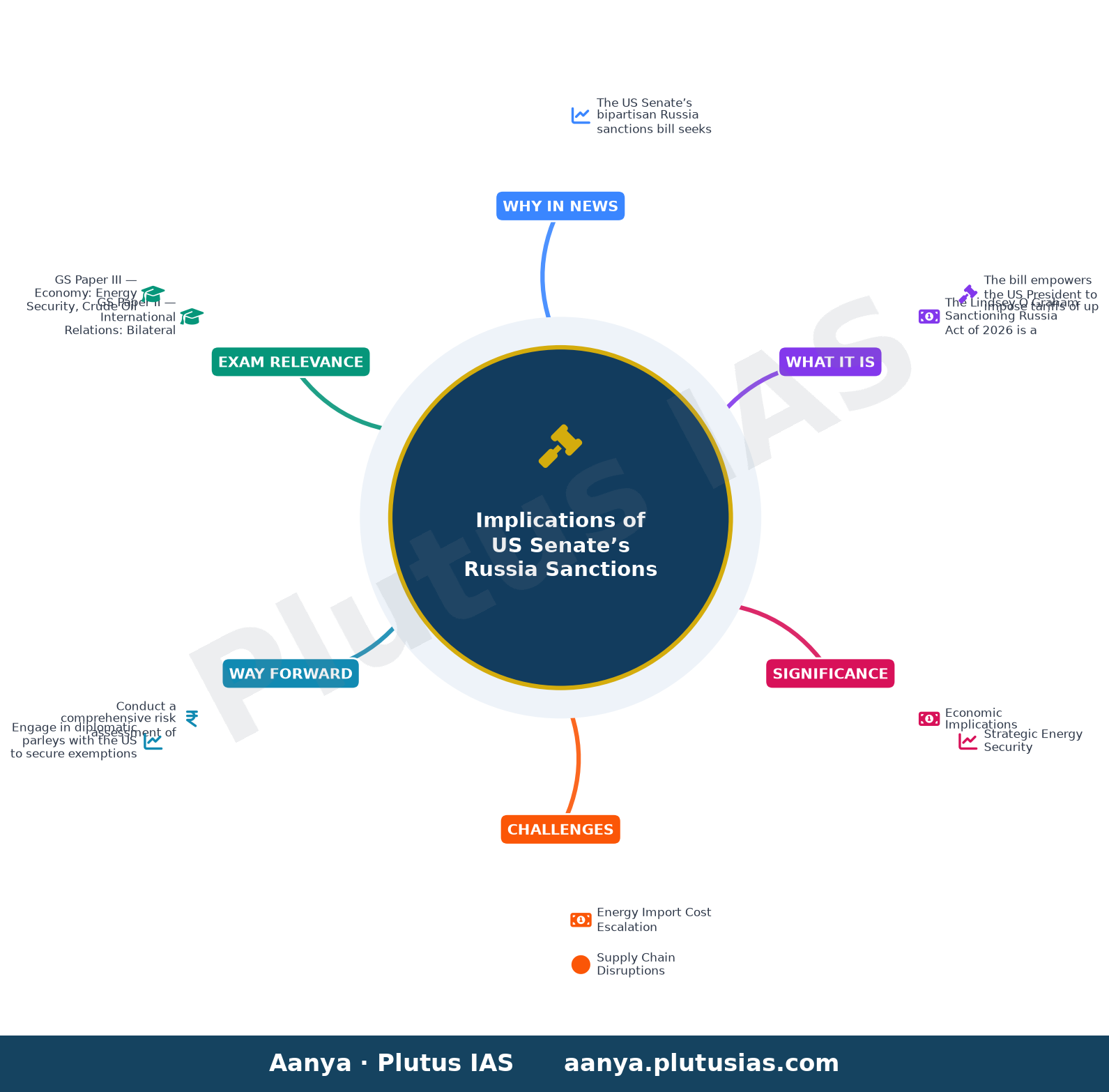
- GS Paper II — International Relations: Bilateral and Multilateral Agreements, Sanctions and their Impact | GS Paper III — Economy: Energy Security, Crude Oil Imports, Inflation, and Trade Policies
- Prelims: Lindsey-Graham Sanctioning Russia Act of 2026, Energy transition, Crude oil import dependency, Geopolitical risks in energy supply, Sanctions and their economic impact, US-India strategic energy partnership, OPEC+ dynamics, Price elasticity of oil demand
- Essay: Energy Security: A Critical Determinant of National Sovereignty in the 21st Century, The Geopolitics of Oil: Balancing Strategic Autonomy and Economic Stability
Quick Revision: The Lindsey O Graham Sanctioning Russia Act of 2026, if enacted, could disrupt global oil markets and jeopardise India’s energy security by imposing tariffs on major importers of Russian crude, thereby increasing import costs and supply risks.
Why is this in the news?
The US Senate’s bipartisan Russia sanctions bill seeks to impose tariffs of up to 100% on imports from countries identified as major purchasers of Russian oil and gas. This legislative move, currently awaiting further procedural steps, has raised concerns over potential disruptions in global crude supply chains, tighter oil markets, and heightened risks to India’s energy security, given its growing dependence on discounted Russian crude since 2022.
Background
- Russia’s invasion of Ukraine in February 2022 triggered a cascade of Western sanctions, including embargoes on Russian oil and gas exports to Europe, disrupting traditional supply chains and redirecting Russian crude towards Asian markets.
- India’s crude oil import portfolio has historically been diversified, with Middle Eastern suppliers such as Iraq, Saudi Arabia, and the UAE accounting for the majority of imports prior to 2022.
- Post-2022, India strategically capitalised on discounted Russian crude, with imports surging from less than 100,000 barrels per day (bpd) in 2021 to approximately 2.8 million bpd in July 2024, making Russia India’s largest crude supplier.
- The US Energy Information Administration (EIA) and independent analysts like Kpler highlight that India’s energy security is now critically linked to the stability and affordability of Russian crude supplies, despite geopolitical risks.
- Global oil markets remain structurally tight due to factors such as OPEC+ production cuts, geopolitical instability in the Middle East, and underinvestment in upstream capacities, amplifying the impact of supply-side disruptions.
- The US administration’s approach to sanctions implementation—including the potential for exemptions or waivers—will determine the bill’s actual impact on trade flows and energy markets.
What is the Lindsey O Graham Sanctioning Russia Act of 2026?
- The Lindsey O Graham Sanctioning Russia Act of 2026 is a bipartisan bill introduced in the US Senate to target countries that are among the world’s largest buyers of Russian oil and gas, aiming to curtail Moscow’s revenue from energy exports.
- The bill empowers the US President to impose tariffs of up to 100% on imports from these countries, thereby incentivising them to reduce or cease purchases of Russian energy.
- The legislation specifically targets the five largest purchasers of Russian oil and gas, though the exact countries are not explicitly named in the bill’s public text, leaving room for interpretation based on trade data.
- The bill is part of broader US efforts to isolate Russia economically following its invasion of Ukraine, aligning with previous sanctions regimes such as the CAATSA (Countering America’s Adversaries Through Sanctions Act).
- The bill must still pass the US House of Representatives and undergo further legislative and administrative scrutiny before it can take effect, introducing a degree of uncertainty regarding its final form and implementation timeline.
- Analysts note that the bill’s impact will depend on the US administration’s willingness to enforce tariffs strictly or grant exemptions, particularly in cases where supply disruptions could destabilise global energy markets.
- The bill reflects a shift in US policy from secondary sanctions targeting specific entities to broader economic measures aimed at altering the behaviour of entire nations, a strategy with potential geopolitical and economic repercussions.
Key Features
| Feature | Significance |
|---|---|
| US Senate Russia Sanctions Bill (Lindsey O Graham Sanctioning Russia Act of 2026) | Proposes up to 100% tariffs on countries purchasing Russian oil, targeting top 5 buyers to curb Moscow’s energy revenues. |
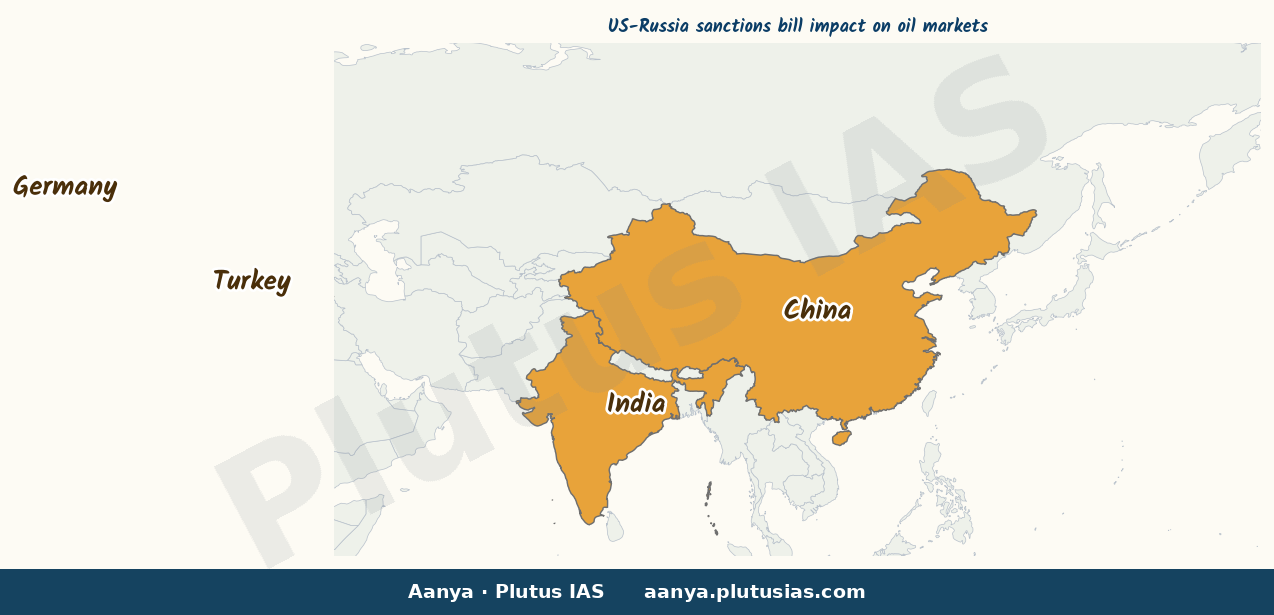
| Targeted Countries | Includes India, China, and other major importers of Russian crude, raising the risk of tariffs on Indian oil imports. |
| Legislative Hurdles | Bill must pass the US House of Representatives and undergo further administrative steps before implementation, delaying immediate impact. |
| Global Oil Market Tightness | Current tightness in crude markets, exacerbated by Middle Eastern supply uncertainties, heightens sensitivity to disruptions in Russian oil flows. |
| India’s Dependence on Russian Crude | Russian oil imports to India surged from 2.5% in 2021 to 39% in 2023, with July 2024 imports reaching a record 2.8 million barrels per day. |
Why it Matters
Economic Implications
- Potential rise in global crude prices due to supply disruptions, increasing India’s energy import bill and inflationary pressures.
- Risk of higher refining costs for Indian state-owned and private refiners, impacting profitability and fuel pricing.
- Possible tariffs on Indian crude imports under the bill could further escalate import costs, straining fiscal balances.
Strategic Energy Security
- India’s diversification of energy sources since 2022 has reduced reliance on Middle Eastern oil but increased dependence on Russian crude, creating geopolitical vulnerabilities.
- Disruptions in Russian oil supplies could force India to seek alternative sources at higher costs, compromising energy security.
- Long-term energy transition goals may be delayed if short-term supply risks dominate policy responses.
Geopolitical Considerations
- US-Russia tensions and sanctions framework could reshape global energy trade dynamics, with India caught between strategic autonomy and economic interests.
- Potential US-India friction over energy partnerships with Russia, testing bilateral relations amid broader strategic alignment.
Refinery Sector Impact
- Indian refiners, particularly those in Gujarat and Maharashtra, have invested in infrastructure to process Russian crude; supply disruptions could render these assets underutilized.
- State-owned refiners like HPCL and BPCL may face operational challenges in sourcing alternative crude grades, affecting output.
Challenges
1. Energy Import Cost Escalation
- Risk of higher crude prices due to supply tightness, directly impacting India’s trade deficit and current account deficit.
- Inflationary pressures on fuel and petrochemical products, disproportionately affecting low-income households.
UPSC Link: GS III: Indian Economy
2. Supply Chain Disruptions
- Potential delays or reductions in Russian crude shipments, forcing refiners to rely on spot markets at elevated prices.
- Logistical bottlenecks in rerouting imports from alternative sources, increasing transportation costs.
UPSC Link: GS III: Infrastructure
3. Geopolitical Balancing Act
- Need to navigate US sanctions while maintaining energy ties with Russia, a critical supplier for India’s energy security.
- Risk of alienating either the US or Russia, impacting broader diplomatic and economic engagements.
UPSC Link: GS II: International Relations
4. Refinery Asset Utilization
- Underutilization of refineries optimized for Russian crude, leading to financial losses and operational inefficiencies.
- Capital-intensive investments in desulfurization units and other infrastructure may face stranded asset risks.
UPSC Link: GS III: Industrial Policy
5. Policy Response Constraints
- Limited fiscal space to absorb higher import costs without compromising other developmental expenditures.
- Regulatory delays in approving alternative crude sourcing strategies or expanding domestic production.
UPSC Link: GS III: Government Budgeting
Challenges — UPSC Perspective
| Issue | Concern |
|---|---|
| Crude Price Volatility | Sudden spikes in global oil prices could destabilize India’s macroeconomic stability. |
| Refinery Margins | Narrowing or negative margins due to higher input costs and price controls on fuel. |
| Alternative Sourcing Costs | Higher premiums for non-Russian crude grades, particularly from West Africa or Latin America. |
| Strategic Reserves Management | Inadequate storage capacity to buffer against prolonged supply disruptions. |
| US-India Diplomatic Friction | Potential strain on bilateral ties if India resists US sanctions or seeks exemptions. |
| Domestic Production Lag | Insufficient growth in domestic crude production to offset import dependencies. |
Way Forward
- Conduct a comprehensive risk assessment of Russian crude supply disruptions and model alternative import scenarios for refiners.
- Engage in diplomatic parleys with the US to secure exemptions or waivers for Indian oil purchases, leveraging strategic partnership narratives.
- Accelerate diversification of import sources by expanding ties with Middle Eastern, African, and Latin American producers.
- Increase strategic petroleum reserves to buffer against short-term supply shocks, aligning with IEA guidelines.
- Subsidize or incentivize refiners to process alternative crude grades, mitigating asset underutilization risks.
- Enhance domestic exploration and production through policy reforms (e.g., Open Acreage Licensing Policy) to reduce import dependence.
- Strengthen bilateral energy dialogues with Russia to explore long-term supply agreements or barter mechanisms.
- Develop a national energy security roadmap integrating crude sourcing, refining capacity, and storage infrastructure.
UPSC Value Addition
Keywords for Mains Answer-Writing
US-Russia sanctions bill · energy security · crude oil imports · Russian crude · global oil markets · India’s energy policy · US Senate sanctions · tariffs on energy imports · geopolitical risks to energy · diversification of energy sources · strategic petroleum reserves · UPSC energy security syllabus
Concept Flow
US Senate sanctions bill targeting Russian oil buyers → Potential tariffs on Indian crude imports → Disruption risk in global crude markets → Tightening of oil supplies → Rise in crude prices → Increased import costs for India → Pressure on energy security and fiscal stability → Refinery sector underutilization → Geopolitical balancing challenges → Policy responses (diversification, diplomacy, reserves)
Prelims Practice Questions
Q1. Consider the following statements regarding India’s crude oil imports from Russia: 1. Russia was India’s largest crude supplier in 2023, accounting for about 39% of its crude imports. 2. India imported less than 100,000 barrels per day (bpd) of Russian crude in 2021. 3. The US Senate sanctions bill targets the five largest purchasers of Russian energy globally. 4. The sanctions bill imposes a mandatory 100% tariff on all imports from countries buying Russian oil. How many of the above statements are correct?
- Only one
- Only two
- Only three
- All four
Answer: Only three — Statements 1, 2, and 3 are correct. Statement 4 is incorrect as the bill grants the US President authority to impose tariffs up to 100%, not mandatorily 100% on all imports.
Q2. Assertion (A): The US Senate’s Russia sanctions bill aims to reduce Russia’s revenue from oil and gas sales by targeting major buyers. Reason (R): The bill imposes a 100% tariff on all imports from countries purchasing Russian energy, regardless of their volume or strategic importance.
- Both A and R are true, and R is the correct explanation of A
- Both A and R are true, but R is not the correct explanation of A
- A is true, but R is false
- A is false, but R is true
Answer: A is true, but R is false — Assertion (A) is true as the bill targets major buyers to cut Russia’s revenue. Reason (R) is false because the bill does not impose a blanket 100% tariff on all imports; it grants discretion to the US President to impose tariffs up to 100%.
Q3. Match the following columns: Column I lists energy sources and Column II lists their share in India’s crude oil imports in recent years. Column I: A. Russian crude oil; B. Saudi Arabian crude oil; C. Iraqi crude oil; D. US crude oil. Column II: 1. ~39% in 2023; 2. ~18%; 3. ~10%; 4. ~5%.
- A-1, B-2, C-3, D-4; A-2, B-1, C-4, D-3; A-3, B-4, C-1, D-2; A-4, B-3, C-2, D-1
- answer_string_array_indexed_answer_only
- explain_match_pairs_only
- format_match_the_following
- A-1, B-2, C-3, D-4
Answer: A-1, B-2, C-3, D-4; A-2, B-1, C-4, D-3; A-3, B-4, C-1, D-2; A-4, B-3, C-2, D-1 —
Mains Practice Question
✍ Critically examine the implications of the proposed US Senate sanctions bill targeting major buyers of Russian energy on India’s energy security and its strategic autonomy in the global oil market. (15 Marks)
Approach: MODEL-ANSWER SKELETON:
1. **Context and Provisions of the Bill**: Briefly outline the Lindsey O Graham Sanctioning Russia Act of 2026, including its targets (five largest purchasers of Russian energy) and the authority granted to the US President to impose tariffs up to 100% on imports from these countries.
2. **India’s Energy Dependence on Russia**: Provide data on India’s rising imports of Russian crude since 2022, including the shift from less than 100,000 bpd in 2021 to nearly 1.8 million bpd in 2023, making Russia India’s largest supplier (~39% of imports). Highlight the strategic rationale behind this shift, such as discounted prices post-Ukraine invasion and reduced European demand.
3. **Immediate and Long-Term Implications**:
– **Supply Disruptions**: Assess the risk of supply disruptions to India if the US imposes tariffs or sanctions, given the tight global oil markets and uncertainty in Middle Eastern supplies.
– **Cost Escalation**: Discuss the potential rise in crude import costs due to tighter markets and tariffs, impacting India’s fiscal balance and inflation.
– **Strategic Autonomy**: Evaluate the tension between India’s strategic autonomy (e.g., maintaining ties with Russia for geopolitical and economic reasons) and compliance with US sanctions.
4. **Diversification Efforts**: Examine India’s ongoing efforts to diversify its energy sources (e.g., increased imports from the US, Middle East, and Latin America) and the challenges in rapidly scaling alternative supplies.
5. **Geopolitical and Diplomatic Considerations**: Discuss the potential diplomatic fallout with the US and Russia, and how India might navigate these pressures while safeguarding its energy security.
6. **Policy Responses and Mitigation Strategies**: Suggest policy measures India could adopt, such as expanding strategic petroleum reserves, accelerating renewable energy adoption, or negotiating exemptions/waivers with the US.
7. **Conclusion**: Balance the risks and opportunities, emphasizing the need for a calibrated approach that prioritizes energy security without compromising strategic autonomy.
Source: Hindustan Times
Generated by AanyaAi for educational purpose.

- Gurugram’s groundwater extraction exceeds limit by 212%; HC seeks ban - October 4, 2026
- स्वतंत्रता सेनानी श्यामजी कृष्ण वर्मा की जन्म जयंती पर पीएम का श्रद्धांजलि - October 4, 2026
- KWML’s Feasibility Reports for Water Metro in 18 Cities: UPSC & PCS Insights - October 3, 2026

No Comments