


09 Aug How AI Can Transform India’s Healthcare System for UPSC Mains 2026
✎ AI in healthcare is a force multiplier for specialist capacity, not a replacement, and its success hinges on robust data infrastructure, predictable regulation, and equitable access.
Subject Relevance — Where This Topic Fits
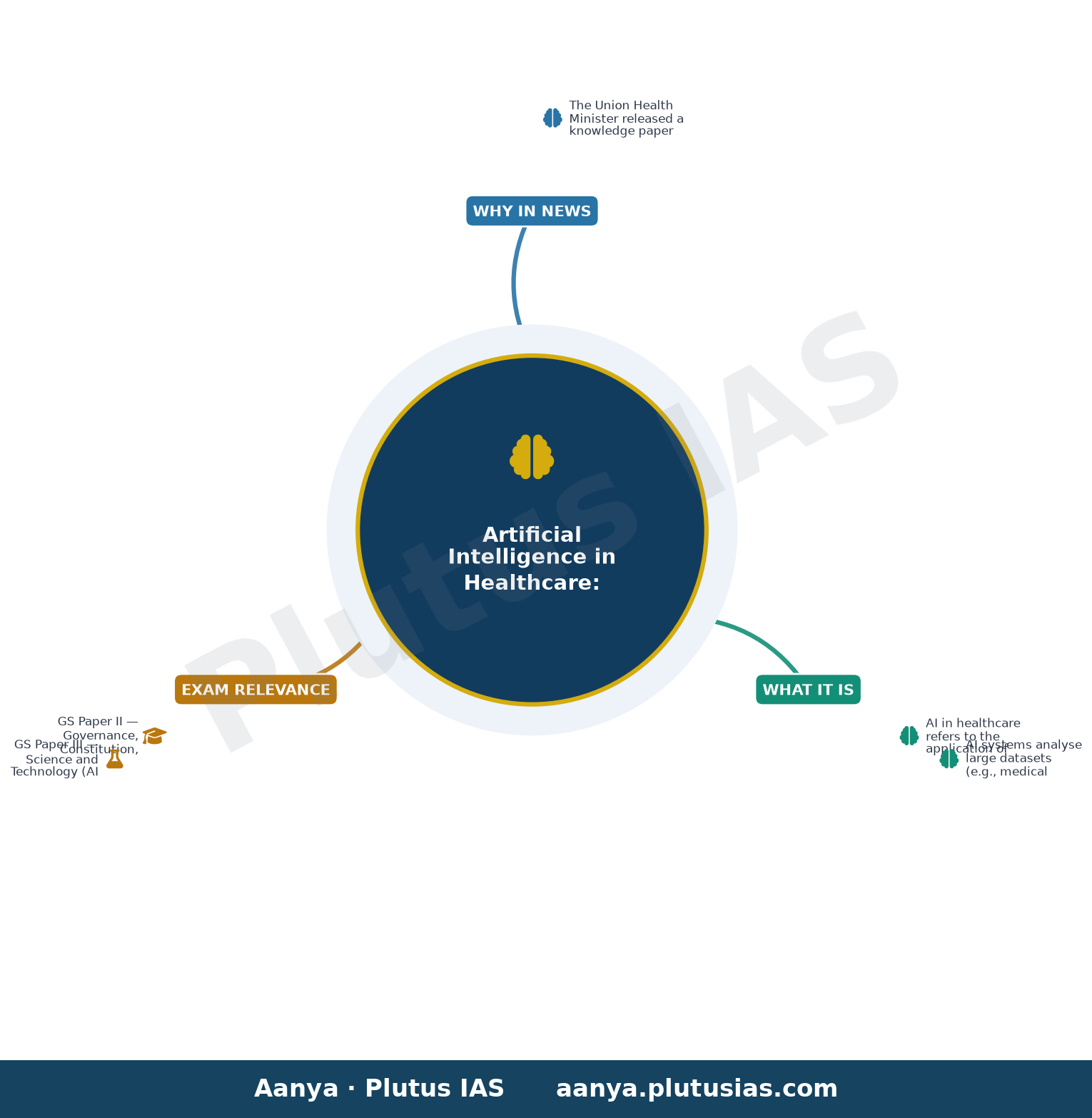
- GS Paper II — Governance, Constitution, Polity, Social Justice and International Relations (Health Sector Governance) | GS Paper III — Science and Technology (AI Applications in Healthcare, Digital Health Infrastructure)
- Prelims: Ayushman Bharat Digital Mission, National Medical Devices Policy 2023, Artificial Intelligence (AI) in healthcare, Non-communicable diseases (NCDs), Health workforce shortages, MRI scanner density, SAHI, BODH initiatives
- Essay: The Role of Technology in Addressing Societal Challenges: A Case Study of AI in Healthcare, Equity in Healthcare: Bridging the Urban-Rural Divide in India
Quick Revision: AI in healthcare is a force multiplier for specialist capacity, not a replacement, and its success hinges on robust data infrastructure, predictable regulation, and equitable access.
Why is this in the news?
The Union Health Minister released a knowledge paper titled ‘AI in MedTech: Revolutionizing Healthcare Through Artificial Intelligence’ at the 9th edition of India Medical Device 2026, highlighting AI’s potential to mitigate India’s healthcare challenges. The report underscores the urgency of leveraging AI to address structural gaps in India’s healthcare system, including doctor-patient ratios, NCD prevalence, and regional disparities in healthcare access.
Background
- India’s healthcare system faces systemic challenges, including a low doctor-patient ratio (9.6 doctors per 10,000 population against the global average of 18.3) and a high burden of non-communicable diseases (NCDs), which account for over 65% of deaths.
- The demographic shift towards an ageing population (projected to exceed 230 million by 2036) will further strain healthcare infrastructure, necessitating scalable solutions.
- Regional disparities persist, with urban areas having better access to healthcare facilities compared to rural and underserved regions, exacerbating health inequities.
- The National Medical Devices Policy 2023 has laid the groundwork for digital health integration, including AI adoption.
- The report emphasizes that AI is not a substitute for doctors but a tool to augment specialist capacity, particularly in primary and secondary healthcare settings.
- Regulatory and reimbursement mechanisms remain critical hurdles in transitioning AI from pilot projects to routine clinical use.
What is Artificial Intelligence (AI) in Healthcare?
- AI in healthcare refers to the application of machine learning, deep learning, and other AI technologies to improve diagnostic accuracy, clinical decision-making, and operational efficiency in medical settings.
- AI systems analyse large datasets (e.g., medical imaging, electronic health records) to identify patterns, predict disease risks, and recommend personalised treatment plans.
- Key applications include AI-enabled diagnostics (e.g., radiology, pathology), predictive analytics for chronic disease management, and virtual health assistants for patient triage.
- AI tools such as computer-aided detection (CAD) systems for mammography or deep learning models for retinal imaging are already deployed in select Indian hospitals.
- The technology aims to reduce human error, optimise resource allocation, and extend specialist expertise to remote and underserved areas where specialist doctors are scarce.
- AI-driven telemedicine platforms can facilitate real-time consultations, bridging the gap between patients and specialists in rural regions.
- Ethical considerations include data privacy, algorithmic bias, and the need for transparent AI decision-making to ensure patient trust and regulatory compliance.
- Global best practices highlight AI’s role in pandemic preparedness, drug discovery, and personalised medicine, though adoption in India remains in its nascent stages.
UPSC Value Addition
Keywords for Mains Answer-Writing
Artificial Intelligence in healthcare · Ayushman Bharat Digital Mission · IndiaAI Mission · National Medical Devices Policy 2023 · Healthcare workforce shortage · Non-communicable diseases (NCDs) burden · AI-enabled diagnostics · Healthcare accessibility in rural India · Regulatory framework for AI in healthcare · Health data governance
Prelims Practice Questions
Q1. Consider the following statements regarding the healthcare workforce in India as per the report released by the Union Health Minister:
1. India has 9.6 doctors per 10,000 population.
2. India has 27.2 nursing personnel per 10,000 population.
3. India has 15.9 hospital beds per 10,000 population.
How many of the above statements are correct?
- Only one
- Only two
- All
- None
Answer: All — Statements 1, 2, and 3 are all correct as per the report. The global averages for doctors, nursing personnel, and hospital beds per 10,000 population are higher than India’s figures.
Q2. Assertion (A): The Ayushman Bharat Digital Mission (ABDM) is a foundational initiative for integrating AI into India’s healthcare system.
Reason (R): ABDM aims to create a national digital health ecosystem by standardizing health records and enabling interoperability.
Options:
A. Both A and R are true, and R is the correct explanation of A.
B. Both A and R are true, but R is not the correct explanation of A.
C. A is true, but R is false.
D. A is false, but R is true.
Answer: ? — Both A and R are true, and R correctly explains A. ABDM provides the digital infrastructure necessary for AI applications in healthcare, such as standardized health data.
Q3. Match the following initiatives with their respective objectives:
Column I
1. Ayushman Bharat Digital Mission
2. IndiaAI Mission
3. National Medical Devices Policy, 2023
4. SAHI
Column II
A. Promoting AI research and development in healthcare
B. Creating a unified digital health infrastructure
C. Standardizing medical device manufacturing and innovation
D. Enhancing diagnostic accuracy through AI-enabled tools
Options:
1-B, 2-A, 3-C, 4-D
1-A, 2-B, 3-C, 4-D
1-C, 2-A, 3-B, 4-D
1-D, 2-B, 3-A, 4-C
- 1-B, 2-A, 3-C, 4-D
- 1-A, 2-B, 3-C, 4-D
- 1-C, 2-A, 3-B, 4-D
- 1-D, 2-B, 3-A, 4-C
Answer: 1-B, 2-A, 3-C, 4-D — 1-B (ABDM aims to create a unified digital health infrastructure), 2-A (IndiaAI Mission promotes AI research and development), 3-C (National Medical Devices Policy 2023 standardizes medical device manufacturing), 4-D (SAHI focuses on AI-enabled diagnostic tools).
Mains Practice Question
✍ Artificial Intelligence (AI) is poised to revolutionise healthcare delivery in India by addressing systemic gaps. Critically examine the potential of AI in bridging India’s healthcare divide, with reference to the existing infrastructure, regulatory challenges, and ethical considerations. (15 Marks)
Approach: MODEL-ANSWER SKELETON:
I. Introduction (2 marks): Define AI in healthcare and its relevance to India’s healthcare challenges (e.g., doctor-patient ratio, NCD burden, rural-urban divide). Cite data from the report (e.g., 9.6 doctors per 10,000 population, 65% deaths due to NCDs).
II. AI’s Role in Bridging Healthcare Gaps (4 marks):
– Extending specialist expertise: AI-enabled diagnostics (e.g., radiology, pathology) to primary/secondary care.
– Improving productivity: Automating routine tasks (e.g., triage, record-keeping).
– Expanding access: Telemedicine and mobile health (mHealth) applications in underserved areas.
– Cite initiatives: ABDM, IndiaAI Mission, SAHI, BODH, and National Medical Devices Policy 2023.
III. Challenges and Limitations (5 marks):
– Infrastructure: Limited digital literacy, unreliable internet in rural areas.
– Regulatory: Lack of a predictable AI-specific regulatory framework and reimbursement mechanisms.
– Ethical: Data privacy (e.g., DPDP Act 2023), algorithmic bias, accountability in AI-driven decisions.
– Workforce resistance: Fear of job displacement among healthcare professionals.
IV. Way Forward (4 marks):
– Strengthen health data governance: Standardise EHRs, ensure interoperability.
– Develop ethical guidelines: Align with global best practices (e.g., WHO AI ethics guidelines).
– Invest in capacity building: Training healthcare workers in AI tools.
– Public-private partnerships: Leverage private sector expertise while ensuring equitable access.
Balance of views: Acknowledge AI’s transformative potential while highlighting the need for robust safeguards to prevent misuse and ensure inclusivity.
Source: Times of India
Generated by AanyaAi for educational purpose.

- UPSC Civil Services (Main) Examination 2026 — Mechanical Engineering Optional Paper I: Question Paper | Plutus IAS - September 24, 2026
- सुप्रीम कोर्ट ने टीएमसी नाम और चुनाव चिह्न विवाद पर चुनाव आयोग से समयसीमा मांगी, 28 सितंबर को सुनवाई - September 24, 2026
- UPSC Civil Services (Main) Examination 2026 — Chemistry Optional Paper I: Questions with Model Answers | Plutus IAS - September 24, 2026

No Comments