


09 Aug India’s First Privately Built 800 kN FFSC Engine: Key for UPSC Mains 2026
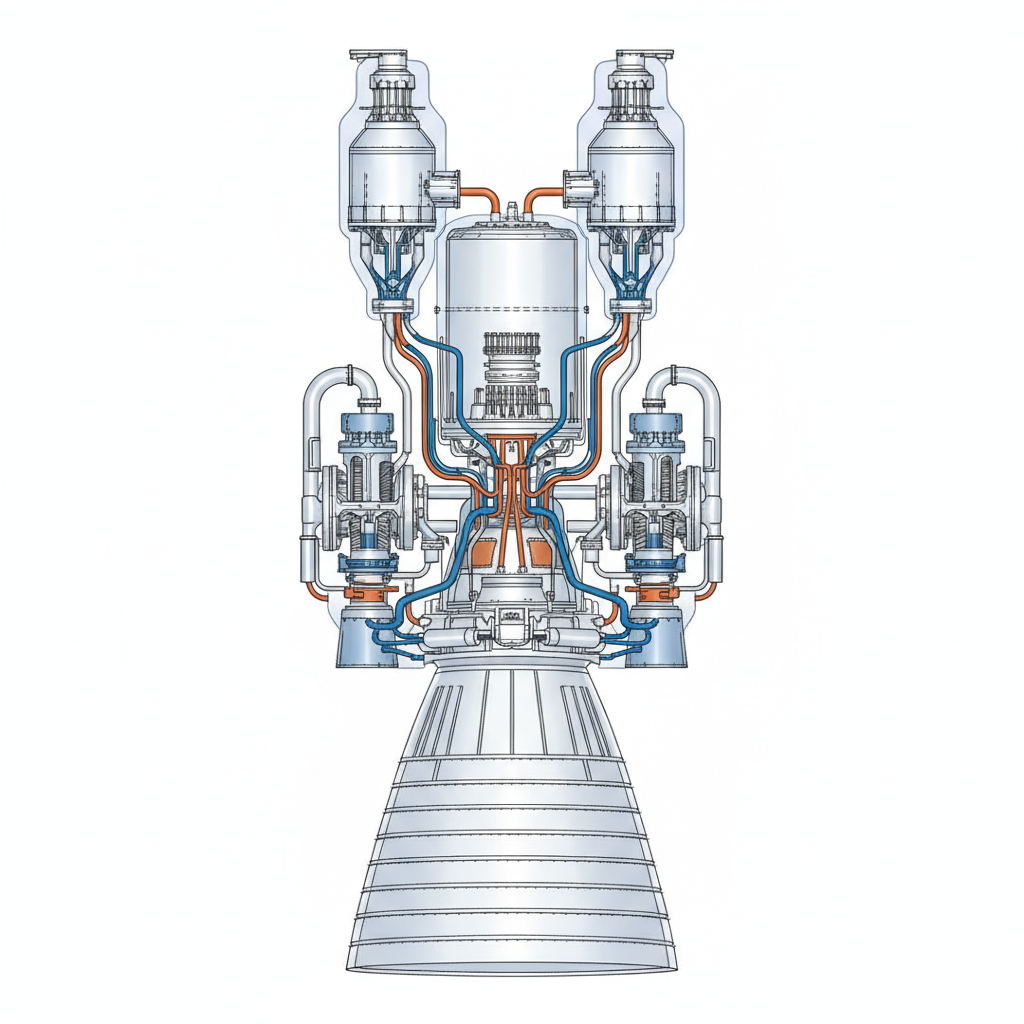
FFSC engineLOX-Methane fuelStaged combustion chamber✎ An FFSC LOX-Methane rocket engine routes all propellants through pre-burners before main combustion, achieving near-total efficiency and enabling reusable, high-performance launch systems.
Subject Relevance — Where This Topic Fits
- GS Paper III — Science and Technology (Developments and their Applications and Effects in Everyday Life) | GS Paper III — Awareness in the fields of Space
- Prelims: Full-Flow Staged Combustion (FFSC) cycle, LOX-Methane propellants, Astrobase Space Technologies, 800 kN thrust class, Reusable launch systems, Liquid rocket engine architectures, Turbopump systems, Privatisation of space sector in India
- Essay: Technological self-reliance in critical aerospace technologies, The role of private enterprise in advancing India’s space ambitions
Quick Revision: An FFSC LOX-Methane rocket engine routes all propellants through pre-burners before main combustion, achieving near-total efficiency and enabling reusable, high-performance launch systems.
Why is this in the news?
On 7 August 2026, Bengaluru-based Astrobase Space Technologies unveiled ‘EVEREST’, India’s first privately developed 800 kN Full-Flow Staged Combustion (FFSC) LOX-Methane rocket engine. This milestone positions India as the fourth nation globally—after Russia, the United States, and China—to achieve FFSC engine technology, underscoring the strategic importance of indigenous innovation in high-thrust propulsion systems for future reusable launch vehicles and heavy-lift capabilities.
Background
- The global space sector is transitioning from government-led programmes to a hybrid model integrating public-private partnerships and fully private enterprises, with India’s space policy reforms (2020) enabling non-governmental entities to engage in end-to-end space activities including launch vehicle development.
- FFSC engines represent the pinnacle of liquid propulsion technology, offering superior efficiency, reusability, and precise throttle control compared to conventional gas-generator or staged-combustion cycles, making them critical for next-generation launch systems.
- Prior to EVEREST, India’s space programme relied primarily on government-led entities such as ISRO, with limited private sector involvement in core propulsion technologies, despite advancements in satellite manufacturing and launch services.
- The development of LOX-Methane engines aligns with global trends prioritising methane as a propellant due to its higher specific impulse, cleaner combustion, and potential for in-situ resource utilisation on Mars or the Moon.
- India’s space sector has witnessed a surge in private participation, with over 150 startups registered under IN-SPACe (Indian National Space Promotion and Authorisation Centre), reflecting a policy-driven shift towards fostering innovation in space technology.
- The successful development of EVEREST demonstrates India’s capability to indigenously design, develop, and manufacture high-thrust liquid rocket engines, a domain historically dominated by a handful of nations.
What is a Full-Flow Staged Combustion (FFSC) LOX-Methane Rocket Engine?
- An FFSC engine is a liquid rocket propulsion system where both fuel (methane) and oxidiser (liquid oxygen) are fully combusted in separate pre-burners before entering the main combustion chamber, enabling near-total utilisation of propellants for thrust generation.
- The staged combustion cycle involves two distinct combustion stages: the fuel-rich pre-burner and the oxidiser-rich pre-burner, which drive the turbopumps that pressurise the propellants for injection into the main chamber.
- Unlike conventional engines where only a fraction of propellants powers the turbopumps, FFSC engines route all propellants through the pre-burners, ensuring maximum thermodynamic efficiency and reducing waste heat and exhaust losses.
- The LOX-Methane propellant combination offers a higher specific impulse (efficiency) compared to traditional kerosene-based systems, alongside cleaner combustion with reduced soot formation, simplifying engine refurbishment and reuse.
- FFSC engines are inherently suited for reusable launch systems due to their ability to operate at high chamber pressures with precise throttle control, enabling multiple firings and rapid turnaround between missions.
- The 800 kN thrust class of EVEREST places it in the heavy-lift category, comparable to engines powering mid-to-heavy payload launch vehicles such as SpaceX’s Raptor or Blue Origin’s BE-4, though with distinct thermodynamic advantages.
- The development of FFSC engines represents a technological leap, as the cycle demands advanced materials, precision manufacturing, and robust thermal management to handle extreme pressures and temperatures exceeding 3,000°C in the combustion chamber.
Key Features
| Feature | Significance |
|---|---|
| Full-Flow Staged Combustion (FFSC) Cycle | Ensures 100% utilisation of propellants by routing both fuel and oxidiser through pre-burners before main combustion, eliminating waste and enhancing efficiency. |
| 800 kN Thrust Capacity | Provides sufficient thrust for heavy-lift launch vehicles, enabling payload delivery to geosynchronous orbits and interplanetary missions. |
| LOX-Methane Propellants | Offers cleaner combustion compared to traditional hypergolic propellants, reducing engine refurbishment complexity and supporting rapid mission turnaround. |
| Reusability Compatibility | Designed for high thermal and structural resilience, making it suitable for reusable launch systems with minimal refurbishment downtime. |
| Private Sector Development | Demonstrates indigenous capability in advanced propulsion systems, reducing dependence on foreign technology for critical space missions. |
Why it Matters
Technological Sovereignty
- India becomes the fourth nation globally to develop FFSC engine technology, joining Russia, USA, and China, thereby enhancing strategic autonomy in space propulsion.
- Reduces reliance on foreign propulsion systems for critical missions, including crewed spaceflight and deep-space exploration.
- Establishes a foundation for India’s private space sector to compete in the global launch market with high-performance, reusable launch vehicles.
Economic Implications
- Lowers the cost of access to space by enabling reusable launch systems, which can reduce per-mission expenses by up to 30-50% compared to expendable systems.
- Attracts foreign and domestic investment in India’s space sector, fostering innovation and job creation in high-technology industries.
- Supports the growth of India’s commercial space economy, including satellite deployment, space tourism, and in-situ resource utilisation missions.
Strategic Advantages
- Enhances India’s position in the global space race by demonstrating indigenous capability in cutting-edge propulsion technology.
- Strengthens India’s bargaining power in international collaborations, such as Artemis Accords or joint lunar missions, by offering proven propulsion solutions.
- Provides a technological edge for India’s defence space programmes, including satellite-based surveillance and secure communications.
Scientific and Exploration Potential
- Enables the development of heavy-lift launch vehicles capable of carrying larger payloads to low Earth orbit, geosynchronous orbit, and beyond.
- Supports future missions to the Moon, Mars, and other celestial bodies by providing a high-efficiency, reusable propulsion system.
- Facilitates the deployment of large-scale space infrastructure, such as space stations or lunar habitats, with reduced logistical constraints.
Challenges
1. Technological Complexity
- FFSC engines require precise control over combustion dynamics, material science, and thermal management, posing significant engineering challenges.
- The integration of pre-burners, turbopumps, and combustion chambers demands advanced computational modelling and high-precision manufacturing.
- Failure modes in FFSC engines can lead to catastrophic events, necessitating rigorous testing and validation protocols.
UPSC Link: Science and Technology > Space Technology
2. Regulatory and Policy Hurdles
- The private sector’s role in developing critical space technologies requires a robust regulatory framework to ensure safety, security, and international compliance.
- Intellectual property protection and technology transfer agreements must be carefully structured to balance innovation with national security concerns.
- Streamlining approval processes for private space ventures while maintaining oversight over launch safety and environmental impact.
UPSC Link: Governance > Regulatory Frameworks
3. Infrastructure and Human Capital
- Developing and testing FFSC engines requires state-of-the-art test facilities, including high-altitude test stands and cryogenic propellant handling systems.
- India faces a shortage of skilled engineers and scientists specialising in advanced propulsion systems, necessitating targeted educational and training programmes.
- Collaboration between ISRO, academia, and private industry is essential to bridge the knowledge gap and accelerate technology development.
UPSC Link: Human Resource Development > Skill Gaps
4. Economic Viability
- The high initial investment required for R&D, testing, and infrastructure may deter private investors without clear revenue models or government incentives.
- Competition from established global players, such as SpaceX and Blue Origin, poses a challenge to market penetration and profitability.
- Ensuring cost-competitiveness while maintaining high performance and reliability remains a critical concern for commercial viability.
UPSC Link: Economy > Private Sector Participation
5. International Collaboration and Competition
- Navigating geopolitical sensitivities in space technology transfer, particularly with allied nations and adversarial states, requires delicate diplomacy.
- Avoiding duplication of efforts with global partners while leveraging international best practices to accelerate indigenous development.
- Ensuring compliance with international treaties, such as the Outer Space Treaty, while protecting proprietary technologies.
UPSC Link: International Relations > Space Diplomacy
Challenges — UPSC Perspective
| Issue | Concern |
|---|---|
| Thermal Management | High combustion temperatures (2,000–3,000°C) require advanced cooling techniques to prevent engine degradation. |
| Material Science | Development of lightweight, high-strength materials to withstand extreme thermal and mechanical stresses. |
| Precision Engineering | Tight tolerances in turbopump and pre-burner components to ensure stable combustion and avoid instability. |
| Testing Infrastructure | Limited domestic facilities for high-altitude and vacuum testing of FFSC engines. |
| Regulatory Gaps | Absence of clear guidelines for private sector involvement in critical space technologies. |
| Skilled Workforce | Shortage of engineers with expertise in staged combustion cycles and cryogenic propulsion systems. |
Way Forward
- Establish dedicated R&D centres for advanced propulsion systems, in partnership with ISRO, DRDO, and leading academic institutions.
- Develop a national test facility for high-thrust cryogenic engines, including high-altitude and vacuum test stands.
- Formulate a clear policy framework for private sector participation in space technology, with incentives for R&D and commercialisation.
- Launch targeted skill development programmes in aerospace engineering, focusing on propulsion systems and materials science.
- Encourage public-private partnerships to co-develop reusable launch vehicles, leveraging India’s cost advantages in space missions.
- Strengthen international collaborations in space propulsion, while safeguarding critical technologies and intellectual property.
- Invest in computational tools and simulation software to accelerate the design and validation of FFSC engines.
- Promote awareness campaigns to highlight the strategic and economic benefits of indigenous propulsion technology.
UPSC Value Addition
Keywords for Mains Answer-Writing
Full-Flow Staged Combustion (FFSC) rocket engines · Astrobase Space Technologies · EVEREST engine · 800 kN LOX-Methane rocket engine · private sector participation in space technology · reusable launch vehicles · ISRO and private sector collaboration · space propulsion technology · LOX-Methane propellants · India’s space capabilities · staged combustion cycle · turbopump efficiency · global space technology leaders · space launch vehicle architecture
Concept Flow
Private sector-led R&D in propulsion technology (Astrobase) -> Development of FFSC engine (EVEREST) -> Demonstration of 800 kN thrust capacity -> Achievement of technological sovereignty -> Reduction in dependence on foreign propulsion systems → High-efficiency FFSC cycle -> Cleaner LOX-Methane combustion -> Lower refurbishment costs -> Enhanced reusability -> Cost-effective access to space → Advanced propulsion system -> Heavy-lift launch capability -> Larger payloads to orbit -> Support for deep-space missions -> Strengthened space exploration agenda → Indigenous technology development -> Attraction of private investment -> Growth of commercial space sector -> Job creation in high-tech industries -> Economic diversification → Strategic autonomy in space -> Enhanced bargaining power in international collaborations -> Participation in Artemis Accords -> Joint lunar missions -> Global space leadership
Prelims Practice Questions
Q1. Consider the following statements regarding Full-Flow Staged Combustion (FFSC) rocket engines:
1. FFSC engines route both fuel and oxidiser through separate pre-burners before entering the main combustion chamber.
2. FFSC engines are less efficient than conventional rocket engines in terms of propellant utilisation.
3. FFSC engines are well-suited for reusable launch systems.
4. The EVEREST engine developed by Astrobase Space Technologies is a 800 kN LOX-Methane FFSC engine.
How many of the above statements are correct?
- Only one
- Only two
- Only three
- All four
Answer: All four — Statements 1, 3, and 4 are correct. Statement 2 is incorrect as FFSC engines are more efficient than conventional engines in propellant utilisation due to their architecture.
Q2. Assertion (A): The Full-Flow Staged Combustion (FFSC) cycle is significantly more complex to design and develop than conventional engine cycles.
Reason (R): FFSC engines require the routing of both fuel and oxidiser through separate pre-burners, which increases the system’s complexity.
Options:
A. Both A and R are true, and R is the correct explanation of A.
B. Both A and R are true, but R is not the correct explanation of A.
C. A is true, but R is false.
D. A is false, but R is true.
Answer: ? — Both Assertion (A) and Reason (R) are true, and R correctly explains A. The complexity arises from the need to manage separate pre-burners for fuel and oxidiser.
Q3. Match the following rocket engine technologies with their respective characteristics:
Column I (Engine Technology) | Column II (Characteristic)
————————————————–|———————————————
1. Full-Flow Staged Combustion (FFSC) | A. Uses only a portion of propellants for turbopumps
2. Conventional Rocket Engines | B. Routes both fuel and oxidiser through pre-burners
3. Gas-Generator Cycle | C. Propellants are burnt in a single stage
4. Expander Cycle | D. Uses heat from combustion to drive turbines
Options:
A. 1-B, 2-A, 3-D, 4-C
B. 1-B, 2-A, 3-C, 4-D
C. 1-A, 2-B, 3-D, 4-C
D. 1-D, 2-C, 3-A, 4-B
Answer: ? — Correct matches: 1-B (FFSC routes both fuel and oxidiser through pre-burners), 2-A (Conventional engines use only a portion of propellants for turbopumps), 3-D (Gas-Generator Cycle uses heat from combustion to drive turbines), 4-C (Expander Cycle burns propellants in a single stage).
Mains Practice Question
✍ The development of India’s first privately built 800 kN Full-Flow Staged Combustion (FFSC) LOX-Methane rocket engine, EVEREST, marks a paradigm shift in the country’s space launch capabilities. Critically examine the technological, strategic, and economic significance of FFSC engines in the context of India’s space ambitions. Also, analyse the challenges associated with their development and deployment. (15 Marks)
Approach: Technological Significance (6 marks): Define FFSC engines and their architecture. Explain the advantages over conventional engines, including high propulsion efficiency, precise throttle control, and suitability for reusable launch systems. Highlight the use of LOX-Methane propellants for cleaner combustion and easier refurbishment. Strategic Significance (4 marks): Discuss how FFSC engines enhance India’s indigenous launch capability and reduce dependence on foreign technologies. Explain their role in supporting reusable launch vehicles and India’s long-term access to space. Mention India’s position as the fourth nation globally to achieve this technology. Economic Significance (3 marks): Analyse the economic benefits of private sector participation in space technology, including cost reduction, innovation, and job creation. Discuss how such advancements can attract investment and foster a competitive space industry in India. Challenges (2 marks): Outline the key challenges in developing FFSC engines, such as high complexity in design, stringent material requirements, and the need for advanced manufacturing capabilities. Briefly mention the role of collaboration with institutions like ISRO in overcoming these challenges.
Source: The Hindu
Generated by AanyaAi for educational purpose.

- भारत का पहला निजी FFSC रॉकेट इंजन: जानिए क्यों है महत्वपूर्ण? - August 9, 2026
- India’s First Privately Built 800 kN FFSC Engine: Key for UPSC Mains 2026 - August 9, 2026
- AI से भारत के स्वास्थ्य सेवा अंतर को कैसे पाट सकता है? जानें पूरी रिपोर्ट - August 9, 2026

No Comments