


09 Aug US sanctions bill on Russia: Threat to India’s energy security & oil markets
✎ The Lindsey O Graham Sanctioning Russia Act of 2026 empowers the US President to impose 100% tariffs on major buyers of Russian oil, posing a direct threat to India’s energy security by risking supply disruptions and higher crude…
Subject Relevance — Where This Topic Fits
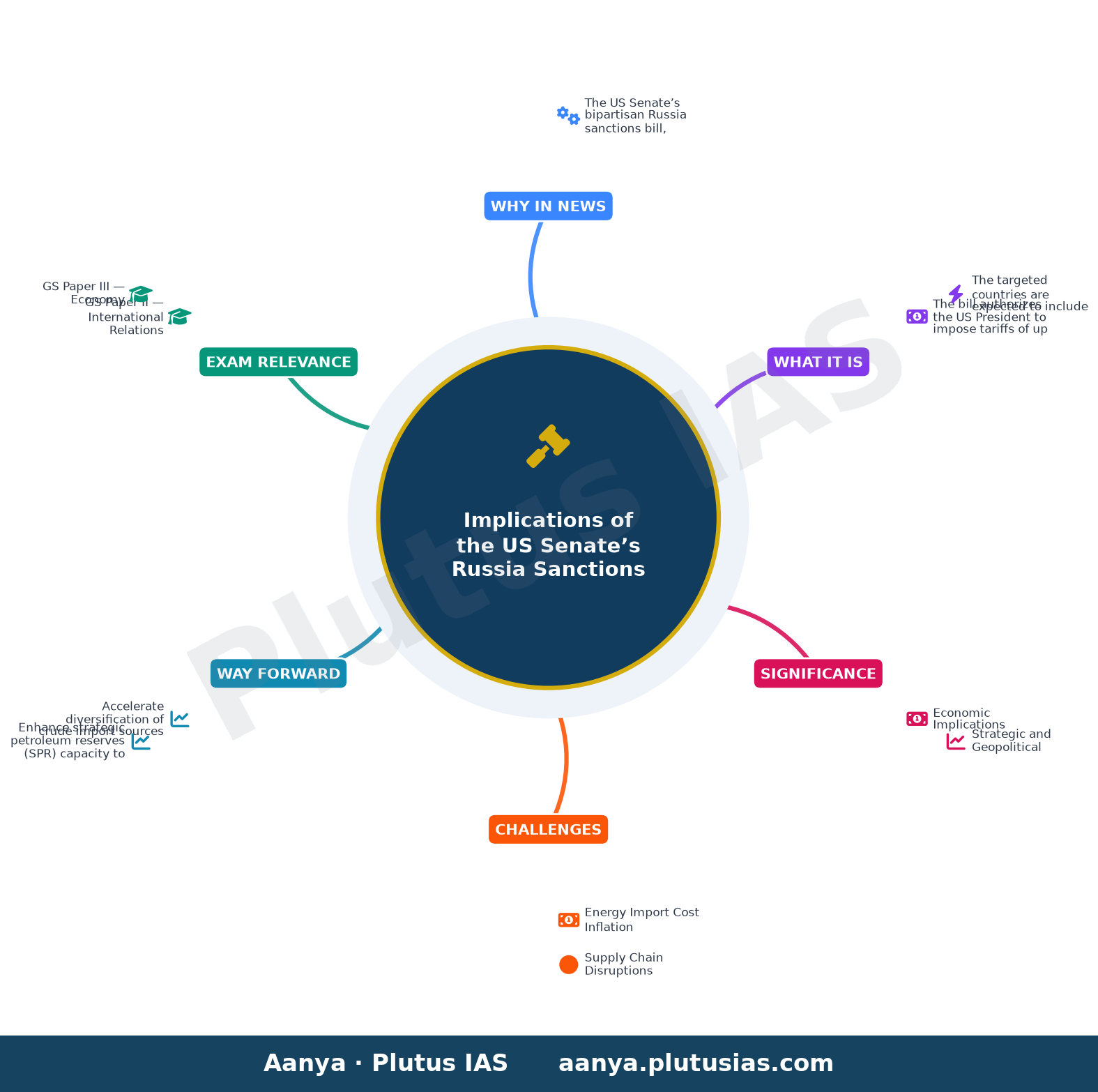
- GS Paper II — International Relations | GS Paper III — Economy
- Prelims: Primary energy mix of India, Crude oil import dependence, US-India strategic energy partnership, Sanctions under UNSC, Geopolitical risks in energy supply chains
- Essay: Energy security as a cornerstone of national sovereignty, The dilemma of strategic autonomy in foreign policy
Quick Revision: The Lindsey O Graham Sanctioning Russia Act of 2026 empowers the US President to impose 100% tariffs on major buyers of Russian oil, posing a direct threat to India’s energy security by risking supply disruptions and higher crude import costs.
Why is this in the news?
The US Senate’s bipartisan Russia sanctions bill, titled the ‘Lindsey O Graham Sanctioning Russia Act of 2026,’ proposes tariffs of up to 100% on imports from countries identified as major purchasers of Russian oil and gas. This development is significant for India, which has become increasingly dependent on discounted Russian crude since the Ukraine conflict, with Russian oil now accounting for nearly 40% of India’s total crude imports. The bill’s potential to disrupt global oil markets and impose tariffs on India underscores the geopolitical and economic risks to India’s energy security.
Background
- The Ukraine conflict, which began in February 2022, triggered a wave of Western sanctions against Russia, including restrictions on Russian oil and gas exports to Europe.
- In response, Russia redirected its crude exports to Asian markets, particularly India and China, offering significant discounts to offset the loss of European buyers.
- The US has historically used sanctions as a tool of foreign policy, including under the Countering America’s Adversaries Through Sanctions Act (CAATSA) and the Iran Sanctions Act.
- Global oil markets remain tight due to geopolitical uncertainties, including instability in the Middle East and OPEC+ production cuts, which heighten the sensitivity of supply disruptions.
- India’s energy security is contingent on diversified import sources, strategic petroleum reserves, and long-term supply agreements to mitigate geopolitical risks.
What is the Lindsey O Graham Sanctioning Russia Act of 2026?
- The bill authorizes the US President to impose tariffs of up to 100% on imports from countries identified as the five largest purchasers of Russian oil and gas, aiming to reduce Moscow’s revenue from energy exports.
- The targeted countries are expected to include India, China, Turkey, and possibly others, based on their volume of Russian energy imports.
- The bill is part of a broader US strategy to isolate Russia economically and reduce its capacity to fund the war in Ukraine, aligning with existing sanctions regimes.
- The legislation must still pass the US House of Representatives and undergo further administrative review before implementation, leaving room for exemptions or waivers.
- The bill reflects the US’s evolving approach to sanctions, which now extend beyond direct adversaries to secondary sanctions targeting third-country buyers of sanctioned goods.
- The proposed measures could disrupt global oil trade flows, particularly if the US administration enforces them aggressively, potentially tightening oil markets and raising prices.
- The bill’s timing is critical, as global oil markets are already tight, and disruptions in Russian supply could exacerbate price volatility and supply insecurity.
- The bill underscores the tension between US strategic objectives and the energy security imperatives of importing nations like India, which rely on discounted Russian crude.
Key Features
| Feature | Significance |
|---|---|
| US Senate sanctions bill targeting Russian energy buyers | Proposes tariffs up to 100% on major importers of Russian oil and gas, aiming to curtail Moscow’s revenue from energy exports. |
| Lindsey O Graham Sanctioning Russia Act of 2026 | Bipartisan legislation targeting the top five purchasers of Russian energy, including India and China, to reduce Russia’s geopolitical leverage. |
| Potential 100% tariffs on Indian crude imports from Russia | Could significantly increase India’s energy import costs, disrupting its energy security and refining margins. |
| Global oil market tightening due to supply constraints | Reduction in Russian crude availability may exacerbate existing tightness, raising global crude prices and impacting net importers like India. |
| India’s reliance on discounted Russian crude post-2022 | Russia became India’s largest crude supplier (39% in 2023) due to Western sanctions and European buyer withdrawal, offering price advantages. |
Why it Matters
Economic Implications
- Potential surge in India’s crude import costs due to higher tariffs on Russian oil, directly impacting fiscal deficit and inflation dynamics.
- Refining margins of Indian PSUs (e.g., IOCL, HPCL) may compress if global crude prices rise without corresponding increases in product prices.
- Risk of supply chain disruptions if Russian crude flows are redirected or restricted, affecting downstream industries like petrochemicals and fertilizers.
Strategic and Geopolitical
- India’s energy diplomacy may face strain as it balances relations with the US (a key strategic partner) and Russia (a long-standing defense and energy partner).
- Increased dependence on Middle Eastern crude (e.g., Saudi Arabia, UAE) could heighten exposure to regional geopolitical risks in West Asia.
- Potential erosion of India’s strategic autonomy in energy procurement if tariffs force a shift away from cost-effective Russian supplies.
Energy Security
- India’s energy security is contingent on diversified supply sources; over-reliance on Russian crude (2.8 million bpd in July 2024) poses vulnerability to external shocks.
- Tight global oil markets, exacerbated by sanctions, may limit India’s ability to secure affordable crude, impacting long-term energy planning.
- Accelerated transition to renewables and domestic refining capacity (e.g., 2030 target of 200 MMT) becomes critical to mitigate import risks.
Policy and Regulatory
- The US administration’s discretion in implementing tariffs (exemptions/waivers) introduces uncertainty in India’s energy procurement strategy.
- India may need to expedite negotiations for long-term supply agreements with alternative sources (e.g., Latin America, Africa) to reduce exposure.
- Domestic policies like the Strategic Petroleum Reserves (SPR) expansion gain urgency to buffer against supply disruptions.
Challenges
1. Energy Import Cost Inflation
- Direct correlation between tariffs on Russian crude and India’s crude import bill, potentially widening the trade deficit.
- Risk of imported inflation, particularly if global crude prices rise beyond $90-100/bbl due to supply constraints.
- Impact on fiscal deficit if subsidies on petroleum products are not rationalized, straining public finances.
UPSC Link: GS III: Indian Economy – Inflation and Balance of Payments
2. Supply Chain Disruptions
- Redirection of Russian crude flows away from India could disrupt refining operations, particularly for complex refineries optimized for Russian grades.
- Potential delays in crude shipments due to rerouting or sanctions compliance, affecting inventory management.
- Increased freight costs if Indian refiners are forced to source from distant markets (e.g., Latin America).
UPSC Link: GS III: Infrastructure – Energy Security
3. Strategic Autonomy vs. Alliances
- Balancing the US’s Indo-Pacific strategy with Russia’s role as a defense partner (e.g., S-400 systems) creates diplomatic tightropes.
- Risk of secondary sanctions if India continues importing Russian crude despite US tariffs, complicating foreign policy maneuverability.
- Potential strain on India’s multi-alignment policy, forcing a recalibration of strategic partnerships.
UPSC Link: GS II: International Relations – Bilateral Groupings
4. Domestic Refinery Margins
- Indian refiners (e.g., Reliance, Nayara Energy) benefit from discounted Russian crude; tariffs could erode their competitive edge in export markets.
- Pressure on public sector refiners (IOCL, HPCL) to maintain profitability amid rising input costs.
- Risk of underutilized refining capacity if crude supply disruptions reduce throughput.
UPSC Link: GS III: Industries – Petrochemicals
5. Geopolitical Risks in West Asia
- Increased reliance on Middle Eastern crude exposes India to regional conflicts (e.g., Israel-Hamas, Yemen) and supply disruptions.
- Potential for OPEC+ production cuts to exacerbate global oil price volatility, impacting India’s energy security.
- Risk of cartelization in global oil markets if Russian crude is sidelined, reducing buyer’s leverage.
UPSC Link: GS II: International Relations – West Asia
Challenges — UPSC Perspective
| Issue | Concern |
|---|---|
| Rising crude import costs | Direct impact on India’s fiscal deficit, inflation, and trade balance due to higher energy prices. |
| Supply disruptions from Russian crude | Risk of refining capacity underutilization and inventory shortages, particularly for complex refineries. |
| Diplomatic strain with the US | Potential secondary sanctions or erosion of strategic autonomy in energy procurement. |
| Over-reliance on Middle Eastern crude | Exposure to West Asian geopolitical risks and OPEC+ production decisions. |
| Compression of refinery margins | Reduced competitiveness of Indian refiners in export markets and pressure on public sector units. |
| Policy uncertainty in US implementation | Lack of clarity on exemptions/waivers complicates India’s long-term energy planning. |
Way Forward
- Accelerate diversification of crude import sources beyond Russia and the Middle East (e.g., Latin America, Africa, North America) to reduce exposure.
- Enhance strategic petroleum reserves (SPR) capacity to 20-25 days of consumption, with a focus on coastal storage for quick deployment.
- Negotiate long-term supply agreements with alternative producers (e.g., Guyana, Brazil, Canada) to secure stable and affordable crude flows.
- Invest in domestic refining capacity expansion and upgradation to process heavier crude grades, reducing import dependency.
- Rationalize petroleum subsidies and introduce dynamic pricing mechanisms to insulate consumers from global price volatility.
- Strengthen energy diplomacy with the US to seek exemptions or waivers for Russian crude imports, while exploring alternative energy partnerships.
- Fast-track renewable energy integration (e.g., solar, wind) and biofuels to reduce crude import dependence over the medium term.
- Enhance bilateral energy cooperation with Russia to secure discounted supplies through barter arrangements or rupee-denominated trade.
UPSC Value Addition
Keywords for Mains Answer-Writing
US Russia sanctions bill · Russian oil imports · India energy security · US Senate Lindsey O Graham Sanctioning Russia Act 2026 · Global oil market dynamics · Crude oil supply disruption · India-Russia energy relations · US tariffs on energy importers · OPEC+ supply constraints · Geopolitical risks in energy trade · Crude oil price volatility · Indian refiners’ crude sourcing strategy · US-India strategic energy partnership · Energy transition and sanctions · Multilateral sanctions regime
Concept Flow
US Senate sanctions bill targeting Russian energy buyers → Potential 100% tariffs on Indian crude imports from Russia → Increase in India’s crude import costs → Compression of refining margins and fiscal strain → Accelerated diversification of crude sources → Enhanced energy security through SPR expansion and renewable integration.
Prelims Practice Questions
Q1. Consider the following statements regarding the Lindsey O Graham Sanctioning Russia Act of 2026:
1. The Act targets the five largest purchasers of Russian oil and gas globally.
2. It empowers the US President to impose tariffs of up to 100% on imports from countries purchasing Russian energy.
3. The Act has already been enacted into law and is currently in force.
4. The Act aims to reduce Moscow’s revenues from oil and gas sales.
How many of the above statements are correct?
- Only one
- Only two
- Only three
- All four
Answer: Only three — Statements 1, 2, and 4 are correct. Statement 3 is incorrect as the Act still faces further legislative and administrative hurdles before it can take effect.
Q2. Assertion (A): The Lindsey O Graham Sanctioning Russia Act of 2026 is designed to disrupt global crude oil supplies.
Reason (R): The Act imposes tariffs on countries that are major buyers of Russian oil, which could tighten global oil markets.
Options:
A. Both A and R are true, and R is the correct explanation of A.
B. Both A and R are true, but R is NOT the correct explanation of A.
C. A is true, but R is false.
D. A is false, but R is true.
Answer: ? — Both Assertion (A) and Reason (R) are true. The Act is intended to disrupt Russian oil sales by imposing tariffs on major buyers, which could tighten global oil markets. R correctly explains A.
Q3. Match the following columns related to India’s crude oil import sources in recent years:
Column I (Year) | Column II (Russian Crude Imports to India in bpd)
1. 2021 | A. ~1.8 million
2. 2022 | B. <100,000
3. 2023 | C. ~740,000
4. July 2025 | D. ~2.8 million
Options:
A. 1-B, 2-C, 3-A, 4-D
B. 1-A, 2-B, 3-C, 4-D
C. 1-D, 2-A, 3-B, 4-C
D. 1-C, 2-D, 3-A, 4-B
Answer: ? — Correct matching: 1-B (<100,000 bpd in 2021), 2-C (~740,000 bpd in 2022), 3-A (~1.8 million bpd in 2023), 4-D (~2.8 million bpd in July 2025).
Mains Practice Question
✍ Critically examine India’s strategic dilemma in balancing its energy security imperatives with the evolving geopolitical dynamics of global oil markets, particularly in the context of the Lindsey O Graham Sanctioning Russia Act of 2026. (15 Marks)
Approach: MODEL-ANSWER SKELETON:
1. **Context and Background**:
– Define India’s energy security challenge post-2022 (post-Ukraine war), highlighting Russia’s emergence as India’s largest crude supplier (39% in 2023, ~2.8 million bpd in July 2025).
– Explain the geopolitical drivers: Western sanctions on Russia, discounted Russian crude, and India’s pragmatic energy diplomacy to secure affordable supplies.
2. **The Lindsey O Graham Act and Its Implications**:
– Outline the key provisions: targeting top 5 Russian energy buyers, potential 100% tariffs, and its aim to curtail Moscow’s oil revenues.
– Analyze the legislative status: bipartisan passage in the US Senate, pending House approval, and administrative discretion in implementation (exemptions/waivers).
– Discuss the market impact: potential tightening of global oil supplies, price volatility, and disruption risks to India’s crude imports.
3. **India’s Strategic Responses and Dilemmas**:
– **Energy Diversification**: Examine India’s efforts to diversify crude sources (Middle East, Africa, Latin America) and reduce import dependence on Russia.
– **Diplomatic Balancing**: Assess India’s stance in the US-Russia-China triangle, including its refusal to condemn Russia and engagement with OPEC+ to stabilize supplies.
– **Refinery Adaptations**: Highlight India’s refinery infrastructure (e.g., Gujarat refineries) optimized for Russian Urals crude and the challenges of switching grades.
4. **Geopolitical and Economic Trade-offs**:
– **Cost Considerations**: Evaluate the economic impact of potential tariffs or supply disruptions on India’s crude import bill and retail fuel prices.
– **Strategic Autonomy**: Discuss the tension between India’s non-aligned foreign policy and the need to align with Western sanctions regimes.
– **Global Supply Chain Risks**: Analyze the broader implications of US sanctions on global oil market stability and India’s vulnerability as a price-taker.
5. **Way Forward**:
– **Policy Recommendations**: Suggest measures such as strategic petroleum reserves (SPR) augmentation, long-term contracts with alternative suppliers, and investments in domestic refining capacity.
– **Diplomatic Engagements**: Propose leveraging India’s strategic partnerships (e.g., with the US, EU, and Gulf states) to mitigate risks.
– **Market Adaptations**: Recommend diversifying crude baskets, investing in flexible refineries, and exploring hedging mechanisms to manage price volatility.
Balanced View: Acknowledge India’s constrained agency in a unipolar sanctions regime while emphasizing its pragmatic approach to safeguarding energy security.
Source: Hindustan Times
Generated by AanyaAi for educational purpose.

- Gurugram’s groundwater extraction exceeds limit by 212%; HC seeks ban - October 4, 2026
- स्वतंत्रता सेनानी श्यामजी कृष्ण वर्मा की जन्म जयंती पर पीएम का श्रद्धांजलि - October 4, 2026
- KWML’s Feasibility Reports for Water Metro in 18 Cities: UPSC & PCS Insights - October 3, 2026

No Comments