


10 Aug Taiwan’s Record ₹34 Billion Defense Budget 2027: UPSC Exam Analysis
✎ Taiwan’s defence budget for 2027, set at over 3% of GDP, reflects a strategic shift towards asymmetric warfare and enhanced deterrence against China, amid domestic political constraints and international pressure for…
Subject Relevance — Where This Topic Fits
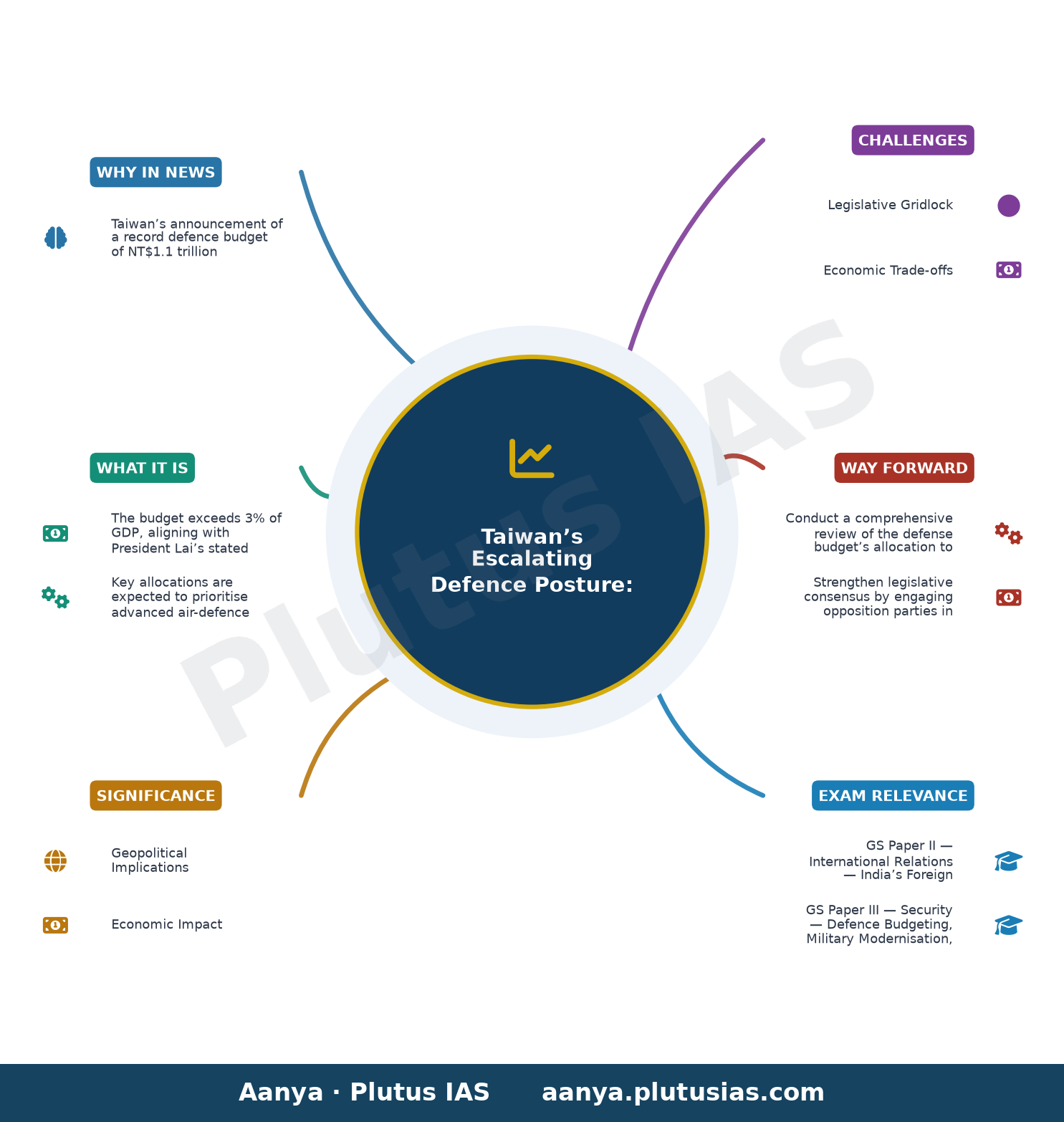
- GS Paper II — International Relations — India’s Foreign Policy, Regional Security Alliances, and Maritime Security | GS Paper III — Security — Defence Budgeting, Military Modernisation, and Strategic Autonomy
- Prelims: One China Policy, Taiwan Strait, Han Kuang Exercises, T-Dome Air-Defence System, US-Taiwan Relations, Cross-Strait Tensions, Defence Budget as % of GDP
- Essay: The role of deterrence in contemporary geopolitics: Lessons from the Indo-Pacific, Can economic interdependence prevent military conflict? A case study of Taiwan and China
Quick Revision: Taiwan’s defence budget for 2027, set at over 3% of GDP, reflects a strategic shift towards asymmetric warfare and enhanced deterrence against China, amid domestic political constraints and international pressure for self-reliance in security.
Why is this in the news?
Taiwan’s announcement of a record defence budget of NT$1.1 trillion (approximately USD 34.1 billion) for 2027, amounting to over 3% of its GDP, underscores the intensifying cross-strait military dynamics. This development follows sustained pressure from the United States to enhance Taiwan’s self-defence capabilities amid escalating coercive actions by China, including increased military and coast guard activities near Taiwanese waters. The move also reflects President Lai Ching-te’s strategic prioritisation of military preparedness since assuming office, signalling a long-term commitment to deterring potential aggression while navigating domestic political constraints.
Background
- Taiwan operates under the constitutional framework of the Republic of China (ROC), a government established in 1912 and relocated to Taipei in 1949 following the Chinese Civil War.
- The ‘One China Principle’ is the diplomatic cornerstone of China’s foreign policy, asserting that Taiwan is an inalienable part of its territory, to be reunified by force if necessary.
- Taiwan’s de facto independence is maintained through a separate government, constitution, military, and currency, though it is not recognised as a sovereign state by the United Nations.
- Cross-strait relations have deteriorated since 2016, with China escalating military pressure through frequent naval exercises, air incursions, and grey-zone tactics such as coast guard patrols.
- The United States, under successive administrations, has adopted a policy of ‘strategic ambiguity,’ providing Taiwan with defensive arms sales while avoiding explicit commitments to military intervention.
- Taiwan’s defence budget has historically hovered around 2% of GDP, but recent geopolitical tensions have prompted calls for increased spending to meet modernisation and deterrence requirements.
Taiwan’s Defence Budget: Objectives, Components, and Strategic Context
- The budget exceeds 3% of GDP, aligning with President Lai’s stated target and surpassing the NATO benchmark of 2% of GDP for defence spending, though comparisons with NATO are contextually distinct.
- Key allocations are expected to prioritise advanced air-defence systems, including the indigenous T-Dome, designed to counter aerial threats such as ballistic missiles and drones, as well as maritime surveillance and cyber defence capabilities.
- The budget also encompasses funding for coast guard expansion and veteran pensions, reflecting an integrated approach to national security that extends beyond traditional military domains.
- Domestic political considerations play a critical role, as the opposition-controlled legislature must approve the budget, introducing potential delays or modifications to the proposed allocations.
- Taiwan’s defence modernisation efforts are part of a broader strategy to achieve ‘asymmetric warfare’ capabilities, leveraging precision-strike weapons, electronic warfare, and mobile defence systems to counter China’s numerical superiority.
- The announcement coincides with the annual Han Kuang military exercises, which simulate scenarios such as a Chinese blockade or invasion, serving as both a deterrent and a readiness assessment.
- International support, particularly from the United States, is pivotal, with Washington urging Taipei to increase its defence spending while providing military aid through mechanisms like the Taiwan Relations Act and the 2023 National Defense Authorization Act.
Key Features
| Feature | Significance |
|---|---|
| Record NT$1.1 trillion (≈$34.1 billion) defense budget for 2027 | Demonstrates Taiwan’s commitment to deterring Chinese aggression; aligns with President Lai’s 3% of GDP target. |
| Exceeds 3% of GDP threshold | Meets the threshold set by President Lai in 2024, signalling heightened military preparedness amid rising tensions. |
| T-Dome air-defense system allocation | Enhances Taiwan’s layered air defense against aerial threats, including drones and missile strikes. |
| Legislative approval pending | Opposition-controlled legislature may modify the budget, introducing uncertainty in final allocation. |
| Integration of coast guard and veteran pensions in budget | Expands the scope of defense spending beyond traditional military expenditures, reflecting a holistic security approach. |
Why it Matters
Geopolitical Implications
- Taiwan’s defense budget escalation is a direct response to China’s assertive military posturing, including frequent naval patrols and air incursions near the Taiwan Strait.
- The move aligns with U.S. strategic interests, as Washington has repeatedly urged Taipei to enhance its self-defense capabilities to reduce reliance on external support.
- China’s ‘One Country, Two Systems’ framework remains non-negotiable for Beijing, making Taiwan’s military buildup a flashpoint in cross-strait relations.
- The budget increase may escalate regional tensions, prompting China to accelerate its military modernization and coercive diplomacy.
Economic Impact
- A 3% GDP defense allocation is fiscally significant for Taiwan, potentially diverting resources from social welfare or infrastructure development.
- The budget’s scale underscores Taiwan’s prioritization of national security over economic trade-offs, reflecting existential threat perceptions.
- Long-term economic risks include capital flight or reduced foreign investment if geopolitical instability persists.
Strategic Doctrine Shift
- Taiwan’s military strategy is transitioning from ‘asymmetric warfare’ to a more conventional deterrence posture, as evidenced by investments in air-defense systems.
- The focus on air superiority (e.g., T-Dome) indicates a shift toward countering China’s anti-access/area-denial (A2/AD) capabilities.
- Enhanced coast guard funding suggests a broader interpretation of ‘defense,’ integrating maritime security into national security calculus.
International Relations
- Taiwan’s budget increase reinforces its role as a ‘frontline state’ in the U.S.-China rivalry, potentially drawing stronger U.S. support under the Taiwan Relations Act.
- The move may strain Taiwan’s relations with regional allies, particularly those dependent on economic ties with China.
- Japan and Australia are likely to view Taiwan’s actions as a stabilizing factor, given shared concerns over Chinese expansionism.
Challenges
1. Legislative Gridlock
- Opposition-controlled legislature may reject or dilute the budget, delaying critical defense procurements.
- Political polarization in Taiwan risks undermining long-term defense planning and deterrence credibility.
UPSC Link: Parliamentary control over budgetary allocations
2. Economic Trade-offs
- Allocating 3% of GDP to defense may crowd out spending on education, healthcare, or industrial innovation.
- High defense spending could exacerbate fiscal deficits, particularly if economic growth slows.
UPSC Link: Fiscal policy and resource allocation
3. Cross-Strait Escalation
- China may interpret Taiwan’s budget hike as a provocation, escalating military drills or imposing economic sanctions.
- The risk of miscalculation or accidental conflict rises as both sides enhance military postures.
UPSC Link: Conflict resolution mechanisms
4. U.S. Policy Uncertainty
- Taiwan’s reliance on U.S. support creates vulnerability to shifts in American foreign policy, especially under new administrations.
- The U.S. may face pressure to increase military aid or deploy forces to Taiwan, risking direct confrontation with China.
UPSC Link: U.S.-China strategic competition
5. Technological Dependence
- Taiwan’s defense industry may face supply chain disruptions due to reliance on foreign components (e.g., semiconductors for missile systems).
- Self-sufficiency in critical technologies remains a challenge despite indigenous programs like the T-Dome.
UPSC Link: Indigenous defense production
Challenges — UPSC Perspective
| Issue | Concern |
|---|---|
| Budget approval delays | Risk of delayed procurement of critical defense systems, undermining deterrence. |
| China’s retaliatory measures | Potential economic coercion, cyberattacks, or military posturing in response to Taiwan’s budget increase. |
| Fiscal sustainability | Long-term strain on Taiwan’s budget, requiring trade-offs with social sector spending. |
| U.S. strategic ambiguity | Uncertainty over U.S. commitment to Taiwan’s defense, complicating deterrence calculations. |
| Indigenous defense gaps | Shortfalls in domestic production of advanced weaponry, necessitating foreign imports. |
| Public opinion polarization | Divisive debates over defense spending may weaken national unity in the face of external threats. |
Way Forward
- Conduct a comprehensive review of the defense budget’s allocation to prioritize high-impact systems (e.g., missile defense, cybersecurity) over low-yield expenditures.
- Strengthen legislative consensus by engaging opposition parties in defense planning to ensure budget stability.
- Accelerate indigenous defense production, particularly in semiconductors and missile systems, to reduce reliance on foreign suppliers.
- Enhance coordination with the U.S. and regional allies (e.g., Japan, Australia) to deter Chinese aggression through joint exercises and intelligence-sharing.
- Invest in public diplomacy to garner international support for Taiwan’s defense posture, countering Chinese narratives of ‘provocation.’
- Develop contingency plans for economic resilience, including diversifying trade partners and securing semiconductor supply chains.
- Establish a dedicated fund for rapid procurement of critical defense systems to mitigate legislative delays.
- Promote research and development in asymmetric warfare tactics to counter China’s A2/AD capabilities.
UPSC Value Addition
Keywords for Mains Answer-Writing
Taiwan Strait crisis · Cross-Strait relations · One China Policy · China-Taiwan conflict · US-Taiwan strategic partnership · Taiwan military modernisation · Han Kuang exercises · Defence expenditure as % of GDP · Taiwan President Lai Ching-te · T-Dome air-defence system · China’s coercive diplomacy · Indo-Pacific security architecture
Concept Flow
Rising Chinese military assertiveness → Taiwan’s existential threat perception → President Lai’s 3% GDP defense target → Record budget proposal for 2027 → Legislative approval challenges → Potential U.S. strategic support → China’s retaliatory measures → Regional geopolitical realignment → Long-term deterrence calculus
Prelims Practice Questions
Q1. Consider the following statements regarding Taiwan’s military budget and strategic context:
1. Taiwan plans to allocate NT$1.1 trillion for its military in 2027, exceeding 3% of its GDP.
2. The T-Dome air-defence system is intended to counter aerial threats from China.
3. The budget proposal requires approval from Taiwan’s legislature, which is currently controlled by the opposition.
4. The Han Kuang exercises are Taiwan’s flagship annual military drills.
How many of the above statements are correct?
- Only one
- Only two
- Only three
- All
Answer: All — Statements 1, 2, and 4 are correct. Statement 3 is incorrect as the legislature is controlled by the opposition, and the budget proposal is subject to its approval.
Q2. Assertion (A): Taiwan’s military budget for 2027 exceeds 3% of its GDP, reflecting heightened tensions with China.
Reason (R): The One China Policy mandates that Taiwan must reunify with mainland China, leading to increased military spending by Taiwan to deter coercive actions.
Options:
A. Both A and R are true, and R is the correct explanation of A.
B. Both A and R are true, but R is not the correct explanation of A.
C. A is true, but R is false.
D. A is false, but R is true.
Answer: ? — Both Assertion (A) and Reason (R) are true. The One China Policy underpins China’s claim over Taiwan, which contributes to the strategic rationale for Taiwan’s increased defence spending.
Q3. Match the following military systems with their respective countries:
Column I (System) | Column II (Country)
—————–|——————-
A. T-Dome air-defence system | 1. India
B. S-400 Triumf | 2. Taiwan
C. Rafale fighter jets | 3. Russia
D. INS Vikrant | 4. France
Options:
A. A-2, B-3, C-4, D-1
B. A-1, B-3, C-4, D-2
C. A-2, B-1, C-3, D-4
D. A-4, B-2, C-1, D-3
Answer: ? — A. T-Dome air-defence system is associated with Taiwan. B. S-400 Triumf is a Russian missile system. C. Rafale fighter jets are from France. D. INS Vikrant is an Indian aircraft carrier.
Mains Practice Question
✍ Taiwan’s plan to allocate a record NT$1.1 trillion defence budget in 2027, exceeding 3% of its GDP, reflects a strategic pivot amid escalating cross-Strait tensions. Critically examine the geopolitical and domestic factors driving this militarisation, and analyse its implications for regional security in the Indo-Pacific. (15 Marks)
Approach: MODEL-ANSWER SKELETON:
1. **Geopolitical drivers**:
– China’s assertive stance under Xi Jinping, including military drills near Taiwan and coercive diplomacy (e.g., ‘One China’ policy enforcement, grey-zone tactics).
– US-Taiwan strategic partnership (e.g., arms sales, diplomatic support) and bipartisan US policy on Taiwan Strait stability.
– Taiwan’s ‘porcupine strategy’ to deter Chinese aggression through asymmetric warfare and indigenous defence production (e.g., T-Dome system).
– Recent Han Kuang exercises as a deterrent signal.
2. **Domestic factors**:
– President Lai Ching-te’s policy focus on military modernisation and self-reliance since 2024.
– Legislative opposition challenges (e.g., 2025 special defence budget approval delays).
– Public sentiment favouring stronger defence post-2022 Ukraine war lessons and China’s military intimidation.
3. **Regional security implications**:
– Risk of miscalculation leading to conflict escalation in the Taiwan Strait.
– Impact on Indo-Pacific security architecture (e.g., Quad’s role, US-China rivalry, ASEAN’s neutral stance).
– Economic repercussions (e.g., semiconductor supply chain disruptions, global trade routes).
4. **Critical analysis**:
– Balance between deterrence and provocation: Does increased spending escalate tensions or deter aggression?
– Role of international law (e.g., UNCLOS, freedom of navigation) vs. sovereignty claims.
– Comparative perspective: How does Taiwan’s strategy align with other conflict zones (e.g., Ukraine, South China Sea)?
5. **Conclusion**:
– Taiwan’s militarisation is a reactive measure to external pressures but risks entrenching a security dilemma in the region. The onus lies on diplomatic engagement to prevent conflict.
Source: Mint
Generated by AanyaAi for educational purpose.


No Comments