


10 Aug Tribunal Reforms Bill 2026: Lok Sabha to Introduce NTC for Judicial Reforms
✎ The Tribunal Reforms Bill, 2026, seeks to establish the National Tribunals Commission (NTC) to ensure transparent, independent, and accountable administration of tribunals, in compliance with the Supreme Court’s directive in the…
Subject Relevance — Where This Topic Fits
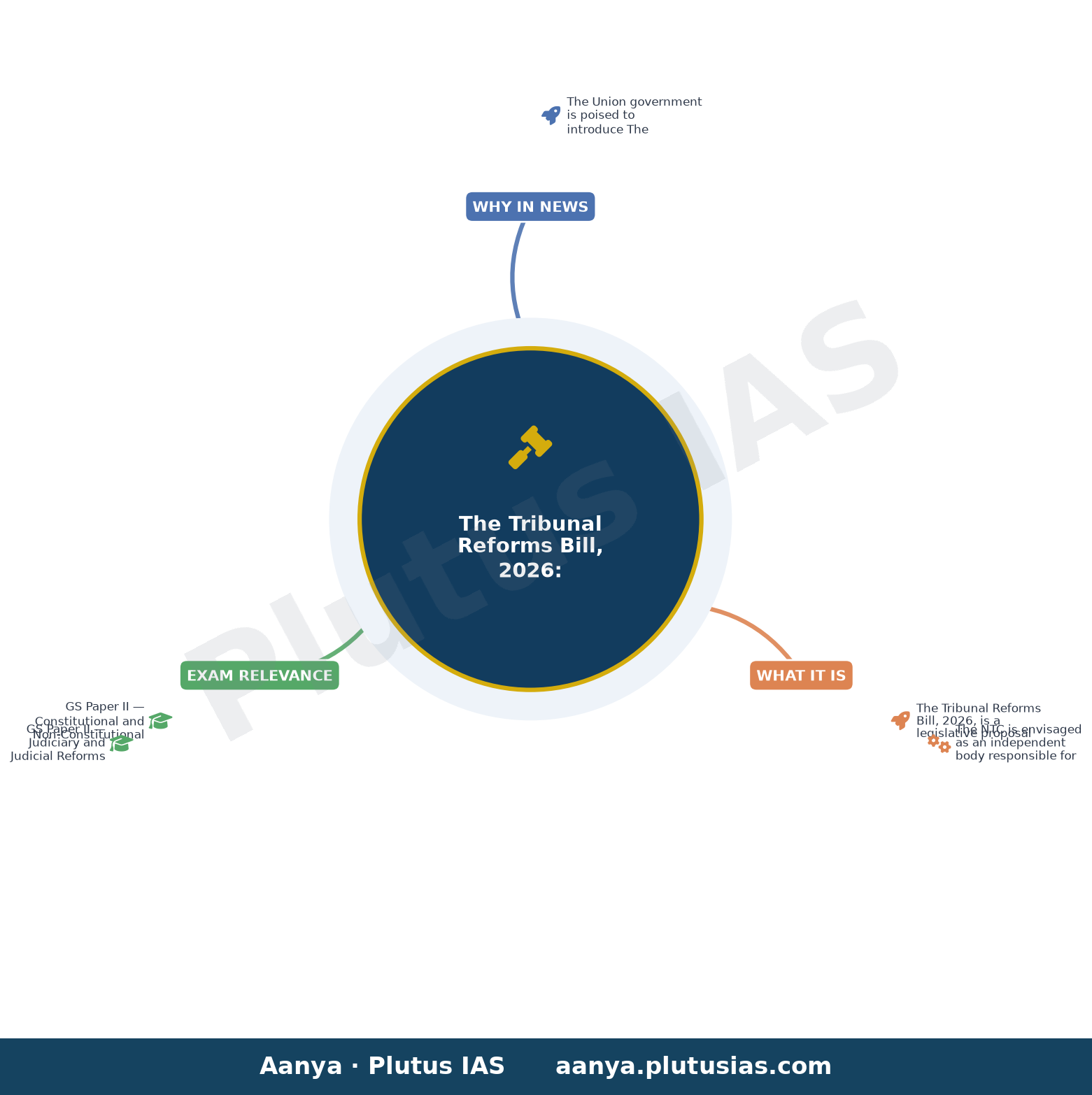
- GS Paper II — Constitutional and Non-Constitutional Bodies | GS Paper II — Judiciary and Judicial Reforms
- Prelims: Tribunal Reforms Bill 2026, National Tribunals Commission (NTC), Madras Bar Association v. Union of India (2025), Tribunals Reforms Act 2021, National Green Tribunal (NGT), Judicial independence, Separation of powers, Constitutional validity of legislation
- Essay: Judicial reforms and constitutional governance in India: Balancing efficiency and independence, The role of tribunals in India’s adjudicatory ecosystem: Challenges and reforms
Quick Revision: The Tribunal Reforms Bill, 2026, seeks to establish the National Tribunals Commission (NTC) to ensure transparent, independent, and accountable administration of tribunals, in compliance with the Supreme Court’s directive in the Madras Bar Association case (2025).
Why is this in the news?
The Union government is poised to introduce The Tribunal Reforms Bill, 2026 in the Lok Sabha, which seeks to establish the National Tribunals Commission (NTC) as a statutory body to oversee the appointment, performance review, and administrative oversight of tribunals across India. This legislative initiative follows the Supreme Court’s landmark directive in the Madras Bar Association case (November 2025), which struck down key provisions of the Tribunals Reforms Act, 2021 for violating judicial independence and the doctrine of separation of powers. The Bill aims to address systemic deficiencies in tribunal governance, particularly concerning executive overreach and the erosion of judicial autonomy.
Background
- The Tribunals Reforms Act, 2021, introduced by the Union government, was challenged in the Supreme Court by the Madras Bar Association and other petitioners, alleging violations of constitutional principles such as judicial independence and the separation of powers.
- In its judgment dated 19 November 2025, the Supreme Court struck down several provisions of the 2021 Act, including the 50-year age limit for appointments, the shortened four-year tenure for tribunal members, and the requirement for the selection committee to propose two names per vacancy, deeming them unconstitutional.
- The apex court directed the Union government to establish a National Tribunals Commission (NTC) to ensure transparent, independent, and accountable administration of tribunals, thereby reducing executive control over judicial appointments and functioning.
- The Tribunal Reforms Bill, 2026, is the legislative response to the Supreme Court’s directive, proposing the creation of the NTC to oversee the selection, performance evaluation, and administrative management of 16 semi-judicial tribunals, including the National Green Tribunal (NGT).
- The Bill reflects a shift from the 2021 Act’s approach, which was criticised for centralising power in the executive and undermining the autonomy of tribunals, particularly through age-based exclusions and reduced tenures.
- The Bill has received support from the opposition, with Congress leader Jairam Ramesh highlighting its potential to restore judicial independence and correct the deficiencies of the 2021 Act.
What is The Tribunal Reforms Bill, 2026?
- The Tribunal Reforms Bill, 2026, is a legislative proposal aimed at reforming the governance and administration of tribunals in India by establishing the National Tribunals Commission (NTC) as a statutory authority.
- The NTC is envisaged as an independent body responsible for overseeing the selection process for appointments to tribunals, ensuring transparency and reducing executive interference in judicial appointments.
- The Bill seeks to address the constitutional concerns raised by the Supreme Court in the Madras Bar Association case (2025), which invalidated provisions of the Tribunals Reforms Act, 2021 for violating judicial independence and the separation of powers.
- Key functions of the NTC include reviewing the performance of tribunal chairpersons and members, submitting annual reports to the Union government, and maintaining a National Tribunals Grid to streamline tribunal operations and data management.
- The Bill proposes to restore a five-year tenure for tribunal members, replacing the four-year tenure envisaged in the 2021 Act, thereby enhancing stability and continuity in tribunal functioning.
- It reinstates the single-name recommendation process for appointments, limiting executive discretion and ensuring that the selection process prioritises merit and independence over bureaucratic control.
- The NTC’s establishment is intended to reduce the concentration of power in the executive, aligning tribunal governance with constitutional principles and judicial autonomy.
- The Bill covers 16 semi-judicial tribunals, including the National Green Tribunal (NGT), the Armed Forces Tribunal (AFT), and the Income Tax Appellate Tribunal (ITAT), among others.
UPSC Value Addition
Keywords for Mains Answer-Writing
Tribunal Reforms Bill 2026 · National Tribunals Commission (NTC) · Madras Bar Association judgment (November 19, 2025) · Tribunals Reforms Act, 2021 · judicial independence · separation of powers · selection process for tribunals · tribunal vacancies · National Green Tribunal (NGT) · Supreme Court directives · executive control over tribunals · constitutional validity of tribunal laws · tenure of tribunal members · appointment process for tribunal chairpersons and members
Prelims Practice Questions
Q1. Consider the following statements regarding the Tribunal Reforms Bill, 2026:
1. The bill proposes the creation of a National Tribunals Commission (NTC) to oversee the selection process for tribunal members.
2. The NTC will also review the performance of chairpersons and members of tribunals and submit annual reports to the Centre.
3. The bill seeks to restore a five-year tenure for tribunal members, as envisaged in the Tribunals Reforms Act, 2021.
4. The bill mandates the selection committee to propose two names per vacancy to limit executive discretion.
How many of the above statements are correct?
- Only one
- Only two
- Only three
- All
Answer: Only three — Statements 1 and 2 are correct as per the bill. Statement 3 is correct as the bill restores a five-year tenure, contrary to the four-year tenure in the 2021 Act. Statement 4 is incorrect as the bill reinstates a single-name recommendation process to limit executive discretion.
Q2. Assertion (A): The Supreme Court, in its November 19, 2025 judgment, struck down key provisions of the Tribunals Reforms Act, 2021 for violating judicial independence.
Reason (R): The court held that the 2021 Act’s provisions on tenure and appointment processes compromised the separation of powers and reduced the independence of tribunals.
Options:
A. Both A and R are true, and R is the correct explanation of A.
B. Both A and R are true, but R is NOT the correct explanation of A.
C. A is true, but R is false.
D. A is false, but R is true.
Answer: ? — Both A and R are true, and R correctly explains A. The Supreme Court struck down provisions of the 2021 Act for violating judicial independence and the separation of powers, as detailed in the judgment.
Q3. Which of the following tribunals is explicitly mentioned in the context of the Tribunal Reforms Bill, 2026?
A. Central Administrative Tribunal
B. National Green Tribunal
C. Armed Forces Tribunal
D. Income Tax Appellate Tribunal
- A
- B
- C
- D
Answer: B — The National Green Tribunal (NGT) is explicitly mentioned in the context of the Tribunal Reforms Bill, 2026, as per the statement by Congress lawmaker Jairam Ramesh.
Mains Practice Question
✍ Critically examine the constitutional necessity of establishing an independent National Tribunals Commission (NTC) under the Tribunal Reforms Bill, 2026. In your answer, analyse the Supreme Court’s directives in the Madras Bar Association judgment (November 19, 2025) and evaluate the implications for judicial independence and the separation of powers in India. (15 Marks)
Approach: MODEL-ANSWER SKELETON:
1. **Introduction (2 marks)**
– Briefly define tribunals in India and their role as quasi-judicial bodies.
– State the constitutional imperative of judicial independence (Art. 50, basic structure doctrine).
2. **Supreme Court’s Directives in Madras Bar Association Judgment (4 marks)**
– Cite the key provisions struck down in the Tribunals Reforms Act, 2021 (e.g., 50-year age limit, four-year tenure, dual-name selection process).
– Explain the court’s reasoning: violation of judicial independence, separation of powers, and executive overreach.
– Highlight the court’s direction to establish an independent NTC within four months.
3. **Constitutional Necessity of NTC (5 marks)**
– Discuss the need for an independent body to oversee tribunal appointments and performance (reference to Art. 323A and 323B).
– Explain how the NTC addresses the flaws in the 2021 Act (e.g., single-name recommendation, five-year tenure, performance review).
– Argue that the NTC ensures transparency, reduces executive discretion, and upholds the basic structure of the Constitution.
4. **Implications for Judicial Independence and Separation of Powers (4 marks)**
– Analyse how the NTC strengthens judicial independence by insulating tribunals from executive control.
– Discuss the separation of powers: how the NTC acts as a buffer between the executive and judiciary.
– Weigh the potential challenges (e.g., autonomy of NTC, accountability mechanisms) and counterarguments (e.g., executive resistance, bureaucratic delays).
5. **Conclusion (1 mark)**
– Summarise the constitutional necessity of the NTC and its role in preserving judicial independence and the separation of powers.
Source: Hindustan Times
Generated by AanyaAi for educational purpose.

- Vettri Payanam Scheme: Free Bus Travel for Women in Tamil Nadu - October 4, 2026
- पेंशन अदालत: 17वीं बैठक की अध्यक्षता करेंगे डॉ. जितेंद्र सिंह, जानिए मुख्य बातें - October 4, 2026
- CBN Rajasthan celebrates National Anti-Drug Day with Gandhi Jayanti events - October 4, 2026

No Comments