


10 Aug Tribunals Reforms Bill 2026: Key Bills in Lok Sabha Monsoon Session
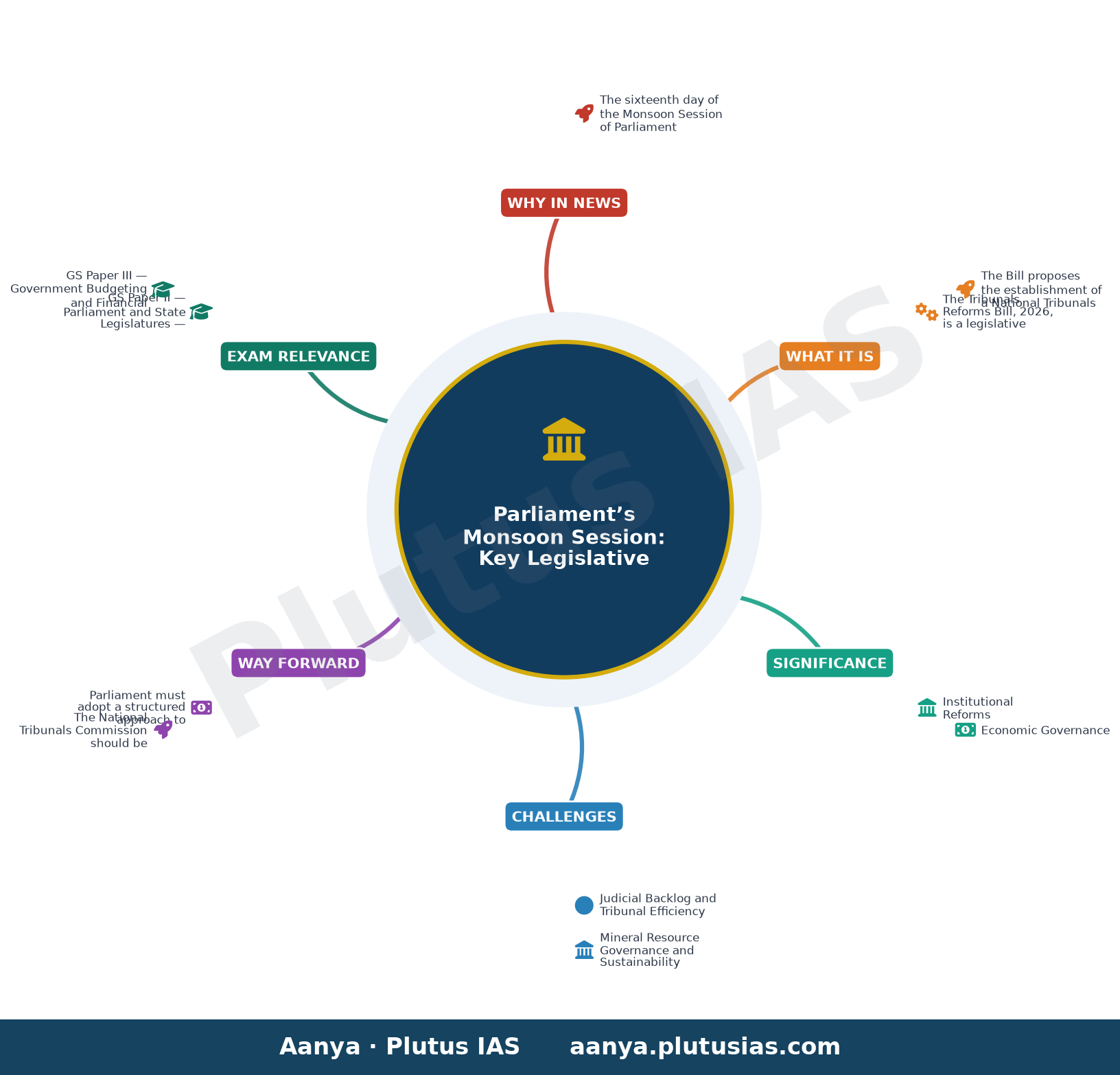
✎ The Tribunals Reforms Bill, 2026, seeks to establish a National Tribunals Commission and standardise the appointment and service conditions of tribunal members to enhance efficiency and transparency in India’s adjudicatory system.
Subject Relevance — Where This Topic Fits
- GS Paper II — Parliament and State Legislatures — Structure, Functioning, Conduct of Business, Powers & Privileges | GS Paper III — Government Budgeting and Financial Management, Administrative Reforms
- Prelims: Tribunals Reforms Bill 2026, Mines and Minerals (Development and Regulation) Amendment Bill 2026, National Tribunals Commission, Foreign Contribution (Regulation) Amendment Bill 2026, Parliamentary proceedings and adjournment motions
- Essay: The Role of Parliament in Democratic Governance: Balancing Efficiency and Accountability, Judicial Reforms and Administrative Efficiency: A Necessary Trade-off?
Quick Revision: The Tribunals Reforms Bill, 2026, seeks to establish a National Tribunals Commission and standardise the appointment and service conditions of tribunal members to enhance efficiency and transparency in India’s adjudicatory system.
Why is this in the news?
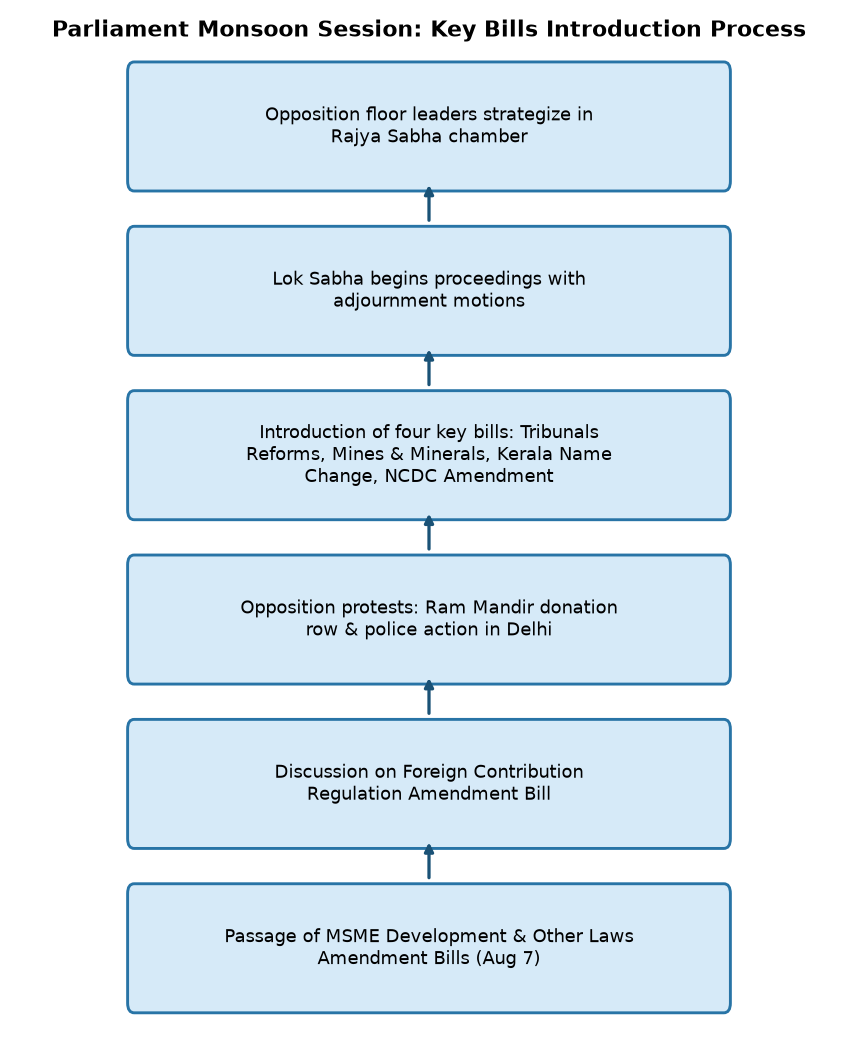
The sixteenth day of the Monsoon Session of Parliament witnessed heightened legislative activity, with the Lok Sabha scheduled to introduce four significant bills, including the Tribunals Reforms Bill, 2026. This Bill assumes critical importance as it seeks to restructure the tribunal system in India by proposing a National Tribunals Commission and standardising appointment and service conditions for tribunal members. Concurrently, the Opposition, led by the INDIA bloc, intensified its parliamentary strategy, focusing on issues such as alleged financial irregularities in the Ram Mandir donation collection and the police response to protests in Delhi.
Background
- The Parliament of India functions as the supreme legislative body under the Constitution, with the Lok Sabha and Rajya Sabha playing distinct roles in lawmaking, oversight, and representation.
- Tribunals in India were established to provide specialised adjudication outside the conventional court system, addressing issues such as taxation, labour disputes, and administrative grievances.
- The Tribunals Reforms (Rationalisation and Conditions of Service) Act, 2021, was a prior attempt to streamline tribunals, but its implementation faced judicial scrutiny and operational challenges.
- The Mines and Minerals (Development and Regulation) Act, 1957, governs the regulation and development of the mineral sector in India, with amendments aimed at enhancing transparency and ease of doing business.
- The Foreign Contribution (Regulation) Act, 2010, regulates the acceptance and utilisation of foreign contributions by individuals, associations, and companies, with amendments often sparking debates on civil liberties and administrative discretion.
- Parliamentary sessions, including the Monsoon Session, are critical for legislative scrutiny, debate, and the passage of bills, with Opposition parties frequently employing procedural tools such as adjournment motions and discussions to highlight governance issues.
What is the Tribunals Reforms Bill, 2026?
- The Tribunals Reforms Bill, 2026, is a legislative proposal aimed at restructuring the tribunal system in India to enhance efficiency, transparency, and uniformity in the appointment and service conditions of tribunal members.
- The Bill proposes the establishment of a National Tribunals Commission, which would act as an apex body for the administration and oversight of tribunals, ensuring standardised processes and reducing multiplicity of authorities.
- It seeks to address longstanding concerns regarding the autonomy and independence of tribunals, which have been subject to judicial criticism for lack of specialised expertise and procedural delays.
- The Bill includes provisions for the merger of certain tribunals to reduce redundancy and improve coordination, aligning with the recommendations of the Law Commission of India and judicial pronouncements.
- The proposed reforms are expected to expedite dispute resolution in sectors such as taxation, labour, and environmental law, thereby reducing the burden on the higher judiciary.
- The Bill also aims to define the qualifications, tenure, and service conditions of tribunal members more clearly, reducing discretionary powers and enhancing accountability.
- Critics argue that the Bill may centralise power further in the executive, potentially undermining the quasi-judicial independence of tribunals, while proponents highlight the need for systemic efficiency in dispute resolution.
- The Bill is part of a broader agenda of judicial and administrative reforms, reflecting the government’s commitment to improving governance through legislative interventions.
Key Features
| Feature | Significance |
|---|---|
| Tribunals Reforms Bill, 2026 | Proposes the establishment of a National Tribunals Commission to ensure uniformity in the appointment, service conditions, and functioning of tribunals, addressing concerns of ad-hocism and lack of transparency in tribunal governance. |
| Mines and Minerals (Development and Regulation) Amendment Bill, 2026 | Aims to amend the 1957 Act to streamline mineral resource governance, potentially enhancing ease of doing business while ensuring sustainable mining practices and equitable revenue distribution. |
| Kerala (Alteration of Name) Bill, 2026 | Seeks to formally rename the state of Kerala, reflecting administrative or political decisions, with implications for official documentation, governance, and public perception. |
| National Co-operative Development Corporation (Amendment) Bill, 2026 | Proposes amendments to strengthen the NCDC’s role in promoting co-operative enterprises, aligning with the government’s emphasis on the co-operative sector as a tool for inclusive growth. |
| Foreign Contribution (Regulation) Amendment Bill, 2026 | Expected to be discussed by Opposition, likely to introduce stricter provisions on foreign funding, impacting NGOs, civil society, and political parties receiving overseas contributions. |
Why it Matters
Institutional Reforms
- The Tribunals Reforms Bill introduces a structured mechanism (National Tribunals Commission) to address long-standing issues of arbitrariness in tribunal appointments and service conditions, enhancing judicial accountability.
- The establishment of a unified commission for tribunals may reduce multiplicity of authorities, improving efficiency in dispute resolution across sectors such as taxation, labour, and environment.
Economic Governance
- The Mines and Minerals Amendment Bill is critical for balancing resource exploitation with environmental sustainability, particularly in the context of India’s commitment to the Paris Agreement and SDGs.
- Streamlining mineral governance can accelerate infrastructure projects, such as the National Infrastructure Pipeline, by reducing procedural delays in land acquisition and clearances.
Federalism and Governance
- The Kerala (Alteration of Name) Bill underscores the Centre’s role in formalising state-level administrative changes, highlighting the interplay between Union and State jurisdictions in constitutional matters.
- Amendments to the NCDC Bill reflect the Centre’s intent to leverage co-operative models for economic empowerment, especially in rural and agricultural sectors.
Political and Legal Accountability
- Opposition protests on the Ram Mandir donation row and FCRA Bill indicate heightened scrutiny of executive actions, particularly concerning transparency in religious and foreign funding.
- Adjournment motions and discussions on Home Minister’s statements signal the Parliament’s role in holding the executive accountable for law and order and financial probity.
Challenges
1. Judicial Backlog and Tribunal Efficiency
- Tribunals in India suffer from chronic backlogs due to understaffing, lack of standardised procedures, and overlapping jurisdictions, exacerbating delays in dispute resolution.
- The proposed National Tribunals Commission must address these systemic issues without creating new bureaucratic layers that could further delay justice delivery.
UPSC Link: GS-II: Judiciary (Structure, Organisation and Functioning)
2. Mineral Resource Governance and Sustainability
- India’s mineral sector faces challenges of illegal mining, environmental degradation, and inequitable revenue sharing, necessitating robust regulatory frameworks.
- Balancing economic growth with environmental sustainability requires stringent enforcement of the amended MMDR Act, which may face resistance from industry lobbies.
UPSC Link: GS-III: Environment and Biodiversity (Mining Sector)
3. Foreign Funding and Civil Society Regulation
- The FCRA Amendment Bill’s stricter provisions could stifle legitimate civil society activities, particularly those advocating for human rights, environmental justice, or minority rights.
- Over-regulation risks undermining India’s soft power and global commitments to democratic freedoms, as highlighted in international reports on civic space.
UPSC Link: GS-II: Fundamental Rights (Article 19(1)(c))
4. Parliamentary Disruptions and Legislative Efficiency
- Frequent disruptions in Parliament, driven by Opposition protests, impede the legislative process, delaying critical reforms and eroding public trust in democratic institutions.
- The Opposition’s strategy of adjournment motions and demands for ministerial statements reflects a broader trend of using Parliament as a forum for political messaging rather than deliberation.
UPSC Link: GS-II: Parliament (Functions and Conduct of Business)
5. Co-operative Sector Revival and Governance
- The co-operative sector in India faces challenges of poor governance, lack of professionalism, and financial mismanagement, limiting its potential as an engine of inclusive growth.
- Amendments to the NCDC Bill must ensure that reforms translate into tangible benefits for primary co-operative societies, particularly in agriculture and allied sectors.
UPSC Link: GS-III: Agriculture (Co-operative Sector)
Challenges — UPSC Perspective
| Issue | Concern |
|---|---|
| Judicial Backlog in Tribunals | Delays in dispute resolution due to understaffing, lack of standardised procedures, and overlapping jurisdictions. |
| Mineral Resource Sustainability | Balancing economic exploitation with environmental protection and equitable revenue distribution. |
| Foreign Funding Restrictions | Risk of over-regulation stifling civil society and undermining democratic freedoms. |
| Parliamentary Disruptions | Frequent adjournments and protests delaying critical legislative business. |
| Co-operative Sector Governance | Poor management and financial mismanagement limiting the sector’s growth potential. |
Way Forward
- Parliament must adopt a structured approach to legislative business, minimising disruptions through consensus on time allocation and prioritising Bills with broad socio-economic impact.
- The National Tribunals Commission should be constituted with transparent criteria for appointment, service conditions, and performance evaluation to ensure judicial independence.
- The Mines and Minerals Amendment Bill must be accompanied by robust implementation frameworks, including digital monitoring of mining activities and strict penalties for violations.
- The FCRA Amendment Bill should undergo rigorous stakeholder consultations to balance national security concerns with the need to protect civic space and democratic freedoms.
- State governments, particularly Kerala, must ensure smooth parliamentary processes for name change Bills, avoiding procedural delays that could undermine federal trust.
- The NCDC should be empowered to provide capacity-building support to primary co-operative societies, ensuring grassroots-level benefits from legislative reforms.
- Parliamentary committees should conduct pre-legislative scrutiny of Bills to identify potential gaps, ensuring that reforms are evidence-based and aligned with constitutional principles.
UPSC Value Addition
Keywords for Mains Answer-Writing
Tribunals Reforms Bill 2026 · National Tribunals Commission · appointment and service conditions of tribunal members · Mines and Minerals (Development and Regulation) Amendment Bill 2026 · Mines and Minerals (Development and Regulation) Act, 1957 · Parliamentary accountability of executive · judicial tribunals in India · legislative process in Parliament · judicial reforms and executive control · cooperative federalism and mineral governance · Kerala (Alteration of Name) Bill 2026 · National Co-operative Development Corporation (Amendment) Bill 2026
Constitutional & Policy Linkages
- Article 246: Distribution of Legislative Powers (Union vs State List)
- Article 254: Inconsistency between Union and State laws (Kerala Bill)
- Article 323B: Tribunals for certain matters (Tribunals Reforms Bill)
- Article 299: Contracts and obligations of the Union (Governance of Tribunals)
Concept Flow
Legislative Agenda Announced → Opposition Protests and Adjournment Motions → Introduction of Key Bills in Lok Sabha → Parliamentary Scrutiny and Debate → Potential Amendments or Passage → Implementation and Impact Assessment → Tribunal Reforms → Judicial Backlog → National Tribunals Commission → Standardised Appointments → Improved Efficiency in Dispute Resolution → Mines and Minerals Amendment → Resource Governance → Economic Growth vs Sustainability → Revenue Sharing Mechanisms → Environmental Compliance → FCRA Amendment → Foreign Funding Regulations → Civil Society Impact → Democratic Freedoms vs National Security → Stakeholder Consultations → Parliamentary Disruptions → Legislative Delays → Erosion of Public Trust → Need for Consensus-Based Governance → Structural Reforms in Parliamentary Conduct
Prelims Practice Questions
Q1. Consider the following statements regarding the Tribunals Reforms Bill, 2026:
1. The Bill proposes the establishment of a National Tribunals Commission.
2. It seeks to ensure uniformity in the appointment and service conditions of tribunal members.
3. The Bill aims to reduce the jurisdiction of tribunals in matters related to service conditions of employees.
How many of the above statements are correct?
- Only one
- Only two
- All three
- None
Answer: All three — Statements 1 and 2 are correct as per the Bill’s provisions. Statement 3 is incorrect because the Bill does not aim to reduce tribunal jurisdiction but rather to reform their functioning.
Q2. Assertion (A): The Mines and Minerals (Development and Regulation) Amendment Bill, 2026 seeks to amend the Mines and Minerals (Development and Regulation) Act, 1957.
Reason (R): The amendment aims to enhance the role of state governments in mineral governance.
In the context of the above two statements, which one of the following is correct?
- Both A and R are true, and R is the correct explanation of A
- Both A and R are true, but R is not the correct explanation of A
- A is true, but R is false
- A is false, but R is true
Answer: A is true, but R is false — Assertion (A) is true as the Bill seeks to amend the 1957 Act. Reason (R) is also true but is not the correct explanation of A, as the Bill’s primary focus is on regulatory reforms rather than solely enhancing state government roles.
Q3. Which of the following Bills introduced in the Lok Sabha during the Monsoon Session, 2026, is NOT related to economic or administrative reforms?
- Tribunals Reforms Bill, 2026
- Mines and Minerals (Development and Regulation) Amendment Bill, 2026
- Kerala (Alteration of Name) Bill, 2026
- National Co-operative Development Corporation (Amendment) Bill, 2026
Answer: Kerala (Alteration of Name) Bill, 2026 — The Kerala (Alteration of Name) Bill, 2026, is a procedural Bill related to the renaming of a state, while the other Bills pertain to economic or administrative reforms.
Mains Practice Question
✍ The Tribunals Reforms Bill, 2026, seeks to establish a National Tribunals Commission and streamline the appointment and service conditions of tribunal members. Critically examine the implications of this Bill on judicial independence, separation of powers, and the efficiency of dispute resolution mechanisms in India. (15 Marks)
Approach: MODEL-ANSWER SKELETON:
1. **Introduction (2 Marks)**
– Brief context: Role of tribunals in India (e.g., CIC, CAT, NCLT) and their significance in reducing judicial burden.
– Purpose of the Bill: Addressing delays, improving transparency, and ensuring uniformity in tribunal functioning.
2. **Judicial Independence (4 Marks)**
– **Concerns**: Provisions for executive control via the National Tribunals Commission (e.g., appointment powers, service conditions).
– **Judicial Precedents**: Reference to the Supreme Court’s observations in Rojer Mathew v. South Indian Bank (2020) on tribunal reforms and judicial independence.
– **Balance of Powers**: How the Bill may tilt the balance between the executive and judiciary, potentially undermining the latter’s autonomy.
3. **Separation of Powers (4 Marks)**
– **Constitutional Framework**: Article 50 and the doctrine of separation of powers.
– **Executive Overreach**: Potential risks of the executive (via the Commission) influencing tribunal appointments and functioning.
– **Judicial Review**: Role of the judiciary in reviewing tribunal decisions and ensuring constitutional safeguards.
4. **Efficiency and Transparency (3 Marks)**
– **Expected Benefits**: Reduction in pendency, standardized service conditions, and improved accountability.
– **Critique**: Lack of clarity on the composition of the National Tribunals Commission and its independence from executive interference.
5. **Conclusion (2 Marks)**
– **Balanced View**: The Bill’s intent is laudable, but its implementation must safeguard judicial independence.
– **Recommendations**: Strengthening the Commission with judicial and domain experts, ensuring transparency in appointments, and periodic reviews by an independent body.
Source: The Hindu
Generated by AanyaAi for educational purpose.

- केरल नाम परिवर्तन विधेयक: संसद में गतिरोध, जानें पूरा अपडेट - August 10, 2026
- Amit Shah to Introduce Kerala Name Change Bill in Monsoon Session: Key Updates - August 10, 2026
- लोकसभा में चार प्रमुख विधेयकों का पेश किया जाना, जानिए प्रमुख मुद्दे - August 10, 2026

No Comments