


10 Aug Amit Shah to Introduce Kerala Name Change Bill in Monsoon Session: Key Updates
✎ The Kerala (Alteration of Name) Bill, 2026, is constitutionally valid under Article 3, requiring a simple majority in Parliament and the President’s prior recommendation, without altering the state’s boundaries or administrative…
Subject Relevance — Where This Topic Fits
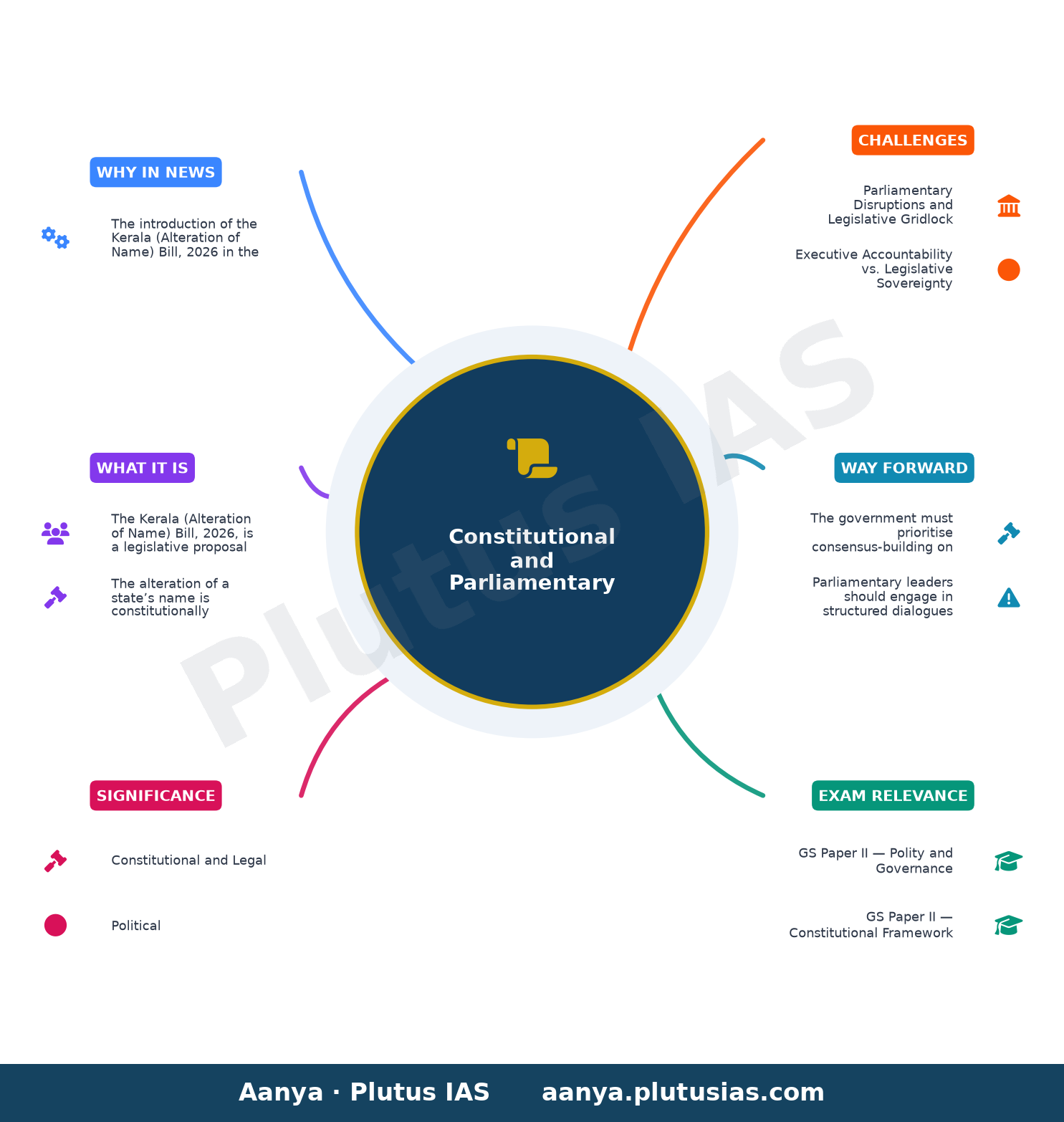
- GS Paper II — Polity and Governance | GS Paper II — Constitutional Framework
- Prelims: Tenth Schedule of the Constitution, 52nd Constitutional Amendment Act, 1985, Anti-Defection Law, Parliamentary Procedures, State Reorganisation Act, 1956
- Essay: The Role of Parliament in Democratic Governance, Federalism and State Identity in India
Quick Revision: The Kerala (Alteration of Name) Bill, 2026, is constitutionally valid under Article 3, requiring a simple majority in Parliament and the President’s prior recommendation, without altering the state’s boundaries or administrative structure.
Why is this in the news?
The introduction of the Kerala (Alteration of Name) Bill, 2026 in the ongoing Monsoon Session of Parliament has become a focal point of political contention, with the Opposition protesting the absence of the Union Home Minister and demanding accountability for alleged police excesses during a student-led protest. This legislative move, alongside the proposed amendments to the anti-defection law, underscores broader debates on constitutional processes, parliamentary ethics, and federal relations.
Background
- The Kerala (Alteration of Name) Bill, 2026, seeks to formally alter the name of the state of Kerala, a process governed by Article 3 of the Constitution, which empowers Parliament to form new states or alter the boundaries or names of existing states.
- The Tenth Schedule of the Constitution, introduced by the 52nd Amendment Act, 1985, contains the anti-defection law, which aims to curb political defections by disqualifying legislators who vote against their party whip.
- The Monsoon Session of Parliament is nearing its conclusion, with only three days remaining, raising concerns over the passage of critical bills such as those on women’s reservation, delimitation, and amendments to the Foreign Contribution (Regulation) Act (FCRA).
- Opposition parties have disrupted proceedings, demanding the presence and accountability of the Union Home Minister, Amit Shah, for alleged police action during the ‘Sansad Chalo’ protest on July 20, 2026.
- The debate on a new anti-defection law has resurfaced, with Congress MP Manish Tewari submitting a notice for an adjournment motion to discuss the need for stricter provisions to prevent mass defections.
- The Kerala (Alteration of Name) Bill follows precedents such as the renaming of Orissa to Odisha (2011) and Madras to Tamil Nadu (1969), which were enacted through similar parliamentary processes.
What is the Kerala (Alteration of Name) Bill, 2026?
- The Kerala (Alteration of Name) Bill, 2026, is a legislative proposal introduced in the Lok Sabha to formally change the name of the state of Kerala to a new name, as yet unspecified in public discourse.
- The alteration of a state’s name is constitutionally permissible under Article 3 of the Constitution, which empowers Parliament to enact such changes upon the recommendation of the President.
- The process requires the President’s prior recommendation, followed by a simple majority in both Houses of Parliament, and the bill does not require ratification by state legislatures unless it alters the boundaries of the state.
- The bill does not alter the geographical boundaries or administrative structure of the state but solely changes its name, which may reflect cultural, linguistic, or political aspirations.
- The introduction of the bill in the Monsoon Session of 2026 coincides with broader parliamentary disruptions, raising questions about the legislative priorities and the procedural norms governing such amendments.
- The bill’s introduction by the Union Home Minister underscores the central government’s role in facilitating state-level administrative changes, even though such changes are initiated by state legislatures.
- The debate surrounding the bill has been overshadowed by political tensions, with Opposition parties linking its introduction to broader demands for accountability and parliamentary decorum.
Key Features
| Feature | Significance |
|---|---|
| Kerala (Alteration of Name) Bill, 2026 | Initiates the constitutional process for renaming a state under Article 3 of the Constitution, which requires parliamentary approval via a simple majority in both Houses. |
| National Co-operative Development Corporation (Amendment) Bill, 2026 | Proposes amendments to the NCDC Act, 1962, aimed at enhancing cooperative sector governance, financing, and operational autonomy, aligning with the cooperative federalism framework. |
| Anti-Defection Law Notice (Tenth Schedule) | Seeks to strengthen the existing anti-defection provisions under the Tenth Schedule of the Constitution, addressing concerns of political instability arising from mass defections. |
| Opposition Protests and Adjournments | Highlights the procedural disruption in Parliament due to demands for accountability, reflecting the tension between executive accountability and legislative functioning. |
| Uncertainty over Key Bills (Women’s Reservation, Delimitation, FCRA) | Demonstrates the legislative gridlock affecting critical reforms, particularly those requiring consensus, with implications for governance and constitutional implementation. |
Why it Matters
Constitutional and Legal
- The Kerala (Alteration of Name) Bill, 2026, underscores the federal structure of India, where state renaming requires parliamentary approval under Article 3, ensuring uniformity and democratic consensus.
- The Anti-Defection Law notice reflects ongoing debates on political ethics and the stability of representative democracy, as enshrined in the Tenth Schedule of the Constitution.
- The uncertainty surrounding the Women’s Reservation Bill, Delimitation Bill, and FCRA Amendment Bill highlights the challenges in implementing constitutional amendments and statutory reforms within parliamentary timelines.
Political
- The Opposition’s demand for Amit Shah’s presence in Parliament to address the Jantar Mantar incident exemplifies the tension between executive accountability and legislative sovereignty, a recurring theme in India’s parliamentary democracy.
- The adjournments and protests signal a breakdown in legislative consensus, potentially eroding public trust in parliamentary institutions and the efficacy of democratic processes.
- The deadlock over key bills may delay critical reforms, impacting governance and policy implementation, particularly in areas like women’s empowerment, electoral democracy, and foreign funding regulation.
Administrative
- The FCRA Amendment Bill’s uncertain fate raises concerns about the regulation of foreign contributions, which has implications for civil society, NGOs, and the broader ecosystem of non-profit organisations in India.
- The delay in passing the Women’s Reservation Bill and Delimitation Bill could postpone the implementation of constitutional provisions aimed at gender justice and equitable electoral representation.
Societal
- The Opposition’s protests, particularly those led by student groups and political parties, reflect broader societal grievances related to police action and state response to dissent, which can influence public perception of governance and institutional trust.
- The demand for an Anti-Defection Law reform highlights concerns about political instability and the erosion of party discipline, which can impact electoral accountability and representation.
Challenges
1. Parliamentary Disruptions and Legislative Gridlock
- Frequent adjournments due to Opposition protests impede the legislative process, delaying critical bills and reforms.
- The lack of consensus on key bills, such as the Women’s Reservation Bill and FCRA Amendment Bill, reflects deep political divisions, hindering constitutional and statutory implementation.
- The uncertainty over the Monsoon Session’s outcomes underscores the fragility of parliamentary democracy in India, where legislative deadlock can stall governance.
UPSC Link: Parliamentary functioning and legislative procedures
2. Executive Accountability vs. Legislative Sovereignty
- The Opposition’s demand for Amit Shah’s presence in Parliament to address the Jantar Mantar incident raises questions about the balance between executive accountability and legislative sovereignty.
- The executive’s absence from the House during critical sessions can be perceived as a lack of responsiveness to parliamentary and public demands, eroding trust in institutions.
- The demand for a statement on police action against student protesters highlights the tension between law enforcement and democratic dissent, a recurring challenge in India’s polity.
UPSC Link: Role of the Executive and Legislature in Indian Democracy
3. Implementation of Constitutional Amendments and Reforms
- The delay in passing the Women’s Reservation Bill and Delimitation Bill postpones the implementation of constitutional provisions aimed at gender justice and equitable electoral representation.
- The uncertainty over the FCRA Amendment Bill raises concerns about the regulation of foreign contributions, which can impact civil society and non-profit organisations.
- The lack of consensus on key reforms underscores the challenges in achieving constitutional and statutory implementation within parliamentary timelines.
UPSC Link: Constitutional Amendments and their Implementation
4. Political Instability and Anti-Defection Concerns
- The demand for an Anti-Defection Law reform highlights concerns about political instability arising from mass defections, which can undermine electoral accountability and representation.
- The existing anti-defection law under the Tenth Schedule of the Constitution has been criticised for its rigidity, leading to calls for reform to address loopholes and enhance democratic accountability.
- The Opposition’s notice for a discussion on the Anti-Defection Law reflects broader concerns about political ethics and the stability of representative democracy.
UPSC Link: Anti-Defection Law and Political Stability
5. Public Trust in Institutions and Democratic Processes
- Frequent parliamentary disruptions and legislative gridlock can erode public trust in democratic institutions, particularly among the youth and marginalised communities.
- The demand for accountability in police action against student protesters highlights concerns about state response to dissent, which can influence public perception of governance and institutional trust.
- The uncertainty over key bills and reforms may lead to public scepticism about the efficacy of parliamentary democracy in addressing societal grievances.
UPSC Link: Public Trust and Democratic Institutions
Challenges — UPSC Perspective
| Issue | Concern |
|---|---|
| Parliamentary Disruptions | Frequent adjournments and protests impede legislative processes, delaying critical reforms and constitutional implementation. |
| Executive Accountability | The Opposition’s demand for Amit Shah’s presence in Parliament raises questions about the balance between executive accountability and legislative sovereignty. |
| Women’s Reservation Bill | The delay in passing the bill postpones the implementation of constitutional provisions aimed at gender justice and equitable representation. |
| FCRA Amendment Bill | The uncertainty over the bill raises concerns about the regulation of foreign contributions and its impact on civil society and non-profit organisations. |
| Anti-Defection Law Reform | The demand for reform highlights concerns about political instability and the erosion of party discipline, impacting electoral accountability. |
| Public Trust in Institutions | Legislative gridlock and institutional disruptions can erode public trust in democratic processes and governance. |
Way Forward
- The government must prioritise consensus-building on key bills such as the Women’s Reservation Bill and FCRA Amendment Bill to ensure their timely passage before the session concludes.
- Parliamentary leaders should engage in structured dialogues with the Opposition to address concerns related to executive accountability, particularly those arising from the Jantar Mantar incident.
- The Anti-Defection Law notice should be taken up for discussion in a manner that balances political stability with democratic accountability, ensuring that reforms are both practical and constitutional.
- Institutional mechanisms, such as the Speaker’s or Chairman’s mediation, should be utilised to resolve deadlocks and restore normal parliamentary functioning.
- The government should consider tabling a statement by the Home Minister on the Jantar Mantar incident to address Opposition demands and restore legislative trust.
- Parliamentary committees should be empowered to deliberate on contentious bills in a bipartisan manner, ensuring that reforms are inclusive and representative of diverse viewpoints.
- Civil society and media should play a proactive role in monitoring parliamentary proceedings and holding institutions accountable for delays in critical reforms.
- Aspirants should focus on the constitutional and procedural aspects of state renaming (Article 3) and anti-defection laws (Tenth Schedule) for UPSC Mains and Prelims preparation.
UPSC Value Addition
Keywords for Mains Answer-Writing
Kerala (Alteration of Name) Bill 2026 · Constitutional provisions for renaming states · Tenth Schedule of the Constitution · Anti-defection law · 52nd Constitutional Amendment Act 1985 · Parliamentary deadlock and disruption · Role of the Speaker in maintaining legislative order · Constitutional morality in legislative functioning · Federalism and state identity · Opposition’s role in parliamentary democracy
Constitutional & Policy Linkages
- {‘Article 3 of the Constitution’: ‘Procedure for altering the name of a state.’}
- {‘Tenth Schedule of the Constitution’: ‘Provisions relating to disqualification on grounds of defection.’}
Concept Flow
Opposition protests and demands for accountability → Legislative disruptions and adjournments → Delay in passing key bills (Women’s Reservation, FCRA, Delimitation) → Erosion of public trust in institutions → Calls for reforms in anti-defection laws and executive accountability → Potential constitutional and statutory implementation gaps → Broader societal grievances over governance and dissent.
Prelims Practice Questions
Q1. Consider the following statements regarding the Kerala (Alteration of Name) Bill, 2026:
1. The Bill seeks to change the name of the state of Kerala to ‘Keralam’.
2. The procedure for altering the name of a state is laid down in Article 3 of the Constitution.
3. The Bill requires the President’s assent after being passed by Parliament.
4. The state legislature’s prior approval is mandatory for such a change.
How many of the above statements are correct?
- Only one
- Only two
- Only three
- All four
Answer: Only three — Statements 1 and 3 are correct. Statement 2 is correct as Article 3 provides the procedure for altering the name of a state. Statement 4 is incorrect because prior approval of the state legislature is not mandatory for altering the name of a state, though it is consulted.
Q2. Assertion (A): The anti-defection law under the Tenth Schedule of the Constitution was introduced to curb political defections.
Reason (R): The 52nd Constitutional Amendment Act, 1985, inserted the Tenth Schedule to address the issue of mass defections in Parliament.
Options:
A. Both A and R are true, and R is the correct explanation of A.
B. Both A and R are true, but R is not the correct explanation of A.
C. A is true, but R is false.
D. A is false, but R is true.
Answer: ? — Both the Assertion (A) and Reason (R) are true, and the Reason (R) correctly explains the Assertion (A). The Tenth Schedule was indeed introduced to curb political defections, and the 52nd Constitutional Amendment Act, 1985, inserted it.
Q3. Match the following bills with their respective subjects:
Column I (Bills) | Column II (Subjects)
————————————-
1. Kerala (Alteration of Name) Bill, 2026 | A. Amendments to the Foreign Contribution (Regulation) Act
2. National Co-operative Development Corporation (Amendment) Bill, 2026 | B. Alteration of the name of a state
3. FCRA Amendment Bill | C. Amendments to the National Co-operative Development Corporation Act
4. Women’s Reservation Bill | D. Provision for reservation of seats for women in Parliament and state legislatures
Options:
A. 1-B, 2-C, 3-A, 4-D
B. 1-A, 2-B, 3-C, 4-D
C. 1-C, 2-A, 3-B, 4-D
D. 1-D, 2-B, 3-A, 4-C
- A
- B
- C
- D
Answer: A — The correct match is: 1-B (Kerala (Alteration of Name) Bill, 2026 seeks to alter the name of the state), 2-C (National Co-operative Development Corporation (Amendment) Bill, 2026 amends the NCDC Act), 3-A (FCRA Amendment Bill amends the Foreign Contribution (Regulation) Act), and 4-D (Women’s Reservation Bill provides for reservation of seats for women in Parliament and state legislatures).
Mains Practice Question
✍ The Kerala (Alteration of Name) Bill, 2026, seeks to rename the state of Kerala to ‘Keralam’. Critically examine the constitutional and political implications of such a proposal, with reference to the procedure for altering the name of a state and the role of parliamentary institutions in facilitating or obstructing such changes. (15 Marks)
Approach: MODEL-ANSWER SKELETON:
1. **Constitutional Procedure for Altering State Names (Art. 3)**
– Article 3 of the Constitution empowers Parliament to alter the name of a state.
– The process involves a Bill introduced in Parliament, followed by the President’s assent.
– Prior approval of the state legislature is not mandatory but is typically sought as a matter of convention.
2. **Political and Identity Implications**
– **Cultural Identity**: The renaming reflects linguistic and cultural identity (e.g., ‘Keralam’ aligns with Malayalam language).
– **Federalism**: Highlights the balance between state autonomy and central authority in matters of identity.
– **Public Sentiment**: Such changes often reflect local aspirations but may also face opposition from groups perceiving it as politically motivated.
3. **Parliamentary Institutions and Legislative Order**
– **Role of the Speaker**: The Speaker’s role in maintaining legislative order and ensuring smooth functioning of Parliament (Art. 93, 178).
– **Opposition’s Role**: The Opposition’s protest underscores the need for consensus-building in Parliament.
– **Constitutional Morality**: The disruption of proceedings raises questions about adherence to constitutional morality and parliamentary discipline.
4. **Comparative Perspective**
– **Precedents**: Examples of state name changes (e.g., Orissa to Odisha, 2011) and their political context.
– **Judicial Scrutiny**: The Supreme Court’s stance on the legality of such changes (e.g., in *State of West Bengal v. Union of India*, 1963).
5. **Balancing Views**
– **Pro-Renaming**: Argues for linguistic and cultural authenticity.
– **Anti-Renaming**: Highlights potential political misuse and lack of broad consensus.
6. **Conclusion**: The proposal is constitutionally valid but politically contentious. It underscores the need for dialogue and consensus-building in a parliamentary democracy.
Source: The Indian Express
Generated by AanyaAi for educational purpose.

- Gurugram’s groundwater extraction exceeds limit by 212%; HC seeks ban - October 4, 2026
- स्वतंत्रता सेनानी श्यामजी कृष्ण वर्मा की जन्म जयंती पर पीएम का श्रद्धांजलि - October 4, 2026
- KWML’s Feasibility Reports for Water Metro in 18 Cities: UPSC & PCS Insights - October 3, 2026

No Comments