


10 Aug National Co-operative Development Corporation Amendment Bill 2026: Key Provisions & UPSC Analysis
✎ The National Co-operative Development Corporation (Amendment) Bill, 2026, aims to enhance the financial autonomy, governance, and technological integration of NCDC to strengthen India's cooperative sector and align it with modern…
Subject Relevance — Where This Topic Fits
- GS Paper II — Government Policies and Interventions for Development in various sectors | GS Paper III — Indian Economy and issues relating to Planning, Mobilisation of Resources, Growth, Development and Employment
- Prelims: NCDC, cooperative societies, financial autonomy, cooperative federalism, credit societies, multi-state cooperatives
- Essay: The role of cooperatives in India’s socio-economic development: Challenges and opportunities, Balancing autonomy and accountability in public institutions: Lessons from the NCDC Amendment
Quick Revision: The National Co-operative Development Corporation (Amendment) Bill, 2026, aims to enhance the financial autonomy, governance, and technological integration of NCDC to strengthen India’s cooperative sector and align it with modern economic practices.
Why is this in the news?
The National Co-operative Development Corporation (Amendment) Bill, 2026, introduced in the Lok Sabha on 10 August 2026, seeks to amend the National Co-operative Development Corporation Act, 1962, with the objective of enhancing the operational efficiency, financial autonomy, and governance framework of the NCDC. This legislative intervention is significant as it aligns with the broader policy thrust towards strengthening the cooperative sector, which plays a pivotal role in India’s rural economy and inclusive growth agenda.
Background
- The National Co-operative Development Corporation (NCDC) was established under the National Co-operative Development Corporation Act, 1962, as a statutory corporation under the Ministry of Cooperation, Government of India.
- NCDC serves as the apex financial and developmental institution for cooperatives in India, providing financial assistance, capacity-building support, and policy guidance to cooperative societies across sectors such as agriculture, dairy, handloom, and housing.
- The cooperative sector in India comprises over 8.5 lakh societies with a membership exceeding 29 crore individuals, contributing significantly to employment generation, rural development, and poverty alleviation.
- Recent policy initiatives, such as the establishment of the Ministry of Cooperation in 2021, underscore the government’s commitment to revitalising the cooperative movement in India.
- The amendment is part of a broader legislative push to modernise cooperative governance, improve financial sustainability, and align with global best practices in cooperative management.
- The Bill is introduced in the context of evolving economic challenges, including the need for greater financial inclusion, digital transformation, and resilience in the cooperative sector.
What is the National Co-operative Development Corporation (Amendment) Bill, 2026?
- The Bill seeks to amend the National Co-operative Development Corporation Act, 1962, to address structural and operational gaps in the governance and financial framework of the NCDC.
- Key amendments include provisions to enhance the financial autonomy of NCDC by allowing it to raise funds through borrowings, issue bonds, and access market-based financing mechanisms, thereby reducing reliance on budgetary allocations.
- The Bill proposes to strengthen the regulatory oversight of NCDC by clarifying its role in supervising multi-state cooperative societies and ensuring compliance with cooperative principles and financial discipline.
- It introduces measures to improve the governance structure of NCDC, including the appointment of independent directors, transparency in decision-making, and accountability in fund utilisation.
- The amendment aims to facilitate greater integration of cooperatives with mainstream financial systems, including digital platforms, to enhance their reach and efficiency in service delivery.
- Provisions are included to promote the adoption of modern technologies in cooperative operations, such as blockchain for transparent transactions and AI for data-driven decision-making.
- The Bill also seeks to align NCDC’s functions with the objectives of the ‘Sahakar Se Samriddhi’ programme, which aims to double the income of farmers and enhance rural prosperity through cooperative enterprises.
- The proposed amendments are expected to empower NCDC to play a more proactive role in addressing the credit needs of cooperatives, particularly in underserved regions and sectors.
Key Features
| Feature | Significance |
|---|---|
| Expansion of NCDC’s mandate to include start-up ecosystems | Enables co-operative models to integrate with agri-tech and rural innovation, fostering inclusive growth in the digital economy. |
| Enhanced financial autonomy for NCDC | Permits greater leveraging of funds through borrowings and public-private partnerships, reducing dependence on budgetary allocations. |
| Inclusion of new sectors (e.g., renewable energy, logistics) | Aligns co-operative development with national priorities like energy transition and supply-chain resilience. |
| Stricter governance norms for board appointments | Ensures professionalisation and reduces political interference in co-operative management. |
| Provisions for digital governance and data-sharing | Facilitates real-time monitoring of co-operative performance and fraud detection. |
Why it Matters
Economic
- Strengthens the co-operative sector’s role in India’s $5 trillion economy by integrating with formal financial and technological ecosystems.
- Promotes rural entrepreneurship through co-operative start-ups, aligning with the ‘Atmanirbhar Bharat’ initiative.
- Enhances credit flow to underserved sectors (e.g., dairy, handloom) via NCDC’s expanded financial tools.
Strategic
- Supports the ‘Vocal for Local’ agenda by institutionalising co-operative models in supply chains for essential goods.
- Reduces import dependence in sectors like fertilizers and edible oils through co-operative-led production.
- Bolsters India’s position in global co-operative governance forums (e.g., ICA) by modernising domestic frameworks.
Social
- Empowers marginalised communities (e.g., women, SC/ST) through co-operative ownership in high-growth sectors.
- Mitigates agrarian distress by diversifying income sources via co-operative agri-business ventures.
- Enhances service delivery in healthcare and education through co-operative models in rural areas.
Institutional
- Professionalises NCDC’s operations, reducing bureaucratic delays in fund disbursement.
- Creates a regulatory sandbox for co-operative innovation, fostering experimentation without systemic risks.
- Aligns with the ‘Minimum Government, Maximum Governance’ principle through decentralised decision-making.
Challenges
1. Political Economy of Co-operatives
- Risk of elite capture in co-operative boards despite stricter norms, given historical patronage systems.
- Potential resistance from traditional co-operative lobbies to digital governance reforms.
- Need for concurrent reforms in state co-operative laws to avoid jurisdictional conflicts.
UPSC Link: GS2: Co-operative Societies (Article 243ZH)
2. Financial Sustainability
- Over-leveraging by NCDC could lead to debt traps, especially in high-risk sectors like renewable energy.
- Dependence on market borrowings may crowd out private investment in co-operative ventures.
- Lack of actuarial expertise in NCDC for pricing risk in new sectors (e.g., logistics).
UPSC Link: GS3: Financial Inclusion & Banking Sector
3. Technological Adoption
- Digital divide in rural areas may limit the effectiveness of data-sharing provisions.
- Cybersecurity risks in co-operative digital platforms, given their decentralised nature.
- High upfront costs for co-operatives to adopt new technologies without adequate subsidies.
UPSC Link: GS3: Science & Technology
4. Regulatory Fragmentation
- Overlapping mandates with other institutions (e.g., NABARD, SFURTI) may create duplication.
- Lack of uniform standards across states for co-operative digital governance.
- Slow pace of rule-making post-enactment, as seen in past co-operative amendments.
UPSC Link: GS2: Federalism & Co-operative Federalism
5. Social Inclusion Gaps
- Caste-based hierarchies in co-operative management may persist despite legal reforms.
- Limited awareness among marginalised groups about new financial tools and governance models.
- Gender disparities in leadership roles within co-operatives, despite policy emphasis.
UPSC Link: GS1: Social Empowerment & Inclusion
Challenges — UPSC Perspective
| Issue | Concern |
|---|---|
| Elite Capture | Risk of traditional power structures dominating co-operative boards despite reforms. |
| Debt Sustainability | Potential over-leveraging of NCDC leading to financial instability in the co-operative sector. |
| Digital Divide | Rural co-operatives may lack infrastructure to leverage digital governance provisions. |
| Regulatory Overlap | Duplication of roles with institutions like NABARD or SFURTI, reducing efficiency. |
| Caste-Based Exclusion | Social hierarchies may persist in co-operative decision-making despite legal safeguards. |
| Slow Implementation | Historical delays in rule-making post-amendment may dilute the Bill’s impact. |
Way Forward
- Constitute a high-powered committee under the Ministry of Cooperation to draft model state co-operative laws aligning with the amended NCDC Act.
- Launch a ‘Digital Co-operative Mission’ with NITI Aayog to fund rural tech adoption and cybersecurity upgrades.
- Establish a ‘Co-operative Start-up Fund’ under NCDC to provide seed capital for agri-tech and renewable energy ventures.
- Introduce mandatory gender and caste audits in co-operative boards, with quotas for women and SC/ST members.
- Create a ‘Co-operative Regulatory Sandbox’ to pilot digital governance tools without systemic risks.
- Strengthen NCDC’s actuarial capacity through partnerships with IITs/IIMs for risk assessment in new sectors.
- Develop a ‘One District, One Co-operative’ initiative to ensure equitable geographic spread of benefits.
- Conduct annual impact assessments of the amended Act’s provisions, with public disclosure of findings.
UPSC Value Addition
Keywords for Mains Answer-Writing
National Co-operative Development Corporation (NCDC) · Co-operative sector reforms · Agriculture and Farmers’ Welfare · Economic Planning · Parliamentary Legislation · Co-operative Societies Act · Multi-State Co-operative Societies Act · Financial Inclusion · Agricultural Credit · Institutional Development · Policy Framework for Co-operatives · Union Government and State Relations
Constitutional & Policy Linkages
- Article 243ZH: Provisions for co-operative societies (Part IXB of the Constitution).
- Article 243ZI: Reservation for women in co-operative societies.
- Article 243ZJ: Audit of accounts of co-operative societies.
Concept Flow
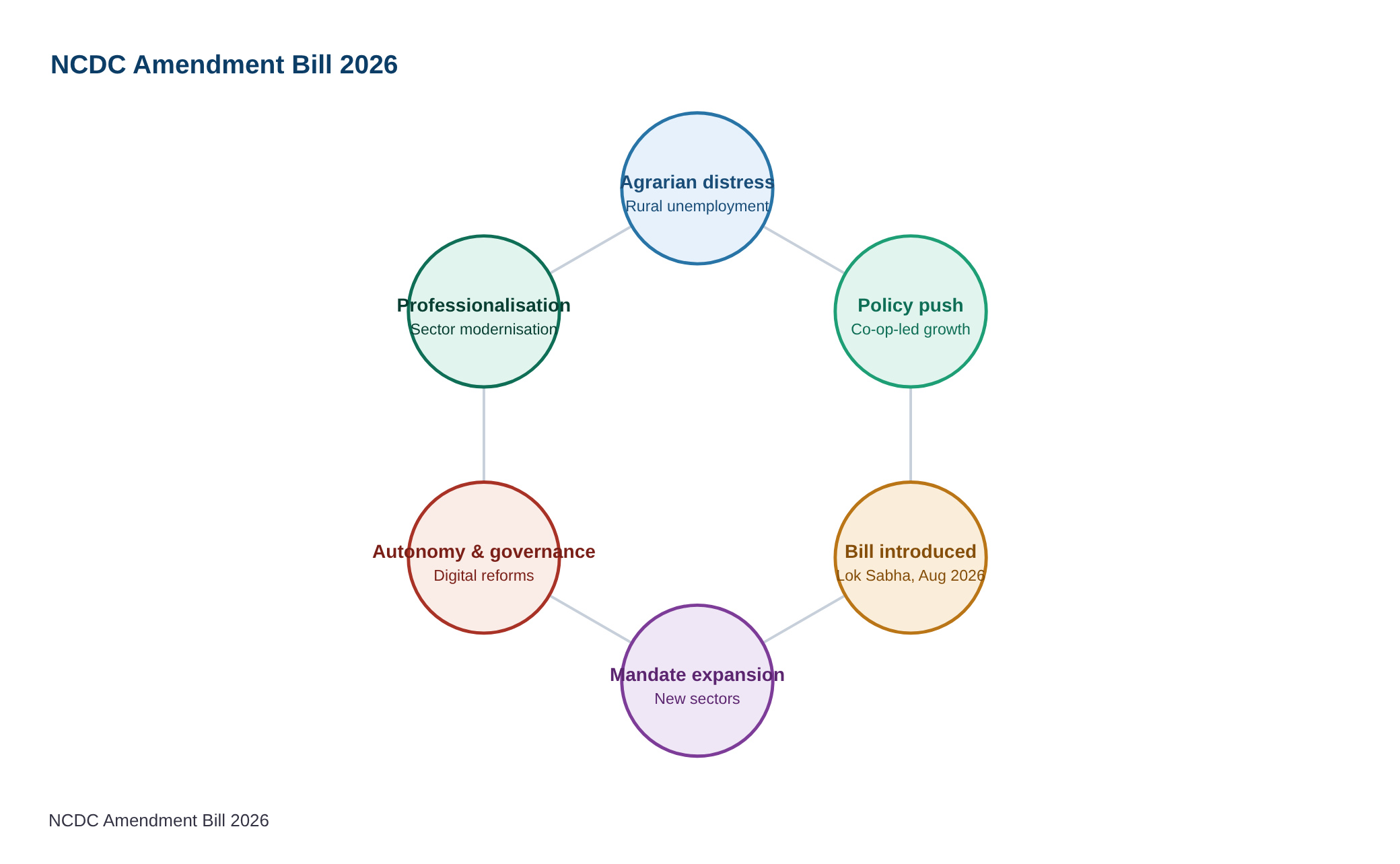
Agrarian distress and rural unemployment → Policy push for co-operative-led growth → Introduction of NCDC Amendment Bill 2026 → Expansion of NCDC’s mandate to new sectors → Increased financial autonomy and digital governance → Professionalisation of co-operatives → Enhanced credit flow to underserved sectors → Inclusive economic growth and reduced import dependence.
Prelims Practice Questions
Q1. Consider the following statements regarding the National Co-operative Development Corporation (NCDC):
1. The NCDC is a statutory body established under the National Co-operative Development Corporation Act, 1962.
2. It functions under the administrative control of the Ministry of Agriculture and Farmers’ Welfare.
3. The NCDC provides financial assistance exclusively to state co-operative banks.
How many of the above statements are correct?
- Only one
- Only two
- All
- None
Answer: Only two — Statement 1 is correct as NCDC was established under the National Co-operative Development Corporation Act, 1962. Statement 2 is incorrect; it functions under the Ministry of Cooperation, not Agriculture and Farmers’ Welfare. Statement 3 is incorrect as NCDC provides financial assistance to a broader range of co-operative institutions, including state co-operative banks, district central co-operative banks, and other co-operative societies.
Q2. Assertion (A): The National Co-operative Development Corporation (Amendment) Bill, 2026 seeks to expand the scope of NCDC’s functions to include digital lending platforms.
Reason (R): The amendment aims to align NCDC’s operations with the recommendations of the Vaidyanathan Committee Report on Agricultural Credit.
- Both A and R are true, and R is the correct explanation of A
- Both A and R are true, but R is not the correct explanation of A
- A is true, but R is false
- A is false, but R is true
Answer: A is false, but R is true — Assertion (A) is false as the amendment does not explicitly mention digital lending platforms. Reason (R) is false because the Vaidyanathan Committee Report primarily focused on strengthening the institutional framework for agricultural credit, not digital lending.
Q3. Match the following Acts with their respective purposes:
Column I
A. Multi-State Co-operative Societies Act, 2002
B. National Co-operative Development Corporation Act, 1962
C. Co-operative Societies Act, 1912
D. Essential Commodities Act, 1955
Column II
1. Regulates the registration and functioning of co-operative societies in a state
2. Provides for the establishment of a statutory body to promote co-operative development
3. Governs the regulation of co-operative societies operating in more than one state
4. Controls the production, supply, and distribution of essential commodities
- A-3, B-2, C-1, D-4
- A-1, B-2, C-3, D-4
- A-2, B-3, C-1, D-4
- A-4, B-1, C-2, D-3
Answer: A-3, B-2, C-1, D-4 — A matches with 3 (Multi-State Co-operative Societies Act, 2002 governs co-operatives operating in multiple states). B matches with 2 (NCDC Act, 1962 establishes the NCDC). C matches with 1 (Co-operative Societies Act, 1912 regulates state-level co-operatives). D matches with 4 (Essential Commodities Act, 1955 controls essential commodity distribution).
Mains Practice Question
✍ The National Co-operative Development Corporation (Amendment) Bill, 2026 seeks to enhance the operational autonomy and financial viability of the National Co-operative Development Corporation (NCDC). Critically examine the significance of this amendment in the context of India’s co-operative sector, with particular reference to its role in agricultural credit and rural development. Also, discuss the constitutional and institutional challenges that may arise in its implementation. (15 Marks)
Approach: MODEL-ANSWER SKELETON:
1. **Introduction (2 marks)**
– Brief background of NCDC: statutory body under the National Co-operative Development Corporation Act, 1962, functioning under the Ministry of Cooperation.
– Core functions: provision of financial assistance, promotion of co-operative development, and support to co-operative societies in agriculture and allied sectors.
– Context of the Amendment Bill: Need for enhanced autonomy, financial sustainability, and alignment with contemporary challenges (e.g., digital transformation, climate change, and farmer distress).
2. **Significance of the Amendment (5 marks)**
– **Operational Autonomy**: Expansion of NCDC’s mandate to include newer financial instruments (e.g., green financing, digital lending) and reduced bureaucratic interference.
– **Financial Viability**: Provisions for raising capital through bonds, equity infusion, or public-private partnerships to address liquidity constraints.
– **Agricultural Credit**: Strengthening of NCDC’s role in providing concessional credit to small and marginal farmers, aligning with schemes like Kisan Credit Card (KCC) and PM-KISAN.
– **Rural Development**: Integration with rural infrastructure development (e.g., warehousing, cold storage) and promotion of Farmer Producer Organisations (FPOs).
– **Policy Alignment**: Harmonisation with the National Cooperative Policy 2023 and recommendations of committees like the Vaidyanathan Committee on agricultural credit.
3. **Constitutional and Institutional Challenges (5 marks)**
– **Federalism**: Potential conflict with state governments over control of co-operative institutions, given the concurrent nature of the subject under Entry 32 of the State List (Co-operative Societies) and Entry 44 of the Union List (Economic Planning).
– **Autonomy vs. Accountability**: Balancing NCDC’s enhanced autonomy with parliamentary oversight and accountability mechanisms (e.g., CAG audits, parliamentary committees).
– **Legal Framework**: Overlap with the Multi-State Co-operative Societies Act, 2002, and need for harmonisation to avoid regulatory conflicts.
– **Capacity Building**: Challenges in building institutional capacity at the grassroots level to utilise enhanced financial resources effectively.
– **Political Economy**: Risk of politicisation of co-operative institutions, given their deep-rooted influence in electoral politics (e.g., sugar co-operatives in Maharashtra).
4. **Conclusion (3 marks)**
– The amendment represents a progressive step toward modernising India’s co-operative sector, but its success hinges on addressing federal tensions, ensuring robust governance, and aligning with broader agricultural and rural development policies.
– Recommendations: Strengthening state-level co-operative federations, leveraging technology for transparency, and ensuring inclusive growth in credit access.
Source: PRS Legislative Research
Generated by AanyaAi for educational purpose.

- Vettri Payanam Scheme: Free Bus Travel for Women in Tamil Nadu - October 4, 2026
- पेंशन अदालत: 17वीं बैठक की अध्यक्षता करेंगे डॉ. जितेंद्र सिंह, जानिए मुख्य बातें - October 4, 2026
- CBN Rajasthan celebrates National Anti-Drug Day with Gandhi Jayanti events - October 4, 2026

No Comments