


11 Aug Kannada groups demand Belagavi CM push BCC for Mahajan Commission resolution
✎ The Mahajan Commission (1966–67) resolved the Belagavi border dispute by recommending the region’s retention within Karnataka, a decision accepted by the Government of India, thereby affirming the constitutional principle of…
Subject Relevance — Where This Topic Fits
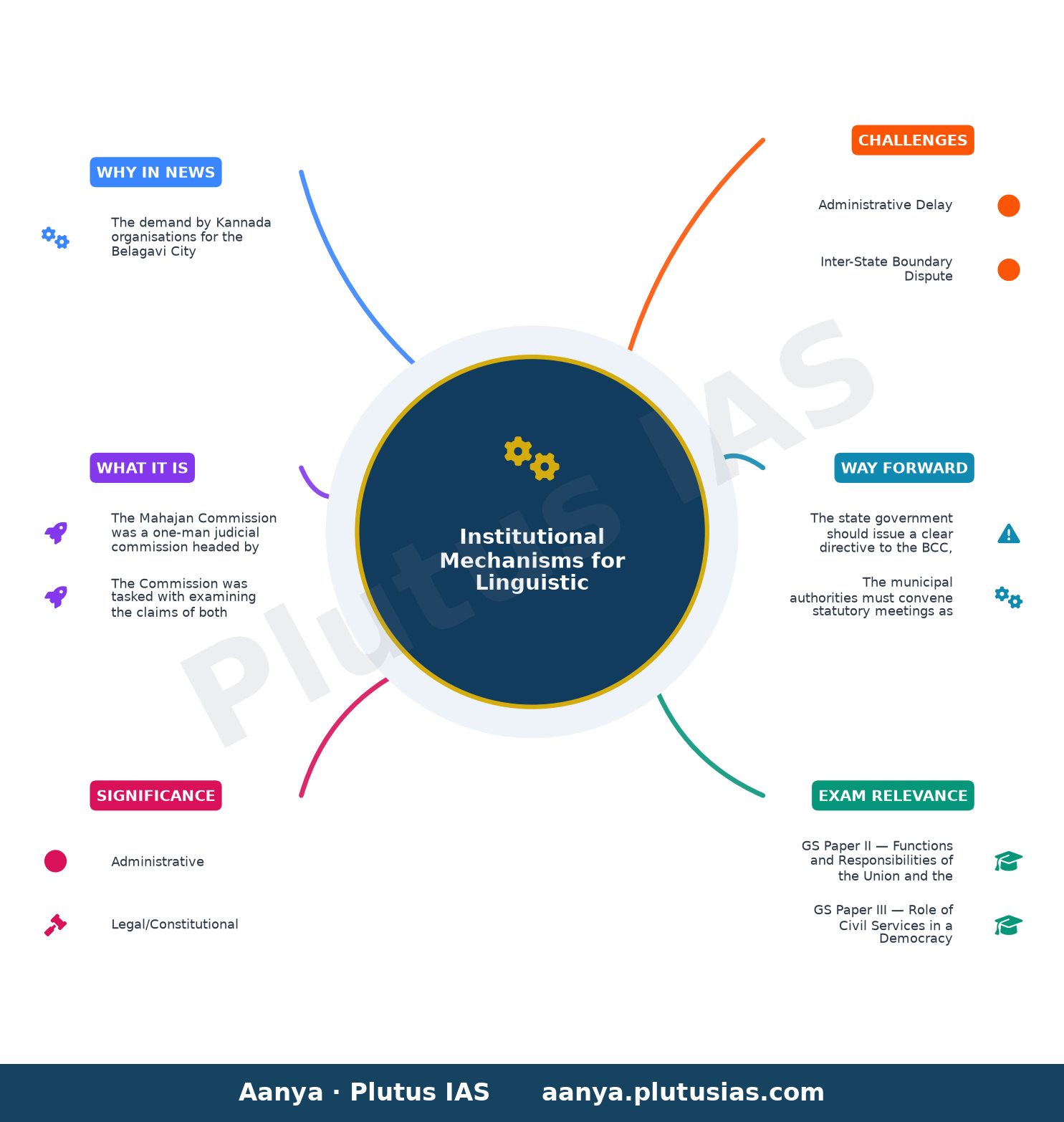
- GS Paper II — Functions and Responsibilities of the Union and the States, Issues and Challenges Pertaining to the Federal Structure | GS Paper III — Role of Civil Services in a Democracy
- Prelims: Mahajan Commission, Belagavi City Corporation (BCC), Constitutional provisions on urban local bodies, Karnataka State Official Language Act, 2008, Inter-State Disputes Resolution, Article 243 of the Constitution (Urban Local Bodies), Federalism in India, Inter-State Water Disputes Act, 1956 (contextual relevance)
Quick Revision: The Mahajan Commission (1966–67) resolved the Belagavi border dispute by recommending the region’s retention within Karnataka, a decision accepted by the Government of India, thereby affirming the constitutional principle of federal cooperation in inter-state territorial disputes.
Why is this in the news?
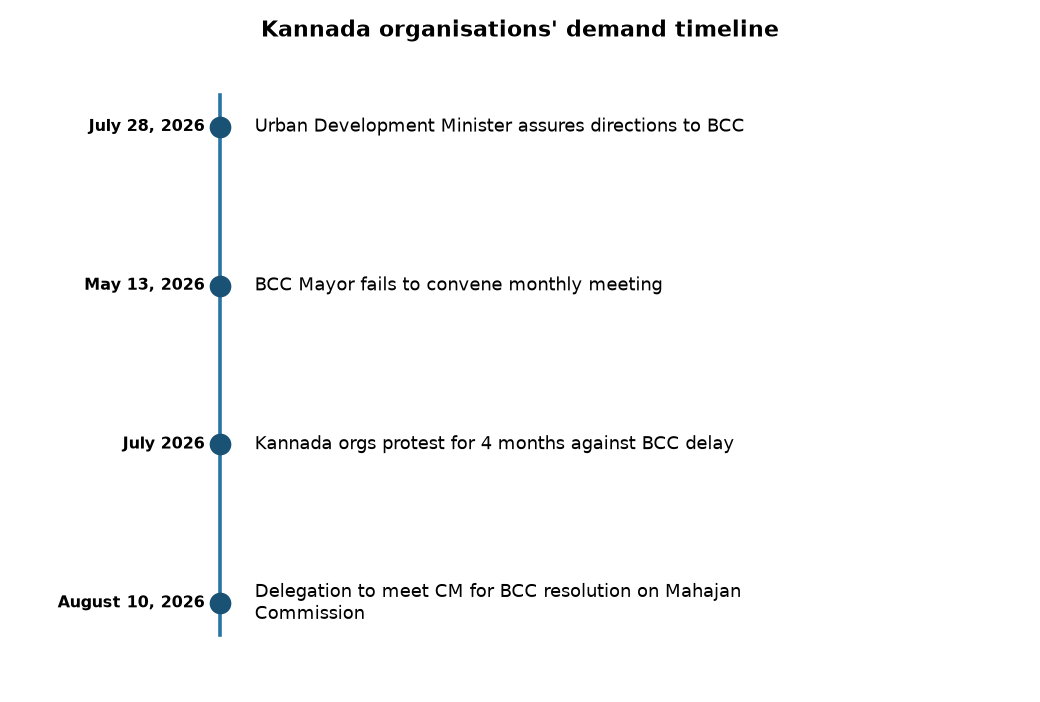
The demand by Kannada organisations for the Belagavi City Corporation (BCC) to pass a resolution affirming Belagavi’s integral status within Karnataka has resurfaced, with a delegation scheduled to meet the Chief Minister of Karnataka. This issue underscores the role of local governance institutions in resolving inter-state disputes and the implementation of constitutional provisions regarding linguistic identity and federal cooperation.
Background
- The Mahajan Commission was constituted in 1966 to resolve the Belagavi (then Belgaum) border dispute between Karnataka and Maharashtra, following the reorganisation of states on linguistic lines.
- The Commission recommended that Belagavi be retained within Karnataka, a decision accepted by the Government of India in 1967, thereby settling the territorial dispute.
- Belagavi remains a focal point for linguistic and cultural assertions by Kannada organisations, which periodically advocate for the affirmation of Karnataka’s administrative and cultural jurisdiction over the region.
- The Belagavi City Corporation (BCC), as an urban local body under the 74th Constitutional Amendment, is mandated to function as a representative institution for local governance and policy implementation.
- The delay in the BCC passing a resolution reaffirming Belagavi’s status within Karnataka has led to prolonged protests by Kannada organisations, highlighting gaps in institutional responsiveness and inter-governmental coordination.
- The Constitution of India, through Article 243, empowers urban local bodies to function as institutions of self-government, with responsibilities including the promotion of local culture and identity.
What is the Mahajan Commission?
- The Mahajan Commission was a one-man judicial commission headed by Justice Mehr Chand Mahajan, constituted by the Government of India in 1966 to adjudicate the Belagavi border dispute between Karnataka (then Mysore) and Maharashtra.
- The Commission was tasked with examining the claims of both states over the Belagavi region, which had been a subject of contention since the linguistic reorganisation of states in 1956.
- In its report submitted in 1967, the Commission recommended that Belagavi be retained within Karnataka, citing linguistic, cultural, and administrative considerations.
- The Government of India accepted the Commission’s recommendations in 1967, thereby settling the territorial dispute and affirming Karnataka’s jurisdiction over Belagavi.
- The Commission’s findings remain a reference point for discussions on inter-state border disputes and the role of judicial commissions in resolving such conflicts.
- The acceptance of the Mahajan Commission’s report underscores the constitutional principle of federal cooperation and the primacy of judicial adjudication in inter-state disputes.
- The Commission’s legacy is invoked in contemporary debates to reinforce the linguistic and cultural identity of Karnataka in regions with historical claims.
Key Features
| Feature | Significance |
|---|---|
| Belagavi City Corporation (BCC) Resolution | A formal declaration by the municipal body affirming Belagavi’s integral status within Karnataka, serving as a symbolic assertion of territorial integrity and administrative jurisdiction. |
| Mahajan Commission | A statutory body constituted to adjudicate inter-state boundary disputes, providing a legal framework for resolving territorial claims between Karnataka and Maharashtra. |
| District in-charge Minister | A state government official entrusted with overseeing administrative functions in Belagavi district, responsible for coordinating between local bodies and higher authorities. |
| Chief Secretary’s Directive | An executive order issued by the state’s highest civil servant to ensure compliance with administrative directives, reinforcing the state government’s position on the matter. |
| Monthly Municipal Meeting | A statutory requirement for urban local bodies to convene meetings, ensuring democratic oversight and accountability in municipal governance. |
Why it Matters
Administrative
- The resolution sought by Kannada organisations would formalise the BCC’s stance on Belagavi’s territorial status, aligning municipal governance with state policy.
- The delay in convening municipal meetings undermines democratic processes and delays civic decision-making, potentially eroding public trust in local institutions.
- The intervention of the Chief Secretary highlights the escalation of a local administrative issue to the state’s highest executive authority, indicating systemic concerns in municipal functioning.
Legal/Constitutional
- The Mahajan Commission operates under the Inter-State River Water Disputes Act, 1956, which also empowers it to adjudicate boundary disputes, making its role pivotal in inter-state territorial disputes.
- The demand for a resolution aligns with the constitutional principle of federalism, where state governments assert jurisdiction over their territories within the framework of constitutional provisions.
Political-Societal
- The agitation reflects long-standing linguistic and cultural assertions by Kannada organisations, underscoring the socio-political significance of territorial identity in Karnataka.
- The delay in addressing the demand may exacerbate local discontent, potentially influencing electoral politics and governance outcomes in the region.
Challenges
1. Administrative Delay
- Prolonged inaction by the BCC despite directives from higher authorities indicates institutional inertia or resistance within local governance structures.
- Failure to convene statutory municipal meetings violates the Karnataka Municipal Corporations Act, 1976, which mandates regular meetings for effective local administration.
- The lack of responsiveness from municipal authorities may erode public confidence in local democratic institutions.
UPSC Link: Local Governance – 73rd & 74th CAAs
2. Inter-State Boundary Dispute
- The Mahajan Commission’s role in adjudicating territorial claims highlights the persistent challenge of inter-state boundary disputes, which can strain federal relations.
- Delays in resolving such disputes may lead to protracted legal and administrative conflicts, impacting regional stability and development.
- The absence of a binding resolution mechanism beyond commissions risks prolonged uncertainty over territorial integrity.
UPSC Link: Inter-State Relations – Article 263
3. Governance Accountability
- The escalation of the issue to the Chief Secretary suggests systemic failures in municipal governance, requiring structural reforms to ensure accountability.
- The lack of coordination between local bodies and state authorities may indicate gaps in the implementation of constitutional provisions for local self-governance.
UPSC Link: Local Governance – Part IX of the Constitution
Challenges — UPSC Perspective
| Issue | Concern |
|---|---|
| Institutional Inertia | Failure of municipal authorities to act despite directives from higher authorities, undermining governance efficacy. |
| Legal Ambiguity | Unresolved territorial disputes between states, leading to prolonged administrative and legal uncertainties. |
| Democratic Deficit | Non-convening of statutory municipal meetings, violating principles of participatory governance. |
| Federal Tensions | Potential strain in inter-state relations due to unresolved boundary disputes, impacting cooperative federalism. |
| Public Trust Erosion | Perceived lack of responsiveness from local institutions, fostering disillusionment among citizens. |
Way Forward
- The state government should issue a clear directive to the BCC, mandating the passage of the resolution within a stipulated timeframe to uphold administrative accountability.
- The municipal authorities must convene statutory meetings as per the Karnataka Municipal Corporations Act, 1976, to restore democratic processes.
- A high-level committee comprising representatives from the state government, municipal authorities, and civil society should be constituted to expedite the resolution of the territorial dispute.
- The Mahajan Commission should be empowered to expedite its proceedings or provide interim recommendations to reduce uncertainty over Belagavi’s status.
- Public awareness campaigns should be undertaken to educate citizens on the legal and administrative processes involved in inter-state boundary disputes.
- The state government should explore constitutional mechanisms, such as a Presidential reference under Article 143, to seek clarity on the territorial dispute.
- Local governance reforms, including capacity-building for municipal officials, should be prioritised to prevent future administrative lapses.
UPSC Value Addition
Keywords for Mains Answer-Writing
Belagavi City Corporation (BCC) · Mahajan Commission · Karnataka-Karnataka border dispute · Urban Local Bodies (ULBs) · Constitutional provisions for municipal governance · Role of the Chief Minister in local governance · Mayor’s powers and responsibilities · Constitutional and statutory bodies in Karnataka · Inter-state boundary disputes · Local self-government in India · Directive principles of State Policy (Article 40) · 74th Constitutional Amendment Act, 1992 · Karnataka Municipal Corporations Act, 1976 · Constitutional remedies for local governance issues · Role of the Chief Secretary in administrative oversight
Constitutional & Policy Linkages
- Article 263 – Inter-State Council for dispute resolution
Concept Flow
Demand for BCC resolution on Belagavi’s territorial status → Failure of municipal authorities to act despite directives → Escalation to state government and Chief Secretary → Legal recourse via Mahajan Commission or constitutional mechanisms → Potential resolution through state intervention or judicial review → Impact on local governance, federal relations, and public trust
Prelims Practice Questions
Q1. Consider the following statements regarding the Belagavi City Corporation (BCC) and the Mahajan Commission:
1. The BCC is an urban local body governed by the Karnataka Municipal Corporations Act, 1976.
2. The Mahajan Commission was constituted to resolve the Karnataka-Maharashtra border dispute.
3. The 74th Constitutional Amendment Act, 1992, mandates the establishment of urban local bodies but does not specify their powers or functions.
How many of the above statements are correct?
- Only one
- Only two
- All three
- None
Answer: Only two — Statement 1 is correct as the BCC operates under the Karnataka Municipal Corporations Act, 1976. Statement 2 is correct as the Mahajan Commission was indeed constituted to address the Karnataka-Maharashtra border dispute. Statement 3 is incorrect because the 74th Constitutional Amendment Act, 1992, not only mandates the establishment of urban local bodies but also defines their powers, functions, and responsibilities under the 12th Schedule.
Q2. Assertion (A): The Chief Minister of a state has the constitutional authority to issue directions to urban local bodies (ULBs) regarding their functioning.
Reason (R): The Constitution of India, under Article 243W, empowers the state legislature to endow ULBs with such functions and powers as it deems necessary.
Select the correct answer using the code below:
- Both A and R are true, and R is the correct explanation of A
- Both A and R are true, but R is not the correct explanation of A
- A is true, but R is false
- A is false, but R is true
Answer: A is true, but R is false — Assertion (A) is true as the Chief Minister, as the head of the state government, can issue administrative directions to ULBs, though such directions are subject to constitutional and statutory limits. Reason (R) is true as Article 243W empowers the state legislature to confer functions and powers on ULBs. However, R does not directly explain A, as the Chief Minister’s authority to issue directions is derived from the constitutional scheme of governance and not solely from Article 243W.
Q3. Which of the following pairs is correctly matched with reference to the governance of urban local bodies in India?
- 73rd Constitutional Amendment Act, 1992 – Panchayati Raj Institutions
- 74th Constitutional Amendment Act, 1992 – Municipalities
- Article 243W – Powers of the Governor
- Article 243ZD – Functions of the State Election Commission
Answer: 74th Constitutional Amendment Act, 1992 – Municipalities — The 73rd Constitutional Amendment Act, 1992, pertains to Panchayati Raj Institutions, while the 74th Constitutional Amendment Act, 1992, pertains to Municipalities. Article 243W deals with the powers, authority, and responsibilities of Municipalities, and Article 243ZD pertains to the State Finance Commission.
Mains Practice Question
✍ The demand for a resolution by the Belagavi City Corporation (BCC) affirming Belagavi’s integral part of Karnataka reflects underlying tensions in inter-state boundary disputes and the role of urban local bodies (ULBs) in governance. Critically examine the constitutional and statutory framework governing ULBs in resolving such disputes, with particular reference to the 74th Constitutional Amendment Act, 1992, and the Karnataka Municipal Corporations Act, 1976. (15 Marks)
Approach: MODEL-ANSWER SKELETON:
1. **Constitutional Framework**:
– Explain the 74th Constitutional Amendment Act, 1992, and its significance in empowering ULBs (Articles 243P to 243ZG).
– Highlight the 12th Schedule, which enumerates the functions and powers of ULBs, including urban planning, public health, and local economic development.
– Discuss the role of the state legislature in conferring additional functions and powers on ULBs under Article 243W.
2. **Statutory Framework in Karnataka**:
– Outline the Karnataka Municipal Corporations Act, 1976, and its provisions governing the BCC, including the roles of the Mayor, Deputy Mayor, and Council.
– Explain the powers of the Mayor under the Act, including the convening of meetings and the passage of resolutions.
– Discuss the administrative oversight mechanisms, such as the role of the Chief Minister, Chief Secretary, and state government in directing ULBs.
3. **Inter-State Boundary Disputes and ULBs**:
– Examine the constitutional and legal provisions governing inter-state boundary disputes (Article 3 of the Constitution).
– Discuss the role of ULBs in such disputes, including their limited jurisdiction and the primacy of the state and central governments in resolving boundary issues.
– Highlight the limitations of ULBs in resolving such disputes, as they lack the constitutional authority to alter state boundaries.
4. **Recent Developments and Challenges**:
– Analyse the specific case of Belagavi, including the demand for a resolution by the BCC and the administrative delays.
– Discuss the role of the Mahajan Commission and its recommendations in the context of the dispute.
– Evaluate the effectiveness of the constitutional and statutory framework in addressing such disputes, including the need for timely administrative action and transparency.
5. **Conclusion**:
– Summarise the key points and provide a balanced view on the role of ULBs in resolving inter-state boundary disputes.
– Suggest measures to enhance the efficacy of ULBs in such contexts, such as strengthening administrative oversight, ensuring timely resolution of disputes, and promoting transparency and accountability.
Source: The Hindu
Generated by AanyaAi for educational purpose.

- खनिजों पर राज्य कर लगाने पर रोक लगाने वाला विधेयक संसद में पेश, विपक्ष ने समिति की समीक्षा की मांग की - August 11, 2026
- कर्नाटक सरकार ने सुप्रीम कोर्ट में बताया, बाइक टैक्सियां सार्वजनिक परिवहन नहीं हैं - August 11, 2026
- Centre tables bill to bar state taxes on minerals; Opposition demands review - August 11, 2026

No Comments