


11 Aug Kerala HC Stays SIC Order on PSC Mark Disclosure: RTI vs Privacy Debate
✎ The Kerala High Court’s interim stay highlights the tension between the RTI Act’s transparency mandate and the constitutional right to privacy, particularly concerning third-party information in recruitment processes.
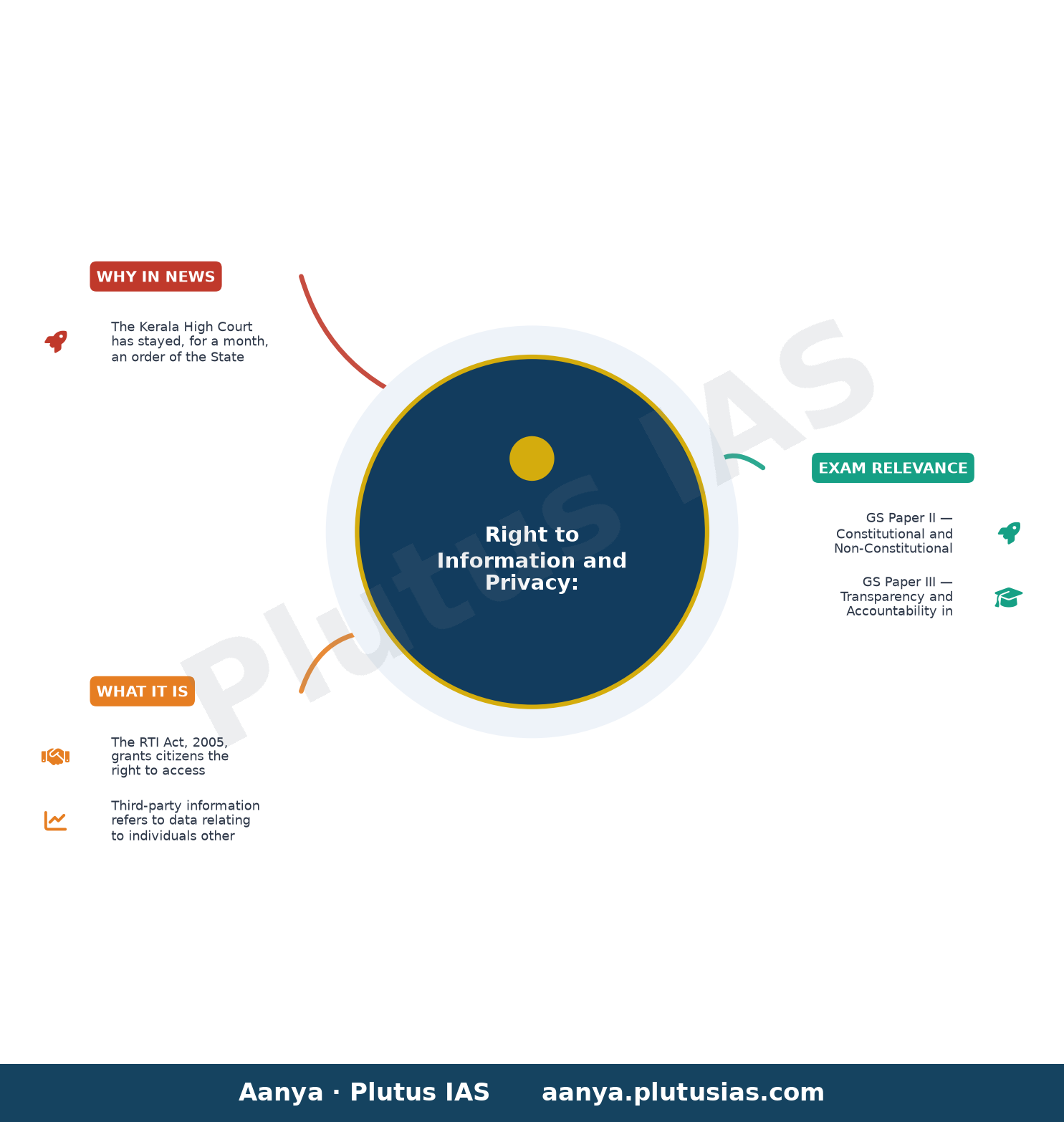
Subject Relevance — Where This Topic Fits
- GS Paper II — Constitutional and Non-Constitutional Bodies (State Information Commissions) | GS Paper III — Transparency and Accountability in Governance | GS Paper IV — Ethics in Governance (Confidentiality vs. Transparency)
- Prelims: Right to Information Act, 2005, State Information Commission, Public Service Commission, Privacy rights under Article 21, Third-party information under RTI
- Essay: Transparency in governance: Balancing public interest and individual privacy, The role of judicial intervention in upholding constitutional rights
Quick Revision: The Kerala High Court’s interim stay highlights the tension between the RTI Act’s transparency mandate and the constitutional right to privacy, particularly concerning third-party information in recruitment processes.
Why is this in the news?
The Kerala High Court has stayed, for a month, an order of the State Information Commission directing the Kerala Public Service Commission (PSC) to disclose examination-related records, including marks and personal details of candidates, to the Kerala State Planning Board. The case raises critical questions about the balance between the Right to Information (RTI) Act’s mandate for transparency and the constitutional right to privacy, particularly concerning third-party information in recruitment processes.
Background
- The Right to Information (RTI) Act, 2005, empowers citizens to seek information from public authorities, subject to exemptions such as personal information that has no public interest.
- State Information Commissions (SICs) are quasi-judicial bodies constituted under the RTI Act to adjudicate disputes between information seekers and public authorities.
- The Kerala Public Service Commission (PSC) conducts recruitment examinations for civil services and other posts, handling data of over 1.25 crore candidates annually.
- The PSC routinely publishes marks and rank lists after completing selection processes, but withholds personal documents (e.g., experience certificates) and detailed marks to protect candidate privacy.
- The PSC challenged the KSIC’s order before the Kerala High Court, arguing that the disclosure violated privacy rights and was impractical given the volume of data.
Right to Information and Privacy: Legal and Institutional Framework
- The RTI Act, 2005, grants citizens the right to access information held by public authorities, with Section 8 providing exemptions for personal information that could harm privacy unless a larger public interest is established.
- Third-party information refers to data relating to individuals other than the applicant, which requires careful consideration under the RTI Act to balance transparency and privacy.
- State Information Commissions (SICs) function as appellate authorities under the RTI Act, tasked with resolving disputes between applicants and public authorities while interpreting exemptions.
- Public Service Commissions (PSCs) are constitutional bodies (Article 320) responsible for conducting fair and transparent recruitment processes, including examinations and interviews.
- The Kerala PSC’s contention revolves around the impracticality of disclosing personal documents (e.g., experience certificates) for over 1.25 crore candidates, which could compromise privacy and administrative efficiency.
- Judicial precedents, such as *RBI v. Jayantilal N. Mistry* (2016), have emphasized the need to balance RTI with privacy, particularly when disclosing third-party information.
- The Kerala High Court’s interim stay reflects the judiciary’s role in adjudicating conflicts between transparency and privacy, ensuring that RTI requests do not infringe upon constitutional rights.
- The case underscores the broader debate on whether examination-related data (e.g., marks, interview scores) should be treated as public information or protected under privacy exemptions.
UPSC Value Addition
Keywords for Mains Answer-Writing
Right to Information Act, 2005 · Public Service Commission · Privacy rights under RTI · Judicial review of RTI orders · State Information Commission · Public interest disclosure · Exemption under Section 8 of RTI Act · Constitutional right to privacy · Recruitment transparency · Data protection in governance
Prelims Practice Questions
Q1. Consider the following statements regarding the Right to Information (RTI) Act, 2005:
1. The RTI Act mandates the disclosure of all information sought by citizens without exception.
2. Section 8 of the RTI Act provides for certain exemptions from disclosure, including information that affects the privacy of individuals.
3. The State Information Commission (SIC) has the authority to direct public authorities to disclose information even if the same is exempted under Section 8.
4. The Kerala High Court, in a recent judgment, upheld the SIC’s order directing the Kerala Public Service Commission (KPSC) to disclose personal information of candidates.
How many of the above statements are correct?
- Only one
- Only two
- Only three
- All
Answer: Only three — Statements 1 and 4 are incorrect. The RTI Act does not mandate disclosure without exception (Statement 1 is wrong). The Kerala High Court stayed the SIC’s order, not upheld it (Statement 4 is wrong). Statements 2 and 3 are correct as they accurately reflect the provisions of Section 8 and the powers of the SIC.
Q2. Assertion (A): The Right to Information Act, 2005, balances transparency and privacy by providing exemptions under Section 8.
Reason (R): The Act explicitly excludes personal information of third parties from disclosure unless a larger public interest is established.
In the context of the above two statements, which one of the following is correct?
- Both A and R are true, and R is the correct explanation of A.
- Both A and R are true, but R is not the correct explanation of A.
- A is true, but R is false.
- A is false, but R is true.
Answer: Both A and R are true, but R is not the correct explanation of A. — Both the Assertion (A) and Reason (R) are true. The RTI Act indeed balances transparency and privacy through Section 8 exemptions, and the Reason (R) correctly explains the Assertion (A) by stating that personal information of third parties is excluded unless larger public interest is demonstrated.
Q3. Match the following provisions of the Right to Information Act, 2005, with their correct descriptions:
Column I (Provisions)
A. Section 8(1)(j)
B. Section 8(1)(d)
C. Section 11
D. Section 6
Column II (Descriptions)
1. Provides for the procedure for seeking information.
2. Exempts personal information, the disclosure of which has no relationship to any public activity or interest.
3. Mandates consultation with third parties before disclosing information that relates to or has been supplied by them.
4. Exempts information including commercial confidence, trade secrets, or intellectual property.
Answer: ? —
Mains Practice Question
✍ The Kerala High Court’s interim stay on the State Information Commission’s order directing the Kerala Public Service Commission (KPSC) to disclose personal information and examination records of candidates raises critical questions about the balance between transparency and privacy under the Right to Information (RTI) Act, 2005. Critically examine the legal and constitutional dimensions of this issue. (15 Marks)
Approach: MODEL-ANSWER SKELETON:
1. **Context and Facts**: Briefly state the Kerala High Court’s order, the Kerala State Information Commission’s directive, and the KPSC’s contention regarding privacy and impracticality.
2. **RTI Act Framework**: Explain the statutory provisions governing disclosure under the RTI Act, 2005, focusing on:
– Section 6 (procedure for seeking information),
– Section 8 (exemptions, particularly Section 8(1)(j) on personal information),
– Section 11 (consultation with third parties).
3. **Judicial Precedents**: Cite relevant Supreme Court and High Court judgments on RTI and privacy, such as:
– *RBI v. Jayantilal N. Mistry* (2016) on the balance between transparency and privacy,
– *Girish Ramchandra Deshpande v. Central Information Commission* (2012) on personal information exemptions.
4. **Constitutional Dimensions**: Discuss the constitutional right to privacy (Puttaswamy judgment, 2017) and its interplay with the RTI Act. Highlight the doctrine of proportionality in limiting privacy rights.
5. **Public Interest Test**: Explain the requirement under Section 8(1)(j) that disclosure of personal information must serve a larger public interest. Discuss whether the State Information Commission’s order met this threshold.
6. **Practical Challenges**: Acknowledge the KPSC’s argument about the impracticality of disclosing personal information for 1.25 crore candidates and the need for systemic safeguards.
7. **Conclusion**: Take a reasoned position on whether the High Court’s interim stay is justified, balancing transparency, privacy, and administrative feasibility. Suggest reforms, if any, to harmonise these competing interests.
Source: The Hindu
Generated by AanyaAi for educational purpose.

- Gurugram’s groundwater extraction exceeds limit by 212%; HC seeks ban - October 4, 2026
- स्वतंत्रता सेनानी श्यामजी कृष्ण वर्मा की जन्म जयंती पर पीएम का श्रद्धांजलि - October 4, 2026
- KWML’s Feasibility Reports for Water Metro in 18 Cities: UPSC & PCS Insights - October 3, 2026

No Comments