


11 Aug Aravallis Panel Urged: Visit All Districts Before Submitting Report to SC
✎ The Supreme Court-appointed High-Powered Committee (HPC) on the Aravallis must prioritise on-ground consultations with local communities in all 64 districts to ensure that its recommendations are participatory, evidence-based…
Subject Relevance — Where This Topic Fits
- GS Paper II — Constitutional and Statutory Bodies | GS Paper III — Environment and Biodiversity | GS Paper III — Conservation, Environmental Pollution and Degradation | GS Paper IV — Ethical Governance and Citizen Participation
- Prelims: Aravalli Range, Environmental Impact Assessment (EIA), Supreme Court-appointed Committees, Forest Rights Act, 2006, Mining Leases, Public Hearings under EIA Notification 2006, National Green Tribunal (NGT), Panchayati Raj Institutions, Right to Information (RTI) Act
- Essay: The Role of Judiciary in Environmental Governance, Balancing Development and Environmental Conservation: The Case of the Aravallis
Quick Revision: The Supreme Court-appointed High-Powered Committee (HPC) on the Aravallis must prioritise on-ground consultations with local communities in all 64 districts to ensure that its recommendations are participatory, evidence-based, and aligned with constitutional and statutory provisions for environmental governance.
Why is this in the news?
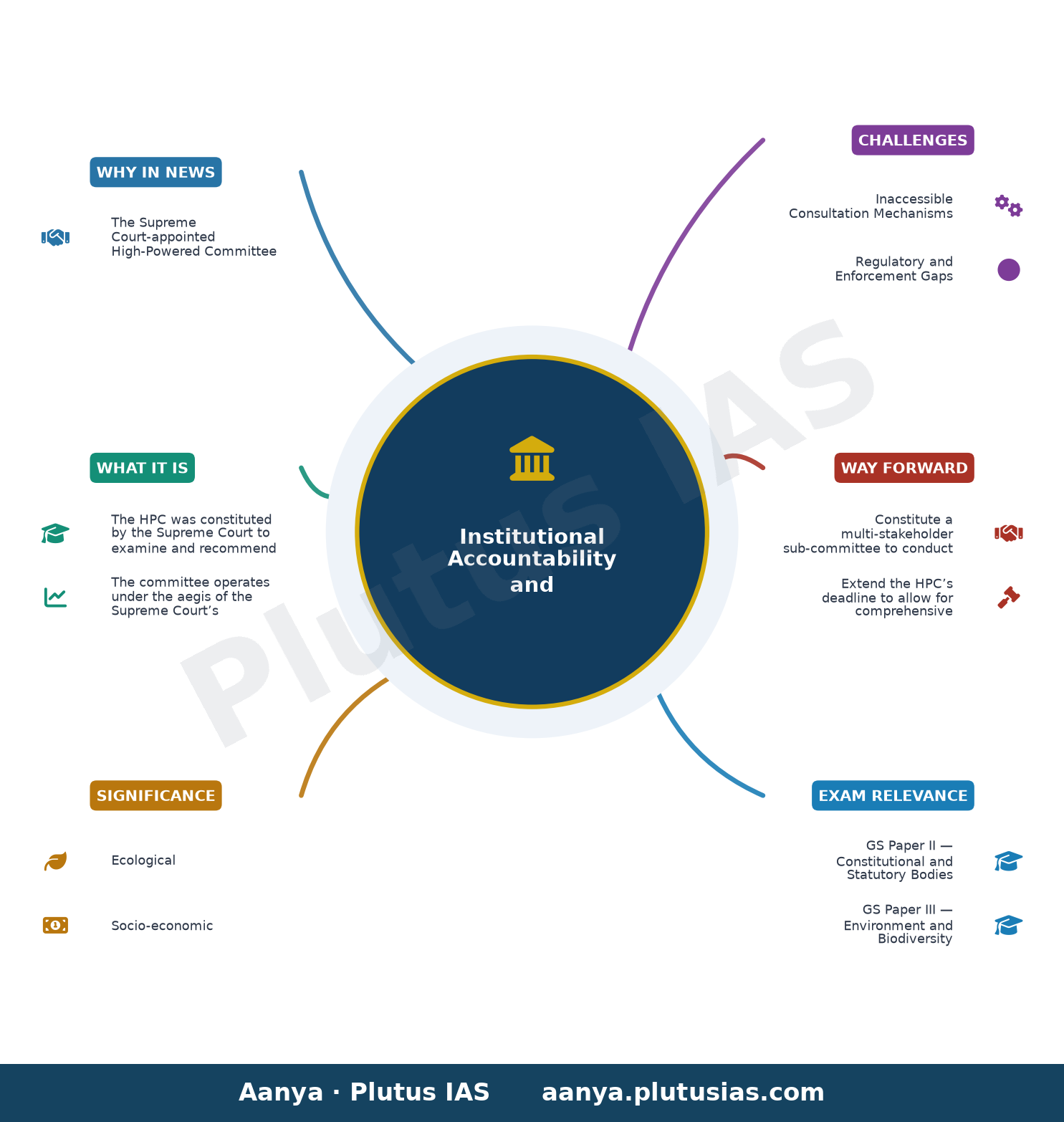
The Supreme Court-appointed High-Powered Committee (HPC) on the Aravalli Range has been criticised by the Aravalli Virasat Jan Abhiyaan (AVJA) for failing to conduct on-ground consultations in mining-affected villages across the 64 districts it spans in Delhi, Haryana, Rajasthan, Uttar Pradesh, and Gujarat. The AVJA has demanded an extension of the HPC’s deadline to submit its report to the Supreme Court, citing the necessity of meaningful consultations with rural communities to ensure informed and participatory decision-making in the protection of India’s oldest mountain range.
Background
- The Aravalli Range, spanning approximately 692 km, is one of the oldest fold mountains in the world and a critical ecological zone in northern India, providing essential ecosystem services such as groundwater recharge, climate regulation, and biodiversity conservation.
- The range traverses five states—Delhi, Haryana, Rajasthan, Uttar Pradesh, and Gujarat—supporting over 10% of India’s human population and hosting diverse flora and fauna, including several endangered species.
- Historically, the Aravallis have faced severe degradation due to unregulated mining, illegal encroachments, and urbanisation, leading to soil erosion, loss of biodiversity, and adverse impacts on local communities.
- The Supreme Court, in a series of landmark judgments (e.g., *T.N. Godavarman Thirumulpad v. Union of India*, 1996), has repeatedly emphasised the need for strict conservation measures in the Aravallis, including the prohibition of mining activities in ecologically sensitive zones.
- The National Green Tribunal (NGT) has also adjudicated on multiple cases related to illegal mining and environmental degradation in the Aravallis, imposing penalties and directing state governments to restore degraded areas.
What is the Supreme Court-appointed High-Powered Committee (HPC) on the Aravallis?
- The HPC was constituted by the Supreme Court to examine and recommend measures for the conservation and restoration of the Aravalli Range, following concerns over environmental degradation and illegal mining.
- The committee operates under the aegis of the Supreme Court’s directives, ensuring compliance with constitutional and statutory provisions for environmental protection, including the Forest Conservation Act, 1980, and the Environment Protection Act, 1986.
- The HPC’s mandate includes conducting field visits, public consultations, and expert evaluations to assess the ecological status of the Aravallis and recommend policy and legal measures for their protection.
- The committee is expected to engage with local communities, particularly those affected by mining and environmental degradation, to ensure that their concerns are integrated into the decision-making process.
- The HPC’s report, once submitted to the Supreme Court, will serve as a key document for judicial and executive actions aimed at restoring the ecological integrity of the Aravallis.
- The committee’s work is guided by the principles of sustainable development, intergenerational equity, and the precautionary principle, as enshrined in India’s environmental jurisprudence.
- The HPC’s proceedings are subject to judicial review, and its recommendations may lead to the imposition of restrictions on mining, land-use changes, or other regulatory measures to protect the Aravallis.
Key Features
| Feature | Significance |
|---|---|
| Aravalli Virasat Jan Abhiyaan (AVJA) | A coalition of environmentalists and activists advocating for the ecological and socio-economic rights of communities affected by mining and degradation in the Aravalli range. |
| Supreme Court-appointed High-Powered Committee (HPC) | Constituted to assess the ecological status and governance challenges of the Aravalli range, with a mandate to submit recommendations to the apex court. |
| Public hearings in urban centres | Formal consultations conducted by the HPC, often inaccessible to rural communities due to logistical and communication barriers. |
| Mining-affected villages | Rural settlements in the Aravalli range experiencing environmental degradation, health hazards, and socio-economic disruptions due to unregulated mining activities. |
| Panchayati Raj Institutions (PRIs) | Local self-government bodies in rural areas, whose engagement is critical for grassroots-level consultations on environmental governance. |
Why it Matters
Ecological
- The Aravalli range is one of the oldest mountain systems in the world, acting as a critical ecological buffer against desertification and supporting biodiversity hotspots.
- The range is a major water recharge zone, with its degradation directly impacting groundwater levels in northern India.
- Mining activities in the Aravallis have led to soil erosion, loss of forest cover, and disruption of wildlife corridors, threatening species like the leopard and the Indian grey wolf.
Socio-economic
- Rural communities in the Aravalli belt face severe health impacts due to dust pollution from mining and stone-crushing activities, including respiratory diseases and skin disorders.
- Livelihoods dependent on agriculture and forest-based resources are at risk due to environmental degradation and water scarcity.
- Marginalised communities, particularly women and children, bear disproportionate burdens of environmental degradation, exacerbating socio-economic inequalities.
Legal and Governance
- The Supreme Court’s intervention underscores the judiciary’s role in environmental governance, particularly in cases of ecological degradation and regulatory failures.
- The HPC’s mandate reflects the need for multi-stakeholder consultations to ensure inclusive and evidence-based policy-making.
- The case highlights the challenges of implementing environmental laws such as the Forest Conservation Act, 1980, and the Mines and Minerals (Development and Regulation) Act, 1957, in ecologically sensitive regions.
Institutional
- The HPC’s composition and functioning demonstrate the role of expert committees in addressing complex environmental governance issues with judicial oversight.
- The AVJA’s advocacy highlights the importance of civil society engagement in environmental policy and enforcement.
Challenges
1. Inaccessible Consultation Mechanisms
- Public hearings held in urban centres exclude rural communities, particularly women, the elderly, and marginalised groups, due to logistical and communication barriers.
- Lack of prior intimation to local panchayats and village authorities results in low participation and misrepresentation of ground realities.
- Threats and intimidation faced by participants at public hearings, particularly in mining-affected areas, undermine the integrity of the consultation process.
UPSC Link: GS-III: Environmental Governance
2. Regulatory and Enforcement Gaps
- Unregulated and illegal mining activities persist despite legal frameworks, indicating systemic failures in enforcement and monitoring.
- Overlapping jurisdictions between state forest departments, mining authorities, and local governments create regulatory ambiguities and gaps.
- Weak institutional capacity at the grassroots level hampers effective implementation of environmental laws and policies.
UPSC Link: GS-III: Environmental Laws
3. Health and Livelihood Impacts
- Chronic exposure to dust and particulate matter from mining and stone-crushing leads to respiratory and dermatological diseases, particularly among vulnerable populations.
- Degradation of the Aravalli range disrupts traditional livelihoods such as agriculture, animal husbandry, and forest-based activities, exacerbating poverty.
- Lack of healthcare infrastructure in rural areas compounds the health impacts of environmental degradation.
UPSC Link: GS-II: Health and GS-III: Sustainable Development
4. Judicial and Policy Constraints
- The HPC’s tight deadline (August 31) may compromise the quality and inclusivity of its recommendations, leading to suboptimal outcomes.
- The absence of a unified national policy for the protection of ecologically sensitive mountain ranges like the Aravallis creates jurisdictional and implementation challenges.
- Balancing economic development with ecological conservation remains a persistent challenge in policy formulation and judicial interventions.
UPSC Link: GS-II: Judiciary and GS-III: Environmental Policy
Challenges — UPSC Perspective
| Issue | Concern |
|---|---|
| Public hearing accessibility | Urban-centric hearings exclude rural stakeholders, leading to underrepresentation of affected communities. |
| Regulatory enforcement | Illegal mining and weak monitoring persist despite legal provisions, indicating systemic failures in governance. |
| Health impacts | Mining-related pollution causes respiratory and dermatological diseases, particularly among marginalised groups. |
| Livelihood disruptions | Environmental degradation threatens traditional livelihoods, exacerbating socio-economic vulnerabilities. |
| Judicial timelines | Tight deadlines for committee reports may compromise inclusivity and evidence-based recommendations. |
| Institutional coordination | Overlapping jurisdictions between agencies create regulatory ambiguities and enforcement gaps. |
Way Forward
- Constitute a multi-stakeholder sub-committee to conduct field visits across all 64 districts in the Aravalli range, ensuring representation of rural communities, women, and marginalised groups.
- Extend the HPC’s deadline to allow for comprehensive consultations, including unannounced visits to mining-affected villages and interactions with local panchayats.
- Strengthen communication mechanisms by disseminating information about public hearings through local radio, newspapers, panchayat offices, and mobile-based alerts.
- Enhance transparency by publishing the HPC’s itinerary, minutes of public hearings, and draft recommendations for public feedback before finalisation.
- Collaborate with state forest departments and mining authorities to conduct joint inspections and audits of mining sites, ensuring compliance with environmental laws.
- Develop a grievance redressal mechanism for affected communities to report violations of environmental norms and seek remediation.
- Integrate health impact assessments into environmental governance frameworks to address the socio-economic consequences of mining-related pollution.
- Establish a dedicated fund for the rehabilitation of mining-affected areas, focusing on afforestation, water conservation, and livelihood restoration.
UPSC Value Addition
Keywords for Mains Answer-Writing
Aravalli Range · Environmental governance · Supreme Court-appointed committees · Mining regulation · Public participation in environmental decision-making · Ecological conservation · Inter-state coordination · Judicial activism in environmental matters · Sustainable development · Forest Rights Act, 2006 · National Green Tribunal (NGT) · Environmental Impact Assessment (EIA) 2006 · Biodiversity conservation
Concept Flow
Unregulated mining and stone-crushing in the Aravalli range → Environmental degradation (soil erosion, loss of forest cover, water scarcity) → Health impacts (respiratory diseases, skin disorders) and livelihood disruptions (agriculture, forest-based activities) → Weak enforcement of environmental laws (Forest Conservation Act, 1980; Mines and Minerals Act, 1957) → Systemic regulatory gaps and overlapping jurisdictions → Supreme Court intervention via High-Powered Committee (HPC) → Public hearings in urban centres exclude rural stakeholders → AVJA raises concerns over inclusivity and ground-level consultations → HPC’s tight deadline risks suboptimal recommendations → Call for field visits, extended timelines, and transparent consultations → Pathway to inclusive environmental governance and sustainable development.
Prelims Practice Questions
Q1. Consider the following statements regarding the Aravalli Range:
1. The Aravalli Range is the oldest mountain range in India.
2. It spans across five states: Delhi, Haryana, Rajasthan, Uttar Pradesh, and Gujarat.
3. The range is primarily composed of sedimentary rocks.
4. Mining activities in the Aravalli Range have been linked to health issues in local communities.
How many of the above statements are correct?
- Only one
- Only two
- Only three
- All four
Answer: All four — Statements 1, 2, and 4 are correct. The Aravalli Range is indeed the oldest mountain range in India. It spans five states as mentioned. Mining activities have been associated with health issues such as respiratory and skin diseases in local communities. Statement 3 is incorrect as the Aravalli Range is primarily composed of metamorphic rocks, not sedimentary rocks.
Q2. Assertion (A): The Supreme Court of India has the power to constitute High-Powered Committees for environmental governance.
Reason (R): The Supreme Court can issue directions under Article 32 of the Constitution to protect and improve the environment.
Options:
A. Both A and R are true, and R is the correct explanation of A.
B. Both A and R are true, but R is not the correct explanation of A.
C. A is true, but R is false.
D. A is false, but R is true.
Answer: ? — Both the Assertion (A) and Reason (R) are true. The Supreme Court has the power to constitute High-Powered Committees under its writ jurisdiction under Article 32 of the Constitution to address environmental concerns. The Reason (R) correctly explains the Assertion (A).
Q3. Match the following environmental legislations with their respective objectives:
Column I (Legislation) | Column II (Objective)
— | —
1. Forest Rights Act, 2006 | A. Regulates environmental clearances for projects
2. Environmental Impact Assessment (EIA) Notification, 2006 | B. Recognizes and vests forest rights in forest-dwelling communities
3. National Green Tribunal Act, 2010 | C. Provides for the establishment of a specialized tribunal for environmental disputes
4. Wildlife Protection Act, 1972 | D. Protects wild animals, birds, and plants and their habitats
Options:
A. 1-B, 2-A, 3-C, 4-D
B. 1-A, 2-B, 3-D, 4-C
C. 1-C, 2-D, 3-A, 4-B
D. 1-D, 2-C, 3-B, 4-A
Answer: ? — The correct matches are: 1-B (Forest Rights Act, 2006 recognizes forest rights), 2-A (EIA Notification, 2006 regulates environmental clearances), 3-C (National Green Tribunal Act, 2010 establishes a tribunal for environmental disputes), and 4-D (Wildlife Protection Act, 1972 protects wildlife).
Mains Practice Question
✍ The Supreme Court-appointed High-Powered Committee (HPC) on the Aravalli Range faces criticism for inadequate ground-level consultations with affected communities before finalizing its report. Critically examine the role of judicial activism in environmental governance in India, with reference to the Aravalli case. Also, assess the importance of public participation in environmental decision-making as envisaged under constitutional and statutory frameworks. (15 Marks)
Approach: MODEL-ANSWER SKELETON:
1. **Judicial Activism in Environmental Governance**:
– Define judicial activism in the context of environmental governance (e.g., PILs under Article 32/226, suo motu cognizance).
– Cite landmark cases: MC Mehta v. Union of India (1986, Oleum Gas Leak case), Vellore Citizens Welfare Forum v. Union of India (1996, sustainable development), and recent Aravalli-related orders.
– Discuss the role of the Supreme Court in constituting committees (e.g., HPC for Aravallis) and issuing directions for environmental protection.
– Highlight strengths: expedited justice, accountability, and enforcement of constitutional environmental rights (Article 21, 48A, 51A(g)).
– Critique: Overreach, lack of domain expertise in committees, delays in implementation, and limited ground-level engagement.
2. **Aravalli Case Analysis**:
– Context: Ecological significance of the Aravalli Range (oldest mountain range, biodiversity hotspot, water recharge zone).
– Criticism of HPC: Inadequate consultations with mining-affected villages (64 districts across 5 states), reliance on urban-centric public hearings, and lack of time for ground visits.
– Link to sustainable mining: Contrast with the principle of sustainable development (Brundtland Report, 1987; Rio Declaration, 1992) and India’s commitments under SDGs.
3. **Public Participation in Environmental Decision-Making**:
– Constitutional basis: Article 21 (right to life), Article 48A (directive principle of state policy), and Article 51A(g) (fundamental duty).
– Statutory frameworks: Environmental Impact Assessment (EIA) Notification, 2006 (public hearings mandatory), Forest Rights Act, 2006 (consent of Gram Sabhas), and National Green Tribunal Act, 2010 (participatory mechanisms).
– International obligations: Principle 10 of the Rio Declaration (access to information, public participation, and access to justice).
– Challenges: Marginalization of rural communities, lack of awareness, intimidation by vested interests, and logistical barriers.
4. **Way Forward**:
– Strengthen participatory mechanisms: Ensure inclusive consultations, use local languages, and leverage digital platforms (e.g., e-consultations).
– Institutional reforms: Empower local bodies (Panchayati Raj Institutions) and tribal institutions (Gram Sabhas) in environmental governance.
– Judicial reforms: Encourage committees to conduct field visits, mandate multi-stakeholder consultations, and set clear timelines for reports.
– Balance between development and conservation: Integrate traditional ecological knowledge and adopt a landscape approach for conservation.
5. **Balanced Conclusion**:
– Judicial activism is a double-edged sword—necessary for environmental protection but must be tempered with inclusivity and expertise.
– Public participation is not just a procedural requirement but a democratic imperative for legitimate and sustainable environmental governance.
Source: The Hindu
Generated by AanyaAi for educational purpose.

- AI आधारित हृदय रोग पूर्वानुमान उपकरण: क्लिनिकल उपयोग के लिए अभी तैयार नहीं – अध्ययन - August 12, 2026
- AI in Heart Disease Prediction: Current Status and UPSC Relevance - August 12, 2026
- लोकसभा में आज पेश होगा यशवंत वर्मा के नकद जांच रिपोर्ट का खुलासा - August 12, 2026

No Comments