


12 Aug Lok Sabha Passes NCDC Amendment & Kerala Renaming Bills Amid Opposition Protests
✎ The NCDC (Amendment) Bill, 2026, broadens the Corporation’s funding mandate without additional budgetary requirements, while the Kerala (Alteration of Name) Bill, 2026, renames the state to 'Keralam'.
Subject Relevance — Where This Topic Fits
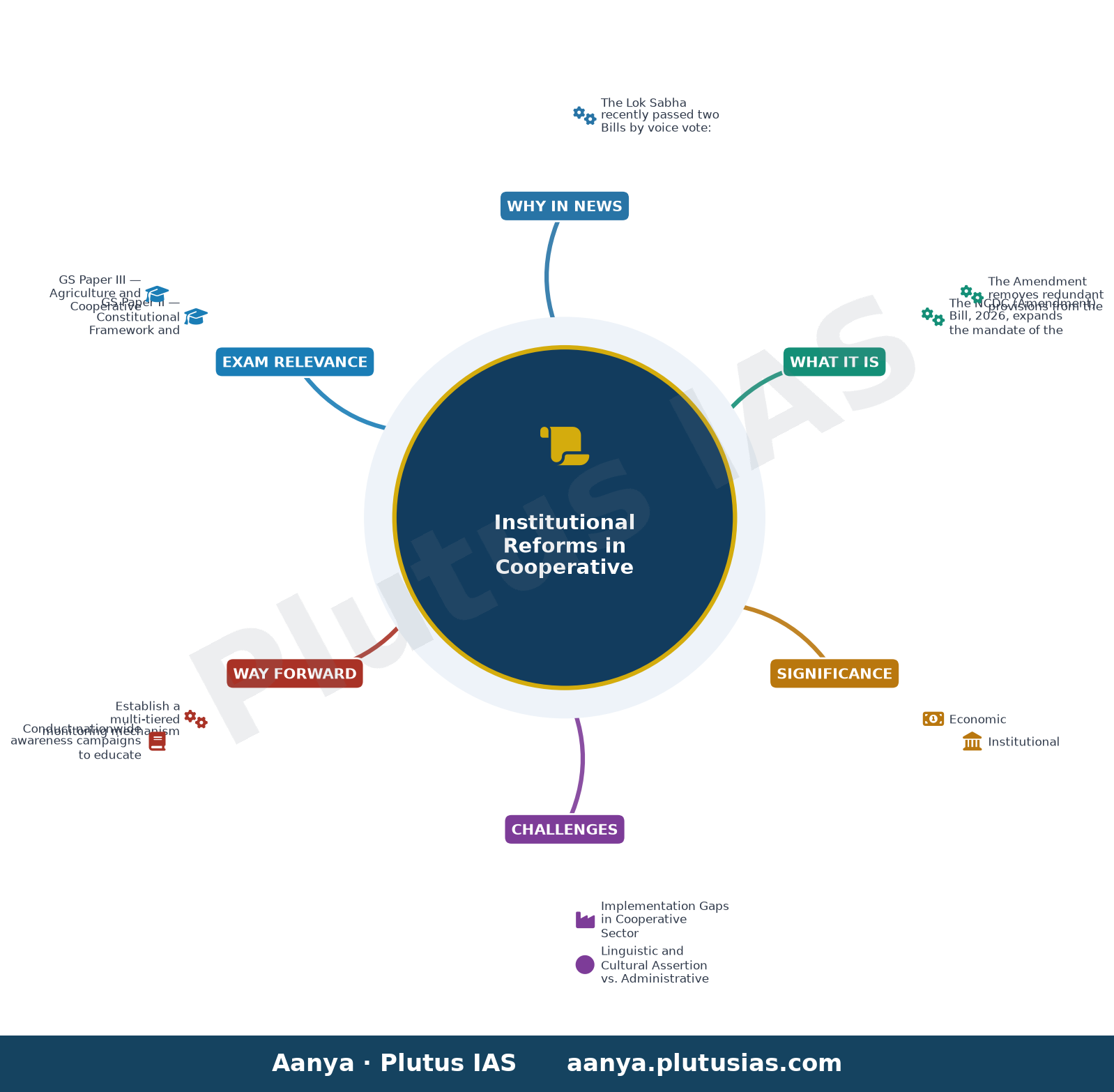
- GS Paper II — Constitutional Framework and Amendments | GS Paper III — Agriculture and Cooperative Societies
- Prelims: National Cooperative Development Corporation (NCDC), Article 3 of the Constitution, cooperative societies, cooperative federalism, voice vote, Monsoon Session of Parliament
- Essay: Cooperative federalism in India: Balancing autonomy and integration, The role of Parliament in constitutional amendments and governance reforms
Quick Revision: The NCDC (Amendment) Bill, 2026, broadens the Corporation’s funding mandate without additional budgetary requirements, while the Kerala (Alteration of Name) Bill, 2026, renames the state to ‘Keralam’.
Why is this in the news?
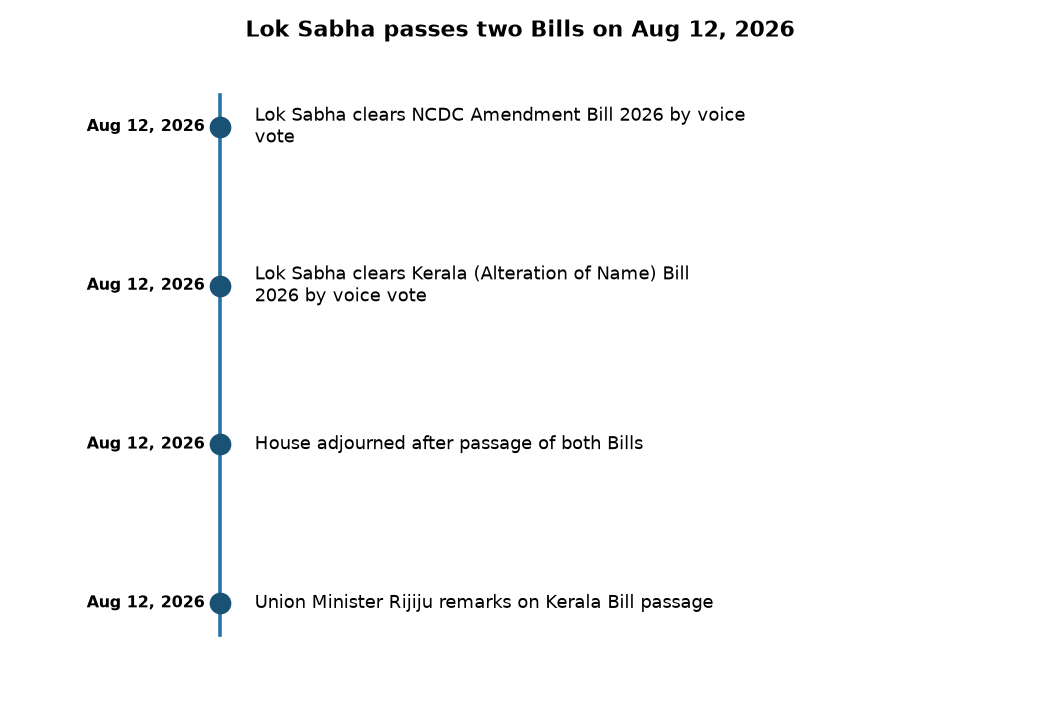
The Lok Sabha recently passed two Bills by voice vote: the National Cooperative Development Corporation (Amendment) Bill, 2026, aimed at expanding the mandate and operational scope of the NCDC, and the Kerala (Alteration of Name) Bill, 2026, to rename the state from ‘Kerala’ to ‘Keralam’. These legislative actions reflect concurrent reforms in cooperative governance and constitutional processes, underscoring Parliament’s role in institutional and nomenclatural adjustments.
Background
- The National Cooperative Development Corporation (NCDC) was established under the National Cooperative Development Corporation Act, 1962, to promote and develop cooperative societies in India.
- The NCDC operates as a statutory body under the Ministry of Cooperation, Government of India, and provides financial assistance, technical guidance, and capacity-building support to cooperative societies across states.
- The original NCDC Act, 1962, permitted the Corporation to extend funds or loans to state governments or directly to cooperative societies operating at the national level or across multiple states.
- Parliamentary procedures for state name alterations are governed by Article 3 of the Constitution, which empowers Parliament to form new states, alter areas, boundaries, or names of existing states.
- The Monsoon Session of Parliament, 2026, has been marked by discussions on legislative reforms, with the passage of these Bills reflecting procedural efficiency amid procedural disruptions.
Key Provisions and Implications of the Bills
- The NCDC (Amendment) Bill, 2026, expands the mandate of the NCDC to include direct funding and grants to any entity engaged in cooperative development, beyond its previous scope limited to state governments or multi-state cooperative societies.
- The Amendment removes redundant provisions from the original Act of 1962, streamlining the Corporation’s operational framework and enhancing its flexibility in disbursing funds.
- The Bill does not require additional budgetary allocation, as it reallocates existing resources to broaden the NCDC’s activities, including direct loans and grants against security to eligible cooperative entities.
- The Bill underscores the principle of cooperative federalism by empowering the NCDC to extend financial support to a wider range of cooperative entities, including those at the grassroots level.
- The passage of these Bills by voice vote highlights the procedural efficiency of Parliament, though it also reflects the challenges of legislative deliberation in a contentious political environment.
- The amendments to the NCDC Act are expected to enhance the Corporation’s role in promoting cooperative development, particularly in sectors such as agriculture, dairy, and rural credit.
Key Features
| Feature | Significance |
|---|---|
| Amendment to NCDC Act (1962) | Expands the scope of funding and operational flexibility for the National Cooperative Development Corporation, enabling direct financial support to cooperative societies and entities beyond state governments. |
| Direct funding to cooperatives | Allows NCDC to provide loans and grants directly to cooperative societies operating at national or multi-state levels, enhancing financial inclusion in the cooperative sector. |
| State government funding extension | Permits state governments to utilise NCDC funds for any entity engaged in cooperative development, broadening the reach of cooperative initiatives. |
| Removal of redundant provisions | Streamlines the NCDC Act by eliminating outdated clauses, improving administrative efficiency and legal clarity. |
| Kerala (Alteration of Name) Bill, 2026 | Legally formalises the change of the state’s name from ‘Kerala’ to ‘Keralam’ in the Eighth Schedule of the Constitution, reflecting linguistic and cultural identity. |
Why it Matters
Economic
- Enhances financial accessibility for cooperative societies, particularly those in remote or underserved regions, by expanding NCDC’s funding mechanisms.
- Strengthens the cooperative sector, which plays a critical role in rural and agricultural economies, by providing direct financial support and reducing dependency on state intermediaries.
- Facilitates greater investment in cooperative enterprises, potentially boosting employment generation and socio-economic development in cooperative-driven sectors.
Institutional
- Modernises the legal framework governing the National Cooperative Development Corporation, aligning it with contemporary cooperative development needs.
- Improves the operational autonomy of NCDC by removing redundant provisions, enabling faster decision-making and resource allocation.
- Reinforces the role of cooperatives as a tool for inclusive growth, in line with constitutional directives under Article 43 (Directive Principles of State Policy).
Constitutional/Legal
- The Kerala (Alteration of Name) Bill, 2026, formalises a linguistic and cultural assertion through constitutional amendment, adhering to the procedure under Article 3 of the Constitution.
- Ensures compliance with the Eighth Schedule of the Constitution, which lists the official languages of India, by updating the name of the state in the Schedule.
Administrative
- Simplifies the process of fund disbursement by NCDC, reducing bureaucratic delays and enabling quicker implementation of cooperative projects.
- Clarifies the roles of state governments and NCDC in cooperative funding, reducing ambiguity in financial governance.
Challenges
1. Implementation Gaps in Cooperative Sector
- Despite expanded funding mechanisms, ensuring equitable distribution of NCDC resources across diverse cooperative societies remains a challenge, particularly in marginalised regions.
- Risk of misutilisation of funds if robust monitoring and evaluation mechanisms are not established under the amended Act.
- Coordination between state governments, NCDC, and cooperative societies may face administrative hurdles, necessitating clear guidelines.
UPSC Link: Cooperative Societies Act, 1912; Directive Principles of State Policy (Article 43)
2. Linguistic and Cultural Assertion vs. Administrative Uniformity
- The renaming of Kerala to ‘Keralam’ raises questions about potential demands for similar changes in other states, necessitating a balanced approach to linguistic identity and administrative consistency.
- Ensuring that the constitutional amendment process for name changes does not become a tool for political symbolism over substantive governance improvements.
UPSC Link: Article 3 of the Constitution (Formation of new States and alteration of areas, boundaries, or names of existing States)
3. Resource Mobilisation and Sustainability
- While the amendment expands NCDC’s funding scope, the long-term sustainability of increased financial outflows requires careful fiscal planning to avoid strain on public exchequer.
- Dependency on NCDC funding may discourage cooperative societies from exploring alternative financing avenues, such as market-based instruments.
UPSC Link: Union Budget and Fiscal Responsibility and Budget Management (FRBM) Act
4. Stakeholder Engagement and Awareness
- Lack of awareness among cooperative societies about the amended provisions may lead to underutilisation of available funds and support mechanisms.
- Ensuring participation of all stakeholders, including marginalised communities, in cooperative development initiatives remains a persistent challenge.
UPSC Link: National Cooperative Development Corporation Act, 1962
Challenges — UPSC Perspective
| Issue | Concern |
|---|---|
| Equitable fund distribution | Risk of concentration of NCDC funds in developed regions, exacerbating regional disparities. |
| Monitoring and evaluation | Absence of robust frameworks may lead to inefficiencies or misuse of funds in the cooperative sector. |
| Administrative coordination | Delays in fund disbursement due to inter-departmental or inter-state coordination gaps. |
| Linguistic demands proliferation | Potential for similar demands in other states, creating administrative and political complexities. |
| Fiscal sustainability | Increased financial burden on the exchequer without corresponding revenue generation mechanisms. |
| Stakeholder awareness | Low participation of cooperative societies due to lack of awareness about amended provisions. |
Way Forward
- Establish a multi-tiered monitoring mechanism under NCDC to track fund utilisation and project outcomes, ensuring transparency and accountability.
- Conduct nationwide awareness campaigns to educate cooperative societies about the amended provisions and funding opportunities.
- Develop state-specific cooperative development plans in consultation with NCDC to ensure equitable resource allocation.
- Strengthen the role of cooperative audits and third-party evaluations to prevent fund misutilisation and enhance project efficacy.
- Integrate NCDC’s funding mechanisms with other government schemes (e.g., PM-KISAN, MGNREGA) to create synergies in rural and agricultural development.
- Formulate clear guidelines for state governments on the utilisation of NCDC funds to prevent delays and ensure targeted disbursement.
- Encourage cooperative societies to diversify funding sources by promoting market-based instruments alongside NCDC support.
- Review the fiscal impact of expanded NCDC funding annually to align with budgetary constraints and long-term sustainability goals.
UPSC Value Addition
Keywords for Mains Answer-Writing
National Cooperative Development Corporation (NCDC) Amendment Bill 2026 · Kerala (Alteration of Name) Bill 2026 · cooperative federalism · Parliamentary processes and procedures · voice vote in Lok Sabha · institutional autonomy of cooperative societies · federal structure and name changes · legislative amendments and governance · Parliamentary Affairs · cooperative movement in India
Constitutional & Policy Linkages
- Article 3: Alteration of names of States (Kerala to Keralam).
- Article 348: Official language provisions and Eighth Schedule updates.
Concept Flow
State demand for linguistic identity → Constitutional amendment process under Article 3 → Parliamentary approval of Kerala (Alteration of Name) Bill, 2026. → Cooperative sector growth challenges → Inadequate funding mechanisms under NCDC Act, 1962 → Need for legislative amendment. → Introduction of NCDC (Amendment) Bill, 2026 → Expansion of funding scope and removal of redundant provisions → Enhanced operational flexibility. → Amendment to NCDC Act → Direct funding to cooperatives and state governments → Increased financial inclusion and sectoral growth. → Implementation of amended provisions → Need for monitoring and evaluation → Ensuring equitable distribution and fiscal sustainability. → Linguistic and cultural assertion → Constitutional formalisation → Administrative and legal recognition of state identity.
Prelims Practice Questions
Q1. Consider the following statements regarding the National Cooperative Development Corporation (NCDC):
1. The NCDC was established under the National Cooperative Development Corporation Act, 1962.
2. The NCDC can provide funds to state governments for financing cooperative societies.
3. The NCDC Amendment Bill 2026 seeks to restrict its funding only to cooperative societies operating in more than one state.
4. The NCDC Amendment Bill 2026 allows state governments to extend funding from the Corporation to any entity engaged in cooperative development.
How many of the above statements are correct?
- Only one
- Only two
- Only three
- All four
Answer: Only three — Statements 1, 2, and 4 are correct. Statement 3 is incorrect as the Bill expands the NCDC’s funding scope rather than restricting it.
Q2. Assertion (A): The Kerala (Alteration of Name) Bill 2026 was passed by the Lok Sabha to rename the state of Kerala to ‘Keralam’.
Reason (R): The Constitution of India empowers Parliament to alter the name of a state under Article 3.
- Both A and R are true, and R is the correct explanation of A
- Both A and R are true, but R is NOT the correct explanation of A
- A is true, but R is false
- A is false, but R is true
Answer: A is true, but R is false — The assertion (A) is true as the Bill seeks to rename Kerala to ‘Keralam’. The reason (R) is also true as Article 3 of the Constitution empowers Parliament to alter the name of a state. However, R is not the correct explanation of A, as the Bill’s passage is a legislative process under Article 3, not a consequence of it.
Q3. Match the following Bills with their respective purposes:
Column I
1. National Cooperative Development Corporation (Amendment) Bill 2026
2. Kerala (Alteration of Name) Bill 2026
Column II
A. To rename the state of Kerala to ‘Keralam’
B. To expand the scope of funding and activities of the NCDC
Select the correct match:
- 1-A, 2-B
- 1-B, 2-A
- 1-A, 2-A
- 1-B, 2-B
Answer: 1-B, 2-A — The National Cooperative Development Corporation (Amendment) Bill 2026 (Column I-1) aims to expand the scope of funding and activities of the NCDC (Column II-B). The Kerala (Alteration of Name) Bill 2026 (Column I-2) seeks to rename the state of Kerala to ‘Keralam’ (Column II-A).
Mains Practice Question
✍ The National Cooperative Development Corporation (Amendment) Bill 2026 seeks to expand the scope of the NCDC’s funding and operational mandate. Critically examine the implications of this amendment for cooperative federalism in India. (15 Marks)
Approach: MODEL-ANSWER SKELETON:
1. **Context and Provisions**:
– Briefly outline the NCDC Act 1962 and its original mandate (funding to state governments and cooperative societies operating across states).
– Highlight key amendments in the 2026 Bill: direct funding to any cooperative entity, removal of redundant provisions, and expansion of eligible entities.
2. **Cooperative Federalism Dimensions**:
– **Strengthening State Autonomy**: Assess how the Bill empowers state governments to utilise NCDC funds for local cooperative development, aligning with the cooperative federalism framework (e.g., 73rd/74th Constitutional Amendments).
– **Expanding NCDC’s Role**: Discuss the rationale for broadening NCDC’s mandate to include direct funding to entities engaged in cooperative development, even if not strictly cooperative societies.
– **Potential Challenges**: Examine risks of centralisation, dilution of cooperative principles, or administrative bottlenecks in fund disbursement.
3. **Comparative Perspective**:
– Contrast with previous cooperative policies (e.g., National Cooperative Policy 2002, NITI Aayog’s cooperative sector recommendations) to evaluate continuity or departure.
4. **Constitutional and Legal Framework**:
– Reference Article 282 (grants-in-aid) and Article 293 (borrowing by states) to assess the Bill’s alignment with fiscal federalism.
5. **Conclusion**:
– Weigh the balance between expanding cooperative development and preserving the cooperative ethos. Provide a reasoned stance on whether the amendment strengthens or complicates cooperative federalism.
Source: The Indian Express
Generated by AanyaAi for educational purpose.

- Gurugram’s groundwater extraction exceeds limit by 212%; HC seeks ban - October 4, 2026
- स्वतंत्रता सेनानी श्यामजी कृष्ण वर्मा की जन्म जयंती पर पीएम का श्रद्धांजलि - October 4, 2026
- KWML’s Feasibility Reports for Water Metro in 18 Cities: UPSC & PCS Insights - October 3, 2026

No Comments