


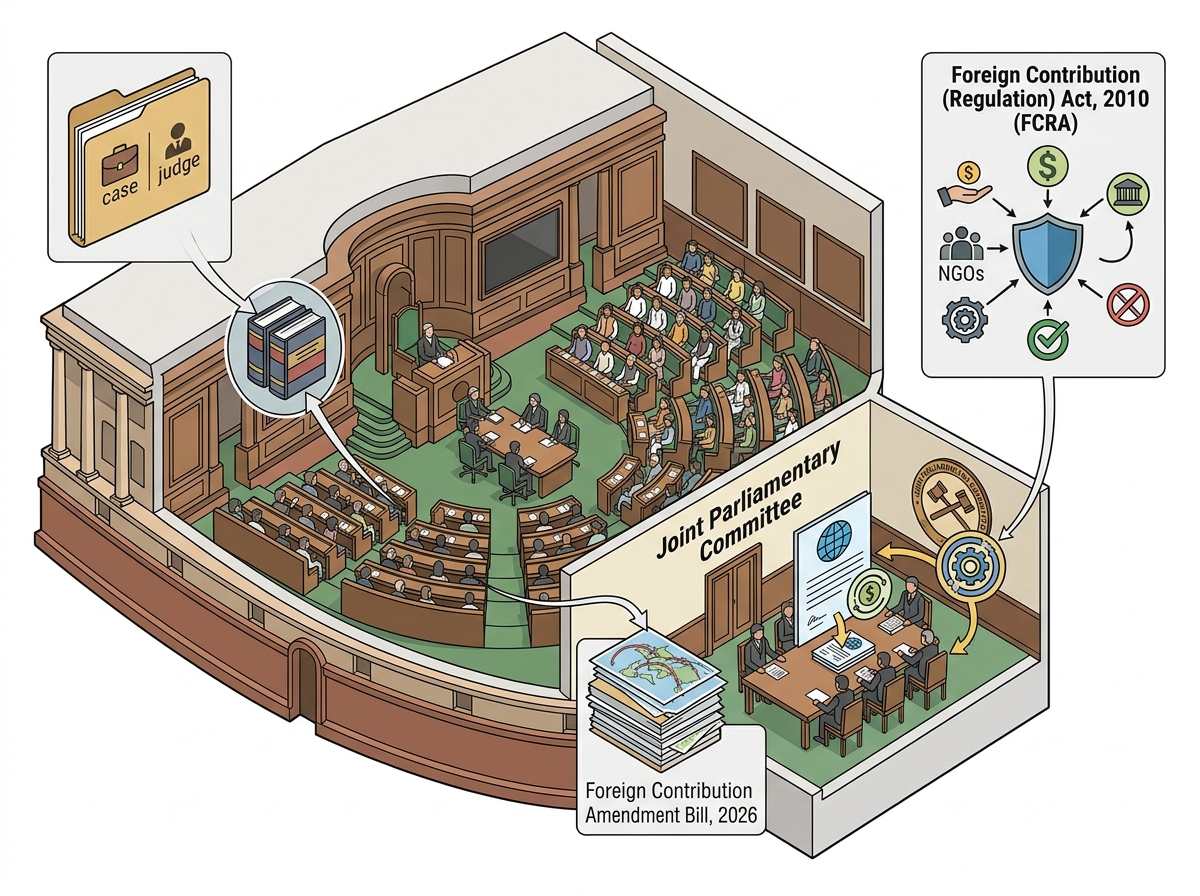
12 Aug FCRA Bill to JPC: Govt to Send Foreign Funding Bill for Scrutiny
✎ The FCRA (Amendment) Bill, 2026 aims to enhance transparency and accountability in the receipt and utilisation of foreign contributions by NGOs, while a JPC may be constituted to examine its provisions in detail.
Subject Relevance — Where This Topic Fits
- GS Paper II — Parliament and State Legislatures — Structure, Functioning, Conduct of Business, Powers & Privileges and Issues Arising out of these | GS Paper II — Functions and Responsibilities of the Union and the States, Issues and Challenges Pertaining to the Federal Structure | GS Paper III — Government Budgeting and Financial Management — Role of NGOs and Foreign Contributions
- Prelims: Foreign Contribution (Regulation) Act, 2010, Joint Parliamentary Committee (JPC), Parliamentary procedures and legislative process, Constitutional provisions related to bills and amendments, Judicial accountability and ethics
- Essay: The Role of Parliament in Ensuring Transparency and Accountability in Governance, Balancing National Security and Democratic Freedoms: The Case of Foreign Contributions
Quick Revision: The FCRA (Amendment) Bill, 2026 aims to enhance transparency and accountability in the receipt and utilisation of foreign contributions by NGOs, while a JPC may be constituted to examine its provisions in detail.
Why is this in the news?
During the Monsoon Session of Parliament, the Lok Sabha is slated to present the investigation report in the Justice Verma cash-for-judges case, while the Union Government has indicated its readiness to refer the Foreign Contribution (Regulation) Amendment Bill, 2026 to a Joint Parliamentary Committee (JPC). These developments underscore the Parliament’s role in legislative scrutiny, oversight of executive actions, and the evolving framework governing foreign contributions to non-governmental organisations (NGOs) in India.
Background
- The Foreign Contribution (Regulation) Act, 2010 (FCRA) regulates the acceptance and utilisation of foreign contributions by individuals, associations, and companies, aiming to prevent foreign interference in domestic matters.
- The Justice Verma cash-for-judges case pertains to allegations of financial impropriety involving a sitting judge of the Delhi High Court, raising questions about judicial ethics and institutional integrity.
- Parliamentary sessions are structured to facilitate legislative business, financial oversight, and discussions on matters of public importance, with the Monsoon Session typically concluding by mid-August.
- The Lok Sabha’s proceedings during the Monsoon Session have been frequently disrupted by opposition protests, particularly on issues related to law and order in Delhi and allegations of excessive use of force by security personnel.
Key Legislative and Institutional Developments in Focus
- A Joint Parliamentary Committee (JPC) is a special committee constituted by Parliament to examine a specific issue in depth, comprising members from both the Lok Sabha and Rajya Sabha, and is empowered to summon witnesses and documents for evidence.
- The Justice Verma cash-for-judges case involves allegations of financial misconduct against a Delhi High Court judge, prompting judicial and parliamentary scrutiny to uphold the integrity of the judiciary and the rule of law.
- Parliamentary procedures govern the introduction, consideration, and passage of bills, including the requirement for select committees or JPCs to review contentious legislation, ensuring thorough deliberation and stakeholder consultations.
- The FCRA framework is designed to balance the need for foreign contributions to support developmental and charitable activities with the imperative to prevent undue foreign influence in India’s internal affairs.
- Judicial accountability mechanisms, including the in-house procedure and parliamentary oversight, play a critical role in maintaining public trust in the judiciary and ensuring adherence to ethical standards.
- The Monsoon Session of Parliament serves as a critical platform for legislative scrutiny, financial oversight, and discussions on governance issues, with disruptions often reflecting broader political and social tensions.
Key Features
| Feature | Significance |
|---|---|
| Justice Yashwant Verma case investigation report | Examines alleged financial irregularities involving a sitting High Court judge, reinforcing judicial accountability and transparency in the higher judiciary. |
| Foreign Contribution (Regulation) Amendment Bill, 2026 | Proposes stricter oversight of foreign funding for NGOs, aiming to enhance national security and prevent misuse of foreign contributions under FCRA, 2010. |
| Joint Parliamentary Committee (JPC) referral | Ensures multi-party scrutiny of the FCRA Amendment Bill, enhancing legislative oversight and democratic accountability in regulatory reforms. |
| Parliamentary disruption and legislative efficiency | Highlights the impact of opposition protests on legislative productivity, raising questions about procedural norms and time management in Parliament. |
Why it Matters
Judicial Governance
- The Justice Verma case underscores the necessity of independent mechanisms to investigate judicial misconduct, aligning with constitutional principles of judicial integrity under Articles 124 and 217.
- A transparent probe report can restore public trust in the judiciary, a critical pillar of India’s democratic framework.
Regulatory Governance
- The FCRA Amendment Bill, 2026, if enacted, will tighten compliance requirements for NGOs receiving foreign funds, addressing concerns of national security and financial transparency.
- The referral to a JPC ensures bipartisan scrutiny, reducing the risk of partisan misuse of regulatory powers.
Legislative Governance
- The referral of the FCRA Bill to a JPC exemplifies Parliament’s role in ensuring robust oversight of executive-led regulatory amendments.
- The disruption in Parliament’s proceedings raises procedural questions about the balance between legislative debate and disruption, impacting the passage of critical bills.
Constitutional Governance
- The episode highlights the tension between legislative sovereignty (Article 75) and judicial independence (Article 50), necessitating clear demarcations to prevent institutional overreach.
Challenges
1. Judicial Accountability vs. Independence
- Balancing the need for transparent investigations into judicial misconduct with the constitutional safeguards protecting judicial independence.
- Risk of politicisation of judicial probes if oversight mechanisms lack impartiality.
UPSC Link: GS-II: Judiciary
2. Regulatory Oversight of NGOs
- Ensuring the FCRA Amendment Bill achieves its intended objectives without stifling legitimate civil society activities.
- Preventing the misuse of regulatory powers to target dissenting NGOs or organisations critical of government policies.
UPSC Link: GS-II: NGOs & Civil Society
3. Parliamentary Disruptions
- Addressing the systemic issue of frequent disruptions that impede legislative productivity and delay critical reforms.
- Developing institutional mechanisms to enforce decorum and ensure constructive debates without resorting to unruly protests.
UPSC Link: GS-II: Parliament
4. Legislative Efficiency
- Ensuring that bills referred to committees (e.g., JPC) are processed within stipulated timelines to avoid legislative logjams.
- Balancing the need for thorough scrutiny with the urgency of passing essential legislation.
UPSC Link: GS-II: Parliament
Challenges — UPSC Perspective
| Issue | Concern |
|---|---|
| Judicial Misconduct Probes | Risk of politicisation undermining judicial independence. |
| NGO Regulation | Potential overreach in monitoring foreign-funded NGOs, affecting civil liberties. |
| Parliamentary Disruptions | Chronic delays in legislative processes due to protests and disruptions. |
| JPC Referral Process | Delays in committee reports may dilute the urgency of regulatory reforms. |
Way Forward
- Constitute an independent, multi-member oversight body to investigate judicial misconduct, ensuring transparency and impartiality.
- Strengthen parliamentary norms to minimise disruptions, such as enforcing time-bound debates and penalising unruly conduct.
- Ensure the FCRA Amendment Bill is referred to the JPC with clear terms of reference, including public consultations.
- Develop a legislative calendar to prioritise critical bills, balancing urgency with thorough scrutiny.
- Enhance inter-institutional coordination between the judiciary, executive, and legislature to address governance gaps.
- Promote awareness campaigns to educate civil society on compliance requirements under the amended FCRA.
- Establish a grievance redressal mechanism for NGOs to address concerns regarding regulatory overreach.
UPSC Value Addition
Keywords for Mains Answer-Writing
Foreign Contribution (Regulation) Amendment Bill, 2026 · Joint Parliamentary Committee (JPC) · NGO accountability · Foreign funding regulation · Parliamentary scrutiny · FCRA compliance · Judicial accountability · Justice Yashwant Verma cash-for-judges case · Parliamentary processes · Constitutional governance
Constitutional & Policy Linkages
- Article 50: Separation of Judiciary from Executive (Judicial Independence)
- Article 124: Appointment and removal of Supreme Court judges
- Article 217: Appointment and removal of High Court judges
- Article 75: Collective responsibility of the Council of Ministers
- Article 105: Powers and privileges of Parliament
Concept Flow
Allegations of judicial misconduct → Parliamentary oversight via Justice Verma case probe → Need for transparency in higher judiciary → Foreign funding to NGOs → Concerns of national security and misuse → Introduction of FCRA Amendment Bill, 2026 → FCRA Amendment Bill, 2026 → Referral to JPC for multi-party scrutiny → Enhanced legislative oversight → Parliamentary disruptions → Reduced legislative efficiency → Delay in passing critical bills → Judicial independence vs. accountability → Constitutional safeguards under Articles 124 & 217 → Need for balanced reforms → Regulatory oversight vs. civil liberties → FCRA Amendment Bill’s impact on NGOs → Risk of overreach
Prelims Practice Questions
Q1. Consider the following statements regarding the Foreign Contribution (Regulation) Amendment Bill, 2026:
1. The Bill seeks to amend the Foreign Contribution (Regulation) Act, 2010.
2. It proposes to prohibit public servants from receiving foreign contributions.
3. The Bill mandates that all NGOs must register afresh every five years.
4. It empowers the government to suspend FCRA registration without prior notice.
How many of the above statements are correct?
- Only one
- Only two
- Only three
- All four
Answer: Only three — Statements 1 and 2 are correct as the Bill amends the FCRA, 2010, and prohibits public servants from receiving foreign contributions. Statements 3 and 4 are incorrect as the Bill does not mandate fresh registration every five years nor does it allow suspension without prior notice.
Q2. Assertion (A): The Joint Parliamentary Committee (JPC) is a statutory body established under the Constitution of India.
Reason (R): A JPC is constituted by a motion passed by either House of Parliament to examine a matter of public importance.
In the context of the above two statements, which one of the following is correct?
- Both A and R are true, and R is the correct explanation of A.
- Both A and R are true, but R is not the correct explanation of A.
- A is true but R is false.
- A is false but R is true.
Answer: ? — Assertion (A) is false because a JPC is not a statutory body established under the Constitution; it is a parliamentary committee constituted by a motion. Reason (R) is true as a JPC is indeed constituted by a motion passed by either House of Parliament.
Q3. Match the following parliamentary committees with their primary functions:
Column I (Committee) | Column II (Function)
1. Public Accounts Committee | A. Examination of the budgetary proposals of ministries
2. Estimates Committee | B. Examination of the audit reports of the Comptroller and Auditor General
3. Committee on Public Undertakings | C. Examination of the functioning of public sector undertakings
4. Joint Parliamentary Committee | D. Examination of specific matters referred by Parliament
Select the correct match:
- 1-B, 2-A, 3-C, 4-D
- 1-A, 2-B, 3-D, 4-C
- 1-D, 2-C, 3-B, 4-A
- 1-C, 2-D, 3-A, 4-B
Answer: 1-B, 2-A, 3-C, 4-D — 1-B: Public Accounts Committee examines audit reports of the CAG. 2-A: Estimates Committee examines budgetary proposals. 3-C: Committee on Public Undertakings examines PSUs. 4-D: JPC examines specific matters referred by Parliament.
Mains Practice Question
✍ The Parliament, through its recent legislative actions, has reinforced the regulatory framework governing foreign contributions and judicial accountability. In this context, critically examine the constitutional and parliamentary mechanisms available to ensure transparency and accountability in the receipt and utilisation of foreign funds by non-governmental organisations (NGOs) in India. Also, discuss the role of parliamentary committees in enhancing legislative scrutiny over such matters. (15 Marks)
Approach: MODEL-ANSWER SKELETON:
1. **Constitutional and Legal Framework**:
– Art. 293(1) read with FCRA, 2010: Parliament’s power to regulate foreign contributions.
– Key provisions of FCRA, 2010: Registration, prior permission, utilisation, and reporting obligations.
– Foreign Contribution (Regulation) Amendment Bill, 2026: Proposed amendments to enhance transparency (e.g., prohibition of public servants, stricter compliance, and JPC referral).
2. **Judicial Accountability Mechanisms**:
– Justice Yashwant Verma cash-for-judges case: Contextual reference to judicial accountability and the role of the judiciary in ensuring probity.
– Judicial review under Art. 226/32: Courts’ power to examine FCRA compliance by NGOs.
3. **Parliamentary Scrutiny and Committees**:
– Role of JPC: Examination of specific matters (e.g., FCRA Bill) to ensure legislative oversight.
– Functions of key committees: Public Accounts Committee (PAC), Estimates Committee, and Committee on Public Undertakings in scrutinising public funds.
– Parliamentary processes: Motions, debates, and resolutions to address lapses in governance.
4. **Challenges and Balancing Views**:
– Balancing transparency with operational autonomy for NGOs.
– Critique of executive overreach vs. need for regulatory oversight.
– Judicial activism vs. legislative primacy in policy formulation.
5. **Conclusion**:
– Parliament’s role in ensuring a robust regulatory framework while safeguarding democratic principles.
– Recommendations: Strengthening parliamentary committees, judicial independence, and stakeholder consultations.
Source: bhaskar.com
Generated by AanyaAi for educational purpose.

- Gurugram’s groundwater extraction exceeds limit by 212%; HC seeks ban - October 4, 2026
- स्वतंत्रता सेनानी श्यामजी कृष्ण वर्मा की जन्म जयंती पर पीएम का श्रद्धांजलि - October 4, 2026
- KWML’s Feasibility Reports for Water Metro in 18 Cities: UPSC & PCS Insights - October 3, 2026

No Comments