


12 Aug Lok Sabha Passes Bills to Rename Kerala and Amend NCDC Act
✎ The renaming of a state under Article 3 of the Constitution requires a state legislative assembly resolution, Union Cabinet approval, and parliamentary legislation, while the NCDC Amendment Bill, 2026, aims to enhance the…
Subject Relevance — Where This Topic Fits
- GS Paper II — Polity and Governance (Constitutional Provisions, State Reorganisation) | GS Paper III — Economy (Cooperative Sector Reforms, Institutional Frameworks)
- Prelims: Article 3 of the Constitution, State Reorganisation Act, 1956, National Co-operative Development Corporation (NCDC), Keralam (Malayalam nomenclature), Cooperative Societies (Amendment) Bill, Parliamentary procedures for state name changes
- Essay: The interplay of federalism and linguistic identity in India’s federal structure, Reforms in cooperative governance: Balancing autonomy and regulatory oversight
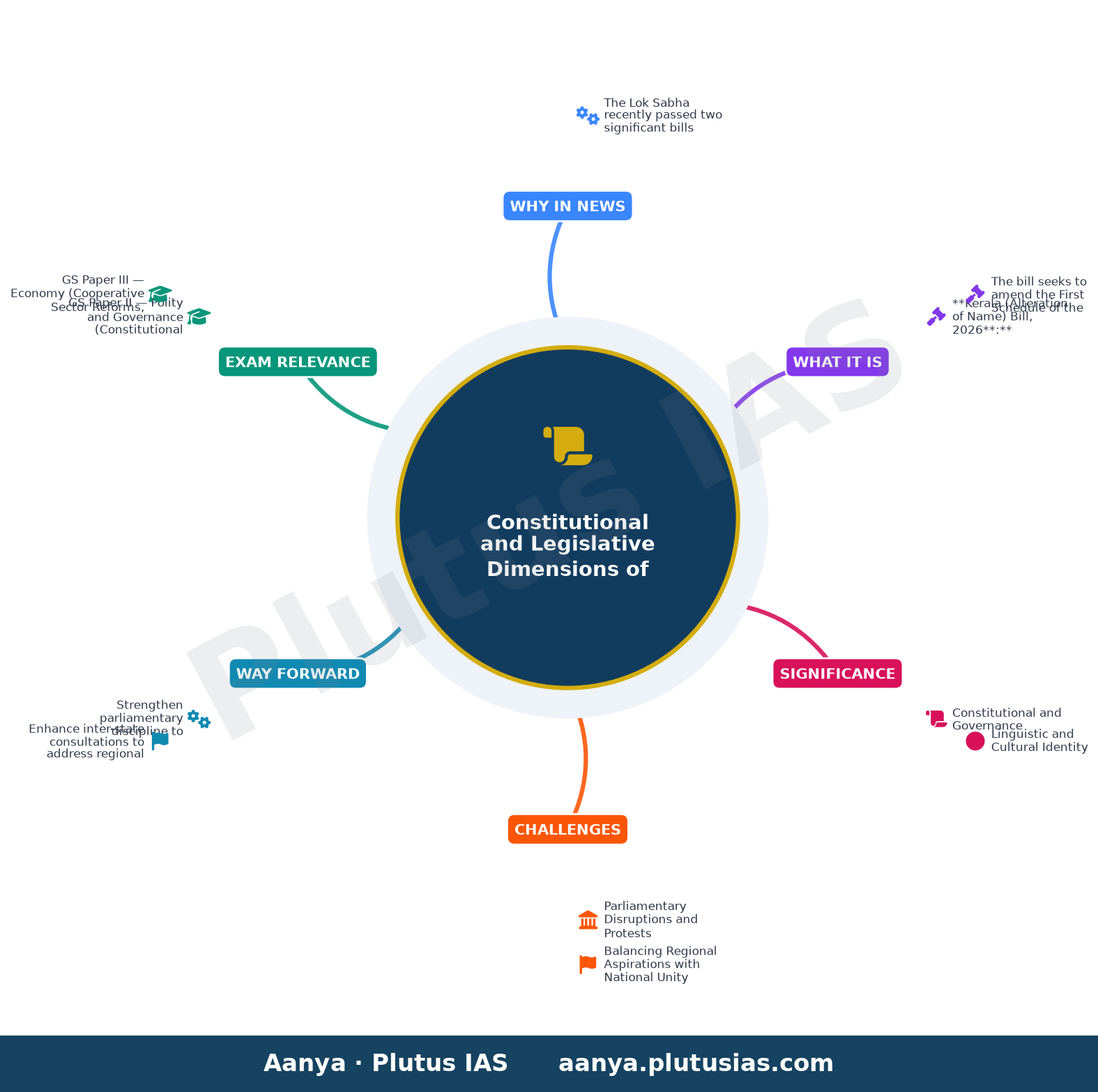
Quick Revision: The renaming of a state under Article 3 of the Constitution requires a state legislative assembly resolution, Union Cabinet approval, and parliamentary legislation, while the NCDC Amendment Bill, 2026, aims to enhance the financial and operational capabilities of India’s apex cooperative development institution.
Why is this in the news?
The Lok Sabha recently passed two significant bills without debate: the Kerala (Alteration of Name) Bill, 2026, which seeks to rename the state of Kerala to ‘Keralam’, and the National Co-operative Development Corporation (Amendment) Bill, 2026, aimed at expanding the funding and operational scope of the NCDC. These legislative actions, while procedurally sound, have sparked political discourse and protests, underscoring the need to examine their constitutional, administrative, and socio-economic implications within the framework of India’s federal governance and cooperative sector policies.
Background
- The demand for renaming Kerala to ‘Keralam’ originates from a linguistic and cultural assertion rooted in the Malayalam-speaking population’s identity, tracing back to the pre-independence period and the post-independence movement for a ‘United Kerala’.
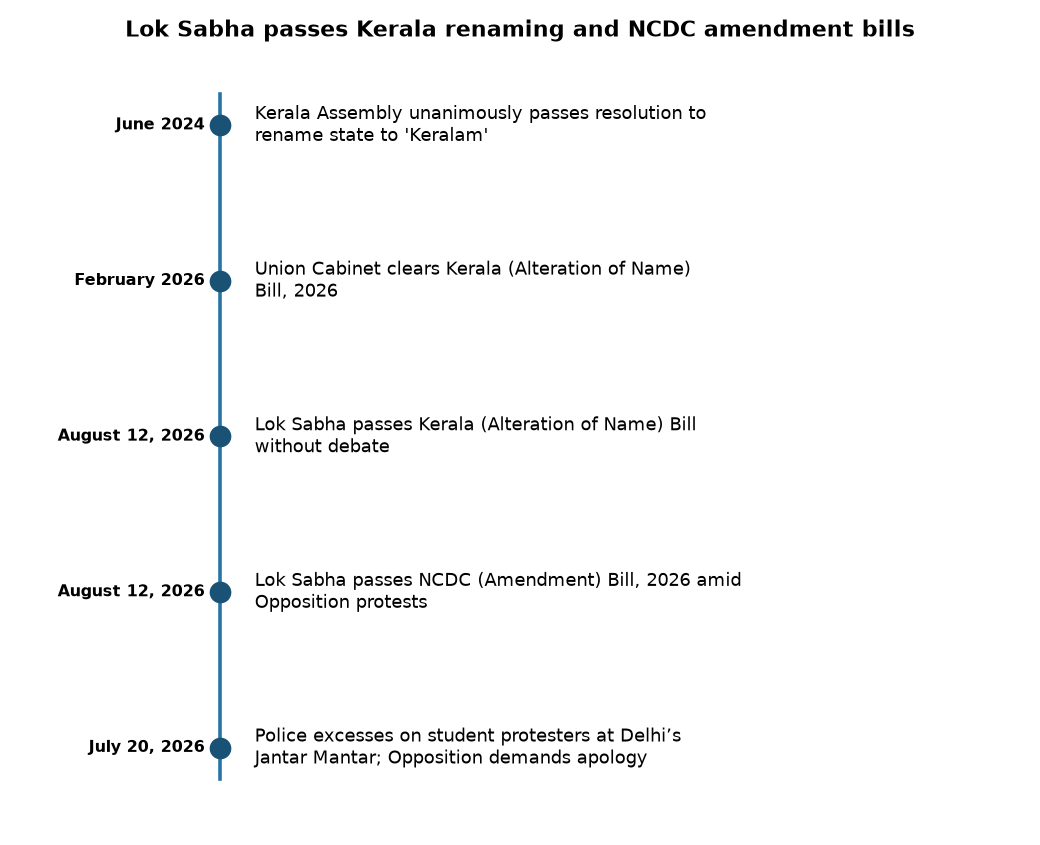
- The Kerala Legislative Assembly passed a unanimous resolution in June 2024, requesting the Central Government to initiate the process for renaming the state under Article 3 of the Constitution.
- The National Co-operative Development Corporation (NCDC) was established in 1963 under the National Co-operative Development Corporation Act, 1962, to promote and develop cooperative societies in India.
- The NCDC Amendment Bill, 2026, proposes to widen the channels of funding and operational flexibility for cooperative societies, aligning with the government’s broader agenda of strengthening the cooperative sector as a key pillar of economic development.
- Parliamentary procedures for state name changes require the introduction of a bill in Parliament, followed by the President’s assent, after which the name change is notified in the Gazette of India.
Key Aspects of the Kerala (Alteration of Name) Bill, 2026 and the NCDC (Amendment) Bill, 2026
- **Kerala (Alteration of Name) Bill, 2026**:**
- The bill seeks to amend the First Schedule of the Constitution to officially rename the state of Kerala as ‘Keralam’, reflecting its Malayalam linguistic identity.
- The process is initiated by a state legislative assembly resolution, as mandated under **Article 3 of the Constitution**, which empowers Parliament to alter the name of a state.
- The name change does not alter the state’s geographical boundaries, administrative structure, or legal status under the Constitution; it is purely a nomenclatural adjustment.
- The bill was passed in the Lok Sabha without debate, though it sparked political protests, highlighting the intersection of federal governance and democratic dissent.
- **National Co-operative Development Corporation (Amendment) Bill, 2026**:**
- The bill proposes amendments to the **National Co-operative Development Corporation Act, 1962**, to expand the funding avenues and operational scope of the NCDC.
- Key amendments include widening the channels through which the NCDC can provide financial assistance to cooperative societies, including direct funding, equity participation, and technical support.
- The NCDC, established under the 1962 Act, functions as a statutory body under the Ministry of Cooperation, Government of India, with the mandate to promote and develop cooperatives across sectors such as agriculture, dairy, and housing.
- The amendment aims to enhance the NCDC’s role in addressing the financial and operational challenges faced by cooperative societies, particularly small and marginal ones, in a competitive economic landscape.
- The bill also seeks to streamline the governance and accountability mechanisms within the NCDC, ensuring greater transparency and efficiency in its functioning.
- The NCDC’s expanded mandate aligns with the government’s vision of fostering a robust cooperative ecosystem as a means to achieve inclusive and sustainable economic growth.
Key Features
| Feature | Significance |
|---|---|
| Kerala (Alteration of Name) Bill, 2026 | Formalises the renaming of the state from ‘Kerala’ to ‘Keralam’ as per the constitutional process under Article 3. |
| National Co-operative Development Corporation (Amendment) Bill, 2026 | Expands the funding and operational scope of the NCDC to enhance support for cooperative societies across sectors. |
| Article 3 of the Constitution | Provides the constitutional framework for altering the name of a state, requiring parliamentary approval. |
| Kerala Assembly Resolution (June 2024) | Unanimously endorsed the demand for renaming, reflecting regional linguistic identity and historical aspirations. |
| Parliamentary Process | Ensures democratic validation of state-level proposals through legislative approval in the Lok Sabha. |
Why it Matters
Constitutional and Governance
- Demonstrates the application of Article 3 of the Constitution in altering a state’s name, reinforcing the federal structure of governance.
- Highlights the role of state legislatures in initiating proposals for name changes, which are then processed at the central level.
- Emphasises the importance of parliamentary scrutiny and approval in constitutional amendments affecting state identities.
Linguistic and Cultural Identity
- Reflects the long-standing demand for a name that aligns with the Malayalam-speaking population’s linguistic identity.
- Underscores the cultural significance of state names as symbols of regional heritage and collective identity.
Cooperative Sector Development
- The NCDC Amendment Bill aims to broaden the financial and operational support mechanisms for cooperative societies, potentially enhancing their viability and reach.
- Expands the NCDC’s role in promoting cooperative enterprises, which are critical for inclusive economic growth and rural development.
Parliamentary Procedure and Consensus
- Illustrates the procedural aspects of legislative approval, including the need for cross-party consensus in matters of state identity.
- Raises questions about the nature of parliamentary debates and the balance between procedural efficiency and democratic deliberation.
Challenges
1. Parliamentary Disruptions and Protests
- Disruptions in the Lok Sabha during the passage of bills highlight challenges in maintaining orderly legislative processes.
- Opposition protests, while a democratic right, may impede the smooth functioning of parliamentary business and delay critical legislations.
UPSC Link: Parliamentary functioning and discipline
2. Balancing Regional Aspirations with National Unity
- The renaming of a state raises questions about the representation of regional linguistic identities within the broader national framework.
- Ensuring that such changes do not inadvertently fuel regionalism or undermine national cohesion remains a governance challenge.
UPSC Link: Federalism and regionalism
3. Operationalising the NCDC Amendment
- The expanded role of the NCDC requires robust implementation mechanisms to ensure effective disbursement of funds and support to cooperatives.
- Potential delays in operationalising the amendments could limit the intended benefits for the cooperative sector.
UPSC Link: Cooperative societies and governance
4. Constitutional Safeguards and Procedural Rigour
- The process under Article 3 involves multiple stages, including state legislature approval and parliamentary scrutiny, which may introduce delays.
- Ensuring that all procedural requirements are met without compromising efficiency remains a challenge for governance institutions.
UPSC Link: Constitutional provisions and amendments
Challenges — UPSC Perspective
| Issue | Concern |
|---|---|
| Parliamentary disruptions | Risk of legislative gridlock and delayed approval of critical bills. |
| Regional identity vs. national unity | Potential tensions between regional aspirations and national cohesion. |
| Implementation of NCDC amendments | Need for effective mechanisms to utilise expanded funding and operational scope. |
| Constitutional procedural delays | Risk of prolonged approval processes under Article 3. |
| Balancing efficiency and deliberation | Ensuring timely passage of bills while maintaining democratic scrutiny. |
Way Forward
- Strengthen parliamentary discipline to minimise disruptions and ensure smooth legislative processes.
- Enhance inter-state consultations to address regional aspirations while maintaining national unity.
- Develop clear operational guidelines for the NCDC Amendment to facilitate effective implementation.
- Conduct awareness campaigns to educate stakeholders about the benefits of the NCDC amendments for cooperatives.
- Establish a dedicated monitoring mechanism to track the progress of state name change processes under Article 3.
- Promote inclusive dialogue between the Centre and states to address concerns related to regional identity and governance.
- Review and streamline procedural requirements under Article 3 to balance efficiency and democratic validation.
UPSC Value Addition
Keywords for Mains Answer-Writing
Constitutional provisions for state name alteration · Article 3 of the Constitution of India · Parliamentary procedures for legislative amendments · Role of State Legislatures in name change proposals · National Co-operative Development Corporation (NCDC) · Co-operative societies governance in India · Parliamentary consensus and legislative process · Federalism and Centre-State relations · Legislative procedures in the Lok Sabha · Constitutional amendments and bills
Constitutional & Policy Linkages
- [‘Article 3’, ‘Alteration of state names’]
- [‘Article 246’, ‘Distribution of legislative powers’]
- [‘Seventh Schedule’, ‘State list and concurrent list’]
Concept Flow
Kerala Assembly passes unanimous resolution in June 2024 for renaming to ‘Keralam’. → Union Cabinet clears the proposal in February 2026, initiating the parliamentary process under Article 3. → Kerala (Alteration of Name) Bill, 2026, introduced in Lok Sabha and passed without debate. → NCDC (Amendment) Bill, 2026, introduced to expand funding and operational scope for cooperatives. → Parliamentary approval of both bills, reflecting democratic validation of state and sectoral governance changes. → Implementation of the NCDC amendments to enhance support for cooperative societies. → Monitoring and review of the renaming process to ensure compliance with constitutional and procedural norms.
Prelims Practice Questions
Q1. Consider the following statements regarding the procedure for altering the name of a State in India:
1. The State Legislature must pass a resolution by a simple majority.
2. The Parliament must enact a law to give effect to the change.
3. The President of India must give his/her assent to the law.
4. The change requires ratification by at least half of the State Legislatures.
How many of the above statements are correct?
- Only one
- Only two
- Only three
- All
Answer: Only three — Statements 1, 2, and 3 are correct. The State Legislature passes a resolution by simple majority (Statement 1), Parliament enacts a law (Statement 2), and the President’s assent is mandatory (Statement 3). Statement 4 is incorrect as ratification by State Legislatures is not required.
Q2. Assertion (A): The National Co-operative Development Corporation (NCDC) is a statutory body.
Reason (R): The NCDC was established under the National Co-operative Development Corporation Act, 1962.
Options:
A. Both A and R are true, and R is the correct explanation of A.
B. Both A and R are true, but R is not the correct explanation of A.
C. A is true, but R is false.
D. A is false, but R is true.
- A
- B
- C
- D
Answer: A — The NCDC is indeed a statutory body established under the National Co-operative Development Corporation Act, 1962. Both the assertion and reason are true, and the reason correctly explains the assertion.
Q3. Which of the following constitutional provisions governs the procedure for altering the name of a State in India?
- Article 2
- Article 3
- Article 4
- Article 5
Answer: Article 3 — Article 3 of the Constitution of India governs the procedure for altering the name of a State. It empowers Parliament to enact laws for such alterations.
Mains Practice Question
✍ The Parliament recently passed the Kerala (Alteration of Name) Bill, 2026, to rename the state from ‘Kerala’ to ‘Keralam’. Examine the constitutional and procedural framework governing such name alterations. Also, discuss the significance of this process in the context of federalism and Centre-State relations. (15 Marks)
Approach: MODEL-ANSWER SKELETON:
1. Constitutional Framework (4 points):
– Article 3 of the Constitution: Power of Parliament to alter names, boundaries, or areas of States.
– Role of State Legislature: Must pass a resolution by simple majority (e.g., Kerala Assembly resolution in June 2024).
– Parliamentary procedure: Bill must be introduced and passed in Parliament, followed by Presidential assent.
– No ratification by State Legislatures required (distinction from Article 368 for constitutional amendments).
2. Procedural Steps (3 points):
– State Legislature resolution (e.g., Kerala Assembly’s 2024 unanimous resolution).
– Union Cabinet clearance (e.g., Cabinet cleared the proposal in February 2026).
– Parliamentary debate and passage (e.g., Lok Sabha passed the bill in August 2026).
3. Federalism and Centre-State Relations (4 points):
– Cooperative federalism: Centre consults State Legislature but retains final authority.
– Symbolic significance: Name change reflects linguistic and cultural identity (e.g., ‘Keralam’ aligns with Malayalam language).
– Precedents: Similar name changes (e.g., Orissa to Odisha in 2011).
– Potential controversies: Opposition to name changes on grounds of identity or political symbolism.
4. Significance and Challenges (4 points):
– Identity and linguistic pride: Reflects regional aspirations (e.g., Malayalam language movement).
– Administrative implications: Updating official records, geographical maps, and public communications.
– Public sentiment: Must balance regional demands with national unity.
– Legal sanctity: Ensures the change is legally and constitutionally valid.
Source: Hindustan Times
Generated by AanyaAi for educational purpose.

- Gurugram’s groundwater extraction exceeds limit by 212%; HC seeks ban - October 4, 2026
- स्वतंत्रता सेनानी श्यामजी कृष्ण वर्मा की जन्म जयंती पर पीएम का श्रद्धांजलि - October 4, 2026
- KWML’s Feasibility Reports for Water Metro in 18 Cities: UPSC & PCS Insights - October 3, 2026

No Comments