


12 Aug Tamil Nadu Urges Freeze on Lok Sabha Seats at 543; Women’s Reservation Demand
✎ The Lok Sabha’s current strength of 543 seats has remained unchanged since 1971 due to the postponement of delimitation; any alteration requires a constitutional amendment under Article 81(2), while women’s reservation…
Subject Relevance — Where This Topic Fits
- GS Paper II — Parliament and State Legislatures — Structure, Functioning, Conduct of Business, Powers & Privileges and Issues Arising out of these | GS Paper II — Constitutional and Non-Constitutional Bodies (Election Commission of India) | GS Paper II — Government Policies and Interventions for Development in various sectors and Issues arising out of their Design and Implementation | GS Paper III — Government Budgeting
- Prelims: Lok Sabha composition, Delimitation Commission, Women’s Reservation Bill, Census and Population Data, Article 81 of the Constitution, Article 330 of the Constitution, Election Commission of India, Constitutional Amendment Bills
- Essay: The interplay of demographic change and political representation: A case for inclusive governance, Federalism and constitutional safeguards: Balancing equity and efficiency in India’s electoral architecture
Quick Revision: The Lok Sabha’s current strength of 543 seats has remained unchanged since 1971 due to the postponement of delimitation; any alteration requires a constitutional amendment under Article 81(2), while women’s reservation necessitates amendments to Articles 330 and 332.
Why is this in the news?
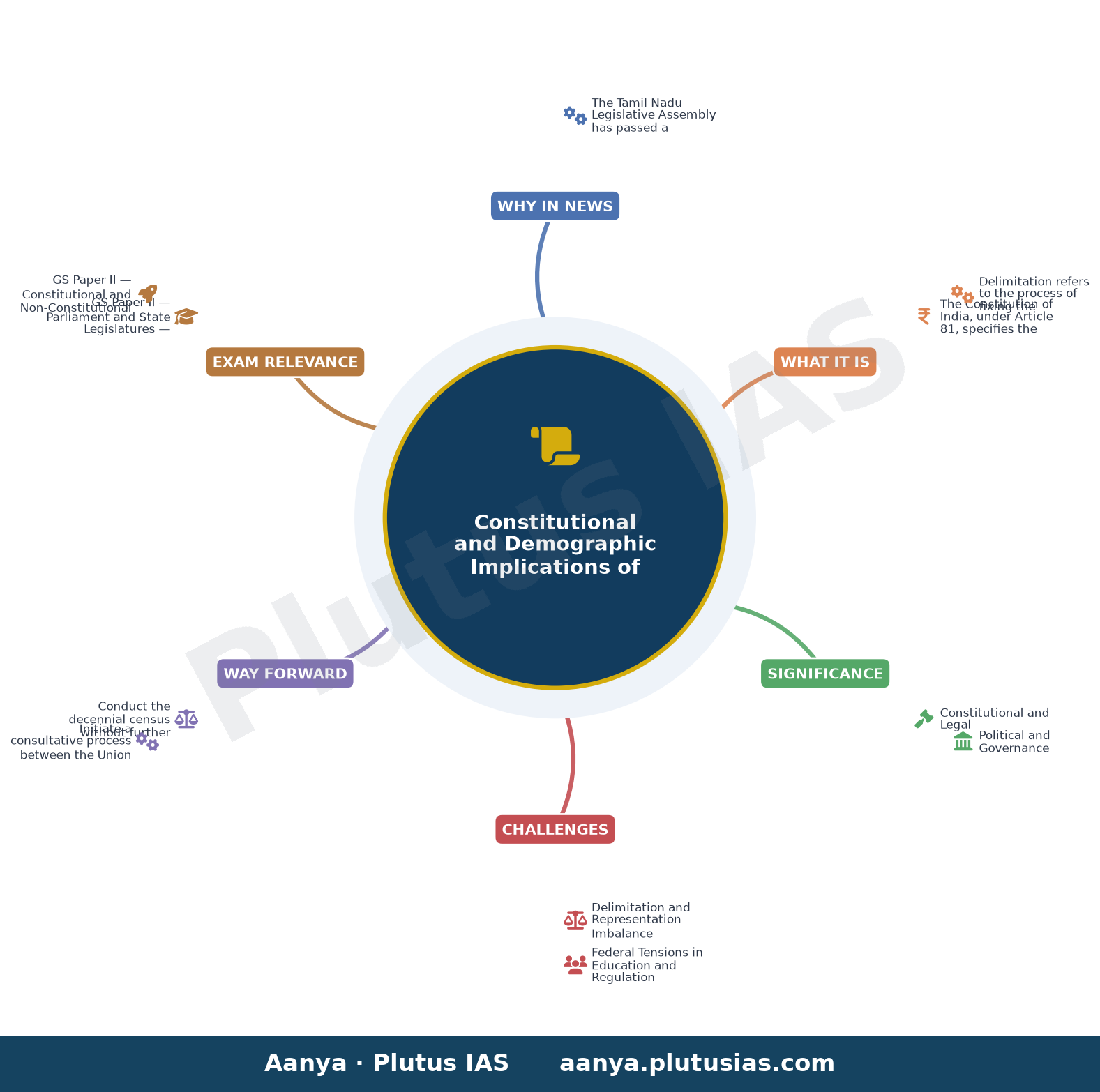
The Tamil Nadu Legislative Assembly has passed a resolution urging the Union Government to maintain the current Lok Sabha strength at 543 seats and to immediately implement 33% reservation for women in the existing Lok Sabha constituencies. The resolution also highlights concerns regarding the long-delayed delimitation process and its potential impact on southern states that have successfully controlled population growth. This development underscores critical constitutional, demographic, and governance issues related to parliamentary representation and electoral reforms.
Background
- The Lok Sabha, India’s directly elected lower house of Parliament, currently has 543 elected members representing territorial constituencies. The total number of seats has remained unchanged since the 1971 delimitation exercise, despite significant demographic shifts.
- The Constitution of India mandates delimitation of parliamentary and assembly constituencies based on the latest census data, as per Article 82 and Article 170.
- Southern states, including Tamil Nadu, have achieved significant progress in population control measures, leading to a lower growth rate compared to northern states. This demographic divergence raises concerns about under-representation in Parliament if future delimitation is based on post-1971 census data.
- The Election Commission of India (ECI) is constitutionally mandated to oversee the delimitation process, but its role is subject to parliamentary legislation. The Delimitation Commission, a statutory body, is constituted periodically to redraw constituency boundaries.
- The Union Government has the authority to amend the total number of Lok Sabha seats through a constitutional amendment, as stipulated under Article 81(2) of the Constitution.
Key Constitutional and Institutional Dimensions of Lok Sabha Representation and Delimitation
- The Constitution of India, under Article 81, specifies the maximum strength of the Lok Sabha as 552 members (530 from states, 20 from Union Territories, and 2 nominated from the Anglo-Indian community, though the latter provision was removed by the 104th Constitutional Amendment Act, 2019). The current strength is 543 elected members.
- Delimitation refers to the process of fixing the boundaries of territorial constituencies for the purpose of elections. It is conducted to ensure equitable representation based on population changes, as mandated by the Constitution.
- The Delimitation Commission Act, 2002, provides the legal framework for the delimitation process. The Commission is appointed by the President of India and comprises the Chief Election Commissioner and two other members nominated by the ECI.
- The principle of ‘one person, one vote’ and ‘equal representation’ underpins the delimitation process. However, the Constitution also allows for special provisions to protect the interests of Scheduled Castes (SCs) and Scheduled Tribes (STs) through reserved constituencies, as per Articles 330 and 332.
- The Women’s Reservation Bill, if enacted, would amend Articles 330 and 332 to reserve one-third of seats in the Lok Sabha and state legislative assemblies for women. This would be implemented through rotation among constituencies.
- The Union Government’s decision to freeze the Lok Sabha strength at 543 is a policy choice that requires constitutional amendment. Such an amendment must be passed by a special majority in Parliament and ratified by at least half of the state legislatures, as per Article 368.
- The ECI has repeatedly highlighted the need for timely conduct of the decennial census to enable evidence-based delimitation. The postponement of the 2021 Census has delayed the delimitation process, creating a governance vacuum in electoral representation.
- Southern states argue that freezing the Lok Sabha strength at 543 without conducting delimitation based on updated census data could lead to disproportionate representation, as their population growth rates have been lower than the national average.
Key Features
| Feature | Significance |
|---|---|
| Freezing Lok Sabha strength at 543 | Maintains the existing parliamentary representation ratio between Lok Sabha and Rajya Sabha (2.2:1), preventing demographic shifts from altering state-wise representation without census-based delimitation. |
| 33% women’s reservation in Lok Sabha | Advocates for immediate implementation of the constitutional provision for women’s reservation in Parliament, aligning with the 106th Constitutional Amendment Act, 2023. |
| Opposition to NEET abolition | Asserts state’s right to regulate medical education, citing concerns over social justice and federalism in the context of a national-level entrance examination. |
| Opposition to FCRA Amendment Bill | Highlights state’s reservations regarding the regulation of foreign funding, emphasizing potential impacts on civil society and non-governmental organizations. |
| Demographic representation concerns | Raises the issue of southern states’ under-representation due to outdated census data (1971) and lack of delimitation, risking permanent imbalance in parliamentary representation. |
Why it Matters
Constitutional and Legal
- The resolution underscores the constitutional principle of federalism, particularly Article 81, which governs the composition of the Lok Sabha and the need for periodic delimitation based on census data.
- It highlights the tension between the Union and State governments regarding the regulation of education (NEET) and foreign funding (FCRA), both of which fall under concurrent or union-list subjects.
- The demand for women’s reservation in Parliament reflects the constitutional commitment to gender equality, as enshrined in Articles 14, 15, and 16.
Political and Governance
- The resolution exemplifies the role of state governments in advocating for regional interests, particularly in matters of representation and federal balance.
- It demonstrates the use of legislative resolutions as a tool for political messaging and pressure on the Union government, especially in contentious policy areas.
- The opposition to NEET and FCRA amendments reflects broader debates on the balance between national uniformity and state autonomy in governance.
Demographic and Representational
- The resolution draws attention to the long-standing issue of delimitation, which has not been updated since 1971, leading to disproportionate representation favoring states with higher population growth.
- It raises concerns about the potential marginalization of southern states, which have successfully controlled population growth, in the national political landscape.
- The demand for immediate women’s reservation in Parliament aligns with global best practices in gender representation and democratic inclusivity.
Educational and Social
- The opposition to NEET reflects debates on the standardization of medical education versus state-level autonomy in curriculum and admissions.
- The resolution highlights the social justice dimension of educational policies, particularly in the context of access to medical education for marginalized communities.
Challenges
1. Delimitation and Representation Imbalance
- The lack of delimitation since 1971 has created a disproportionate representation in Parliament, favoring states with higher population growth and potentially marginalizing states like Tamil Nadu.
- Any future delimitation based on post-1971 census data risks permanently reducing the representation of southern states, which have effectively controlled population growth.
- The Union government’s reluctance to conduct a census and undertake delimitation exacerbates the representational imbalance, raising questions about federal equity.
UPSC Link: GS-II: Federalism, Representation
2. Federal Tensions in Education and Regulation
- The state’s opposition to NEET challenges the Union government’s authority to standardize medical education, raising questions about the balance between national uniformity and state autonomy.
- The opposition to the FCRA Amendment Bill reflects concerns over the Union government’s regulatory powers over foreign funding, which may impact civil society and non-governmental organizations.
- These tensions highlight the need for cooperative federalism and consensus-building in policy-making, particularly in concurrent subjects.
UPSC Link: GS-II: Federalism, Cooperative Governance
3. Implementation of Women’s Reservation
- Despite the constitutional mandate for 33% women’s reservation in Parliament (106th Amendment Act, 2023), its implementation remains pending, raising questions about political will and administrative preparedness.
- The state’s demand for immediate implementation reflects broader societal expectations for gender inclusivity in governance.
- Challenges in implementation include logistical hurdles, such as the reservation of seats in Parliament and state legislatures, and the need for supportive administrative frameworks.
UPSC Link: GS-II: Constitutional Provisions, Gender Representation
4. Census and Data Governance
- The postponement of the census (originally scheduled for 2021, delayed due to the COVID-19 pandemic) has stalled the delimitation process, exacerbating representational imbalances.
- The lack of updated demographic data hinders evidence-based policy-making and planning, particularly in areas like healthcare, education, and infrastructure.
- The Union government’s delay in conducting the census raises questions about institutional capacity and prioritization of data governance.
UPSC Link: GS-II: Census, Data Governance
5. Social Justice in Education Policy
- The debate over NEET reflects differing perspectives on the role of standardized examinations in ensuring meritocracy versus their impact on social justice and access to education.
- The state’s argument against NEET highlights concerns about the disproportionate burden on marginalized communities, particularly in states with strong affirmative action policies.
- The resolution underscores the need for a balanced approach that addresses both national standards and state-level equity in education.
UPSC Link: GS-II: Social Justice, Education Policy
Challenges — UPSC Perspective
| Issue | Concern |
|---|---|
| Delimitation delay | Representational imbalance favoring high-growth states, risking permanent marginalization of southern states. |
| NEET opposition | Tension between national standardization and state autonomy in medical education, raising social justice concerns. |
| FCRA Amendment opposition | Regulatory overreach by Union government, potential impact on civil society and non-governmental organizations. |
| Women’s reservation implementation | Pending operationalization despite constitutional mandate, reflecting political and administrative challenges. |
| Census postponement | Lack of updated demographic data hinders evidence-based policy-making and planning. |
Way Forward
- Conduct the decennial census without further delay to enable evidence-based delimitation and address representational imbalances.
- Initiate a consultative process between the Union and State governments to resolve federal tensions in education (NEET) and foreign funding (FCRA) regulations.
- Accelerate the implementation of the 33% women’s reservation in Parliament, including logistical and administrative preparations for seat reservation.
- Establish a federal commission to review and recommend measures for equitable representation, particularly for states with controlled population growth.
- Strengthen data governance frameworks to ensure timely and accurate demographic data for policy-making and planning.
- Promote dialogue between states and the Union government to align educational policies with constitutional principles of federalism and social justice.
- Enhance transparency in the regulation of foreign funding to address concerns of civil society organizations and non-governmental entities.
UPSC Value Addition
Keywords for Mains Answer-Writing
Delimitation of constituencies · Lok Sabha strength · Women’s Reservation in Parliament · Constitutional Amendment for Delimitation · Census and Representation · Federalism and Centre-State Relations · Population Control and Representation · Anti-NEET Bill · Women’s Reservation Bill · Lok Sabha-Rajya Sabha Ratio · Constitutional Provisions on Delimitation · State Assembly Resolutions and Centre’s Role · Representation of Southern States in Parliament · Demographic Changes and Political Representation
Constitutional & Policy Linkages
- [‘Article 81: Composition of Lok Sabha’]
- [‘Article 14: Equality before law’]
- [‘Article 15: Prohibition of discrimination’]
- [‘Article 16: Equality of opportunity’]
- [“106th Constitutional Amendment Act, 2023: Women’s reservation”]
Concept Flow
Population growth disparities → Delayed census (2021 postponed) → No delimitation since 1971 → Representational imbalance in Parliament → Southern states’ under-representation → State government’s resolution to freeze Lok Sabha strength at 543. → NEET introduction → State’s opposition on grounds of social justice and federalism → Assembly resolution against NEET → Broader debate on education policy and state autonomy. → FCRA Amendment Bill introduction → State’s opposition to regulatory overreach → Assembly resolution against FCRA amendments → Concerns over civil society impact. → 106th Constitutional Amendment Act, 2023 → Women’s reservation mandate → State’s demand for immediate implementation → Resolution for 33% women’s reservation in Lok Sabha. → Federal tensions in education and regulation → State resolutions → Pressure on Union government → Need for cooperative federalism and consensus-building. → Lack of updated demographic data → Hinders evidence-based policy-making → Delays in delimitation and representational reforms → Calls for census and data governance reforms.
Prelims Practice Questions
Q1. Consider the following statements regarding the delimitation of constituencies in India:
1. Delimitation in India is based on the latest census data.
2. The number of Lok Sabha seats is constitutionally fixed at 543.
3. The delimitation process is carried out by the Election Commission of India.
4. The 84th Amendment Act, 2001, froze the delimitation of constituencies until the first census after 2026.
How many of the above statements are correct?
- Only one
- Only two
- Only three
- All four
Answer: Only three — Statements 1 and 3 are correct. Statement 2 is incorrect as the number of Lok Sabha seats is not constitutionally fixed at 543; it can be altered by a constitutional amendment. Statement 4 is incorrect as the 84th Amendment Act, 2001 froze delimitation until the first census after 2000, not 2026.
Q2. Assertion (A): The Women’s Reservation Bill seeks to reserve 33% of seats in the Lok Sabha for women.
Reason (R): The Bill was introduced to address the underrepresentation of women in Parliament and state legislatures.
Options:
A. Both A and R are true, and R is the correct explanation of A.
B. Both A and R are true, but R is not the correct explanation of A.
C. A is true, but R is false.
D. A is false, but R is true.
Answer: ? — Both the assertion and reason are true. The Women’s Reservation Bill indeed seeks to reserve 33% of seats in the Lok Sabha and state legislatures for women (Assertion A). The reason (R) correctly explains the purpose of the Bill, which is to address the underrepresentation of women in these bodies.
Q3. Match the following pairs related to constitutional provisions and their purposes:
Column I
1. Article 82
2. Article 330
3. Article 332
4. Article 324
Column II
A. Reservation of seats for Scheduled Castes and Scheduled Tribes in the Lok Sabha
B. Reservation of seats for Scheduled Castes and Scheduled Tribes in the Legislative Assemblies of the States
C. Delimitation of constituencies
D. Superintendence, direction and control of elections
- 1-A, 2-B, 3-C, 4-D
- 1-C, 2-A, 3-B, 4-D
- 1-D, 2-A, 3-B, 3-C
- 1-B, 2-D, 3-A, 4-C
Answer: 1-C, 2-A, 3-B, 4-D — Article 82 deals with the delimitation of constituencies. Article 330 provides for the reservation of seats for Scheduled Castes and Scheduled Tribes in the Lok Sabha. Article 332 provides for the reservation of seats for Scheduled Castes and Scheduled Tribes in the Legislative Assemblies of the States. Article 324 vests the superintendence, direction, and control of elections in the Election Commission of India.
Mains Practice Question
✍ The Government of Tamil Nadu has recently passed a resolution urging the Centre to freeze the strength of the Lok Sabha at 543 seats and to implement 33% women’s reservation in the existing seats. Critically examine the constitutional, political, and demographic implications of this resolution. Also, analyse the challenges in implementing the Women’s Reservation Bill in the context of delimitation. (15 Marks)
Approach: MODEL-ANSWER SKELETON:
1. **Constitutional Framework and Delimitation**:
– Article 82: Delimitation of constituencies based on the latest census.
– Article 330 and 332: Reservation for SCs and STs; no explicit provision for women.
– 84th Amendment Act, 2001: Froze delimitation until the first census after 2000 (now extended to 2026).
– Constitutional Amendment required to alter Lok Sabha strength (Article 81).
2. **Political Implications**:
– Federalism: Centre-State relations; states’ demand for fair representation.
– Southern States’ Argument: Effective population control measures may reduce their representation if delimitation is based on post-1971 census data.
– Women’s Reservation Bill: Pending since 1996; political consensus required for passage.
3. **Demographic and Representational Concerns**:
– Census Data: Last delimitation based on 1971 census; subsequent censuses delayed.
– Population Growth: Northern states with higher growth rates may gain seats, altering political balance.
– Women’s Representation: Current representation ~15%; 33% reservation aims to address this gap.
4. **Challenges in Implementation**:
– Delimitation Process: Requires updated census data; political consensus on freezing seats.
– Women’s Reservation Bill: Requires constitutional amendment; opposition from some quarters citing lack of adequate representation in local bodies.
– Legal Hurdles: Potential judicial review of any constitutional amendment.
5. **Conclusion**:
– Need for a balanced approach that addresses both demographic changes and gender representation.
– Centre-State dialogue essential to ensure fair and equitable representation.
Source: Hindustan Times
Generated by AanyaAi for educational purpose.

- Gurugram’s groundwater extraction exceeds limit by 212%; HC seeks ban - October 4, 2026
- स्वतंत्रता सेनानी श्यामजी कृष्ण वर्मा की जन्म जयंती पर पीएम का श्रद्धांजलि - October 4, 2026
- KWML’s Feasibility Reports for Water Metro in 18 Cities: UPSC & PCS Insights - October 3, 2026

No Comments