


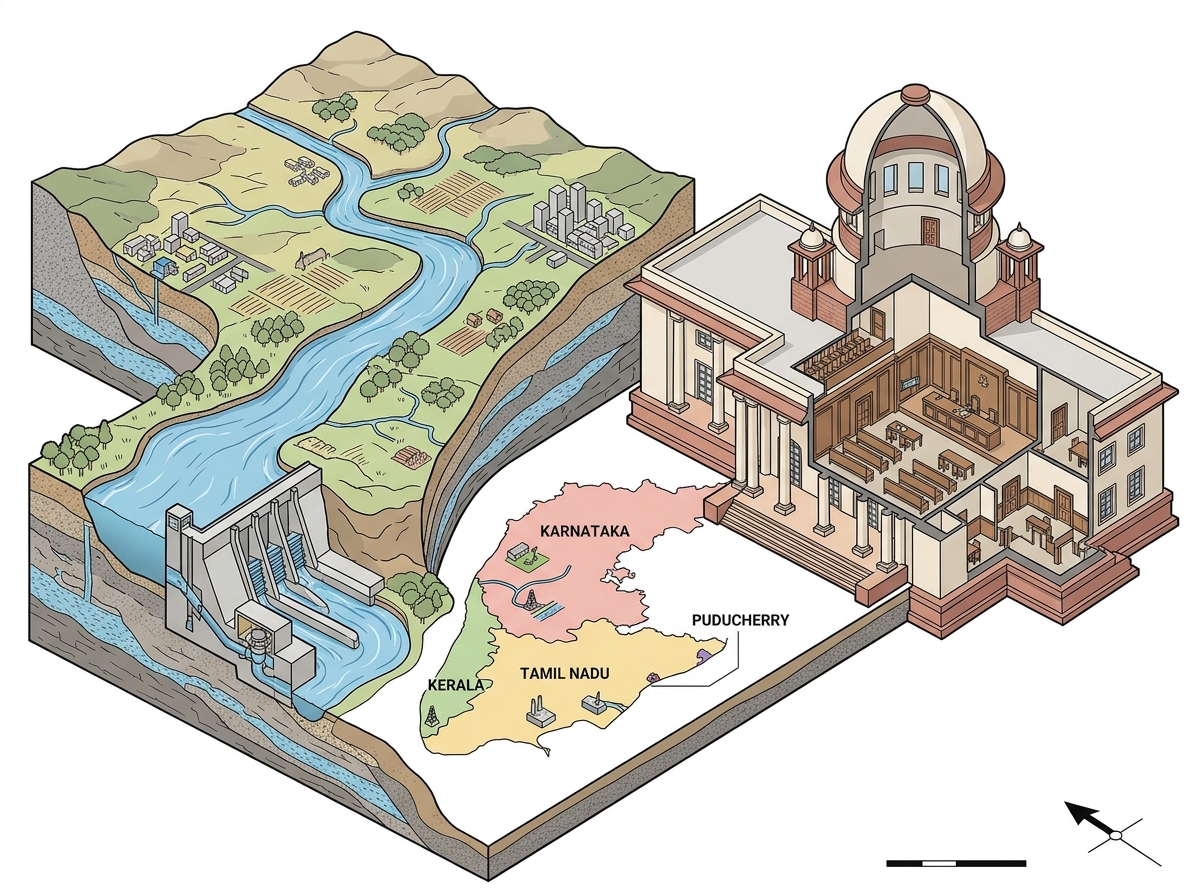
12 Aug Cauvery Water Dispute: SC Hearing Postponed to August 17 Due to Judge’s Illness
Supreme CourtCauvery disputeTamil NaduKarnatakaInter-state water dispute✎ The Cauvery Water Dispute is governed by the Inter-State Water Disputes Act, 1956, and the Cauvery Water Management Authority (CWMA) was established under the Inter-State Water Disputes Act, 1956 to enforce tribunal awards and…
Subject Relevance — Where This Topic Fits
- GS Paper II — Functions and Responsibilities of the Union and the States, Issues and Challenges Pertaining to the Federal Structure | GS Paper II — Judiciary: Structure, Organisation and Functioning | GS Paper III — Conservation, Environmental Pollution and Degradation, Environmental Impact Assessment
- Prelims: Inter-State Water Disputes Act, 1956, Cauvery Water Disputes Tribunal (CWDT), Cauvery Water Management Authority (CWMA), Inter-State River Water Disputes (Amendment) Act, 2019, Article 262 of the Constitution, Article 136 of the Constitution, Cauvery River Basin, Riparian States, Tribunal Awards, Supreme Court’s Appellate Jurisdiction
- Essay: Federalism and Centre-State Relations: Challenges in Governance of Shared Natural Resources, Judicial Activism vs. Legislative Federalism: Balancing Water Rights and Environmental Justice
Quick Revision: The Cauvery Water Dispute is governed by the Inter-State Water Disputes Act, 1956, and the Cauvery Water Management Authority (CWMA) was established under the Inter-State Water Disputes Act, 1956 to enforce tribunal awards and ensure equitable water-sharing among riparian states.
Why is this in the news?
The Supreme Court of India has adjourned the hearing of the Cauvery water dispute between Tamil Nadu and Karnataka to August 17, 2026, due to the unavailability of a presiding judge. The case pertains to Tamil Nadu’s plea for the implementation of a Central Water Management Authority (CWMA) decision directing Karnataka to release 3,500 cusecs of water for 15 days from its reservoirs. This development underscores the persistent challenges in resolving inter-state water disputes through judicial and institutional mechanisms, particularly in the context of seasonal water scarcity and competing demands.
Background
- The Cauvery River Basin is a shared resource between the states of Karnataka, Tamil Nadu, Kerala, and the Union Territory of Puducherry, with Karnataka and Tamil Nadu being the primary disputing parties due to their riparian positions.
- The dispute dates back to the late 19th century, with formal adjudication beginning in 1990 when the Government of India constituted the Cauvery Water Disputes Tribunal (CWDT) under the Inter-State Water Disputes Act, 1956.
- The CWDT delivered its final award in 2007, allocating water shares among the riparian states, but Karnataka and Tamil Nadu have repeatedly contested the implementation of the award, leading to recurring legal and political friction.
- In 2018, the Supreme Court, exercising its appellate jurisdiction under Article 136 of the Constitution, delivered a landmark judgment upholding the CWDT’s award while modifying certain allocations to reflect changing hydrological realities and equitable principles.
- To operationalise the CWDT’s award, the Government of India constituted the Cauvery Water Management Authority (CWMA) in 2018 under the Inter-State River Water Disputes Act, 1956, with the mandate to enforce water-sharing decisions and monitor compliance.
- The CWMA’s July 30, 2026, decision to direct Karnataka to release 3,500 cusecs of water for 15 days reflects the ongoing efforts to balance the demands of agriculture, ecology, and human settlements in the basin, particularly during the monsoon-dependent cropping seasons.
What is the Cauvery Water Dispute?
- The Cauvery Water Dispute is a protracted inter-state conflict between Karnataka and Tamil Nadu (with Kerala and Puducherry as stakeholders) over the equitable allocation and utilisation of the waters of the Cauvery River Basin.
- The dispute arises from the geographical asymmetry of the basin: Karnataka, as the upper riparian state, controls major reservoirs (e.g., Kabini, Krishna Raja Sagara), while Tamil Nadu, as the lower riparian state, relies on downstream flows for irrigation, particularly in the fertile Cauvery Delta.
- The legal framework governing the dispute includes the Inter-State Water Disputes Act, 1956, which empowers the Union Government to constitute tribunals for resolving inter-state water disputes.
- The Cauvery Water Disputes Tribunal (CWDT), constituted in 1990, delivered its final award in 2007, allocating 30 TMC (thousand million cubic feet) to Tamil Nadu, 270 TMC to Karnataka, 30 TMC to Kerala, and 7 TMC to Puducherry, with additional allocations for environmental flows and contingencies.
- The Supreme Court, in its 2018 judgment, upheld the CWDT’s award while increasing Karnataka’s share to 284.75 TMC and Tamil Nadu’s share to 404.25 TMC, reflecting a rebalancing of allocations based on equitable principles and hydrological data.
- The Cauvery Water Management Authority (CWMA), established in 2018, is tasked with monitoring the implementation of the CWDT’s award, ensuring compliance with water-sharing decisions, and resolving disputes through technical and administrative mechanisms.
- The dispute highlights the broader challenges of inter-state water governance in India, including the tension between state autonomy and national integration, the need for robust institutional mechanisms, and the impact of climate variability on water availability.
- The recurring legal and administrative interventions underscore the limitations of judicial and quasi-judicial mechanisms in resolving disputes that are inherently political, economic, and ecological in nature.
Key Features
| Feature | Significance |
|---|---|
| Cauvery Water Disputes Tribunal (CWDT) Award, 2007 | Establishes the quantum of water share for Tamil Nadu, Karnataka, Kerala, and Puducherry, resolving inter-state water allocation disputes through a judicial mechanism. |
| Central Water Management Authority (CWMA) | Constitutional body under Article 262(2) to enforce CWDT awards and regulate inter-state river water disputes, ensuring compliance with tribunal directives. |
| Supreme Court’s Original Jurisdiction under Article 131 | Empowers the Supreme Court to adjudicate disputes between states, including inter-state river water sharing, without requiring prior reference to tribunals. |
| Riparian Principles in Water Allocation | International and domestic legal principle governing water-sharing between upstream and downstream states, balancing equitable use and no-harm doctrine. |
| Inter-State Water Disputes Act, 1956 | Legislative framework governing the adjudication and resolution of inter-state river water disputes, including the establishment of tribunals and enforcement mechanisms. |
Why it Matters
Economic
- Agricultural productivity in Tamil Nadu’s Cauvery delta, particularly in districts like Thanjavur and Tiruvarur, is critically dependent on timely water releases from Karnataka’s reservoirs.
- Approximately 14.91 lakh acres of net sown area and livelihoods of over 10 million agricultural workers are directly impacted by water availability in the Cauvery basin.
- The Cauvery delta is a major rice-producing region, contributing significantly to India’s food security and rural employment.
Legal-Institutional
- The Supreme Court’s intervention underscores the role of constitutional courts in resolving inter-state disputes when statutory mechanisms face implementation challenges.
- The CWMA’s directive of July 30, 2026, reflects the authority vested in it under the Inter-State Water Disputes Act, 1956, to enforce tribunal awards.
- The case highlights the interplay between judicial review and administrative enforcement in inter-state water governance.
Environmental
- The dispute underscores the need for sustainable water management in the Cauvery basin, particularly in the context of climate change-induced variability in precipitation.
- The Mettur reservoir, a key storage facility for Tamil Nadu, relies on upstream releases, making its operational efficiency contingent on equitable basin-wide water sharing.
Federalism
- The case exemplifies the challenges of cooperative federalism in natural resource governance, where state-level autonomy must align with basin-wide sustainability.
- The Supreme Court’s role in adjudicating the dispute reflects the tension between state rights and national interest in water resource management.
Challenges
1. Implementation Deficit in Inter-State Water Awards
- States often fail to comply with tribunal or court directives due to political pressures, administrative bottlenecks, or competing water demands.
- The lack of a robust enforcement mechanism under the Inter-State Water Disputes Act, 1956, exacerbates delays in compliance.
- The CWMA’s authority is frequently contested by states, leading to prolonged disputes and judicial interventions.
UPSC Link: GS-II: Federalism, Water Disputes
2. Equitable Water Allocation vs. Riparian Rights
- The principle of equitable apportionment must balance historical usage, geographical advantage, and future needs, which often conflict.
- Upstream states (e.g., Karnataka) prioritise their agricultural and urban demands, while downstream states (e.g., Tamil Nadu) argue for prior usage rights.
- The absence of a basin-wide agreement complicates long-term water security planning.
UPSC Link: GS-II: Water Resources
3. Institutional Coordination Gaps
- The CWMA, CWRC, and state agencies operate with overlapping mandates, leading to coordination failures in water release and monitoring.
- The lack of real-time data sharing and integrated basin management hampers evidence-based decision-making.
- Political interference in technical bodies undermines their autonomy and effectiveness.
UPSC Link: GS-II: Governance
4. Climate Change and Water Scarcity
- Increasing frequency of droughts and erratic monsoons in the Cauvery basin exacerbates water stress, intensifying inter-state conflicts.
- The Mettur reservoir’s storage levels have hit 50-year lows, reflecting broader challenges in basin-wide water availability.
- Adaptation strategies, such as rainwater harvesting and wastewater recycling, remain underutilised.
UPSC Link: GS-III: Climate Change
5. Judicial Overreach vs. Legislative Role
- Frequent Supreme Court interventions in inter-state water disputes raise questions about the separation of powers and the role of tribunals.
- The judiciary’s limited technical expertise in water management may lead to suboptimal solutions.
- The need for a permanent constitutional mechanism to resolve such disputes remains unaddressed.
UPSC Link: GS-II: Judiciary
Challenges — UPSC Perspective
| Issue | Concern |
|---|---|
| Non-compliance with Tribunal Awards | States frequently ignore CWDT or CWMA directives due to political or administrative reasons, leading to prolonged disputes. |
| Politicisation of Water Governance | Water allocation decisions are influenced by electoral considerations rather than technical or equitable criteria. |
| Data Asymmetry and Misinformation | Disputes often arise from conflicting data on water availability, usage, and projections, complicating negotiations. |
| Inadequate Basin-Wide Planning | The absence of integrated river basin management plans results in fragmented and unsustainable water use. |
| Judicial Delays and Backlog | Prolonged litigation in inter-state water disputes delays resolution and exacerbates water scarcity for affected communities. |
| Climate-Induced Water Stress | Changing precipitation patterns and rising temperatures reduce water availability, intensifying conflicts between states. |
Way Forward
- Strengthen the enforcement mechanism of the CWMA by empowering it with penal provisions for non-compliance with tribunal or court directives.
- Establish a permanent Inter-State Water Disputes Tribunal with exclusive jurisdiction to reduce judicial delays and ensure timely resolution.
- Develop a basin-wide water management plan for the Cauvery, incorporating climate change projections and equitable allocation principles.
- Enhance real-time data sharing between states and central agencies to improve transparency and evidence-based decision-making.
- Promote integrated water resource management through rainwater harvesting, wastewater recycling, and conjunctive use of surface and groundwater.
- Conduct regular consultations between riparian states to build trust and foster cooperative governance mechanisms.
- Invest in climate-resilient infrastructure, such as multi-purpose reservoirs and drought-proofing measures, to mitigate water scarcity.
UPSC Value Addition
Keywords for Mains Answer-Writing
Inter-State Water Disputes Act, 1956 · Cauvery Water Management Authority (CWMA) · Inter-State River Water Disputes Tribunal (ISRWDT) · Supreme Court of India · Article 262 of the Constitution · Federalism in India · Water sharing agreements · Riparian rights · Judicial intervention in water disputes · Constitutional provisions for inter-state disputes · Central Water Commission (CWC) · Karnataka-Tamil Nadu water dispute · Judicial delay and governance · Constitutional remedies for federal disputes · Inter-state cooperation mechanisms
Constitutional & Policy Linkages
- [‘Article 262(1) – Adjudication of inter-state water disputes’]
- [‘Article 262(2) – Exclusion of jurisdiction of courts in such disputes’]
- [‘Article 131 – Original jurisdiction of Supreme Court for state disputes’]
- [‘Article 265 – Taxes not to be imposed except by authority of law (relevant for water pricing and levies)’]
Concept Flow
Cauvery Water Disputes Tribunal (CWDT) Award, 2007 → Establishes water shares for riparian states. → Implementation challenges → Karnataka’s non-compliance with CWMA directives of July 30, 2026. → Tamil Nadu’s plea to Supreme Court → Seeks enforcement of CWMA directives via judicial direction. → Supreme Court’s intervention → Postponement due to judicial vacancy; highlights role of constitutional courts. → Impact on agriculture → 14.91 lakh acres in Tamil Nadu delta dependent on Mettur reservoir water. → Broader implications → Federalism, equitable water allocation, and climate change challenges in river basin governance.
Prelims Practice Questions
Q1. Consider the following statements regarding the Cauvery Water Disputes Tribunal (CWDT):
1. The CWDT was constituted under the Inter-State Water Disputes Act, 1956.
2. The CWDT’s award is binding on the parties and has the force of a decree of the Supreme Court.
3. The Cauvery Management Board (CMB) was established as a permanent body to implement the CWDT award.
4. The CWDT’s award can be challenged only before the Supreme Court of India.
How many of the above statements are correct?
- Only one
- Only two
- Only three
- All four
Answer: All four — Statements 1, 2, and 4 are correct. Statement 3 is incorrect as the Cauvery Water Management Authority (CWMA) was established in 2018 to implement the CWDT award, not the CMB, which was a temporary body.
Q2. Assertion (A): The Supreme Court of India has the power to adjudicate disputes between States on matters of inter-state river water sharing.
Reason (R): Article 262 of the Constitution of India empowers the Parliament to provide for the adjudication of such disputes by a Tribunal, but the Supreme Court retains appellate jurisdiction under Article 136.
Options:
A. Both A and R are true, and R is the correct explanation of A.
B. Both A and R are true, but R is not the correct explanation of A.
C. A is true, but R is false.
D. A is false, but R is true.
Answer: ? — Both the Assertion and Reason are correct. The Supreme Court can adjudicate inter-state water disputes under its appellate jurisdiction (Article 136) even after the establishment of a Tribunal under Article 262. The Reason correctly explains the Assertion.
Q3. Match the following institutions with their respective roles in the management of the Cauvery river basin:
Column I (Institution)
A. Cauvery Water Management Authority (CWMA)
B. Central Water Commission (CWC)
C. Inter-State River Water Disputes Tribunal (ISRWDT)
D. Supreme Court of India
Column II (Role)
1. Constituted under the Inter-State Water Disputes Act, 1956 to adjudicate disputes.
2. A permanent body established to implement the Cauvery Water Disputes Tribunal award.
3. A constitutional body that provides technical advice on water resources and monitors river systems.
4. Adjudicates disputes between States and also hears appeals against the decisions of Tribunals.
- A-2, B-3, C-1, D-4; A-1, B-2, C-3, D-4; A-4, B-1, C-2, D-3; A-3, B-4, C-2, D-1
- answer_indexes_in_options_array_for_json_output_only_here_then_erase_this_line_but_keep_the_rest_as_is: [0],
Answer: A-2, B-3, C-1, D-4; A-1, B-2, C-3, D-4; A-4, B-1, C-2, D-3; A-3, B-4, C-2, D-1 — The correct match is: A-2 (CWMA implements the CWDT award), B-3 (CWC provides technical advice), C-1 (ISRWDT adjudicates disputes), D-4 (Supreme Court adjudicates disputes and hears appeals).
Mains Practice Question
✍ The Supreme Court of India, while adjudicating inter-state water disputes, often finds itself balancing federalism, constitutional provisions, and the urgency of equitable water distribution. In this context, critically examine the role of the judiciary in resolving the Cauvery water dispute between Karnataka and Tamil Nadu. Also, analyse the effectiveness of the Cauvery Water Management Authority (CWMA) in implementing the decisions of the Inter-State River Water Disputes Tribunal (ISRWDT). (15 Marks)
Approach: MODEL-ANSWER SKELETON:
1. **Introduction (2 Marks)**
– Briefly define the Cauvery water dispute as an inter-state river water sharing issue between Karnataka and Tamil Nadu.
– Mention the constitutional and statutory framework: Article 262 (exclusion of jurisdiction of courts), Inter-State Water Disputes Act, 1956, and the role of the Supreme Court under Article 136.
2. **Judicial Role in Resolving the Cauvery Dispute (5 Marks)**
– **Constitutional Basis**: Explain the Supreme Court’s jurisdiction under Article 136 to hear appeals from the decisions of the ISRWDT or directly adjudicate disputes when no Tribunal exists (as in the initial phases of the Cauvery dispute).
– **Judicial Activism vs. Judicial Restraint**: Discuss the Supreme Court’s approach in balancing federalism and the rights of riparian states. Cite landmark judgments such as *Karnataka v. State of Tamil Nadu* (2018) where the Court modified the ISRWDT award to ensure equitable distribution.
– **Urgency and Equity**: Highlight the Court’s role in ensuring timely implementation of water-sharing decisions, especially during agricultural seasons, as seen in the recent Supreme Court’s intervention in August 2026.
– **Challenges**: Discuss the limitations of judicial intervention, such as delays in adjudication, lack of enforcement mechanisms, and the political sensitivity of water-sharing decisions.
3. **Effectiveness of the Cauvery Water Management Authority (CWMA) (5 Marks)**
– **Legal Framework**: Explain the establishment of the CWMA under the Inter-State Water Disputes Act, 1956, and its mandate to implement the ISRWDT award (2007).
– **Functions and Powers**: Describe the CWMA’s role in monitoring water releases, coordinating with states, and ensuring compliance with the Tribunal’s decisions.
– **Challenges in Implementation**: Discuss the recurring disputes over water releases, political resistance from states, and the lack of a permanent enforcement mechanism. Cite the recent instance where Karnataka did not comply with the CWMA’s decision to release 3500 cusecs of water, leading to judicial intervention.
– **Suggestions for Improvement**: Propose measures such as strengthening the CWMA’s enforcement powers, increasing transparency, and fostering inter-state cooperation through data-sharing and joint management.
4. **Conclusion (3 Marks)**
– Summarise the judiciary’s role as a crucial arbiter in inter-state water disputes, balancing constitutional provisions and equitable distribution.
– Acknowledge the CWMA’s potential as a permanent mechanism for water management but stress the need for political will and institutional reforms to ensure its effectiveness.
– Conclude with a forward-looking statement on the importance of cooperative federalism and sustainable water management in addressing such disputes.
Source: The Hindu
Generated by AanyaAi for educational purpose.

- Gurugram’s groundwater extraction exceeds limit by 212%; HC seeks ban - October 4, 2026
- स्वतंत्रता सेनानी श्यामजी कृष्ण वर्मा की जन्म जयंती पर पीएम का श्रद्धांजलि - October 4, 2026
- KWML’s Feasibility Reports for Water Metro in 18 Cities: UPSC & PCS Insights - October 3, 2026

No Comments