



12 Aug RBI Auction Results: 91/182/364-Day T-Bills Cut-off Yields Explained for UPSC
✎ Treasury Bills are zero-coupon, short-term government securities issued at a discount to face value, with tenors of 91, 182, and 364 days, and their yields (YTM) reflect market expectations of short-term interest rates and…
Subject Relevance — Where This Topic Fits
- GS Paper III — Indian Economy: Money and Banking, Government Budgeting and Fiscal Policy
- Prelims: Treasury Bills (T-Bills), Yield to Maturity (YTM), Open Market Operations (OMO), Liquidity Adjustment Facility (LAF), Fiscal Deficit, Government Securities (G-Secs), Money Market Instruments
- Essay: Role of Government Securities in Fiscal Consolidation and Monetary Policy Transmission, Impact of Short-Term Borrowing on Long-Term Economic Stability
Quick Revision: Treasury Bills are zero-coupon, short-term government securities issued at a discount to face value, with tenors of 91, 182, and 364 days, and their yields (YTM) reflect market expectations of short-term interest rates and liquidity conditions.
Why is this in the news?
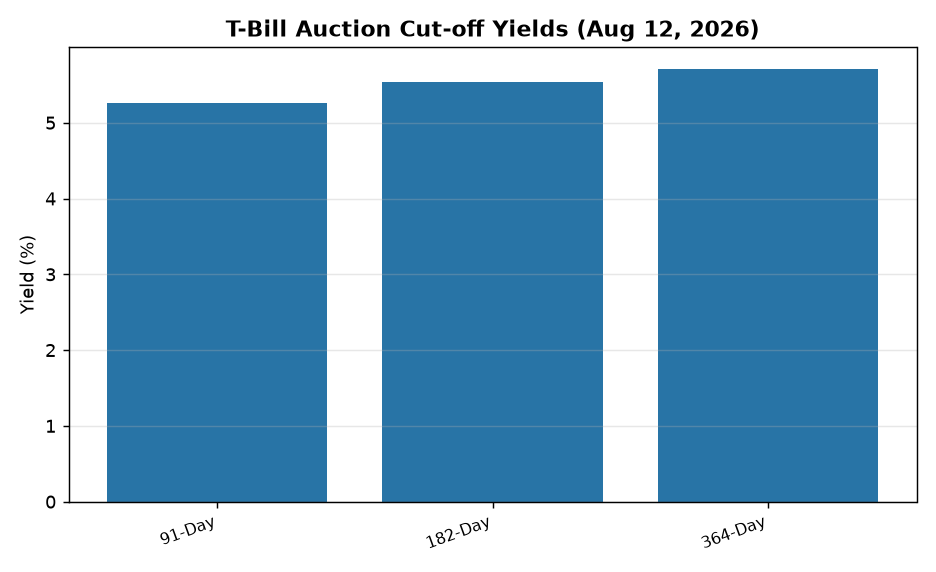
The Reserve Bank of India (RBI) conducted auctions for 91-day, 182-day, and 364-day Treasury Bills (T-Bills) on August 12, 2026, with notified amounts of ₹9,000 crore, ₹8,000 crore, and ₹7,000 crore respectively. The cut-off yields (implicit yields at cut-off prices) for these T-Bills were 5.2624%, 5.5390%, and 5.7094%, indicating market expectations about short-term interest rates and liquidity conditions. These results are significant for understanding the RBI’s monetary policy stance, government’s borrowing strategy, and the broader financial market dynamics.
Background
- Treasury Bills are short-term government securities issued by the RBI on behalf of the Government of India to meet its short-term borrowing requirements.
- T-Bills are issued through auctions conducted by the RBI under the framework of the Government Securities Act, 2006, and the Reserve Bank of India Act, 1934.
- The notified amounts for T-Bills are determined based on the Government’s fiscal deficit targets and cash flow requirements.
- Yield to Maturity (YTM) is a key metric for investors, reflecting the annualised return if the bill is held to maturity, and serves as a benchmark for short-term interest rates.
- The RBI uses T-Bill auctions as part of its Open Market Operations (OMO) to manage liquidity in the banking system and influence interest rates.
- Short-term borrowing through T-Bills is a critical component of the Government’s fiscal strategy, particularly in the context of managing revenue-expenditure gaps and reducing reliance on long-term debt.
What are Treasury Bills (T-Bills)?
- Treasury Bills are zero-coupon securities issued by the Government of India, meaning they do not pay periodic interest; instead, they are issued at a discount to their face value and redeemed at par on maturity.
- T-Bills are issued in three tenors: 91 days, 182 days, and 364 days, catering to different liquidity and investment horizons of market participants.
- The RBI conducts auctions for T-Bills on behalf of the Government, with the notified amounts and cut-off yields determined through competitive bidding by primary dealers and institutional investors.
- Yield to Maturity (YTM) is calculated as the annualised rate of return an investor earns if the T-Bill is held until maturity, derived from the difference between the issue price and the face value.
- T-Bills are highly liquid instruments, traded in the secondary market, and serve as a benchmark for short-term interest rates in the economy.
- Investors in T-Bills include commercial banks, mutual funds, insurance companies, non-banking financial companies (NBFCs), and foreign portfolio investors (FPIs).
- The issuance of T-Bills is governed by the Government Securities Act, 2006, and the Reserve Bank of India Act, 1934, ensuring transparency and regulatory oversight.
- T-Bills play a crucial role in the Government’s cash management operations, helping to bridge temporary mismatches between revenue receipts and expenditure commitments.
Key Features
| Feature | Significance |
|---|---|
| Maturity Tenor | The auction covers three distinct maturity tenors—91 days, 182 days, and 364 days—enabling the government to manage short-term liquidity needs and roll over debt obligations efficiently. |
| Cut-off Price | The cut-off price determines the yield at which the Treasury Bills (T-Bills) are issued, reflecting market sentiment, liquidity conditions, and the government’s borrowing cost for that specific tenor. |
| Implicit Yield | The implicit yield (YTM) derived from the cut-off price indicates the return investors expect for holding T-Bills of varying maturities, serving as a benchmark for short-term interest rates in the economy. |
| Total Face Value Notified | The notified face value (₹9,000 Crore for 91-day, ₹8,000 Crore for 182-day, and ₹7,000 Crore for 364-day T-Bills) represents the government’s planned borrowing through this auction, aligning with fiscal deficit targets. |
| Full Subscription | The total face value accepted matches the notified amount for all tenors, indicating robust demand from investors and successful absorption of the government’s borrowing program. |
Why it Matters
Monetary Policy Transmission
- The implicit yields on T-Bills serve as a reference for short-term interest rates, influencing the broader yield curve and monetary policy transmission mechanisms.
- Higher yields may signal tightening liquidity conditions or elevated inflation expectations, prompting the central bank to adjust policy rates or liquidity operations.
- The auction results provide insights into the liquidity preference of investors, which can guide the Reserve Bank of India (RBI) in fine-tuning its liquidity management framework.
Fiscal Management
- T-Bills are a key instrument for the government to meet short-term fiscal deficits without resorting to long-term borrowing, thereby optimizing the debt maturity profile.
- The auction ensures that the government’s borrowing program is executed within the fiscal deficit targets set in the Union Budget, maintaining macroeconomic stability.
- Full subscription of notified amounts reflects investor confidence in India’s sovereign debt, reinforcing fiscal credibility.
Investor Sentiment and Market Dynamics
- The cut-off yields act as a barometer for investor sentiment, with higher yields indicating demand for higher returns due to perceived risks or liquidity constraints.
- Institutional investors, including banks and mutual funds, rely on T-Bill yields to price other short-term instruments, such as Commercial Paper (CP) and Certificates of Deposit (CD).
- The auction results influence secondary market liquidity for T-Bills, which is critical for maintaining an active and efficient money market.
Benchmarking for Financial Markets
- T-Bill yields are used as benchmarks for pricing corporate bonds, money market instruments, and even some retail financial products like floating-rate loans.
- The implicit yields provide a reference for the term structure of interest rates, aiding in the valuation of financial assets and liabilities across the economy.
- The auction results contribute to the development of a liquid and transparent government securities market, which is essential for financial market deepening.
Challenges
1. Liquidity Management Challenges
- Balancing the supply of T-Bills with liquidity conditions in the banking system to avoid excessive volatility in short-term interest rates.
- Ensuring adequate investor participation across tenors to prevent over-reliance on specific investor segments, such as banks or mutual funds.
- Mitigating the impact of sudden shifts in investor sentiment, which can lead to higher borrowing costs for the government.
UPSC Link: Monetary Policy Framework
2. Fiscal Discipline and Debt Sustainability
- Maintaining fiscal discipline while meeting short-term borrowing requirements without compromising long-term debt sustainability.
- Avoiding excessive reliance on short-term borrowing, which can increase refinancing risks and expose the government to interest rate volatility.
- Ensuring that the cost of borrowing (implicit yields) remains within sustainable limits relative to GDP growth and revenue receipts.
UPSC Link: Fiscal Responsibility and Budget Management Act
3. Market Volatility and Investor Confidence
- Managing market volatility arising from global or domestic economic shocks, which can disrupt the smooth functioning of the T-Bill auction process.
- Ensuring transparency and predictability in auction processes to maintain investor confidence in sovereign debt instruments.
- Addressing liquidity crunches in the banking system that may reduce investor appetite for T-Bills.
UPSC Link: Financial Market Regulation
4. Inflation and Interest Rate Dynamics
- Balancing the need for higher yields to attract investors with the risk of stoking inflationary pressures through higher borrowing costs.
- Aligning T-Bill yields with the RBI’s inflation and growth objectives to ensure consistency with monetary policy goals.
- Monitoring the impact of global interest rate trends on domestic T-Bill yields, particularly in an environment of rising US Federal Reserve rates.
UPSC Link: Inflation Targeting Framework
Challenges — UPSC Perspective
| Issue | Concern |
|---|---|
| Excessive Borrowing Costs | Higher implicit yields increase the government’s cost of borrowing, potentially straining fiscal resources and limiting fiscal space for development expenditures. |
| Investor Concentration Risk | Over-reliance on specific investor segments (e.g., banks) may lead to liquidity constraints or systemic risks if those segments face stress. |
| Refinancing Risk | Short-term borrowing exposes the government to refinancing risks, particularly if global or domestic conditions lead to higher future borrowing costs. |
| Global Spillovers | External factors, such as changes in global risk appetite or US monetary policy, can influence domestic T-Bill yields, complicating domestic liquidity management. |
| Liquidity Crunches | Sudden liquidity shortages in the banking system can reduce investor appetite for T-Bills, disrupting the auction process and increasing borrowing costs. |
| Transparency and Predictability | Lack of clarity in auction processes or sudden policy shifts can erode investor confidence, leading to lower participation and higher yields. |
Way Forward
- Enhance liquidity forecasting mechanisms to align T-Bill issuance with systemic liquidity conditions, reducing volatility in short-term interest rates.
- Diversify the investor base for T-Bills by encouraging participation from non-bank investors, such as insurance companies, pension funds, and foreign portfolio investors.
- Strengthen communication strategies to provide clear guidance on the government’s borrowing calendar and auction processes, fostering transparency and predictability.
- Develop secondary market liquidity for T-Bills by incentivizing market-making activities and improving trading infrastructure.
- Integrate T-Bill yields with broader financial market benchmarks to enhance pricing efficiency and reduce systemic risks.
- Monitor global macroeconomic developments to anticipate spillovers and adjust domestic liquidity management strategies proactively.
- Conduct periodic reviews of the T-Bill auction framework to incorporate feedback from market participants and address emerging challenges.
- Promote financial literacy among retail investors to broaden participation in government securities, including T-Bills.
UPSC Value Addition
Keywords for Mains Answer-Writing
Treasury Bills (T-Bills) · Money Market Instruments · Yield to Maturity (YTM) · Reserve Bank of India (RBI) · Government Securities (G-Secs) · Auction Mechanism · Monetary Policy Operations · Liquidity Management · Short-Term Debt Instruments · Cut-off Price in Auctions · Implicit Yield · Public Debt Management
Concept Flow
Government announces borrowing program → RBI conducts T-Bill auction → Investors submit bids based on liquidity conditions and yield expectations → Cut-off prices and implicit yields are determined → Government raises funds at auction-determined yields → Yields influence short-term interest rates and monetary policy transmission → Investor sentiment and market liquidity are affected → Secondary market trading of T-Bills adjusts to reflect auction outcomes → Broader financial markets (e.g., corporate bonds, loans) price off T-Bill yields → Economic agents adjust spending and investment decisions based on interest rate signals → Feedback loop influences future borrowing and liquidity conditions.
Prelims Practice Questions
Q1. Consider the following statements regarding Treasury Bills (T-Bills) in India:
1. T-Bills are issued by the Government of India to meet short-term borrowing requirements.
2. The maturity period of T-Bills ranges from 91 days to 364 days.
3. T-Bills are sold through auctions conducted by the Reserve Bank of India (RBI).
4. T-Bills are tradable in the secondary market.
How many of the above statements are correct?
- Only one
- Only two
- Only three
- All four
Answer: All four — Statements 1, 3, and 4 are correct. Statement 2 is incorrect because T-Bills are issued with maturity periods of 91 days, 182 days, and 364 days, not beyond 364 days.
Q2. Assertion (A): The yield to maturity (YTM) of a Treasury Bill is inversely related to its cut-off price.
Reason (R): A higher cut-off price implies a lower discount rate, which reduces the YTM for the investor.
- Both A and R are true, and R is the correct explanation of A
- Both A and R are true, but R is not the correct explanation of A
- A is true, but R is false
- A is false, but R is true
Answer: Both A and R are true, and R is the correct explanation of A — Both the assertion and reason are true. The YTM of a T-Bill is calculated based on the discount to its face value, so a higher cut-off price (closer to face value) results in a lower YTM, making R the correct explanation of A.
Q3. Match the following columns related to Treasury Bills (T-Bills) in India:
Column I (Maturity Period) | Column II (Type of T-Bill)
—————————|————————–
A. 91 days | 1. Treasury Bill
B. 182 days | 2. Cash Management Bills (CMBs)
C. 364 days | 3. Dated Government Securities
D. Less than 91 days | 4. Zero-Coupon Instruments
- A-1, B-4, C-2, D-3
- A-4, B-1, C-2, D-3
- A-4, B-1, C-3, D-2
- A-1, B-4, C-3, D-2
Answer: A-1, B-4, C-3, D-2 — A (91 days), B (182 days), and C (364 days) correspond to Treasury Bills (Type 1), which are zero-coupon instruments (Type 4). D (less than 91 days) corresponds to Cash Management Bills (Type 2), not dated securities.
Mains Practice Question
✍ The Reserve Bank of India (RBI) conducts auctions for Treasury Bills (T-Bills) to manage liquidity and public debt. In this context, critically examine the role of T-Bills in India’s monetary policy framework. Also, analyse how the cut-off price and yield to maturity (YTM) in T-Bill auctions reflect the market’s perception of liquidity and risk. (15 Marks)
Approach: MODEL-ANSWER SKELETON:
1. **Introduction (2 Marks)**: Define Treasury Bills (T-Bills) as short-term government securities issued by the Government of India to meet fiscal deficits. State their role as zero-coupon instruments with maturities of 91, 182, and 364 days.
2. **Role in Monetary Policy Framework (5 Marks)**:
– **Liquidity Management**: Explain how T-Bills are used by the RBI to absorb or inject liquidity in the banking system through Open Market Operations (OMOs).
– **Benchmark for Interest Rates**: Discuss how T-Bill yields serve as a benchmark for pricing other short-term debt instruments, including commercial papers and certificates of deposit.
– **Public Debt Management**: Highlight how T-Bills help the government manage its short-term borrowing requirements efficiently.
– **Market Stabilisation Scheme (MSS)**: Briefly mention the role of T-Bills in the MSS framework for sterilisation operations.
3. **Auction Mechanism and Market Perception (5 Marks)**:
– **Auction Process**: Describe the competitive bidding process for T-Bills, including the role of primary dealers and the non-competitive segment.
– **Cut-off Price and YTM**: Explain the inverse relationship between cut-off price and YTM. Use the given data (e.g., 91-day T-Bill cut-off price of ₹98.7050 with YTM of 5.2624%) to illustrate how higher cut-off prices indicate lower yields and vice versa.
– **Market Sentiment**: Analyse how the cut-off price and YTM reflect liquidity conditions (e.g., tight liquidity may lead to higher yields) and risk perceptions (e.g., inflation expectations, credit risk).
4. **Challenges and Criticisms (3 Marks)**:
– **Interest Rate Risk**: Discuss the volatility in T-Bill yields due to changes in monetary policy or macroeconomic conditions.
– **Over-reliance on Short-Term Borrowing**: Highlight concerns about excessive short-term borrowing by the government, which could expose it to refinancing risks.
– **Secondary Market Liquidity**: Note the relatively lower liquidity of T-Bills in the secondary market compared to other G-Secs, which may deter some investors.
5. **Conclusion (2 Marks)**: Summarise the significance of T-Bills in India’s monetary policy and public debt management. Emphasise their role in maintaining macroeconomic stability while acknowledging the need for balanced debt management strategies.
Source: RBI
Generated by AanyaAi for educational purpose.

- PM Modi Praises Youth-Led Nasha Mukt Yuva Abhiyan Momentum - September 27, 2026
- राजनाथ सिंह का बड़ा बयान: भारत किसी की ज़मीन कब्ज़ा नहीं करेगा, लेकिन सुरक्षा पर होगा कठोर - September 27, 2026
- Exercise Tarang Shakti 2026: India’s Mega Multi-Nation Air Power Showcase - September 27, 2026

No Comments