


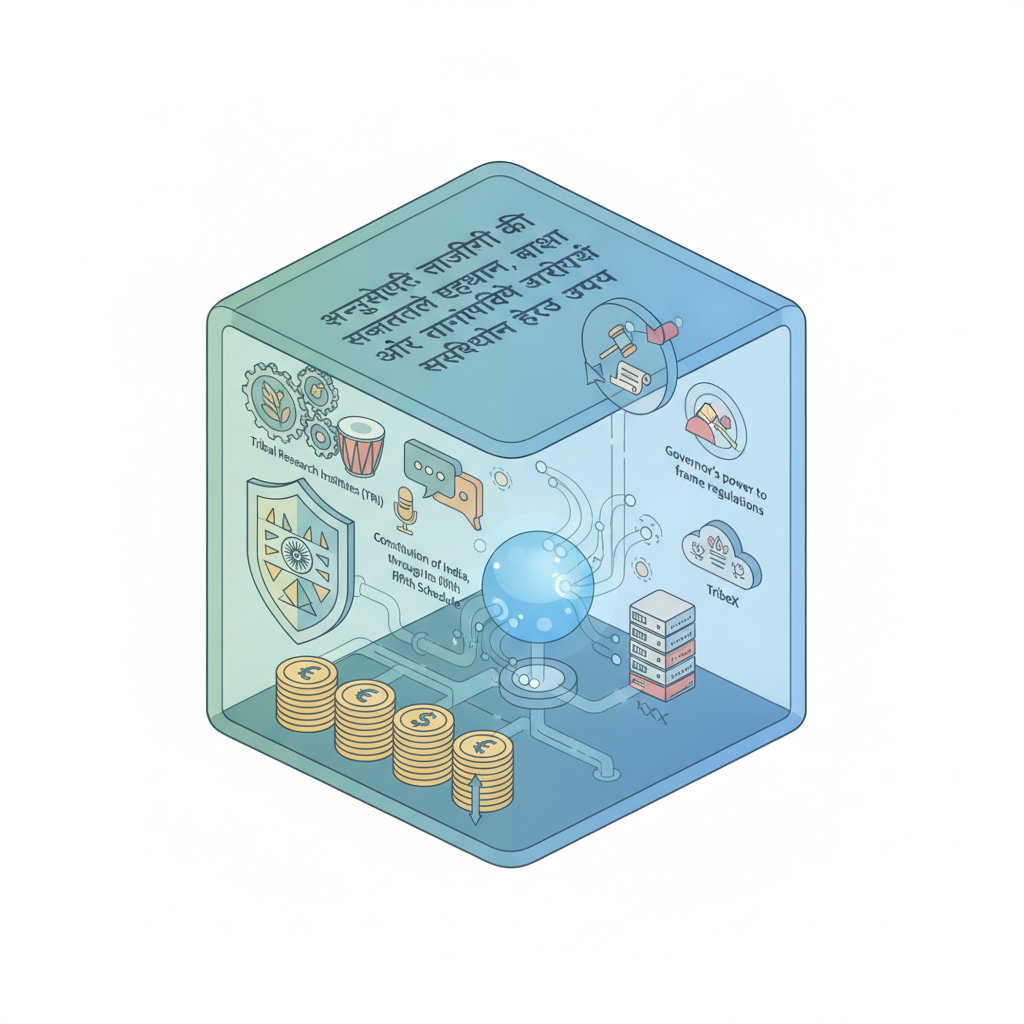
12 Aug Tribal Heritage Protection: Govt Initiatives for Cultural Identity & Rights
Tribal Research InstitutesTribeX platformFifth Schedule✎ Tribal Research Institutes (TRIs) are funded under a centrally sponsored scheme to document, preserve, and promote tribal cultural heritage, languages, and traditional knowledge, in alignment with constitutional provisions like…
Subject Relevance — Where This Topic Fits
- GS Paper II — Governance, Constitution, Polity, Social Justice and International Relations (Tribal Affairs, Constitutional Provisions) | GS Paper III — Environment, Biodiversity, and Traditional Knowledge Systems
- Prelims: Fifth Schedule, PESA Act, 1996, Forest Rights Act, 2006, Tribal Research Institutes (TRIs), Tribal Sub-Plan, Scheduled Areas, Tribal Heritage, Digital Archiving of Tribal Culture
- Essay: Cultural preservation as a pillar of national unity and sustainable development, Role of constitutional safeguards in protecting vulnerable sections
Quick Revision: Tribal Research Institutes (TRIs) are funded under a centrally sponsored scheme to document, preserve, and promote tribal cultural heritage, languages, and traditional knowledge, in alignment with constitutional provisions like the Fifth Schedule and statutory acts such as PESA and the Forest Rights Act.
Why is this in the news?
The Union Tribal Affairs Ministry, in a statement to the Rajya Sabha on 12 August 2026, highlighted the institutional and digital measures being implemented for the preservation, documentation, and promotion of tribal cultural identity, languages, oral traditions, and traditional knowledge systems. This includes financial support to 29 Tribal Research Institutes (TRIs), including the TRI in Jharkhand, under the centrally sponsored scheme ‘Assistance to Tribal Research Institutes (TRIs)’, as well as the development of AI-enabled tools like ‘Aadi Vaani’ for translation of tribal languages and the ‘TribeX’ digital platform for archiving and disseminating tribal cultural resources.
Background
- The Constitution of India, through the Fifth Schedule, empowers the Governor of each state having Scheduled Areas to frame regulations for the protection of tribal interests, including cultural heritage and traditional rights.
- The Panchayats (Extension to Scheduled Areas) Act, 1996 (PESA), seeks to ensure tribal self-governance by vesting gram sabhas with powers over natural resources and cultural matters in Scheduled Areas.
- The Scheduled Tribes and Other Traditional Forest Dwellers (Recognition of Forest Rights) Act, 2006, recognises individual and community forest rights, including rights over cultural and community resources.
- India is home to over 700 Scheduled Tribes, many of whom possess distinct languages, art forms, oral traditions, and traditional knowledge systems that are integral to their identity.
- Tribal languages are among the most endangered in the world, with many facing the risk of extinction due to lack of documentation and intergenerational transmission.
- The Ministry of Tribal Affairs was established in 1999 to formulate policies and programmes for the socio-economic development and empowerment of Scheduled Tribes in India.
What are Tribal Research Institutes (TRIs) and their role in cultural preservation?
- There are currently 29 TRIs across India, including one in Jharkhand, functioning under the administrative control of respective state governments or Union Territory administrations.
- TRIs implement annual action plans approved by the Ministry of Tribal Affairs, funded under the centrally sponsored scheme ‘Assistance to Tribal Research Institutes (TRIs)’, which provides financial support for approved activities.
- Key functions of TRIs include: documentation of tribal languages, folklore, customs, and traditional knowledge; organisation of cultural programmes; strengthening of tribal museums; and publication of research findings to inform policy.
- TRIs serve as knowledge repositories and provide evidence-based inputs to the Ministry for policy formulation and implementation, particularly in areas related to tribal welfare and cultural preservation.
- TRIs also play a role in capacity building by conducting training programmes and workshops for tribal communities and researchers.
Key Features
| Feature | Significance |
|---|---|
| Tribal Research Institutes (TRIs) | Institutional mechanism under 29 TRIs to document, research, and promote tribal languages, oral traditions, art forms, and traditional knowledge systems, functioning under state administrative control with financial support from the Ministry of Tribal Affairs. |
| TribalX Digital Platform | A Ministry-led digital initiative for documentation, preservation, and dissemination of tribal cultural resources, including Jharkhand’s Sohrai paintings, Dokra craft, and Jadupatia artworks, through short-term certificate courses. |
| AI-based Translation Tool ‘Aadi Vaani’ | Facilitates text and speech translation between tribal languages (e.g., Santali, Mundari) and Hindi/English, enhancing accessibility and preservation of indigenous linguistic heritage. |
| Annual Work Plans under CSS | TRIs implement Ministry-approved annual plans for cultural preservation, museum strengthening, research publication, and capacity-building activities, funded under the Centrally Sponsored Scheme (CSS). |
| Constitutional Safeguards | Implementation of Fifth Schedule provisions, PESA Act (1996), and FRA (2006) in Scheduled Areas, with the Ministry providing policy guidance and TRIs generating evidence for effective enforcement by state governments. |
Why it Matters
Cultural Preservation
- Ensures intergenerational transmission of tribal languages, oral traditions, and indigenous knowledge systems critical to the socio-cultural fabric of Scheduled Tribes.
- Digitally archives and promotes endangered art forms (e.g., Sohrai, Dokra) to prevent cultural erosion and support livelihoods through certification courses.
- Strengthens tribal identity by validating and disseminating traditional practices, thereby fostering social cohesion and self-esteem among tribal communities.
Policy and Governance
- Provides evidence-based research through TRIs to inform policy formulation and implementation under constitutional safeguards (Fifth Schedule, PESA, FRA).
- Enhances administrative capacity of state governments in Scheduled Areas by facilitating documentation of tribal customs and rights, aiding in compliance with statutory provisions.
- Bridges gaps between grassroots realities and policy-making through TRIs’ role in data generation and analysis of tribal development challenges.
Technological Integration
- Leverages AI and digital platforms (TribalX, Aadi Vaani) to democratize access to tribal knowledge, overcoming linguistic barriers and geographical constraints.
- Supports preservation of intangible cultural heritage (e.g., folk tales, rituals) through structured documentation and multimedia dissemination.
- Enables scalable solutions for cultural conservation, reducing dependency on physical archives and manual transcription methods.
Institutional Framework
- Establishes a decentralized yet coordinated network of 29 TRIs across states to address region-specific cultural and linguistic needs.
- Promotes multi-stakeholder collaboration between central ministries, state governments, and tribal communities for inclusive heritage conservation.
- Ensures financial sustainability of TRIs through CSS funding, enabling long-term planning and execution of preservation activities.
Challenges
1. Linguistic Endangerment
- Many tribal languages in India face extinction due to lack of intergenerational transmission and limited documentation efforts.
- Dialectal variations within languages (e.g., Santali, Mundari) complicate standardization and digital preservation efforts.
- Limited linguistic expertise and resources hinder the development of comprehensive translation tools and educational materials.
UPSC Link: GS-I: Tribal languages and cultural heritage
2. Institutional Capacity Constraints
- TRIs often lack adequate infrastructure, trained personnel, and technological tools for effective documentation and research.
- Delays in fund disbursement under CSS and bureaucratic hurdles impede timely implementation of approved work plans.
- Weak coordination between TRIs, state governments, and local tribal bodies leads to fragmented efforts and duplication of work.
UPSC Link: GS-II: Centre-state relations and public administration
3. Cultural Appropriation and Commercialization
- Tribal art forms and traditional knowledge are increasingly exploited commercially without equitable benefit-sharing with communities.
- Lack of legal frameworks for protecting indigenous intellectual property rights (e.g., geographical indications, copyrights) for tribal creations.
- Globalization and market pressures threaten the authenticity of tribal cultural expressions, prioritizing mass production over traditional craftsmanship.
UPSC Link: GS-III: IPR and cultural heritage
4. Access and Digital Divide
- Digital platforms (e.g., TribalX) may exclude marginalized tribal communities due to limited internet connectivity and digital literacy in remote areas.
- Low penetration of AI-based tools (e.g., Aadi Vaani) among elderly tribal members and non-literate populations restricts their utility.
- Language barriers persist in digital interfaces, requiring continuous updates to accommodate evolving tribal vocabularies.
UPSC Link: GS-II: Digital divide and inclusion
5. Policy Implementation Gaps
- Despite constitutional safeguards (Fifth Schedule, PESA, FRA), enforcement remains weak due to lack of awareness and political will at the grassroots level.
- TRIs’ research often remains confined to academic circles, failing to translate into ground-level policy interventions or community benefits.
- Inadequate monitoring and evaluation mechanisms to assess the impact of TRI activities on tribal welfare and cultural preservation.
UPSC Link: GS-II: Governance and constitutional provisions
Challenges — UPSC Perspective
| Issue | Concern |
|---|---|
| Linguistic Endangerment | Risk of extinction of tribal languages due to inadequate documentation and intergenerational transmission. |
| Institutional Capacity | TRIs face resource constraints, leading to suboptimal research and preservation efforts. |
| Cultural Appropriation | Exploitation of tribal art and knowledge without equitable benefit-sharing mechanisms. |
| Digital Divide | Limited access to digital tools among tribal communities, exacerbating exclusion. |
| Policy Enforcement | Weak implementation of constitutional safeguards due to administrative and awareness gaps. |
Government Initiatives — Must-Memorise for Prelims
- Tribal Research Institutes (TRIs) Support Scheme (Centally Sponsored Scheme)
- TribalX Digital Platform (Ministry of Tribal Affairs)
- AI-based Translation Tool ‘Aadi Vaani’ (Ministry of Tribal Affairs)
Way Forward
- Strengthen TRIs by augmenting infrastructure, training personnel, and integrating advanced digital tools for documentation and research.
- Expand the coverage of AI-based translation tools (e.g., Aadi Vaani) to include more tribal languages and dialects, ensuring user-friendly interfaces for non-literate populations.
- Develop robust legal frameworks for protecting tribal intellectual property rights, including geographical indications and traditional knowledge databases.
- Enhance inter-state coordination among TRIs to share best practices, avoid duplication, and address region-specific challenges.
- Launch community-led awareness campaigns to educate tribal populations about constitutional safeguards (e.g., PESA, FRA) and their rights.
- Establish a dedicated fund for urgent preservation of critically endangered languages and art forms, prioritizing marginalized tribal groups.
- Promote public-private partnerships to scale digital initiatives (e.g., TribalX) and ensure sustainable funding for long-term cultural conservation.
UPSC Value Addition
Keywords for Mains Answer-Writing
Scheduled Tribes · Tribal Research Institutes (TRIs) · Fifth Schedule · PESA Act 1996 · Forest Rights Act 2006 · Tribal cultural heritage · Tribal languages and oral traditions · Digital documentation of tribal art · Tribal knowledge systems · Constitutional safeguards for STs · AI-based translation tools for tribal languages · Tribal museums and cultural preservation
Constitutional & Policy Linkages
- Fifth Schedule: Administration and control of Scheduled Areas.
- PESA Act, 1996: Extension of Panchayati Raj to Scheduled Areas.
- Article 244(1): Provisions for administration of Scheduled Areas and Tribal Areas.
Concept Flow
Tribal cultural heritage faces erosion due to globalization and lack of documentation. → Ministry of Tribal Affairs establishes TRIs and digital platforms (TribalX, Aadi Vaani) for preservation. → TRIs conduct research, document languages, and promote art forms under CSS funding. → Constitutional safeguards (Fifth Schedule, PESA, FRA) provide legal framework for implementation. → State governments enforce these provisions with support from TRIs’ evidence-based inputs. → Digital tools enhance accessibility and inclusivity, bridging gaps in linguistic and cultural preservation. → Strengthened institutional mechanisms ensure sustainable conservation and community empowerment.
Prelims Practice Questions
Q1. Consider the following statements regarding the Tribal Research Institutes (TRIs) in India:
1. TRIs are autonomous bodies under the administrative control of the Ministry of Tribal Affairs.
2. TRIs receive financial assistance under the centrally sponsored scheme ‘Support to Tribal Research Institutes (TRIs)’.
3. TRIs are mandated to document tribal languages, oral traditions, and traditional knowledge systems.
4. TRIs operate independently of state governments and Union Territory administrations.
How many of the above statements are correct?
- Only one
- Only two
- Only three
- All
Answer: Only three — Statements 2 and 3 are correct. TRIs function under the administrative control of state governments/UT administrations (Statement 1 is incorrect), and Statement 4 is incorrect as TRIs work in coordination with state authorities.
Q2. Assertion (A): The Tribal Research Institutes (TRIs) primarily focus on the commercial exploitation of tribal art forms.
Reason (R): The Ministry of Tribal Affairs provides financial support to TRIs for the documentation and preservation of tribal cultural heritage.
Choose the correct option from below:
A. Both A and R are true, and R is the correct explanation of A.
B. Both A and R are true, but R is not the correct explanation of A.
C. A is true, but R is false.
D. A is false, but R is true.
- A
- B
- C
- D
Answer: D — Assertion (A) is false as TRIs focus on documentation and preservation, not commercial exploitation. Reason (R) is true and aligns with the stated objectives of the Ministry of Tribal Affairs.
Q3. Match the following initiatives with their respective objectives:
Column I (Initiative) | Column II (Objective)
———————|———————–
1. Tribal Research Institutes (TRIs) | A. AI-based translation tool for tribal languages
2. Tribal Digital Platform (TribeX) | B. Documentation and promotion of tribal art forms
3. PESA Act 1996 | C. Strengthening tribal self-governance in scheduled areas
4. Forest Rights Act 2006 | D. Recognition and vesting of forest rights to forest-dwelling tribes
Choose the correct match:
- 1-B, 2-A, 3-C, 4-D
- 1-C, 2-B, 3-D, 4-A
- 1-D, 2-A, 3-B, 4-C
- 1-A, 2-D, 3-C, 4-B
Answer: 1-B, 2-A, 3-C, 4-D — 1 matches with B (TRIs document and promote tribal art forms), 2 with A (TribeX is a digital platform for tribal cultural resources), 3 with C (PESA Act strengthens tribal self-governance), and 4 with D (Forest Rights Act recognizes forest rights).
Mains Practice Question
✍ The preservation of tribal cultural identity, languages, and traditional knowledge systems is not merely a cultural imperative but a constitutional obligation. Critically examine this statement in the light of the role of Tribal Research Institutes (TRIs) and the constitutional safeguards provided under the Fifth Schedule and the Panchayats (Extension to Scheduled Areas) Act, 1996 (PESA). Also, analyse how digital initiatives like the TribeX platform and AI-based tools such as ‘Aadi Vani’ contribute to the broader objectives of tribal heritage conservation. (15 Marks)
Approach: MODEL-ANSWER SKELETON:
1. **Constitutional and Statutory Framework** (4 points):
– Fifth Schedule provisions: Administration and control of Scheduled Areas; Governor’s role; Tribal Advisory Councils.
– PESA Act 1996: Recognition of traditional governance systems; empowerment of Gram Sabhas in Scheduled Areas.
– Forest Rights Act 2006: Recognition of forest rights and community forest resources.
– Emphasise that these provisions are not merely symbolic but impose a duty on the state to protect tribal identity and rights.
2. **Role of Tribal Research Institutes (TRIs)** (4 points):
– Function under the centrally sponsored scheme ‘Support to Tribal Research Institutes (TRIs)’.
– Activities: Documentation of tribal languages, oral traditions, and traditional knowledge; organisation of cultural programmes; strengthening of tribal museums; research and publication.
– TRIs as bridges between tribal communities and policymakers, providing evidence-based inputs for policy formulation.
– Limitations: Dependence on state governments for implementation; need for greater autonomy and capacity-building.
3. **Digital Initiatives and AI Tools** (4 points):
– TribeX (Tribal Digital Platform): Digital documentation and dissemination of tribal cultural resources; inclusion of tribal art forms like Sohrai painting and Dokra craft in short-term certificate courses.
– ‘Aadi Vani’: AI-enabled translation tool for tribal languages (e.g., Santali, Mundari) to facilitate preservation and accessibility.
– Contributions: Democratisation of tribal knowledge; preservation of endangered languages; facilitation of inter-generational transmission.
– Challenges: Digital divide; need for continuous updating of databases; ensuring community participation in digital documentation.
4. **Critical Analysis and Way Forward** (3 points):
– **Critique**: While constitutional and statutory safeguards exist, implementation gaps persist due to administrative delays, lack of awareness, and resource constraints.
– **Digital Divide**: Despite digital initiatives, access to technology remains uneven across tribal communities.
– **Way Forward**: Strengthening TRIs through greater financial and administrative autonomy; integrating digital initiatives with grassroots governance structures; promoting community-led documentation.
Balance: Present both the strengths and limitations of the existing framework, supported by constitutional provisions and practical examples.
Source: PIB (Press Information Bureau)
Generated by AanyaAi for educational purpose.

- Gurugram’s groundwater extraction exceeds limit by 212%; HC seeks ban - October 4, 2026
- स्वतंत्रता सेनानी श्यामजी कृष्ण वर्मा की जन्म जयंती पर पीएम का श्रद्धांजलि - October 4, 2026
- KWML’s Feasibility Reports for Water Metro in 18 Cities: UPSC & PCS Insights - October 3, 2026

No Comments