


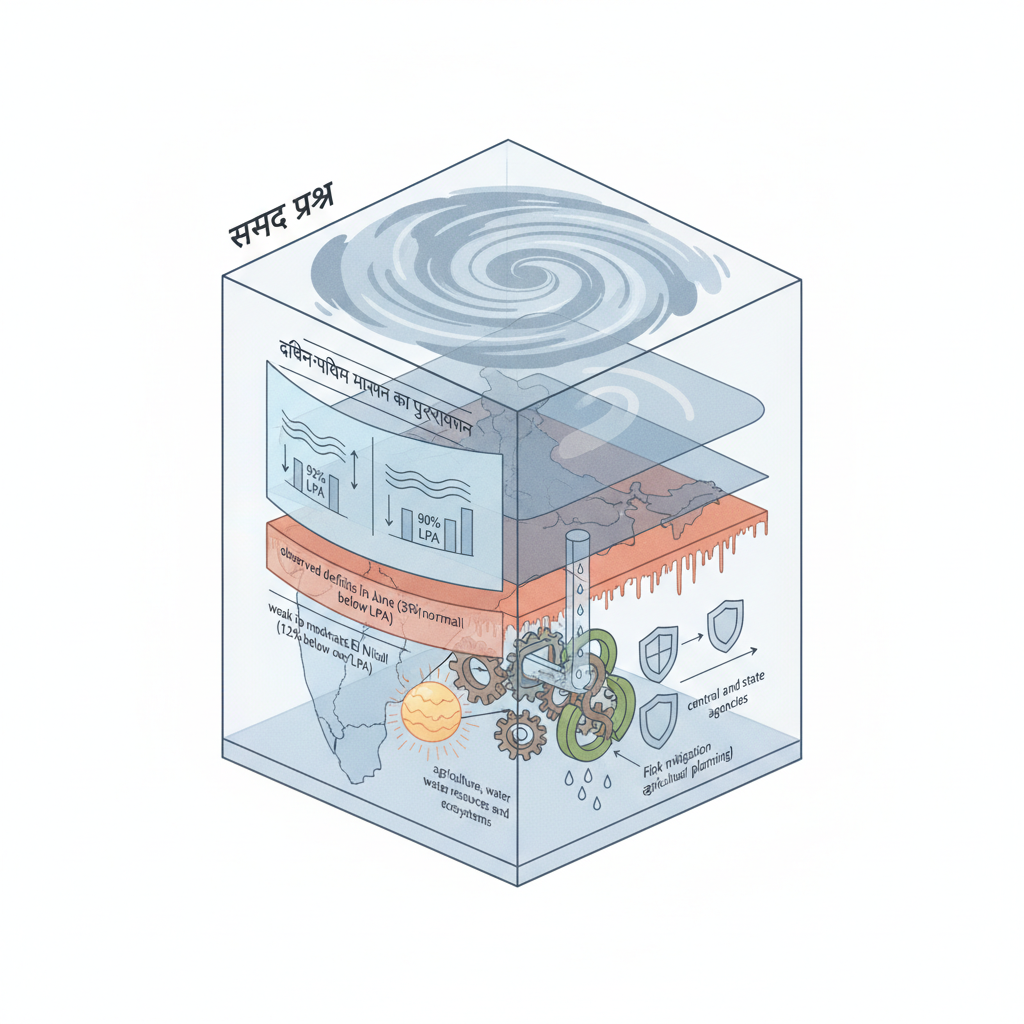
12 Aug UPSC Alert: 2026 Monsoon Forecast & Al Nino Impact on India’s Rainfall
✎ South-West Monsoon 2026 forecasts predicted below-normal rainfall (90% of LPA) due to emerging El Niño, validated by a 12% cumulative deficit as of 2 August 2026, with 47% of districts experiencing deficient rainfall.
Subject Relevance — Where This Topic Fits
- GS Paper I — Geography (Climate and Monsoon Systems) | GS Paper III — Disaster Management and Agricultural Planning
- Prelims: El Niño-Southern Oscillation (ENSO), Long Period Average (LPA), India Meteorological Department (IMD), Cumulative Rainfall Deficit, Sub-divisional Rainfall Variability, Drought-like Conditions, Agricultural Impact Assessment
- Essay: Climate Change and its Socio-Economic Implications, Disaster Preparedness and Resilience in India
Quick Revision: South-West Monsoon 2026 forecasts predicted below-normal rainfall (90% of LPA) due to emerging El Niño, validated by a 12% cumulative deficit as of 2 August 2026, with 47% of districts experiencing deficient rainfall.
Why is this in the news?
The India Meteorological Department (IMD) issued its first and second-stage long-range forecasts for the South-West Monsoon 2026, predicting below-normal rainfall (92% and subsequently 90% of the Long Period Average, LPA). These forecasts were validated by observed deficits in June (35% below normal) and cumulative seasonal rainfall (12% below LPA as of 2 August 2026), with significant regional disparities. The emergence of weak to moderate El Niño conditions in the equatorial Pacific further exacerbated monsoon disruptions, necessitating governance responses from central and state agencies for risk mitigation and agricultural planning.
Background
- The South-West Monsoon is a critical climatic phenomenon for India, contributing ~75% of annual precipitation and sustaining agriculture, water resources, and ecosystems.
- The IMD issues long-range monsoon forecasts in two stages (April and June) based on statistical models and dynamical climate predictions, including ENSO and Indian Ocean Dipole (IOD) indices.
- The LPA for monsoon rainfall is calculated over a 50-year period (1971–2020) and serves as the benchmark for assessing normal, deficient, or excess rainfall.
- El Niño, a phase of ENSO, is associated with warmer-than-average sea surface temperatures in the central and eastern equatorial Pacific, often leading to suppressed monsoon rainfall over India.
- Inter-seasonal variability is a natural feature of the monsoon, but prolonged deficits can trigger drought-like conditions, impacting crop yields, soil moisture, and water storage.
- The IMD collaborates with the Ministry of Earth Sciences, state governments, and disaster management agencies to issue advisories and mitigate risks.
What is the South-West Monsoon and its Forecasting Framework?
- The South-West Monsoon refers to the seasonal reversal of winds in the Indian subcontinent, bringing heavy rainfall from June to September, which is vital for kharif (summer) crops like rice, pulses, and oilseeds.
- The IMD’s long-range forecast is based on a combination of statistical models (e.g., Parametric and Ensemble models) and dynamical climate models that simulate global ocean-atmosphere interactions.
- The first-stage forecast (April) provides an outlook for the entire monsoon season, while the second-stage forecast (June) refines the prediction based on evolving climatic conditions, including ENSO and IOD.
- The LPA for monsoon rainfall is 88 cm (based on 1971–2020 data), and deviations are classified as excess (>110% of LPA), normal (96–104%), deficient (90–96%), or scanty (<90%).
- El Niño and La Niña are opposite phases of ENSO, with El Niño typically associated with reduced monsoon rainfall over India, while La Niña often enhances it.
- The IMD’s forecasts are used by central and state agencies for agricultural planning, water resource management, and disaster preparedness, including contingency crop planning and reservoir operations.
- Regional disparities in monsoon rainfall are common due to topographical features, local wind patterns, and proximity to moisture sources (e.g., the Western Ghats or Bay of Bengal).
- The IMD also issues sub-divisional and district-level advisories to guide state governments in targeted interventions, such as drought relief measures or crop diversification.
Key Features
| Feature | Significance |
|---|---|
| Long-Range Forecast (LRF) for Southwest Monsoon 2026 | Issued in two phases (April and June) by the India Meteorological Department (IMD) under the Ministry of Earth Sciences, providing probabilistic estimates of seasonal rainfall relative to the Long Period Average (LPA). |
| El Niño Southern Oscillation (ENSO) Monitoring | Critical climate driver influencing monsoon variability; weak El Niño conditions observed in June 2026, intensifying to moderate levels by August, correlating with reduced cumulative rainfall. |
| Spatial Rainfall Distribution | Significant geographical disparities in rainfall deficits, with 16 meteorological sub-divisions recording deficits exceeding 20% of LPA, affecting agricultural and water resource planning. |
| Cumulative Seasonal Rainfall | As of 2 August 2026, 12% below LPA, aligning with IMD’s initial forecast despite intra-seasonal variations like July’s surplus rainfall in central India. |
| Disaster Preparedness and Advisory Mechanism | IMD issues sub-divisional alerts to central and state agencies for proactive risk mitigation, including agricultural advisories and water resource management. |
Why it Matters
Agricultural Productivity
- Rain-fed agriculture, covering ~52% of India’s net sown area, is highly vulnerable to monsoon variability, with kharif crops (e.g., rice, pulses, coarse cereals) directly dependent on timely rainfall.
- Deficits in rainfall (e.g., 38% in Bihar, 35% in Assam-Meghalaya) may reduce crop yields, exacerbate soil moisture stress, and trigger fodder shortages, impacting food security and rural incomes.
- Crop diversification and drought-resistant varieties become critical mitigation strategies under prolonged El Niño conditions.
Water Resource Management
- Monsoon rainfall replenishes ~80% of India’s annual water resources, with major reservoirs (e.g., Bhakra, Nagarjunasagar) and groundwater aquifers dependent on seasonal precipitation.
- A 12% cumulative deficit increases pressure on irrigation systems, particularly in deficit-prone regions (e.g., Punjab, Haryana), necessitating groundwater extraction and inter-basin water transfers.
- Long-term strategies like rainwater harvesting, watershed management, and conjunctive use of surface and groundwater gain urgency.
Economic Impact
- Agriculture contributes ~18% to India’s GDP and employs ~42% of the workforce; monsoon deficits can depress rural demand, slow GDP growth, and increase inflationary pressures on food items.
- Disruptions in kharif sowing may lead to delayed rabi planting, affecting crop cycles and market supplies, with cascading effects on agri-export earnings and input industries (e.g., fertilizers, seeds).
- Insurance schemes (e.g., Pradhan Mantri Fasal Bima Yojana) and market interventions (e.g., Minimum Support Prices) become pivotal to stabilize farmer incomes.
Climate Change Adaptation
- El Niño events, projected to intensify under climate change, underscore the need for climate-resilient agricultural practices and early warning systems.
- IMD’s dynamic forecasting models (e.g., Monsoon Mission) and sub-seasonal to seasonal (S2S) predictions enhance adaptive capacity by providing actionable insights for stakeholders.
- Integration of traditional knowledge (e.g., indigenous weather forecasting) with modern meteorological tools can improve local-level resilience.
Challenges
1. Rainfall Deficit and Spatial Disparities
- Cumulative seasonal rainfall 12% below LPA as of August 2026, with 47% of districts experiencing deficits, disproportionately affecting eastern and northeastern regions.
- Regional imbalances (e.g., -38% in Bihar vs. +1% surplus in central India) complicate uniform policy responses and resource allocation.
- Link to UPSC syllabus: Geography (Monsoon variability, agro-climatic zones); Economics (agricultural output, inflation).
UPSC Link: Geography: Monsoons and their variability
2. El Niño-Induced Agricultural Stress
- Weak to moderate El Niño conditions disrupt monsoon circulation, leading to prolonged dry spells, delayed onset, and erratic rainfall distribution.
- Soil moisture deficits and heat stress reduce crop productivity, particularly in rain-fed areas, exacerbating farmer distress and rural migration.
- Link to UPSC syllabus: Climate change (ENSO impacts), Agriculture (crop water requirements).
UPSC Link: Climate Change: ENSO and its impacts
3. Water Scarcity and Irrigation Challenges
- Reduced reservoir levels and groundwater depletion in deficit regions (e.g., Punjab, Haryana) threaten irrigation reliability for rabi crops, increasing dependence on groundwater.
- Over-extraction of groundwater for supplementary irrigation risks long-term aquifer depletion, necessitating policy measures like aquifer mapping and recharge augmentation.
- Link to UPSC syllabus: Water resources (irrigation, groundwater depletion).
UPSC Link: Water Resources: Irrigation and groundwater
4. Policy Coordination and Early Warning Gaps
- Despite IMD’s sub-divisional alerts, translating meteorological forecasts into localized agricultural and disaster management actions remains a challenge due to institutional and logistical constraints.
- Need for integrated frameworks linking IMD, state agriculture departments, and local bodies to disseminate real-time advisories and implement contingency plans.
- Link to UPSC syllabus: Disaster Management (early warning systems), Governance (inter-agency coordination).
UPSC Link: Disaster Management: Early warning systems
5. Market and Supply Chain Disruptions
- Delayed kharif sowing may lead to supply chain bottlenecks, affecting food inflation and consumer prices, particularly for staples like rice and pulses.
- Vulnerability of small and marginal farmers to price volatility underscores the need for robust procurement mechanisms and buffer stock management.
- Link to UPSC syllabus: Economics (inflation, supply chain), Agriculture (market reforms).
UPSC Link: Economy: Inflation and supply chain management
Challenges — UPSC Perspective
| Issue | Concern |
|---|---|
| Cumulative Rainfall Deficit (12% below LPA) | Reduced soil moisture, delayed sowing, and lower kharif crop yields, particularly in eastern and northeastern states. |
| Spatial Rainfall Disparities | Uneven distribution complicates uniform policy responses and resource allocation, exacerbating regional inequalities. |
| El Niño-Induced Dry Spells | Prolonged heat stress and moisture deficits disrupt monsoon circulation, affecting crop productivity and water availability. |
| Groundwater Over-Extraction | Increased reliance on groundwater for irrigation in deficit regions risks long-term aquifer depletion and energy-intensive pumping. |
| Agricultural Market Volatility | Delayed sowing and reduced yields may trigger food inflation and supply chain disruptions, impacting consumer prices and farmer incomes. |
| Institutional Coordination Gaps | Challenges in translating IMD alerts into localized actionable plans due to inter-agency coordination and logistical constraints. |
Government Initiatives — Must-Memorise for Prelims
- Pradhan Mantri Fasal Bima Yojana (PMFBY)
- National Agricultural Insurance Scheme (NAIS)
- Mahatma Gandhi National Rural Employment Guarantee Scheme (MGNREGS) for water conservation works
- National Mission for Sustainable Agriculture (NMSA)
Way Forward
- Enhance IMD’s sub-divisional forecasting accuracy through advanced data assimilation techniques and high-resolution models to improve localized advisory dissemination.
- Strengthen inter-ministerial coordination between the Ministry of Earth Sciences, Ministry of Agriculture, and state governments to translate meteorological forecasts into actionable agricultural and disaster management plans.
- Promote climate-resilient agricultural practices, including drought-resistant crop varieties, micro-irrigation (e.g., drip and sprinkler systems), and soil moisture conservation techniques.
- Accelerate groundwater recharge initiatives through schemes like Atal Bhujal Yojana, with a focus on participatory water management and aquifer mapping.
- Expand crop insurance coverage under PMFBY to include more crops and regions, with simplified claim settlement processes to mitigate farmer distress.
- Develop contingency plans for deficit regions, including alternative cropping patterns, seed replacement strategies, and market linkages to stabilize supplies.
- Invest in agricultural research and extension services to disseminate best practices for climate adaptation, including weather-based agro-advisories.
- Strengthen early warning systems for flash floods and localized droughts, integrating traditional knowledge with modern meteorological tools for community-level resilience.
UPSC Value Addition
Keywords for Mains Answer-Writing
South-West Monsoon 2026 · Long Period Average (LPA) rainfall deficit · El Niño-Southern Oscillation (ENSO) · India Meteorological Department (IMD) · Regional rainfall disparity · Agricultural impact of deficient monsoon · Disaster preparedness for drought · Cumulative seasonal rainfall · Sub-divisional rainfall anomalies · Climate variability and forecasting · Inter-seasonal variability in monsoon · Crop water stress and soil moisture deficit · Union Ministry of Earth Sciences · Parliamentary Question on monsoon forecast
Concept Flow
El Niño conditions in equatorial Pacific → Disruption of Walker circulation → Weakened monsoon trough over India → Delayed onset and erratic rainfall distribution. → Reduced cumulative rainfall (12% below LPA) → Soil moisture deficit and heat stress → Lower kharif crop yields, particularly in rain-fed regions. → Spatial disparities in rainfall (e.g., -38% in Bihar vs. +1% in central India) → Uneven agricultural output and water resource availability. → Groundwater over-extraction in deficit regions → Long-term aquifer depletion and energy-intensive irrigation → Increased vulnerability to future deficits. → Delayed sowing and reduced yields → Supply chain disruptions and food inflation → Impact on rural incomes and consumer prices. → IMD’s early warning alerts → Sub-divisional advisories → State and local implementation challenges → Need for integrated disaster management frameworks.
Prelims Practice Questions
Q1. Consider the following statements regarding the South-West Monsoon in India for the year 2026:
1. The first stage long-range forecast issued by the India Meteorological Department (IMD) in April 2026 predicted seasonal rainfall at 92% of the Long Period Average (LPA).
2. By August 2, 2026, the cumulative seasonal rainfall was 12% below the LPA, consistent with the IMD’s initial forecast.
3. The El Niño conditions observed in the equatorial Pacific during June-August 2026 acted as a major climatic factor disrupting monsoon flow.
4. The IMD’s second-stage forecast in June 2026 revised the expected rainfall to 95% of the LPA.
How many of the above statements are correct?
- Only one
- Only two
- Only three
- All four
Answer: Only three — Statements 1, 2, and 3 are correct. Statement 4 is incorrect as the second-stage forecast revised the expected rainfall to 90% of the LPA, not 95%.
Q2. Assertion (A): The El Niño phenomenon is a major climatic driver that often leads to below-normal monsoon rainfall in India.
Reason (R): El Niño is characterized by the warming of sea surface temperatures in the equatorial Pacific Ocean, which disrupts the Walker circulation and weakens the Indian monsoon flow.
Options:
A. Both A and R are true, and R is the correct explanation of A.
B. Both A and R are true, but R is not the correct explanation of A.
C. A is true but R is false.
D. A is false but R is true.
Answer: ? — Both the assertion and reason are correct, and the reason accurately explains the assertion. El Niño-induced warming in the equatorial Pacific disrupts atmospheric circulation patterns, weakening the Indian monsoon.
Q3. Match the following pairs related to the South-West Monsoon 2026 rainfall anomalies:
Column I (Sub-division) Column II (Rainfall Deficit % as of August 5, 2026)
A. Bihar 1. -22%
B. Kerala and Mahe 2. -35%
C. East Uttar Pradesh 3. -38%
D. Coastal Andhra Pradesh and Yanam 4. -35%
Options:
A. A-3, B-1, C-4, D-2
B. A-3, B-1, C-2, D-4
C. A-2, B-3, C-1, D-4
D. A-4, B-2, C-3, D-1
- A
- B
- C
- D
Answer: A — Correct matching: A-3 (Bihar: -38%), B-1 (Kerala and Mahe: -22%), C-2 (East Uttar Pradesh: -30%), D-4 (Coastal Andhra Pradesh and Yanam: -35%).
Mains Practice Question
✍ The India Meteorological Department (IMD) issued a second-stage long-range forecast for the South-West Monsoon 2026, revising the expected seasonal rainfall to 90% of the Long Period Average (LPA) and highlighting the development of El Niño conditions. Critically analyse the implications of this forecast for India’s agricultural sector, water resource management, and disaster preparedness. Also, examine the role of the IMD in mitigating the adverse impacts of such climatic variability. (15 Marks)
Approach: MODEL-ANSWER SKELETON:
1. **Introduction (2 marks)**
– Briefly define the South-West Monsoon and its significance for India’s agriculture and economy.
– Mention the IMD’s role in providing long-range forecasts and the importance of such forecasts for policy planning.
2. **Implications of the Forecast (6 marks)**
– **Agricultural Impact**: Discuss the likely effects on kharif crops (e.g., rice, pulses, coarse cereals), soil moisture deficit, and crop water stress. Reference the 47% of districts experiencing rainfall deficiency.
– **Water Resource Management**: Explain the impact on reservoir levels, groundwater recharge, and inter-state water disputes. Highlight the cumulative rainfall deficit of 12% as of August 2, 2026.
– **Regional Disparities**: Analyse the spatial variability in rainfall (e.g., Bihar at -38%, Kerala at -22%) and its socio-economic consequences.
3. **Role of IMD in Mitigation (5 marks)**
– **Forecasting and Early Warning**: Discuss the IMD’s multi-stage forecasting system (April and June 2026), sub-divisional alerts, and its integration with central and state agencies.
– **Collaboration with Ministries**: Highlight the IMD’s coordination with the Ministry of Earth Sciences, Ministry of Agriculture, and state governments for disaster preparedness and agricultural planning.
– **Limitations and Challenges**: Acknowledge the inherent uncertainties in monsoon forecasting and the need for adaptive strategies.
4. **Conclusion (2 marks)**
– Emphasise the importance of integrating IMD’s forecasts with long-term climate adaptation strategies, including crop diversification, water conservation, and drought-resilient infrastructure.
– Stress the need for a multi-stakeholder approach involving farmers, policymakers, and scientists to mitigate the adverse impacts of climatic variability.
Source: PIB (Press Information Bureau)
Generated by AanyaAi for educational purpose.

- Gurugram’s groundwater extraction exceeds limit by 212%; HC seeks ban - October 4, 2026
- स्वतंत्रता सेनानी श्यामजी कृष्ण वर्मा की जन्म जयंती पर पीएम का श्रद्धांजलि - October 4, 2026
- KWML’s Feasibility Reports for Water Metro in 18 Cities: UPSC & PCS Insights - October 3, 2026

No Comments