


12 Aug India’s Nuclear Energy Roadmap 2047: Self-Reliance & SMR Goals Explained
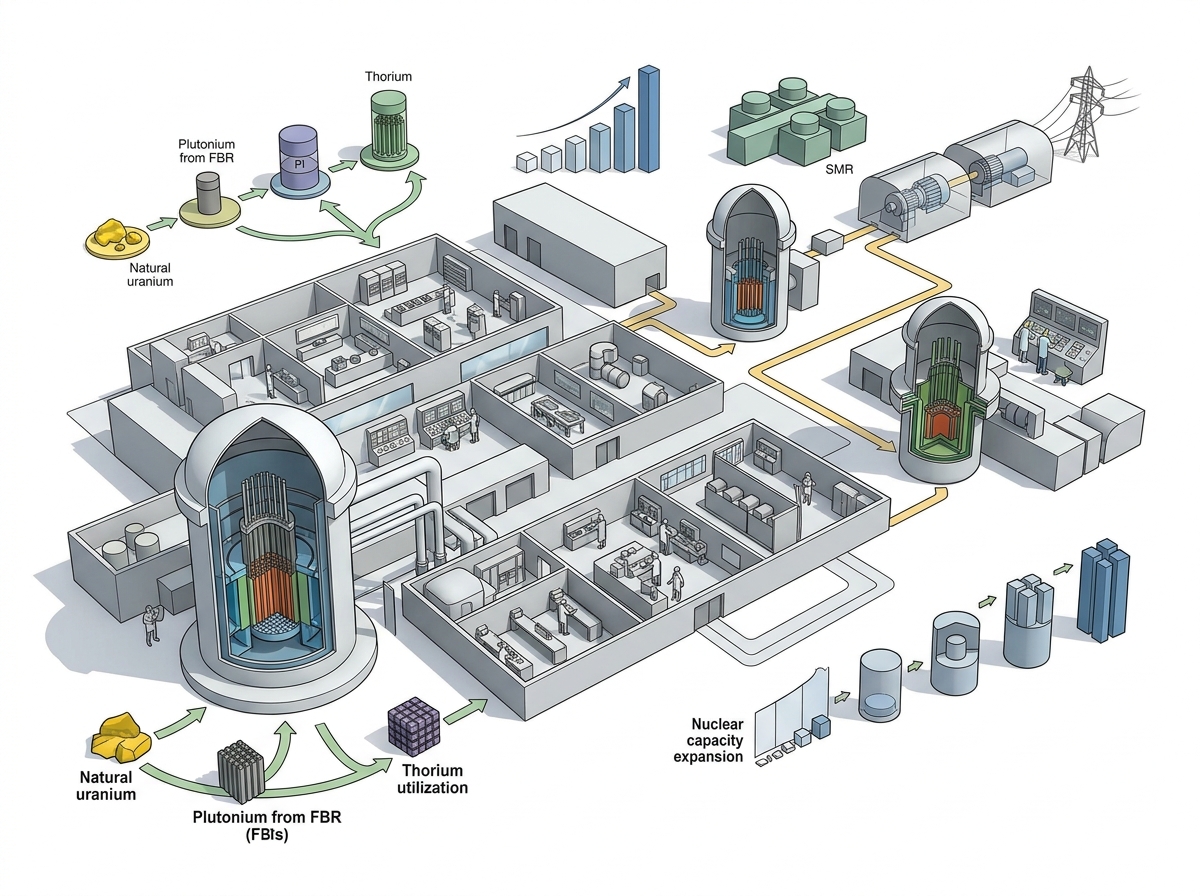
✎ India’s nuclear energy roadmap targets 100 GW capacity by 2047 through a three-stage programme, leveraging indigenous PHWRs, SMRs, thorium utilization, and advanced reactor technologies, supported by the Nuclear Energy (Peaceful…
Subject Relevance — Where This Topic Fits
- GS Paper III — Science and Technology (Developments and Applications of Science) | GS Paper III — Environment and Disaster Management (Energy Security and Low-Carbon Transition) | GS Paper III — Economy (Infrastructure and Investment) | GS Paper II — International Relations (Energy Diplomacy and Nuclear Non-Proliferation)
- Prelims: Nuclear Power Corporation of India Limited (NPCIL), Pressurized Heavy Water Reactor (PHWR), Small Modular Reactors (SMRs), Thorium-based Nuclear Fuel Cycle, Nuclear Energy (Peaceful Uses) Act, 2025, Fast Breeder Reactor (FBR), Atomic Energy Regulatory Board (AERB), Bhabha Atomic Research Centre (BARC), Indira Gandhi Centre for Atomic Research (IGCAR), Nuclear Power Programme Phase-I, II, III
- Essay: Energy Security and Sustainable Development: India’s Nuclear Energy Strategy, Technological Self-Reliance and Global Competitiveness in Strategic Sectors
Quick Revision: India’s nuclear energy roadmap targets 100 GW capacity by 2047 through a three-stage programme, leveraging indigenous PHWRs, SMRs, thorium utilization, and advanced reactor technologies, supported by the Nuclear Energy (Peaceful Uses) Act, 2025, and private sector participation.
Why is this in the news?
The Union Minister of State (Independent Charge) for Science and Technology, Atomic Energy, and Personnel, Public Grievances and Pensions, Dr. Jitendra Singh, presented in the Lok Sabha a comprehensive roadmap outlining the Government of India’s strategy to achieve self-reliance and global competitiveness in the nuclear energy sector. The roadmap emphasizes indigenous technological development, private sector participation, and the phased expansion of nuclear capacity to 100 GW by 2047, anchored in India’s three-stage nuclear power programme. This initiative is aligned with the Nuclear Energy Mission announced in the Union Budget 2025-26 and underscores the strategic importance of thorium utilization, advanced reactor designs, and Small Modular Reactors (SMRs) in India’s long-term energy security framework.
Background
- India’s nuclear energy programme is guided by the three-stage nuclear power programme, conceptualized by Dr. Homi J. Bhabha, to achieve energy independence through the sequential utilization of uranium and thorium resources.
- The first stage involves Pressurized Heavy Water Reactors (PHWRs) using natural uranium, which are indigenous in design and operation, such as the 700 MWe PHWRs being deployed at Kakrapar, Rawatbhata, and other sites.
- The second stage focuses on Fast Breeder Reactors (FBRs), utilizing plutonium produced in PHWRs, with the Prototype Fast Breeder Reactor (PFBR) at Kalpakkam being a key milestone.
- The third stage envisages the use of thorium as a fertile material in Advanced Heavy Water Reactors (AHWRs) or other designs, leveraging India’s vast thorium reserves, particularly in the monazite sands of Kerala and Tamil Nadu.
- The Nuclear Energy (Peaceful Uses) Act, 2025, enacted to facilitate broader public and private sector participation, replaces the Atomic Energy Act, 1962, and introduces provisions for technology transfer, joint ventures, and regulatory flexibility to accelerate nuclear capacity addition.
- The Union Budget 2025-26 announced the Nuclear Energy Mission with a target of 100 GW nuclear capacity by 2047, signalling a significant acceleration in the deployment of nuclear power as part of India’s clean energy transition.
What constitutes India’s roadmap for a self-reliant and globally competitive nuclear energy ecosystem?
- Three-Stage Nuclear Power Programme: India’s nuclear energy strategy is structured in three stages to progressively utilize uranium and thorium resources, ensuring long-term energy security and minimizing dependence on imported fuel.
- Target Capacity Expansion: The roadmap sets a target of 100 GW of nuclear power capacity by 2047, nearly tenfold increase from the current ~7.5 GW, to be achieved through a mix of large indigenous reactors and Small Modular Reactors (SMRs).
- Indigenous Reactor Technologies: Deployment of 700 MWe Pressurized Heavy Water Reactors (PHWRs) as the backbone of the first stage, with ongoing construction at multiple sites and plans for future expansion.
- Small Modular Reactors (SMRs): Development and deployment of indigenous SMRs, including the BARC-designed 220 MWe India Small-Modular Reactor (BSMR-200) and 55 MWe SMR-55, with a target of at least five SMRs operational by 2033. SMRs offer modularity, scalability, and suitability for brownfield sites, including repurposing of retired thermal power plants.
- Advanced Reactor Designs: Research and development on advanced reactor technologies such as High-Temperature Gas-Cooled Reactors (HTGRs) at BARC, capable of producing hydrogen via thermochemical cycles, and Fast Breeder Reactors (FBRs) at IGCAR for plutonium breeding and closed fuel cycle operations.
- Thorium Utilization Strategy: India’s long-term focus on thorium as a nuclear fuel, leveraging its abundant thorium reserves, with the third stage of the nuclear programme envisaging thorium-based reactors to ensure energy independence.
- Private Sector Participation: The Nuclear Energy (Peaceful Uses) Act, 2025, enables private sector involvement in nuclear power generation, fuel cycle activities, and associated infrastructure, fostering innovation and investment in the nuclear ecosystem.
- Institutional and Regulatory Framework: Strengthening of domestic manufacturing capabilities, knowledge sharing through BARC and IGCAR, and collaboration with industry to develop critical components such as reactor pressure vessels and reactivity control mechanisms, ensuring indigenous supply chains.
Key Features
| Feature | Significance |
|---|---|
| Three-Stage Nuclear Power Programme | Ensures long-term energy security by leveraging India’s vast thorium reserves through a phased approach: (i) natural uranium-fueled PHWRs, (ii) fast breeder reactors, and (iii) thorium-based reactors. |
| Small Modular Reactors (SMRs) | Enable rapid deployment, modular scalability, and suitability for brownfield sites (e.g., decommissioned thermal plants), reducing gestation periods and capital risks while supporting off-grid applications. |
| Indigenous 700 MWe PHWRs | Demonstrates self-reliance in large-scale reactor technology, with standardized designs reducing construction timelines and costs for future projects. |
| Advanced Reactor Technologies (e.g., HTGR, Sodium-Cooled Fast Breeder Reactors) | Facilitate higher thermal efficiency, closed fuel cycles, and potential co-generation of hydrogen, aligning with India’s decarbonisation and energy transition goals. |
| Nuclear Energy Act, 2025 | Legal framework enabling public-private partnerships, streamlined regulatory approvals, and domestic manufacturing incentives to accelerate capacity addition and technology transfer. |
Why it Matters
Energy Security and Sustainability
- Supports India’s commitment to net-zero emissions by diversifying the energy mix with low-carbon nuclear power, reducing dependence on fossil fuels.
- Leverages indigenous fuel cycles (thorium) to mitigate supply chain vulnerabilities associated with imported uranium.
- Enables baseload power generation, complementing intermittent renewable sources to ensure grid stability.
Economic Growth and Industrial Development
- Stimulates domestic manufacturing through localisation of critical components (e.g., reactor pressure vessels, control mechanisms), creating high-skilled employment.
- Fosters innovation in advanced materials, high-temperature systems, and fuel cycle technologies, positioning India as a global player in nuclear exports.
- Reduces import dependency in energy infrastructure, enhancing trade balance and foreign exchange reserves.
Technological Self-Reliance and Innovation
- Accelerates indigenous R&D in SMRs, fast breeder reactors, and thorium utilisation, reducing reliance on foreign technology transfers.
- Promotes public-private collaboration in nuclear R&D, bridging the gap between academic research (e.g., BARC, IGCAR) and industrial application.
- Develops exportable nuclear technologies, aligning with the ‘Atmanirbhar Bharat’ initiative for strategic sectors.
Strategic and Geopolitical Dimensions
- Enhances energy sovereignty by reducing exposure to global uranium price volatility and supply disruptions.
- Strengthens India’s position in international nuclear governance (e.g., IAEA safeguards, NSG waivers) through indigenous compliance and transparency.
- Supports climate diplomacy by showcasing a scalable, low-carbon energy model for developing nations.
Challenges
1. Regulatory and Licensing Bottlenecks
- Complexity in obtaining clearances for new reactor sites, especially for SMRs in brownfield locations, due to stringent safety and environmental norms.
- Need for harmonised regulatory frameworks to address novel technologies (e.g., HTGRs, thorium reactors) not covered under existing guidelines.
UPSC Link: GS-III: Energy, Environment and Disaster Management
2. Public Perception and Acceptance
- Historical stigma associated with nuclear accidents (e.g., Fukushima, Chernobyl) may hinder community acceptance, necessitating robust stakeholder engagement.
- Misinformation and lack of awareness about nuclear safety and benefits among local populations near proposed sites.
UPSC Link: GS-II: Governance, Transparency and Citizen Participation
3. Technological and Infrastructure Gaps
- Limited domestic capacity for manufacturing high-purity nuclear-grade materials (e.g., zirconium alloys, low-alloy steels) required for advanced reactors.
- Insufficient grid infrastructure in remote areas to integrate SMRs for off-grid applications, requiring parallel investments in transmission networks.
UPSC Link: GS-III: Infrastructure, Science and Technology
4. Fuel Cycle and Waste Management
- Challenges in scaling thorium-based fuel cycles, including reprocessing technologies and waste immobilisation for long-term storage.
- Need for indigenous spent fuel reprocessing facilities to close the nuclear fuel cycle, reducing reliance on foreign reprocessing services.
UPSC Link: GS-III: Environment, Pollution and Waste Management
5. Human Resource and Skill Development
- Shortage of specialised nuclear engineers, technicians, and safety personnel due to limited academic programmes and industry-academia collaboration.
- Rapid obsolescence of nuclear technologies necessitates continuous upskilling of the workforce to maintain global competitiveness.
UPSC Link: GS-III: Human Resource Development and Employment
Challenges — UPSC Perspective
| Issue | Concern |
|---|---|
| Land Acquisition for Nuclear Sites | Delays due to legal disputes, environmental clearances, and rehabilitation challenges, particularly in densely populated regions. |
| High Capital Costs and Financing Risks | Large upfront investments in nuclear projects deter private sector participation without government guarantees or viability gap funding. |
| Supply Chain Vulnerabilities | Dependence on imported critical components (e.g., control rods, instrumentation) for advanced reactors, despite localisation efforts. |
| Public Opposition to Nuclear Projects | NIMBY (Not In My Backyard) syndrome and protests by local communities against perceived health and safety risks. |
| International Safeguards and Export Controls | Stringent IAEA safeguards and NSG guidelines limit India’s ability to export nuclear technologies without waivers. |
Government Initiatives — Must-Memorise for Prelims
- Nuclear Energy Mission (2025-26 Budget)
Way Forward
- Accelerate the development and deployment of 5 indigenous SMRs by 2033 through targeted R&D funding and streamlined regulatory pathways.
- Expand domestic manufacturing of nuclear-grade materials and components via PLI schemes and technology transfer agreements with global partners.
- Strengthen the thorium fuel cycle by scaling up pilot projects (e.g., AHWR) and investing in reprocessing and waste management infrastructure.
- Enhance public awareness campaigns to address misconceptions about nuclear safety and highlight the role of nuclear energy in climate mitigation.
- Establish dedicated nuclear energy parks with integrated fuel cycle facilities to reduce logistics costs and improve operational efficiency.
- Foster international collaborations (e.g., with the USA, France, Russia) for technology transfer in advanced reactors while ensuring compliance with non-proliferation norms.
- Develop a national nuclear skills framework in partnership with IITs, NITs, and industry to address the shortage of specialised human resources.
- Integrate nuclear energy into state-level renewable energy policies to ensure grid stability and optimise the energy mix.
UPSC Value Addition
Keywords for Mains Answer-Writing
Atomic Energy Act, 2025 · Self-reliance in nuclear technology · Small Modular Reactors (SMRs) · Thorium-based nuclear programme · Three-stage nuclear power programme · Nuclear Power Corporation of India Limited (NPCIL) · Bhabha Atomic Research Centre (BARC) · Indira Gandhi Centre for Atomic Research (IGCAR) · Pressurised Heavy Water Reactors (PHWRs) · Fast Breeder Reactors (FBRs) · Nuclear energy capacity target of 100 GW by 2047 · Domestic nuclear manufacturing ecosystem · Peaceful Uses of Atomic Energy Act, 1948 · Public-Private Partnership in nuclear sector · Advanced reactor technologies · Off-grid nuclear applications
Concept Flow
India’s three-stage nuclear programme → Thorium utilisation for long-term energy security → Development of indigenous PHWRs and SMRs → Expansion of nuclear capacity to 100 GWe by 2047 → Enhanced public-private partnerships under the Nuclear Energy Act, 2025 → Strengthened domestic nuclear ecosystem → Reduced import dependence and improved energy sovereignty.
Prelims Practice Questions
Q1. Consider the following statements regarding India’s three-stage nuclear power programme:
1. The first stage utilises Pressurised Heavy Water Reactors (PHWRs) to produce fissile material for the second stage.
2. The second stage involves Fast Breeder Reactors (FBRs) to utilise thorium as a fertile material.
3. The third stage aims to deploy thorium-based reactors to achieve long-term energy security.
How many of the above statements are correct?
- Only one
- Only two
- All
- None
Answer: All — Statements 1 and 3 are correct. Statement 2 is incorrect because the second stage utilises FBRs to utilise uranium-238 as fertile material to breed plutonium-239, while thorium utilisation is the focus of the third stage.
Q2. Assertion (A): The Atomic Energy Act, 2025, aims to enable comprehensive participation of both public and private entities in India’s nuclear sector.
Reason (R): The Act seeks to replace the Peaceful Uses of Atomic Energy Act, 1948, to align with contemporary technological and economic demands.
Options:
A. Both A and R are true, and R is the correct explanation of A.
B. Both A and R are true, but R is not the correct explanation of A.
C. A is true, but R is false.
D. A is false, but R is true.
Answer: ? — Both A and R are true. The Atomic Energy Act, 2025, is designed to facilitate broader participation in the nuclear sector, including private entities, while the Peaceful Uses of Atomic Energy Act, 1948, was the earlier regulatory framework. However, R does not directly explain A as the latter is about participation, not replacement.
Q3. Match the following components of India’s nuclear energy programme with their respective institutions:
Column I (Component) Column II (Institution)
A. Design and development of Small Modular Reactors (SMRs) 1. Indira Gandhi Centre for Atomic Research (IGCAR)
B. Development of Fast Breeder Reactors (FBRs) 2. Nuclear Power Corporation of India Limited (NPCIL)
C. Operation of Pressurised Heavy Water Reactors (PHWRs) 3. Bhabha Atomic Research Centre (BARC)
D. Thorium utilisation research 4. Atomic Minerals Directorate for Exploration and Research (AMDER)
Options:
A. A-3, B-1, C-2, D-4
B. A-2, B-1, C-3, D-4
C. A-1, B-3, C-2, D-4
D. A-4, B-2, C-1, D-3
Answer: ? — Correct matching: A-3 (BARC designs SMRs), B-1 (IGCAR develops FBRs), C-2 (NPCIL operates PHWRs), D-4 (AMDER explores thorium resources).
Mains Practice Question
✍ Critically analyse the strategic significance of India’s three-stage nuclear power programme in achieving energy security and self-reliance. Also, examine the role of Small Modular Reactors (SMRs) and thorium utilisation in this context. (15 Marks)
Approach: MODEL-ANSWER SKELETON:
1. **Introduction**: Define the three-stage nuclear programme and its objectives (energy security, self-reliance, utilisation of indigenous resources like thorium).
2. **Stage-wise analysis**:
– **Stage I**: Pressurised Heavy Water Reactors (PHWRs) using natural uranium; production of plutonium for Stage II.
– **Stage II**: Fast Breeder Reactors (FBRs) utilising plutonium to breed uranium-233 from thorium; establishment of closed fuel cycle.
– **Stage III**: Thorium-based reactors (e.g., Advanced Heavy Water Reactors) for long-term energy security.
3. **Strategic significance**:
– **Energy security**: Diversification of energy mix, reduction in import dependence for fossil fuels.
– **Self-reliance**: Indigenous development of technology, fuel cycle, and manufacturing (e.g., NPCIL, BARC, IGCAR).
– **Geopolitical leverage**: Reduced vulnerability to international fuel supply disruptions.
4. **Role of SMRs**:
– Definition and advantages: Modularity, scalability, suitability for off-grid and industrial applications.
– India’s initiatives: Development of indigenous SMRs (e.g., BSM-200, SMR-55) by BARC; target of 5 SMRs by 2033.
– Strategic fit: Complements large reactors, enables deployment in remote areas and industrial clusters.
5. **Thorium utilisation**:
– India’s thorium reserves: Among the largest globally; long-term energy security potential.
– Challenges: Technological maturity, economic viability, regulatory framework.
6. **Critique and challenges**:
– **Technological hurdles**: Delays in FBR deployment, SMR commercialisation.
– **Regulatory and safety concerns**: Stringent norms for nuclear installations, public perception.
– **Economic viability**: High capital costs, long gestation periods.
7. **Conclusion**: Summarise the programme’s strategic importance while acknowledging challenges; emphasise the need for sustained investment, R&D, and stakeholder collaboration.
Source: PIB (Press Information Bureau)
Generated by AanyaAi for educational purpose.

- Gurugram’s groundwater extraction exceeds limit by 212%; HC seeks ban - October 4, 2026
- स्वतंत्रता सेनानी श्यामजी कृष्ण वर्मा की जन्म जयंती पर पीएम का श्रद्धांजलि - October 4, 2026
- KWML’s Feasibility Reports for Water Metro in 18 Cities: UPSC & PCS Insights - October 3, 2026

No Comments