


12 Aug 78 Prisoners Clear SSC via NIOS in Telangana: UPSC & PCS Exam Insight
✎ The National Institute of Open Schooling (NIOS) provides flexible, open learning opportunities at the school level, and its integration into prison education programmes, such as in Telangana, exemplifies rehabilitation through…
Subject Relevance — Where This Topic Fits
- GS Paper II — Governance, Transparency and Accountability | GS Paper III — Human Resource Development
- Prelims: National Institute of Open Schooling (NIOS), Special Remission, Prison Reforms, Open Schooling, Dr B.R. Ambedkar Open University, Correctional Services
- Essay: Rehabilitation through Education: A Pillar of Justice Reform, The Role of Open Learning in Social Inclusion
Quick Revision: The National Institute of Open Schooling (NIOS) provides flexible, open learning opportunities at the school level, and its integration into prison education programmes, such as in Telangana, exemplifies rehabilitation through structured academic and vocational pathways.
Why is this in the news?
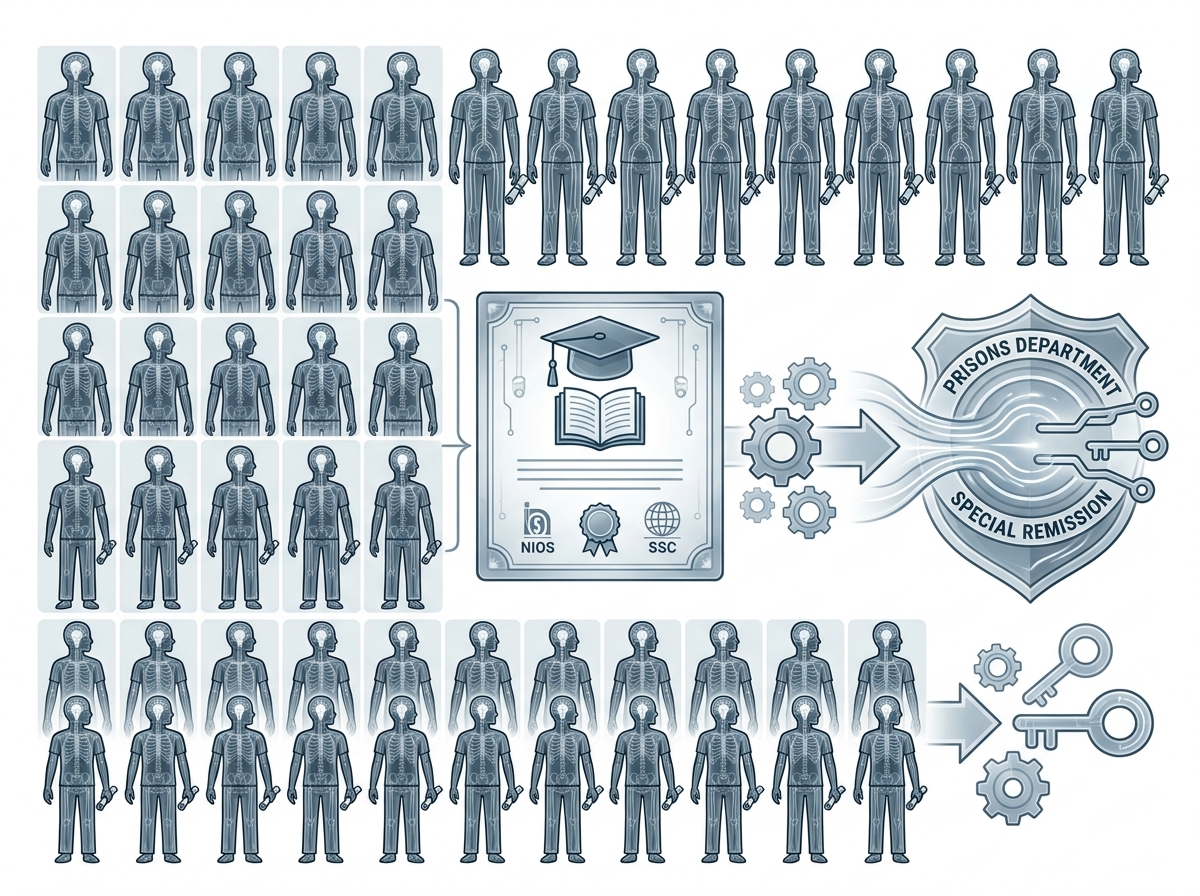
On August 12, 2026, the Telangana Prisons Department announced special remission for 78 jail inmates who successfully cleared the Secondary School Certificate (SSC) examination through the National Institute of Open Schooling (NIOS). This initiative, executed under a Memorandum of Understanding (MoU) between the Prisons Department and NIOS, underscores the integration of educational reforms within the correctional system, promoting rehabilitation and reducing recidivism through structured learning pathways.
Background
- The National Institute of Open Schooling (NIOS) is an autonomous institution under the Ministry of Education, Government of India, established to provide flexible, open, and distance learning opportunities at the school level.
- Prison education is a critical component of correctional policy, aimed at reducing recidivism by equipping inmates with academic and vocational skills, thereby enhancing their prospects of socio-economic reintegration.
- Telangana has been a pioneer in implementing prison education reforms, collaborating with NIOS and other open universities to offer structured educational programmes within correctional facilities.
- Special remission schemes are legal provisions that allow for the reduction of sentences as a reward for meritorious conduct, good behaviour, or exceptional achievements, as stipulated under prison rules and judicial guidelines.
- The integration of open schooling in prisons aligns with the National Education Policy (NEP) 2020, which emphasises inclusive and equitable education for all, including marginalised and incarcerated populations.
- The programme is supported by government and private teachers, with mock tests and pre-board examinations conducted to ensure rigorous academic preparation.
What is the National Institute of Open Schooling (NIOS)?
- NIOS is an autonomous organisation under the Ministry of Education, Government of India, established in 1989 to provide flexible, open, and distance learning opportunities at the school level (Class X and XII) and vocational courses.
- It operates under the National Policy on Education (1986) and the Right to Education (RTE) Act, 2009, ensuring equitable access to education for all, including those in remote areas, working professionals, and marginalised groups.
- NIOS offers programmes in English, Hindi, and regional languages, with examinations conducted twice a year (April–May and October–November).
- The institute provides self-learning materials, online resources, and personal contact programmes to facilitate learning, making it particularly suitable for prison inmates who require flexible study schedules.
- NIOS certificates are recognised by the Government of India and are equivalent to those issued by conventional school boards, enabling further education or employment opportunities.
- The organisation collaborates with state governments, NGOs, and international agencies to expand its reach and impact, including initiatives in prison education.
- NIOS also offers vocational courses in collaboration with the National Skill Development Corporation (NSDC), enhancing employability among learners.
- The success of NIOS programmes in prisons demonstrates the efficacy of open schooling in reaching incarcerated populations, aligning with global best practices in correctional education.
Key Features
| Feature | Significance |
|---|---|
| National Institute of Open Schooling (NIOS) certification for prisoners | Provides a recognised academic qualification to inmates, enhancing their prospects for post-release employment and social reintegration. |
| Special remission for educational achievement | Incentivises academic effort among prisoners, aligning correctional goals with rehabilitation through measurable outcomes. |
| MoU between Telangana Prisons Department and NIOS | Formalises collaboration between correctional and educational institutions, ensuring structured and accredited educational programmes within prisons. |
| Support from government and private teachers | Ensures pedagogical quality and continuity of instruction, addressing resource constraints in prison education systems. |
| Progression pathways to Senior Secondary, ITI, and BA programmes | Creates a seamless educational continuum, reducing barriers to higher education and vocational training for inmates. |
Why it Matters
Correctional Reforms
- Demonstrates the integration of education as a core component of rehabilitation within the prison system, aligning with global best practices in correctional administration.
- Highlights the role of structured educational interventions in reducing recidivism by equipping inmates with marketable skills and academic credentials.
- Showcases Telangana’s initiative as a model for other states to emulate, particularly in leveraging open schooling systems for marginalised populations.
Social Equity
- Reinforces the constitutional principle of equality of opportunity by providing incarcerated individuals access to education, irrespective of their socio-economic background.
- Underscores the state’s commitment to inclusive governance by addressing systemic barriers to education for vulnerable groups.
- Contributes to the broader agenda of reducing socio-economic disparities by enabling post-release socio-economic mobility.
Administrative Efficiency
- Illustrates the effective utilisation of inter-departmental coordination between the Prisons Department and NIOS to achieve public policy objectives.
- Demonstrates the scalability of prison education programmes through public-private partnerships and resource optimisation.
- Shows how administrative incentives (e.g., special remission) can be used to motivate behavioural change within correctional institutions.
Challenges
1. Access to Quality Education in Prisons
- Limited availability of trained educators within prison facilities, particularly in high-security or overcrowded prisons.
- Ensuring consistent participation of inmates in educational programmes amid security protocols and logistical constraints.
- Addressing the digital divide, as online resources and digital literacy remain unevenly distributed among inmates.
UPSC Link: GS2: Governance, GS2: Social Justice
2. Sustainability of Educational Programmes
- Maintaining long-term funding and institutional support for prison education initiatives beyond pilot phases.
- Ensuring continuity of education for inmates post-release, including linkages with external educational institutions.
- Balancing security concerns with the need for open and flexible learning environments within prisons.
UPSC Link: GS2: Governance, GS4: Ethics
3. Reintegration and Post-Release Support
- Providing socio-economic support (e.g., housing, employment) to former inmates to prevent recidivism after educational attainment.
- Ensuring that educational credentials obtained in prison are recognised by external institutions and employers.
- Addressing stigma and societal barriers that may hinder the reintegration of former inmates into the workforce.
UPSC Link: GS1: Social Issues, GS2: Governance
Challenges — UPSC Perspective
| Issue | Concern |
|---|---|
| Resource Constraints | Limited availability of teaching staff and infrastructure within prisons to support educational programmes. |
| Security Protocols | Balancing the need for open learning environments with stringent prison security measures. |
| Post-Release Recognition | Ensuring that certificates and qualifications obtained in prison are accepted by external educational and vocational institutions. |
| Socio-Economic Barriers | Addressing systemic discrimination and stigma faced by former inmates in accessing employment and higher education. |
| Funding Sustainability | Securing long-term financial support for prison education initiatives beyond initial pilot phases. |
| Digital Divide | Unequal access to digital learning tools and internet connectivity within prison facilities. |
Way Forward
- Expand the NIOS-based education programme to all state prisons, with phased rollout based on infrastructure readiness.
- Establish dedicated study centres within prisons, equipped with digital resources and trained educators to enhance learning outcomes.
- Develop post-release mentorship programmes to support former inmates in utilising their educational credentials for employment.
- Strengthen inter-departmental coordination between the Prisons Department, NIOS, and other educational bodies to ensure seamless transitions.
- Introduce incentives for private sector participation in prison education, such as tax benefits or CSR funding for vocational training.
- Conduct periodic evaluations of the programme’s impact on recidivism rates and socio-economic reintegration to inform policy adjustments.
- Raise awareness among employers about the value of hiring former inmates, particularly those with recognised educational qualifications.
- Integrate mental health and counselling services within prison education programmes to address underlying barriers to learning.
UPSC Value Addition
Keywords for Mains Answer-Writing
Open and Distance Learning (ODL) · National Institute of Open Schooling (NIOS) · Prison education policy · Special remission for educational achievement · Constitutional provisions for prisoners’ rights · Right to Education (RTE) Act · Prisons Act, 1894 · Rehabilitation of incarcerated individuals · Open University system · Vocational training in prisons · Article 21 (Right to Life) · Article 19 (Freedom of profession) · Prison reforms · Human rights of prisoners
Constitutional & Policy Linkages
- Article 15(4): Special provisions for advancement of socially and educationally backward classes
- Article 21: Right to life and personal liberty, including the right to education
- Article 41: Directive Principles of State Policy on public assistance and right to work
- Article 45: Provision for free and compulsory education for children (extended to adults in spirit)
Concept Flow
Identification of educational gaps among incarcerated populations → → Formation of MoU between Prisons Department and NIOS for structured education → → Implementation of NIOS-based SSC programme with teacher support → → Assessment and certification of inmates through NIOS examinations → → Award of special remission as incentive for educational achievement → → Progression to higher education (Senior Secondary, ITI, BA) via open universities → → Post-release socio-economic reintegration facilitated by recognised credentials
Prelims Practice Questions
Q1. Consider the following statements regarding the National Institute of Open Schooling (NIOS):
1. NIOS is an autonomous institution under the Ministry of Education, Government of India.
2. It provides education through distance learning mode.
3. NIOS is empowered to conduct examinations and award certificates equivalent to those issued by the Central Board of Secondary Education (CBSE).
4. NIOS does not offer vocational courses.
How many of the above statements are correct?
- Only one
- Only two
- Only three
- All four
Answer: Only three — Statements 1, 2, and 3 are correct. NIOS is an autonomous institution under the Ministry of Education and offers distance learning. It conducts examinations and awards certificates equivalent to CBSE. Statement 4 is incorrect as NIOS offers vocational courses.
Q2. Which of the following constitutional provisions is MOST directly relevant to the right of prisoners to education in India?
- Article 14
- Article 19(1)(g)
- Article 21
- Article 30
Answer: Article 21 — Article 21 guarantees the right to life and personal liberty, which has been interpreted by the Supreme Court to include the right to education as part of the right to live with dignity.
Q3. Assertion (A): The Prisons Act, 1894, mandates the provision of education to prisoners in India.
Reason (R): The Act requires every prison to have a library and provide educational facilities to inmates.
In the context of the above two statements, which one of the following is correct?
- Both A and R are true, and R is the correct explanation of A.
- Both A and R are true, but R is NOT the correct explanation of A.
- A is true, but R is false.
- A is false, but R is true.
Answer: A is true, but R is false. — The Prisons Act, 1894, does not explicitly mandate education as a right for prisoners. While it encourages the provision of libraries and educational facilities (Section 26), it is not a statutory obligation. Thus, A is false, but R is true.
Mains Practice Question
✍ The integration of Open and Distance Learning (ODL) systems in prison education represents a paradigm shift in the rehabilitation of incarcerated individuals. Critically examine the constitutional, statutory, and policy frameworks that enable such educational initiatives. Also, discuss the significance of vocational training and open university linkages in achieving the broader objectives of prison reforms in India. (15 Marks)
Approach: MODEL-ANSWER SKELETON:
1. **Constitutional Foundations (4 Marks)**
– Article 21: Right to life and personal liberty (Maneka Gandhi v. Union of India, 1978; Unnikrishnan v. State of Andhra Pradesh, 1993) — education as part of dignity.
– Article 19(1)(g): Freedom of profession — vocational training aligns with skill development.
– Article 14: Equality before law — equitable access to education for prisoners.
2. **Statutory and Policy Frameworks (5 Marks)**
– Prisons Act, 1894 (Section 26): Encourages libraries and educational facilities (not mandatory).
– Right of Children to Free and Compulsory Education (RTE) Act, 2009: Applicability to juvenile prisoners (Section 12).
– National Education Policy (NEP) 2020: Emphasizes inclusive education and lifelong learning.
– Model Prison Manual, 2016: Recommends ODL and vocational training.
– NIOS framework: Autonomous body under Ministry of Education; equivalence with CBSE/State boards.
3. **Operational Mechanisms (3 Marks)**
– Open University linkages (e.g., Dr. B.R. Ambedkar Open University in Telangana): Enable 10+2 and higher education.
– Vocational training: ITI linkages (e.g., Cherlapalli prison ITI) — aligns with Skill India Mission.
– Role of NGOs and private partners: Community support for educational infrastructure.
4. **Challenges and Critiques (3 Marks)**
– Implementation gaps: Inconsistent provision across states; lack of standardized monitoring.
– Stigma and societal reintegration: Need for post-release support systems.
– Resource constraints: Funding, teacher availability, and digital divide in prisons.
Balance of views: While ODL and vocational training enhance rehabilitation, systemic barriers (funding, policy enforcement) limit scalability. Conclude with the need for a rights-based, outcome-oriented approach.
Source: The Hindu
Generated by AanyaAi for educational purpose.

- युवाओं ने न्यूयॉर्क में AI मानकों को लेकर शुरू किया वैश्विक अभियान - August 13, 2026
- UN Youth Summit Launches Global AI Standards Framework for UPSC 2026 - August 13, 2026
- न्यूयॉर्क में युवाओं ने AI मानकों के लिए लॉन्च किया अभियान, जानिए कैसे होगा भविष्य तय - August 13, 2026

No Comments