


13 Aug Supreme Court Expands Police Custody Scope Under BNSS: Key Implications for UPSC Aspirants
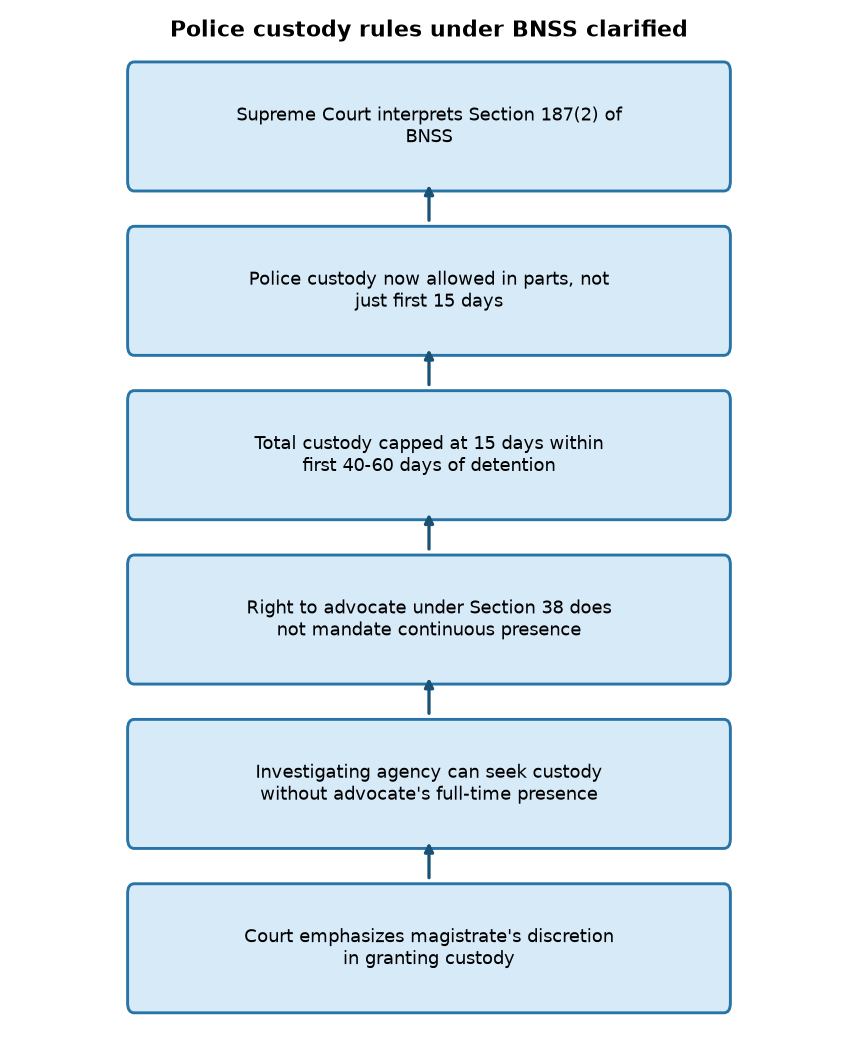
✎ Under the BNSS, police custody may be granted in parts during the investigation, with the aggregate not exceeding 15 days within the first 40 or 60 days, subject to magistrate authorisation and without absolute non-extendability…
Subject Relevance — Where This Topic Fits
- GS Paper II — Constitutional and Statutory Governance | GS Paper III — Security and Criminal Justice System
- Prelims: Bharatiya Nagarik Suraksha Sanhita (BNSS), Section 187(2), Section 58, police custody, remand period, Section 38 BNSS, Bharatiya Sakshya Adhiniyam (BSA), judicial magistrate, custodial death, right to legal aid
- Essay: The interplay between individual rights and state power in criminal justice administration
Quick Revision: Under the BNSS, police custody may be granted in parts during the investigation, with the aggregate not exceeding 15 days within the first 40 or 60 days, subject to magistrate authorisation and without absolute non-extendability of the custody period.
Why is this in the news?
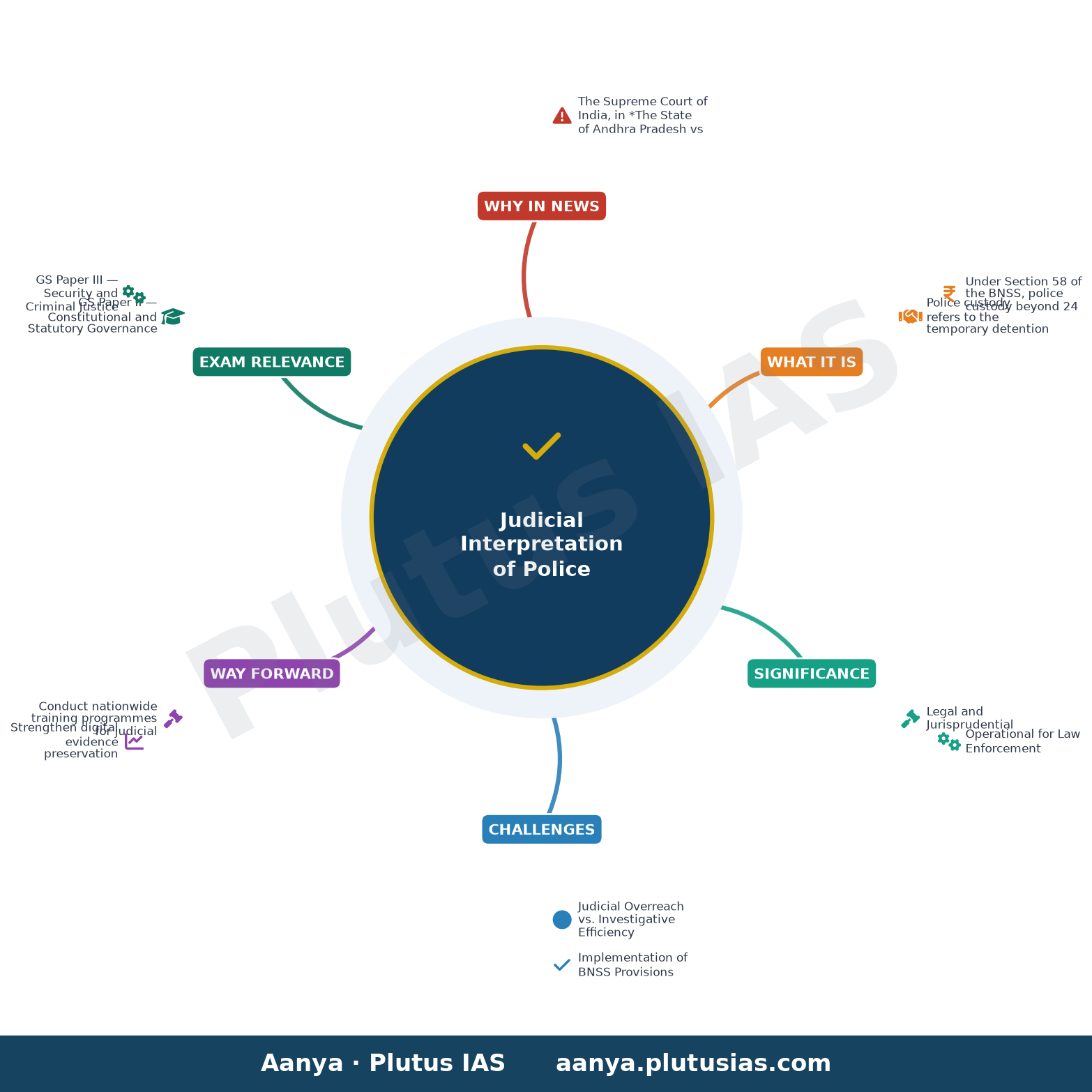
The Supreme Court of India, in *The State of Andhra Pradesh vs Suda Suresh Veera Venkata Naga Raju* (2026), clarified the scope of police custody under the Bharatiya Nagarik Suraksha Sanhita (BNSS), particularly the interpretation of Section 187(2). The judgment addressed whether police custody could be granted in parts during the investigation period and the limits on judicial oversight, especially concerning the presence of legal counsel and the non-extendability of custody periods. This ruling is significant as it delineates the boundaries of investigative autonomy vis-à-vis judicial supervision and constitutional safeguards.
Background
- Section 58 of the BNSS mandates that a person arrested without a warrant cannot be detained beyond 24 hours unless authorised by a magistrate, ensuring a foundational check on arbitrary detention.
- Section 187(2) of the BNSS permits police custody beyond 24 hours if the investigating officer demonstrates that the investigation cannot be completed within that period, subject to judicial approval.
- The case arose from a custodial death investigation where critical evidence (e.g., CCTV hard disks) remained untraced, and discoveries under the Bharatiya Sakshya Adhayam (BSA) were pending, necessitating extended police custody.
- The Supreme Court’s intervention followed a High Court order that restricted the total period of police custody and mandated the continuous presence of an advocate during interrogation, prompting the State to challenge these conditions.
- The judgment underscores the tension between investigative efficiency and the protection of arrested persons’ rights, a recurring theme in criminal justice jurisprudence.
What is Police Custody under the BNSS?
- Police custody refers to the temporary detention of an arrested person by investigating authorities for the purpose of interrogation and evidence collection, distinct from judicial remand where the accused is held in judicial custody.
- Under Section 58 of the BNSS, police custody beyond 24 hours requires magistrate authorisation, ensuring a judicial check on executive detention powers.
- Section 187(2) of the BNSS permits police custody in *parts* (intermittent periods) during the investigation, provided the aggregate does not exceed 15 days within the first 40 or 60 days of the total permissible detention period, depending on the offence.
- The BNSS introduces flexibility in custody periods to accommodate complex investigations, such as those involving forensic evidence or multiple accused, while maintaining statutory limits to prevent abuse.
- Section 38 of the BNSS guarantees the right to consult an advocate of choice, but this does not imply the advocate’s continuous physical presence during interrogation, as clarified by the Supreme Court.
- The magistrate’s role is supervisory: they must balance the investigating agency’s need for custody with the arrested person’s rights, ensuring no arbitrary or excessive detention.
- The BNSS’s provisions reflect a shift from the CrPC’s rigid 15-day police custody limit to a more nuanced approach, acknowledging the evolving nature of criminal investigations in the digital age.
- The Supreme Court’s ruling reaffirms that judicial oversight is essential but must not undermine the statutory framework designed to facilitate thorough investigations.
Key Features
| Feature | Significance |
|---|---|
| Section 187(2) of BNSS | Enlarges the permissible window for police custody beyond the initial 15-day remand period, allowing custody in parts during the first 40 or 60 days of total detention, provided the aggregate does not exceed 15 days. |
| Section 58 of BNSS | Mandates that any person arrested without a warrant cannot be detained beyond 24 hours unless authorised by a magistrate, thereby balancing investigative needs with constitutional safeguards. |
| Right to advocate under Section 38 of BNSS | Guarantees the right to meet an advocate of choice during police custody but does not mandate their continuous physical presence throughout interrogation sessions. |
| Judicial oversight in granting police custody | Highlights the magistrate’s role in authorising police custody while ensuring compliance with statutory limits and safeguarding against arbitrary detention. |
| Prohibition of absolute outer limits on custody | Clarifies that courts cannot impose non-extendable limits on police custody, as such limits may hinder the investigation process under Section 187(2). |
Why it Matters
Legal and Jurisprudential
- Reaffirms the balance between investigative efficiency and constitutional protections against arbitrary detention under Articles 21 and 22 of the Constitution.
- Clarifies the interpretation of Section 187(2) of the BNSS, ensuring statutory compliance while preventing judicial overreach in limiting investigative procedures.
- Emphasises the role of magistrates in exercising supervisory jurisdiction to prevent abuse of police custody while facilitating legitimate investigation.
- Sets a precedent for future cases involving custodial interrogation, delineating the boundaries of police powers and detainee rights.
Operational for Law Enforcement
- Provides clarity on the permissible duration and conditions of police custody under the BNSS, reducing ambiguity in investigative procedures.
- Facilitates the recovery of evidence and completion of investigations within statutory timelines, particularly in complex cases like custodial deaths.
- Allows for flexibility in granting police custody in phases, ensuring that critical phases of investigation are not prematurely curtailed.
Rights of the Accused
- Reinforces the right to legal representation under Section 38 of the BNSS, ensuring access to counsel during police custody without imposing impractical constraints on investigation.
- Prevents arbitrary or excessive detention by mandating judicial oversight and adherence to statutory limits on police custody.
Challenges
1. Judicial Overreach vs. Investigative Efficiency
- Risk of courts imposing rigid limits on police custody, thereby hindering the completion of investigations within statutory timelines.
- Need for magistrates to balance the rights of the accused with the exigencies of investigation, avoiding both judicial activism and inaction.
- Potential for prolonged detention under the guise of phased police custody, raising concerns about due process and constitutional safeguards.
UPSC Link: GS Paper 2: Fundamental Rights
2. Implementation of BNSS Provisions
- Ensuring uniform interpretation and application of Section 187(2) across jurisdictions, particularly in states with varying judicial precedents.
- Training of judicial officers and law enforcement agencies on the nuances of the BNSS to prevent misinterpretation or misuse of police custody provisions.
- Monitoring mechanisms to prevent the extension of police custody beyond statutory limits, especially in cases involving sensitive offences.
UPSC Link: GS Paper 2: Judiciary and Legal Framework
3. Protection Against Custodial Abuse
- Addressing the risk of custodial violence or coercion despite statutory safeguards, necessitating robust oversight and accountability mechanisms.
- Ensuring transparency in the conduct of interrogations, including the presence of advocates and adherence to procedural safeguards.
- Strengthening mechanisms for the recovery of evidence and the preservation of digital records to prevent tampering or loss.
UPSC Link: GS Paper 2: Fundamental Rights
4. Balancing Statutory Flexibility and Constitutional Safeguards
- Preventing the misuse of phased police custody to extend detention beyond reasonable limits, thereby violating the spirit of Article 21.
- Ensuring that the right to legal representation under Section 38 does not become a procedural hurdle that impedes investigation.
- Clarifying the boundaries of magistrate’s discretion in granting police custody to avoid arbitrary or discriminatory practices.
UPSC Link: GS Paper 2: Fundamental Rights
Challenges — UPSC Perspective
| Issue | Concern |
|---|---|
| Rigid judicial limits on police custody | May impede the completion of investigations, particularly in complex cases. |
| Inconsistent interpretation of BNSS provisions | Could lead to varying standards of judicial oversight across states. |
| Risk of custodial abuse despite safeguards | Requires robust monitoring to prevent violations of detainee rights. |
| Extension of police custody beyond statutory limits | Necessitates strict adherence to timelines to prevent arbitrary detention. |
| Balancing investigative needs with detainee rights | Demands nuanced judicial discretion to avoid both overreach and inaction. |
| Preservation and recovery of digital evidence | Critical in cases involving custodial deaths to ensure transparency and accountability. |
Way Forward
- Conduct nationwide training programmes for judicial officers and law enforcement agencies on the provisions of the BNSS, particularly Section 187(2) and Section 38, to ensure uniform interpretation and application.
- Strengthen digital evidence preservation protocols, including mandatory recording and storage of CCTV footage and electronic data, to prevent tampering or loss.
- Establish independent oversight bodies to monitor the implementation of police custody provisions under the BNSS and investigate allegations of custodial abuse.
- Develop standard operating procedures (SOPs) for magistrates to guide the granting of police custody, balancing investigative needs with constitutional safeguards.
- Enhance the role of legal aid services to ensure detainees have access to advocates during police custody, particularly in cases involving vulnerable individuals.
- Promote awareness among detainees about their rights under the BNSS, including the right to legal representation and the limits on police custody.
- Encourage the use of technology, such as body-worn cameras and digital interrogation logs, to ensure transparency and accountability during custodial interrogations.
- Review and update existing state-level guidelines on police custody to align with the provisions of the BNSS and judicial precedents.
UPSC Value Addition
Keywords for Mains Answer-Writing
Bharatiya Nagarik Suraksha Sanhita (BNSS), police custody, Section 187(2) BNSS, Section 58 BNSS, judicial magistrate, right to legal aid, Section 38 BNSS, custodial death, Bharatiya Sakshya Adhiniyam (BSA), police remand, constitutional safeguards, due process, investigative agency, Supreme Court of India, Andhra Pradesh High Court, right to counsel, remand period, statutory interpretation, criminal procedure · Bharatiya Nagarik Suraksha Sanhita · police remand provisions · judicial oversight in remand · right to legal representation during interrogation · custodial safeguards · Supreme Court interpretation of BNSS · investigative agency powers vs. constitutional rights
Constitutional & Policy Linkages
- Article 21: Protection of Life and Personal Liberty — safeguards against arbitrary detention and custodial abuse.
- Article 22: Protection against Arrest and Detention in certain cases — mandates judicial oversight and procedural safeguards for detainees.
Concept Flow
Arrest without warrant under Section 58 of BNSS → Detention beyond 24 hours requires magistrate’s authorisation → Magistrate’s discretion under Section 187(2) to grant police custody in phases → Aggregate custody limited to 15 days within first 40 or 60 days → Right to advocate under Section 38 during custody → Judicial oversight to prevent abuse → Supreme Court’s clarification on statutory limits and flexibility → Implementation challenges and safeguards → Way forward for uniform application and accountability.
Prelims Practice Questions
Q1. Consider the following statements regarding the Bharatiya Nagarik Suraksha Sanhita (BNSS), 2023:
1. Section 58 of BNSS mandates that any person arrested without a warrant cannot be detained beyond 24 hours unless authorised by a magistrate.
2. Section 187(2) of BNSS restricts police custody to the first 15 days of remand only.
3. Section 38 of BNSS guarantees the right to meet an advocate of choice during police custody.
4. The Supreme Court in State of Andhra Pradesh vs Suda Suresh Veera Venkata Naga Raju held that police custody under BNSS can be granted in parts, not exceeding 15 days in aggregate during the first 40 or 60 days of detention.
How many of the above statements are correct?
- Only one
- Only two
- Only three
- All four
Answer: Only three — Statements 1, 3, and 4 are correct. Statement 2 is incorrect as Section 187(2) of BNSS enlarges the window for police custody beyond the first 15 days, allowing it in parts up to 15 days during the first 40 or 60 days of detention.
Q2. Assertion (A): The Supreme Court in State of Andhra Pradesh vs Suda Suresh Veera Venkata Naga Raju held that a magistrate cannot impose an absolute and non-extendable outer limit on police custody under BNSS.
Reason (R): The Court observed that such a limit would foreclose recourse to Section 187(2) of BNSS, which permits police custody in parts up to 15 days during the first 40 or 60 days of detention.
In the context of the above two statements, which of the following is correct?
- Both A and R are true, and R is the correct explanation of A.
- Both A and R are true, but R is not the correct explanation of A.
- A is true, but R is false.
- A is false, but R is true.
Answer: Both A and R are true, and R is the correct explanation of A. — Both Assertion (A) and Reason (R) are true, and Reason (R) correctly explains Assertion (A). The Supreme Court’s ruling explicitly permits flexibility in police custody periods under BNSS, overriding rigid limits imposed by lower courts.
Q3. Match the following provisions of the Bharatiya Nagarik Suraksha Sanhita (BNSS) with their respective functions:
Column I (Provision)
A. Section 58
B. Section 187(2)
C. Section 38
D. Section 187
Column II (Function)
1. Mandates that a person arrested without a warrant cannot be detained beyond 24 hours unless authorised by a magistrate.
2. Permits police custody in parts, not exceeding 15 days in aggregate during the first 40 or 60 days of detention.
3. Guarantees the right to meet an advocate of choice during police custody.
4. Authorises a magistrate to grant police custody for investigation.
Select the correct match:
- A-1, B-2, C-3, D-4; A-2, B-1, C-4, D-3; A-3, B-4, C-1, D-2; A-4, B-3, C-2, D-1
- answer_string_0_1_2_3_4
- answer_index_array_0_1_2_3_4
- answer_index_array_0_1_2_3_4
- answer_index_array_0_1_2_3_4
Answer: ? — The correct matches are: A-1 (Section 58 mandates 24-hour detention limit), B-2 (Section 187(2) permits police custody in parts up to 15 days), C-3 (Section 38 guarantees right to legal aid), D-4 (Section 187 authorises magistrate to grant police custody).
Mains Practice Question
✍ The Supreme Court, in State of Andhra Pradesh vs Suda Suresh Veera Venkata Naga Raju, has clarified the scope of police custody under the Bharatiya Nagarik Suraksha Sanhita (BNSS). Critically examine the constitutional and statutory safeguards governing police remand in India, with particular reference to the balance between investigative agency powers and the rights of the accused. (15 Marks)
Approach: MODEL-ANSWER SKELETON:
1. **Statutory Framework**:
– Section 58 BNSS: 24-hour detention limit post-arrest without warrant; magistrate’s authorisation required for extension.
– Section 187 BNSS: Magistrate’s power to grant police custody for investigation, including the new provision in Section 187(2) allowing custody in parts up to 15 days during the first 40 or 60 days of detention.
– Section 38 BNSS: Right to legal aid and counsel during police custody, though not an absolute right to continuous physical presence.
2. **Constitutional Safeguards**:
– Article 21 (Right to Life and Personal Liberty): Judicial oversight to prevent arbitrary detention and custodial violence.
– Article 22(1): Right to be informed of grounds of arrest and right to legal representation.
– Judicial precedents: DK Basu v. State of West Bengal (1997) on custodial safeguards; Nandini Sundar v. State of Chhattisgarh (2011) on police excesses.
3. **Judicial Interpretation and Balance**:
– Supreme Court’s ruling in the instant case: Flexibility in police custody periods under BNSS to facilitate thorough investigation, while ensuring no arbitrary extension.
– High Court’s role: Supervisory jurisdiction to prevent misuse of remand powers.
– Tension between investigative efficiency and constitutional rights: Need for proportionality and adherence to due process.
4. **Contemporary Relevance**:
– Recent cases of custodial deaths and lack of traceability of evidence (e.g., CCTV hard disks) highlight the urgency of balancing investigative needs with safeguards.
– Bharatiya Sakshya Adhiniyam (BSA) and its interplay with BNSS in ensuring admissibility of evidence.
5. **Critique and Way Forward**:
– Potential for misuse: Need for stricter judicial scrutiny and mandatory video recording of interrogations.
– Role of the National Human Rights Commission (NHRC) and State Human Rights Commissions in monitoring custodial practices.
– Recommendations of the Justice Malimath Committee (2003) on reforming criminal justice administration.
6. **Conclusion**:
– The BNSS provisions, as interpreted by the Supreme Court, strike a balance by enlarging investigative windows while retaining judicial oversight. However, implementation gaps and lack of systemic safeguards (e.g., CCTV coverage) necessitate further reforms to uphold constitutional guarantees.
Source: The Hindu
Generated by AanyaAi for educational purpose.

- Gurugram’s groundwater extraction exceeds limit by 212%; HC seeks ban - October 4, 2026
- स्वतंत्रता सेनानी श्यामजी कृष्ण वर्मा की जन्म जयंती पर पीएम का श्रद्धांजलि - October 4, 2026
- KWML’s Feasibility Reports for Water Metro in 18 Cities: UPSC & PCS Insights - October 3, 2026

No Comments