


13 Aug Rajya Sabha Approves Mineral Laws Amendment Bill 2023: Key Implications for UPSC
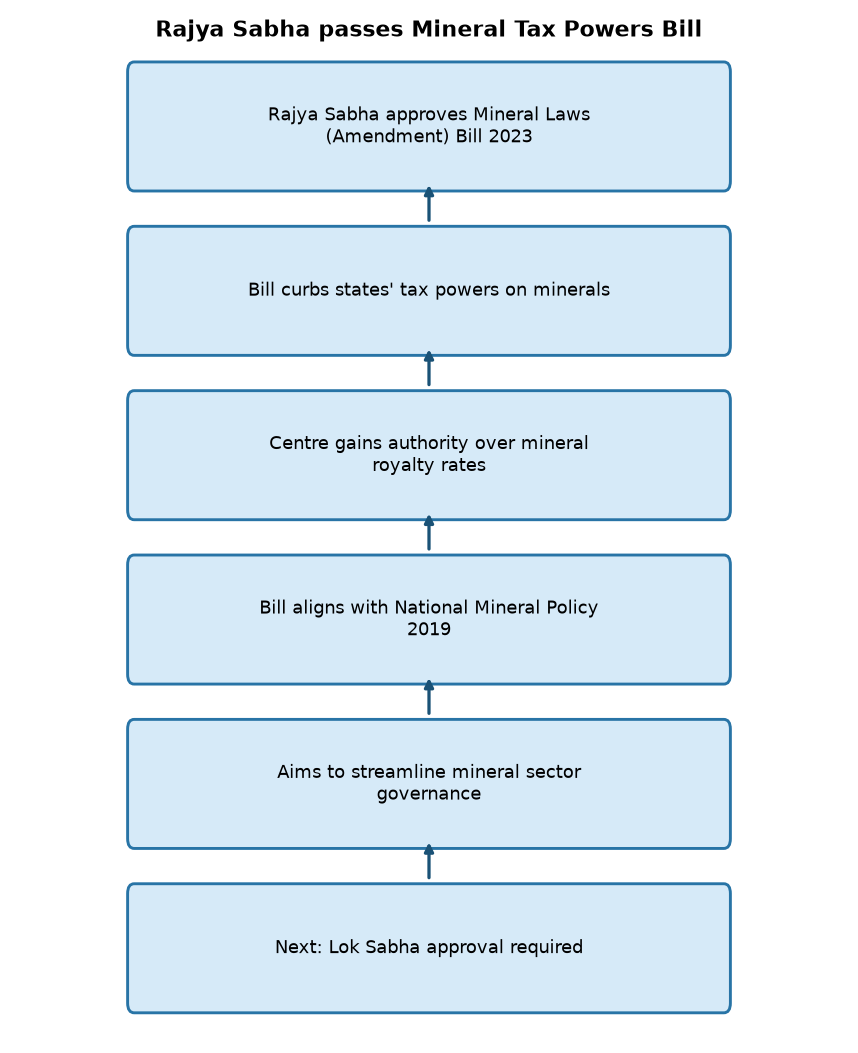
✎ Centre gains control over mineral royalties, reducing state autonomy under amended MMDR Act.
Relevance for UPSC & State PCS: Polity
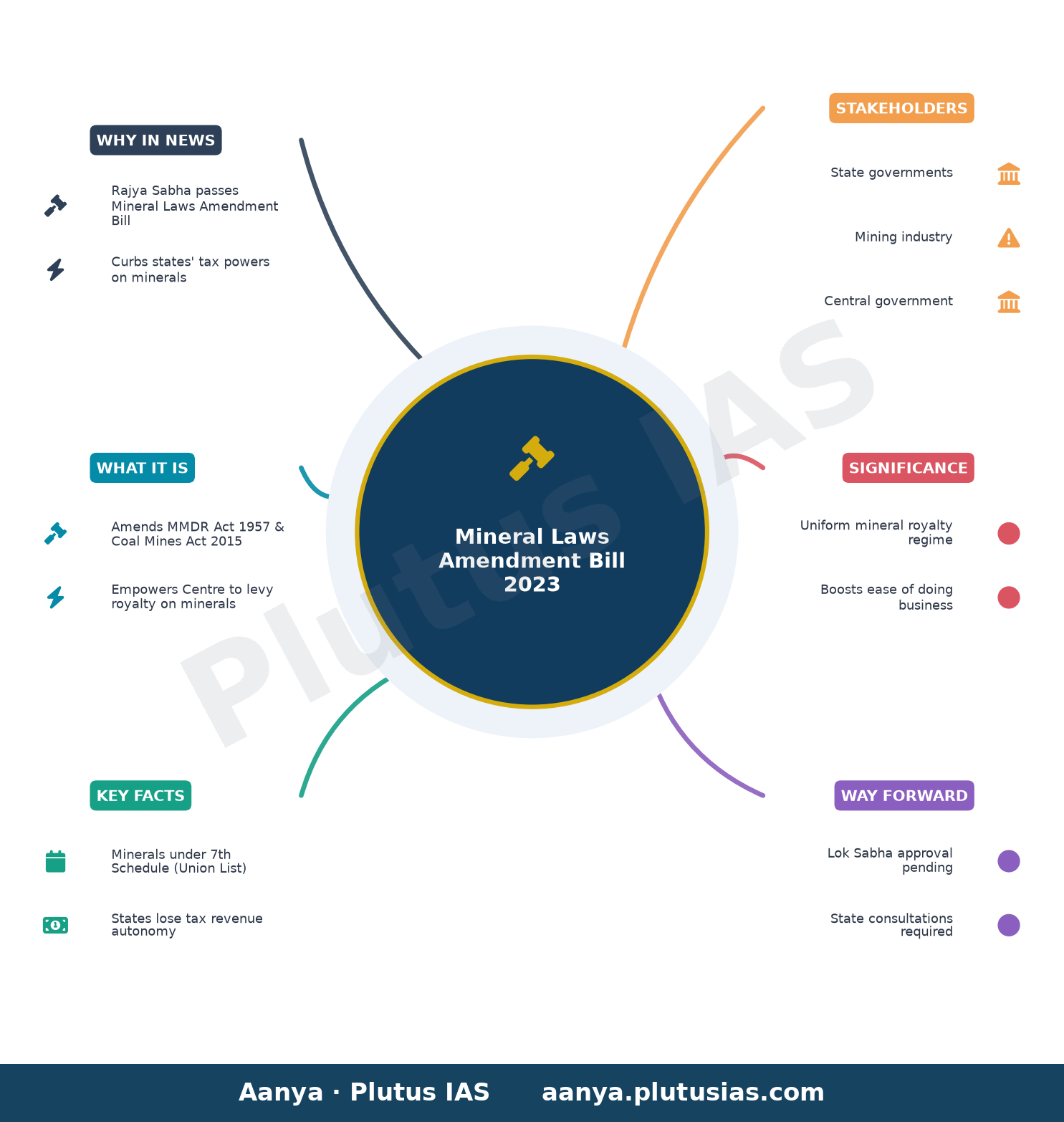
The Rajya Sabha recently passed the Mines and Minerals (Development and Regulation) Amendment Bill, 2023, which seeks to curb the taxing powers of state governments over minerals. The bill, which was introduced in the Lok Sabha in July 2023 and later approved by the Rajya Sabha, aims to bring uniformity in the taxation of minerals across the country. Currently, state governments have the authority to levy taxes on minerals, leading to disparities in royalty rates and other levies. The bill proposes to empower the central government to prescribe the manner of calculating royalty rates for all minerals, thereby reducing the discretion of state governments in this regard.
This move is significant for UPSC and State PCS aspirants as it touches upon the federal structure of India, a crucial topic in the polity syllabus. The bill’s provisions highlight the tussle between the center and states over fiscal autonomy, a recurring theme in Indian governance. Understanding the nuances of this bill can help aspirants analyze the broader implications of centralization versus decentralization in India’s federal setup. Moreover, the bill’s focus on mineral taxation can be linked to the broader economic policies of the government, including the Make in India initiative and the push for self-reliance in critical minerals.
For State PCS aspirants, this bill is particularly relevant as it directly impacts the revenue generation capacity of state governments. The reduction in state-level taxation powers could lead to a decline in their financial resources, which is a critical aspect of federalism. Aspirants should be aware of how such legislative changes can influence the financial health of states and the potential consequences for state-level planning and development. This bill also underscores the importance of understanding the constitutional provisions related to taxation and the distribution of powers between the center and the states.
The passage of this bill also raises questions about the role of Parliament in legislating on subjects that fall within the state list. The Mines and Minerals (Development and Regulation) Act, 1957, originally vested the power to regulate mines and minerals with the states. However, the 2023 amendment seeks to shift this power to the center, raising constitutional questions about the extent of Parliament’s authority under Article 246. For UPSC aspirants, this provides an opportunity to delve into the constitutional provisions governing the distribution of legislative powers and the doctrine of federalism in India.
Source: ndtv.com
Practice Questions
Q1. Which of the following legislative bodies recently passed a bill aimed at curbing the tax powers of states on minerals?
- Lok Sabha
- Rajya Sabha
- President of India
- Supreme Court
Answer
Rajya Sabha — The Rajya Sabha passed the bill to curb states’ tax powers on minerals, as reported in the given current-affairs story.
Q2. What is the primary objective of the bill passed by the Rajya Sabha regarding minerals?
- To increase state tax powers on minerals
- To curb state tax powers on minerals
- To abolish all taxes on minerals
- To transfer mineral ownership to the central government
Answer
To curb state tax powers on minerals — The bill aims to curb the tax powers of states on minerals, indicating a centralization of tax authority in this domain.
Generated by AanyaAi for educational purpose.

- Gurugram’s groundwater extraction exceeds limit by 212%; HC seeks ban - October 4, 2026
- स्वतंत्रता सेनानी श्यामजी कृष्ण वर्मा की जन्म जयंती पर पीएम का श्रद्धांजलि - October 4, 2026
- KWML’s Feasibility Reports for Water Metro in 18 Cities: UPSC & PCS Insights - October 3, 2026

No Comments