


13 Aug Supreme Court to Decide: Can Legislative Privilege Override Free Speech?
Supreme Court BenchLegislative privilegeFree speechConstitution BenchFundamental rightsArticle 194✎ The Supreme Court’s seven-judge Bench will determine whether legislative privileges under Article 194 can override the fundamental right to free speech under Article 19(1)(a), resolving long-standing ambiguities in constitutional…
Subject Relevance — Where This Topic Fits
- GS Paper II — Polity and Governance: Constitutional Framework, Fundamental Rights, and Judicial Review | GS Paper II — Polity and Governance: Role of the Judiciary and Judicial Activism
- Prelims: Legislative Privileges (Article 194), Fundamental Rights (Article 19(1)(a)), Constitutional Bench, Judicial Review, Freedom of the Press, Article 21 (Right to Personal Liberty), Pandit M.S.M. Sharma vs Shri Krishna Sharma (1959), Presidential Reference (1964)
- Essay: Balancing Fundamental Rights and Parliamentary Privileges: A Constitutional Imperative, The Role of the Judiciary in Safeguarding Democratic Freedoms
Quick Revision: The Supreme Court’s seven-judge Bench will determine whether legislative privileges under Article 194 can override the fundamental right to free speech under Article 19(1)(a), resolving long-standing ambiguities in constitutional jurisprudence.
Why is this in the news?
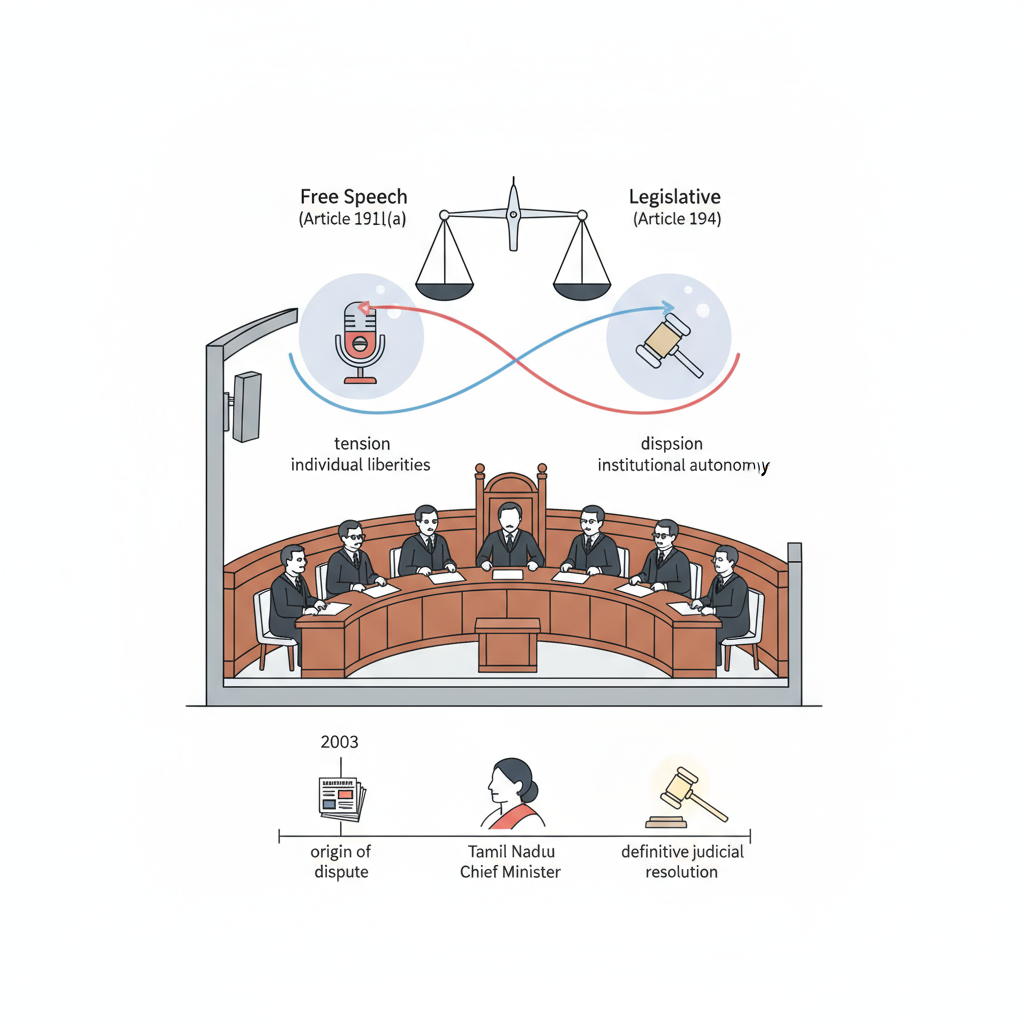
The Supreme Court has constituted a seven-judge Constitution Bench to adjudicate whether legislative privileges, as defined under Article 194 of the Constitution, can override the fundamental right to freedom of speech and expression guaranteed under Article 19(1)(a). This reference arises from a long-standing dispute initiated in 2003 involving The Hindu’s criticism of a Tamil Nadu Chief Minister, which led to allegations of breach of legislative privilege. The case underscores the tension between institutional autonomy and individual liberties, necessitating a definitive judicial resolution.
Background
- The dispute originated in April 2003 when The Hindu published an editorial criticising the then Chief Minister of Tamil Nadu, Jayalalithaa, which was perceived as a breach of legislative privilege by the Tamil Nadu State Assembly.
- The Assembly passed a resolution accusing the newspaper of distorting proceedings and commenting contrary to the events in the House, invoking Article 194(3) of the Constitution.
- The Assembly also resolved to initiate coercive action against five senior journalists of The Hindu, including the then Editor, N. Ravi.
- The journalists approached the Supreme Court and secured a stay on any coercive measures, leading to a prolonged legal battle over the scope of legislative privileges.
What is the Legal Conflict Between Legislative Privilege and Free Speech?
- Legislative privilege, as enshrined in Article 194 of the Constitution, grants Members of State Legislatures the freedom of speech within the House and protects them from legal proceedings for their statements, ensuring uninhibited legislative functioning.
- Article 19(1)(a) guarantees to all citizens the fundamental right to freedom of speech and expression, which includes the freedom of the press, subject to reasonable restrictions under Article 19(2).
- The conflict arises when criticism of legislative actions or individuals, whether by media or citizens, is deemed to infringe upon legislative privilege, potentially chilling free speech.
- The Supreme Court has previously adjudicated on this issue in *Pandit M.S.M. Sharma vs Shri Krishna Sharma* (1959), where it held that legislative privileges are not absolute and must be balanced against fundamental rights.
- A Presidential Reference in 1964 further examined the scope of legislative privileges, creating ambiguity that necessitates a definitive ruling.
- The current seven-judge Bench aims to resolve whether legislative privileges can be invoked to override free speech, particularly when exercised by the media or citizens outside the legislative domain.
- The case also implicates Article 21 (Right to Personal Liberty), as coercive actions against journalists could constitute a violation of their liberty.
- The judiciary’s role is to delineate the boundaries of legislative privilege without undermining the democratic principle of free expression.
Key Features
| Feature | Significance |
|---|---|
| Seven-judge Constitution Bench | To authoritatively resolve the long-standing conflict between legislative privilege and fundamental free speech rights under Articles 19(1)(a) and 194(3) of the Constitution. |
| Article 194(3) of the Constitution | Confers immunity to members of State legislatures for their speech and actions in the House, raising questions about its scope vis-à-vis citizens’ free speech rights. |
| Article 19(1)(a) of the Constitution | Guarantees the fundamental right to freedom of speech and expression, which may be tested against legislative privilege claims. |
| Supreme Court’s referral mechanism | Demonstrates the judiciary’s role in balancing constitutional rights through constitutional bench references for authoritative interpretation. |
| Case trajectory (2003–2026) | Highlights the prolonged legal journey of a case involving media criticism of a Chief Minister, underscoring the need for clarity in constitutional interpretation. |
Why it Matters
Constitutional Governance
- The case underscores the delicate balance between parliamentary sovereignty and individual liberties, a cornerstone of democratic governance.
- A definitive ruling by the seven-judge Bench will clarify the limits of legislative privilege, preventing arbitrary assertions that stifle legitimate criticism.
- The judgment will influence how State Assemblies interpret their powers under Article 194(3), ensuring alignment with constitutional rights.
- It reinforces the judiciary’s role as the final arbiter in disputes involving fundamental rights and institutional privileges.
Media and Free Speech
- The case reaffirms the media’s role as a watchdog, critical to democratic accountability and public discourse.
- A ruling in favour of free speech will protect journalists and citizens from coercive actions for critical commentary.
- The case highlights the vulnerability of the press to legislative overreach, necessitating judicial safeguards.
- It may set a precedent for how courts view criticism of public officials and institutions, balancing accountability with immunity.
Judicial Precedent
- The case traces its origins to conflicting judgments (e.g., *Pandit MSM Sharma vs Shri Krishna Sharma*, 1959, and Presidential Reference, 1964), necessitating a seven-judge Bench for resolution.
- A definitive ruling will harmonise judicial interpretations, reducing ambiguity in future cases involving legislative privilege and free speech.
- The prolonged litigation underscores the need for constitutional clarity to avoid prolonged legal uncertainty.
Challenges
1. Conflict Between Legislative Privilege and Free Speech
- The primary challenge is delineating the boundary between legitimate legislative privilege and the fundamental right to free speech under Article 19(1)(a).
- State legislatures may interpret Article 194(3) expansively, leading to overreach that stifles criticism and undermines democratic norms.
- The judiciary must ensure that legislative privilege does not become a tool to suppress dissent or hold the executive accountable.
- The case raises questions about the accountability of legislators and the media in a democracy where transparency is paramount.
UPSC Link: GS II: Fundamental Rights (Part III)
2. Judicial Deliberation and Delay
- The case has traversed over two decades, highlighting the inefficiency in resolving constitutional ambiguities promptly.
- Prolonged litigation may deter journalists and citizens from exercising their free speech rights due to fear of legal repercussions.
- The judiciary must streamline constitutional bench references to ensure timely resolution of critical disputes.
UPSC Link: GS II: Judiciary
3. Enforcement of Judicial Pronouncements
- Even after a definitive ruling, the challenge lies in ensuring State legislatures and executive bodies comply with the judgment.
- There may be resistance from institutions accustomed to broad interpretations of legislative privilege.
- The media and civil society must remain vigilant to prevent backsliding into arbitrary practices.
UPSC Link: GS II: Parliament and State Legislatures
Challenges — UPSC Perspective
| Issue | Concern |
|---|---|
| Scope of Legislative Privilege | Risk of overbroad interpretations that stifle free speech and democratic accountability. |
| Judicial Delays in Resolving Constitutional Ambiguities | Prolonged litigation may deter citizens and media from exercising rights due to uncertainty. |
| Enforcement of Supreme Court Rulings | Ensuring compliance by State legislatures and executive bodies post-judgment. |
| Balance Between Accountability and Immunity | Preventing legislative privilege from becoming a shield against criticism of public officials. |
| Protection of Press Freedom | Safeguarding journalists from coercive actions for critical commentary on public figures. |
Way Forward
- The seven-judge Bench should deliver a clear, balanced ruling that harmonises Articles 19(1)(a) and 194(3) without undermining either constitutional value.
- State legislatures must review their rules on legislative privilege to align with the Supreme Court’s interpretation, ensuring no overreach.
- Journalists and media organisations should document cases of alleged legislative overreach to build a body of evidence for future judicial scrutiny.
- The judiciary should expedite constitutional bench references to avoid prolonged legal uncertainty in critical disputes.
- Civil society and legal aid organisations must educate citizens on their free speech rights and the limits of legislative privilege.
- Parliament and State Assemblies should consider codifying the boundaries of legislative privilege to provide legal certainty.
- The Press Council of India and media bodies should advocate for stronger protections for journalists facing legal threats.
- Academic institutions should incorporate the case’s legal principles into constitutional law curricula to foster informed discourse.
UPSC Value Addition
Keywords for Mains Answer-Writing
Legislative Privileges · Freedom of Speech and Expression · Article 19(1)(a) · Article 194 · Constitutional Bench · Supreme Court of India · Press Freedom · Judicial Review · Interplay of Fundamental Rights · Separation of Powers · Doctrine of Basic Structure · Judicial Activism · Parliamentary Sovereignty · Rule of Law · Constitutional Morality
Constitutional & Policy Linkages
- Article 19(1)(a): Fundamental right to freedom of speech and expression.
- Article 194(3): Immunities and privileges of State legislatures and their members.
- Article 21: Right to liberty, indirectly engaged in balancing free speech with institutional powers.
Concept Flow
Publication of critical editorial (2003) → State Assembly resolution invoking Article 194(3) → Police action against journalists → Supreme Court intervention → Stay on coercive action → Referral to five-judge Bench (2003) → Referral to seven-judge Bench (2004) → Pending hearing (2026) → Judicial resolution of conflict between Articles 19(1)(a) and 194(3).
Prelims Practice Questions
Q1. Consider the following statements regarding legislative privileges and fundamental rights in India:
1. Article 194(3) of the Constitution grants freedom of speech to members of State legislatures.
2. Article 19(1)(a) of the Constitution guarantees the right to freedom of speech and expression to all citizens.
3. The Supreme Court has the power to review the scope of legislative privileges under Article 194.
4. Legislative privileges can never be challenged on the grounds of violating fundamental rights.
How many of the above statements are correct?
- Only one
- Only two
- Only three
- All four
Answer: Only three — Statements 1, 2, and 3 are correct. Statement 4 is incorrect as legislative privileges are subject to judicial review, particularly when they conflict with fundamental rights under Articles 19 and 21.
Q2. Assertion (A): Legislative privileges under Article 194 of the Constitution are absolute and cannot be challenged in a court of law.
Reason (R): The Constitution explicitly states that the privileges of State legislatures are beyond judicial scrutiny.
Options:
A. Both A and R are true, and R is the correct explanation of A.
B. Both A and R are true, but R is not the correct explanation of A.
C. A is true, but R is false.
D. A is false, but R is true.
- A
- B
- C
- D
Answer: D — Assertion (A) is false because legislative privileges are not absolute and can be reviewed by the judiciary, especially when they conflict with fundamental rights. Reason (R) is also false as the Constitution does not state that privileges are beyond judicial scrutiny.
Q3. Match the following Constitutional Provisions with their respective Articles:
Column I
1. Freedom of speech and expression to citizens
2. Immunity of members of State legislatures for their speeches
3. Power of the Supreme Court to issue writs
4. Right to constitutional remedies
Column II
A. Article 32
B. Article 19(1)(a)
C. Article 194(1)
D. Article 194(3)
Options:
1. 1-B, 2-D, 3-A, 4-C
2. 1-B, 2-C, 3-A, 4-D
3. 1-A, 2-B, 3-C, 4-D
4. 1-D, 2-A, 3-B, 4-C
- 1
- 2
- 3
- 4
Answer: 3 — Correct matching: 1-B (Article 19(1)(a)), 2-C (Article 194(1)), 3-A (Article 32), 4-D (Article 194(3)).
Mains Practice Question
✍ The Supreme Court has referred the question of whether legislative privileges can override the fundamental right to freedom of speech and expression to a seven-judge Constitution Bench. Critically examine the constitutional and judicial perspectives on this issue, with reference to relevant Articles and landmark judgments. Also, discuss the implications of such a judicial resolution for the balance between parliamentary sovereignty and fundamental rights. (15 Marks)
Approach: MODEL-ANSWER SKELETON:
1. **Constitutional Framework**:
– Article 19(1)(a): Fundamental right to freedom of speech and expression.
– Article 194: Privileges of State legislatures, including freedom of speech for members (Article 194(1)) and immunities (Article 194(3)).
– Article 21: Right to life and personal liberty, interpreted to include freedom of expression.
2. **Judicial Perspectives and Landmark Cases**:
– **Pandit MSM Sharma vs Shri Krishna Sharma (1959)**: Held that legislative privileges are part of the basic structure and cannot be abridged by fundamental rights.
– **Kesavananda Bharati vs State of Kerala (1973)**: Established the doctrine of basic structure, which includes fundamental rights.
– **S.P. Gupta vs Union of India (1981)**: Emphasized judicial review as a basic feature of the Constitution.
– **Recent Context**: The Supreme Court’s decision to refer the matter to a seven-judge Bench indicates a need to reconcile conflicting judgments and clarify the interplay between Articles 19 and 194.
3. **Doctrinal Tensions**:
– **Parliamentary Sovereignty vs Fundamental Rights**: Debate on whether legislative privileges, as a part of parliamentary sovereignty, can override fundamental rights.
– **Rule of Law and Constitutional Morality**: The judiciary’s role in ensuring that no institution, including legislatures, acts beyond constitutional limits.
4. **Implications of Judicial Resolution**:
– **Strengthening Fundamental Rights**: A ruling in favor of free speech may reinforce the primacy of fundamental rights over legislative privileges.
– **Judicial Activism**: The Supreme Court’s intervention underscores its role as the guardian of the Constitution.
– **Impact on Press Freedom**: The case highlights the need to protect critical speech, including media criticism, from arbitrary invocation of legislative privileges.
5. **Balanced View**:
– Acknowledge the necessity of legislative privileges for the functioning of democratic institutions.
– Emphasize that such privileges must not be used to stifle legitimate criticism or violate fundamental rights.
Source: The Hindu
Generated by AanyaAi for educational purpose.

- Gurugram’s groundwater extraction exceeds limit by 212%; HC seeks ban - October 4, 2026
- स्वतंत्रता सेनानी श्यामजी कृष्ण वर्मा की जन्म जयंती पर पीएम का श्रद्धांजलि - October 4, 2026
- KWML’s Feasibility Reports for Water Metro in 18 Cities: UPSC & PCS Insights - October 3, 2026

No Comments