


15 Aug Odisha’s Fiscal Autonomy Under Threat: BJD Demands All-Party Meet on Mining Bill
✎ The Mines and Minerals (Development and Regulation) Amendment Bill, 2026, centralises rule-making and taxation powers with the Union Government, potentially undermining the fiscal autonomy of mineral-rich states under the…
Subject Relevance — Where This Topic Fits
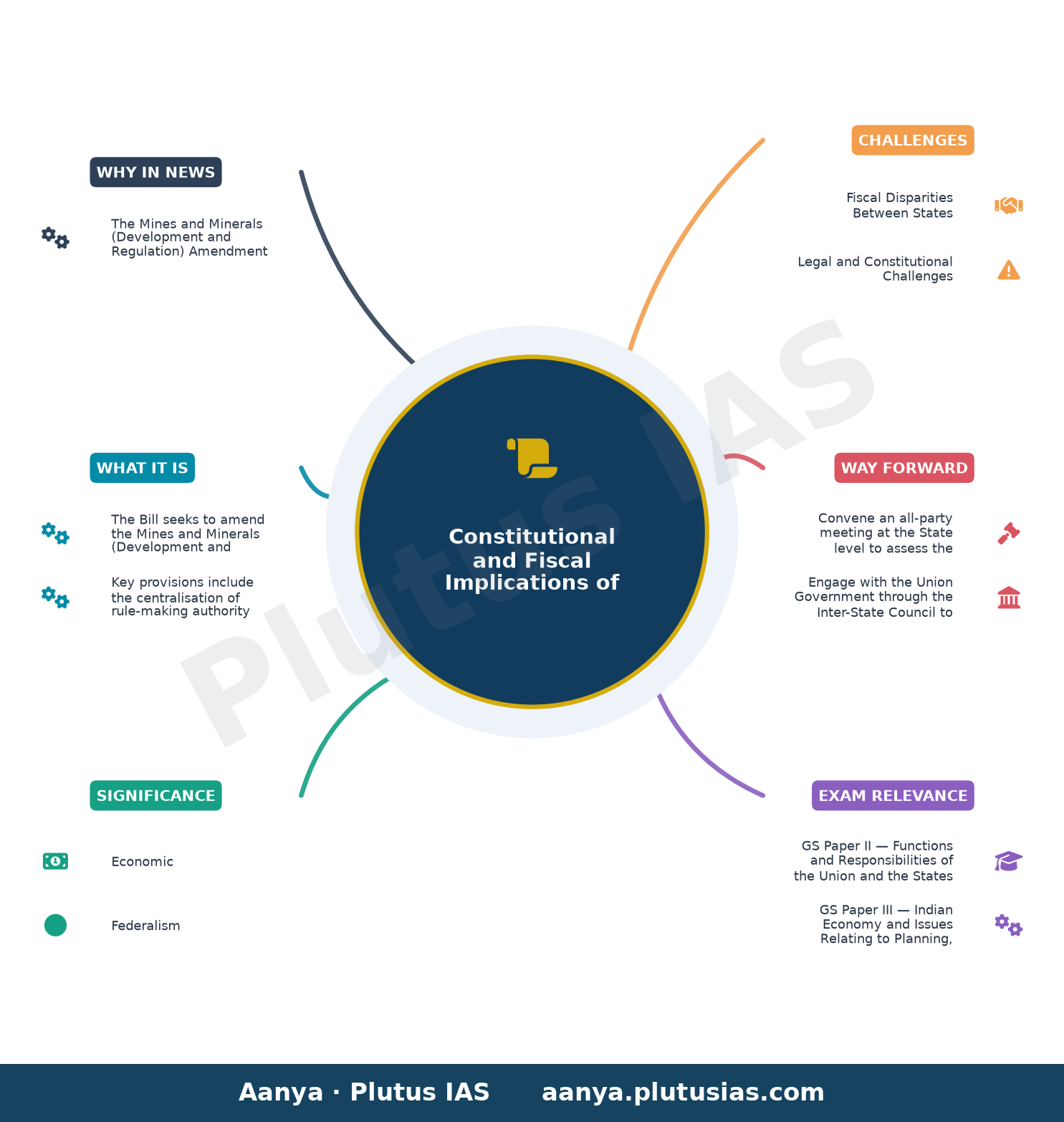
- GS Paper II — Functions and Responsibilities of the Union and the States | GS Paper III — Indian Economy and Issues Relating to Planning, Mobilisation of Resources, Growth, Development and Employment | GS Paper III — Government Budgeting
- Prelims: Mines and Minerals (Development and Regulation) Act, 1957, Article 246 of the Constitution, Federalism in India, Fiscal federalism, Concurrent List (List III of Seventh Schedule), Union List (List I of Seventh Schedule), State List (List II of Seventh Schedule), Compensation Cess, GST Council, Inter-State Council
- Essay: Federalism in India: Balancing Unity and Diversity, Resource Governance and Sustainable Development: Lessons from Mineral-Rich States
Quick Revision: The Mines and Minerals (Development and Regulation) Amendment Bill, 2026, centralises rule-making and taxation powers with the Union Government, potentially undermining the fiscal autonomy of mineral-rich states under the constitutional framework of federalism.
Why is this in the news?
The Mines and Minerals (Development and Regulation) Amendment Bill, 2026, recently passed by Parliament, has sparked significant debate regarding its potential impact on the fiscal autonomy of mineral-rich states such as Odisha and Jharkhand. The Bill, which amends the Mines and Minerals (Development and Regulation) Act, 1957, centralises rule-making authority with the Union Government and restricts the power of states to levy taxes on minerals, thereby raising constitutional and federalism-related concerns. This development has prompted political leaders from affected states to demand urgent deliberations to safeguard state interests.
Background
- The Mines and Minerals (Development and Regulation) Act, 1957, is the primary legislation governing the regulation of mines and minerals in India, defining the roles of the Union and State Governments in mineral resource management.
- Mineral-rich states such as Odisha, Jharkhand, Chhattisgarh, and Rajasthan derive significant revenue from the extraction and taxation of minerals, which funds critical developmental and welfare initiatives.
- The Seventh Schedule of the Indian Constitution divides legislative powers between the Union and State Governments, with minerals falling under the Concurrent List, allowing both levels of government to legislate on the subject.
- The Goods and Services Tax (GST) regime, introduced in 2017, subsumed several state taxes but explicitly excluded taxes on minerals, allowing states to levy additional levies such as royalty, cess, and duties.
- The Union Government has historically exercised control over mining policy, including auction mechanisms and environmental clearances, while states retain authority over land revenue and local taxation.
- Recent amendments to mining laws have increasingly centralised regulatory powers, raising concerns about the erosion of state fiscal autonomy and federal principles.
What is the Mines and Minerals (Development and Regulation) Amendment Bill, 2026?
- The Bill seeks to amend the Mines and Minerals (Development and Regulation) Act, 1957, with the stated objective of streamlining mineral resource governance, enhancing transparency, and attracting investment in the mining sector.
- Key provisions include the centralisation of rule-making authority with the Union Government, thereby reducing the discretionary powers of state governments in framing rules related to mineral development and regulation.
- The Bill restricts the power of state governments to levy taxes, cess, or additional levies on minerals, which could significantly impact the revenue streams of mineral-rich states.
- It introduces provisions for the auction of mineral concessions, with the Union Government retaining control over the auction process, including the determination of reserve prices and eligibility criteria.
- The Bill proposes to replace the existing system of royalty payments with a fixed rate structure determined by the Union Government, potentially reducing the financial benefits accruing to states from mineral extraction.
- The legislation aims to align India’s mining regime with global best practices, including environmental safeguards and sustainable mining practices, though critics argue that the centralisation of powers may undermine local governance.
- The Bill has been framed in the context of India’s commitment to the Sustainable Development Goals (SDGs) and the need to balance economic growth with environmental conservation in the mining sector.
- The proposed amendments have been criticised by state governments for encroaching upon their constitutional rights under the Seventh Schedule, particularly in relation to land revenue and local taxation.
Key Features
| Feature | Significance |
|---|---|
| Centralisation of rule-making authority | Shifts power from State governments to the Union Government under the Mines and Minerals (Development and Regulation) Act, 1957, restricting State discretion in mineral governance. |
| Restriction on State taxation powers | Prohibits State governments from levying taxes, cesses, or royalties on minerals beyond the limits prescribed by the Union, impacting State revenue autonomy. |
| Impact on mineral-rich States | States like Odisha and Jharkhand, which derive significant revenue from mining, face potential fiscal losses due to reduced revenue streams. |
| Constitutional implications of federalism | The Bill raises questions about the balance of power between the Union and States under the Seventh Schedule of the Constitution. |
| Developmental funding dependency | Reduced State revenue from mining may constrain funding for critical sectors such as healthcare, education, and infrastructure in mineral-rich States. |
Why it Matters
Economic
- The Bill alters the fiscal landscape for mineral-rich States by centralising control over mineral taxation, potentially reducing their revenue base.
- Mineral royalties and taxes constitute a significant portion of State revenues in States like Odisha, which may now face budgetary constraints.
- The move could lead to a reallocation of financial resources from State to Union coffers, affecting developmental priorities in mining-dependent regions.
- Long-term economic implications include reduced State capacity to invest in local industries, education, and healthcare, exacerbating regional disparities.
Federalism
- The Bill encroaches upon the fiscal federalism principle, where States have historically exercised autonomy over local resources under Entry 50 of the State List (Seventh Schedule).
- It challenges the cooperative federalism model by unilaterally imposing Union-centric policies without adequate consultation with State governments.
- The restriction on State taxation powers may be seen as a violation of the spirit of fiscal federalism, where States are expected to have discretion over resource utilisation.
- The move could set a precedent for similar centralisation efforts in other resource-rich sectors, further diluting State autonomy.
Constitutional
- The Bill raises questions about the interpretation of Articles 246 and 254, which delineate the legislative competence of Parliament and State Legislatures over mineral resources.
- The Seventh Schedule’s distribution of powers between Union and States is tested, particularly Entry 50 (State List) and Entry 54 (Union List), which govern minerals and taxes on mineral rights.
- The Bill may require judicial scrutiny to determine its constitutional validity, especially concerning the doctrine of pith and substance and the doctrine of federal supremacy.
Strategic
- Mineral resources, particularly iron ore, bauxite, and coal, are critical for India’s industrial and energy security, making their governance a matter of national importance.
- Centralisation of control could streamline mineral policy but may also lead to inefficiencies in addressing local developmental needs and environmental concerns.
- The Bill could impact India’s compliance with international commitments on sustainable mining and resource governance, particularly under the UN Sustainable Development Goals.
Challenges
1. Fiscal Disparities Between States
- Mineral-rich States like Odisha and Jharkhand may face significant revenue losses, exacerbating fiscal imbalances with less resource-endowed States.
- The Bill could widen the gap between resource-rich and resource-poor States, leading to unequal development outcomes.
- State governments may struggle to fund social welfare schemes, infrastructure projects, and local governance initiatives due to reduced revenue inflows.
UPSC Link: https://www.upsc.gov.in/sites/default/files/QP_CSE_2021.pdf#page=45
2. Legal and Constitutional Challenges
- The Bill may face legal challenges on grounds of violating the principles of federalism and State autonomy under the Constitution.
- State governments could petition the Supreme Court to strike down provisions that encroach upon their legislative and fiscal powers.
- Judicial interpretation of the Bill’s constitutional validity could set a precedent for future Centre-State disputes over resource governance.
UPSC Link: https://main.sci.gov.in/jonew/judis/46439.pdf
3. Environmental and Social Concerns
- Centralisation of mineral governance may dilute local environmental safeguards and community participation in mining decisions.
- States with strong environmental regulations could face constraints in enforcing local norms, leading to ecological degradation.
- Indigenous and tribal communities dependent on mineral-rich lands may face displacement or loss of livelihoods due to weakened State oversight.
UPSC Link: https://niti.gov.in/sites/default/files/2021-08/Strategy-for-New-India-2022_1.pdf#page=120
4. Economic Growth and Industrial Policy
- Reduced State revenue from mining could limit investments in industrialisation and job creation in mineral-rich regions.
- The Bill may discourage States from promoting local industries dependent on mineral resources, impacting economic diversification.
- Long-term industrial policy goals could be undermined if States lose financial autonomy to incentivise local manufacturing and value addition.
UPSC Link: https://dipp.gov.in/sites/default/files/National_Industrial_Corridor_Programme_2020.pdf#page=15
5. Inter-State Coordination and Conflicts
- The Bill could lead to inter-State disputes over mineral resources, particularly in border regions with overlapping claims.
- States may seek to challenge the Bill’s provisions through political channels, leading to tensions in Centre-State relations.
- Lack of a consultative mechanism may result in ad-hoc policy implementation, further complicating governance.
UPSC Link: https://interstatecouncil.nic.in/
6. Impact on State Development Agendas
- States like Odisha, which rely heavily on mining revenues for welfare schemes, may face setbacks in achieving development targets.
- The Bill could force States to reallocate budgets from critical sectors to compensate for lost revenue, affecting social sector spending.
- Local governance institutions may face funding shortages, leading to reduced service delivery and public discontent.
UPSC Link: https://planningcommission.gov.in/reports/sereport/ser/stplan/r10.pdf#page=85
Challenges — UPSC Perspective
| Issue | Concern |
|---|---|
| Revenue Loss for States | Mineral-rich States may experience significant reductions in revenue, limiting their ability to fund developmental projects. |
| Centralisation of Power | Shifts authority from States to the Union Government, potentially undermining cooperative federalism. |
| Legal Challenges | Provisions of the Bill may be constitutionally vulnerable, leading to judicial scrutiny and potential invalidation. |
| Environmental Degradation | Weakened State oversight could result in unchecked mining activities, harming ecosystems and local communities. |
| Inter-State Disputes | Overlapping claims and reduced State autonomy may trigger conflicts between mineral-rich States. |
| Policy Implementation Gaps | Lack of consultation with States could lead to inefficiencies and resistance in policy execution. |
Way Forward
- Convene an all-party meeting at the State level to assess the Bill’s implications and formulate a unified response.
- Engage with the Union Government through the Inter-State Council to negotiate amendments that preserve State fiscal autonomy.
- Explore legal recourse by seeking an advisory opinion from the Supreme Court on the Bill’s constitutional validity.
- Strengthen State-level mineral governance frameworks to mitigate the impact of reduced revenue streams.
- Enhance transparency in mineral revenue utilisation to ensure public accountability and optimal resource allocation.
- Collaborate with other mineral-rich States to present a united front in Centre-State negotiations.
- Develop alternative revenue models, such as green taxes or value-addition incentives, to compensate for potential losses.
- Undertake a detailed impact assessment of the Bill on State budgets and developmental priorities.
UPSC Value Addition
Keywords for Mains Answer-Writing
Mines and Minerals (Development and Regulation) Amendment Bill, 2026 · State fiscal autonomy · Cooperative federalism · Concurrent List · Union-State financial relations · Mineral taxation powers · Parliamentary sovereignty · Article 246 of the Constitution · Inter-State water disputes · State revenue autonomy · Mineral-bearing States · Federal structure of India
Constitutional & Policy Linkages
- Article 246: Distribution of Legislative Powers (Union, State, and Concurrent Lists)
- Article 254: Inconsistency between Union and State laws
- Seventh Schedule: State List (Entry 50) and Union List (Entry 54)
- Doctrine of Federal Supremacy
- Doctrine of Pith and Substance
Concept Flow
Introduction of the Mines and Minerals (Development and Regulation) Amendment Bill, 2026 in Parliament → Passage of the Bill by both Houses of Parliament, centralising rule-making authority with the Union Government → Restriction of State powers to levy taxes and cesses on minerals, reducing State revenue autonomy → Expression of dissent by mineral-rich States (Odisha, Jharkhand) citing violations of federalism and constitutional rights → Potential legal challenges to the Bill on grounds of encroachment on State legislative competence → Impact assessment on State budgets, developmental agendas, and inter-State fiscal disparities → Formation of a unified State response through all-party meetings and consultations with the Union Government → Exploration of alternative revenue models and judicial or political recourse to address concerns
Prelims Practice Questions
Q1. Consider the following statements regarding the Mines and Minerals (Development and Regulation) Amendment Bill, 2026:
1. The Bill grants the Union Government sole authority over framing rules for mineral development.
2. It restricts States from levying taxes or cesses on minerals extracted within their territory.
3. The Bill was passed by Parliament without any debate in the Rajya Sabha.
How many of the above statements are correct?
- Only one
- Only two
- All three
- None
Answer: Only two — Statements 1 and 2 are correct as per the Bill’s provisions. Statement 3 is incorrect; the Bill was debated and passed in the Rajya Sabha.
Q2. Assertion (A): The Mines and Minerals (Development and Regulation) Amendment Bill, 2026, is perceived as an encroachment on State fiscal autonomy.
Reason (R): The Bill centralises the power to frame rules for mineral development and restricts State taxation on minerals.
In the context of the above statements, which of the following is correct?
- Both A and R are true, and R is the correct explanation of A.
- Both A and R are true, but R is not the correct explanation of A.
- A is true, but R is false.
- A is false, but R is true.
Answer: Both A and R are true, and R is the correct explanation of A. — Both A and R are true, and R correctly explains why A is true—centralisation of rule-making and restriction on State taxation undermine fiscal autonomy.
Q3. Which of the following Articles of the Constitution of India empowers the Parliament to make laws on matters included in the Concurrent List?
- Article 245
- Article 246
- Article 256
- Article 262
Answer: Article 246 — Article 246 empowers Parliament to make laws on matters in the Concurrent List, which includes mineral development.
Mains Practice Question
✍ Critically examine the constitutional and federal implications of the Mines and Minerals (Development and Regulation) Amendment Bill, 2026, in the context of State fiscal autonomy. (15 Marks)
Approach: MODEL-ANSWER SKELETON:
1. **Introduction**: Briefly outline the Bill’s key provisions—centralisation of rule-making authority and restriction on State taxation powers.
2. **Constitutional Framework**:
– Article 246 (Concurrent List) and Parliament’s legislative competence.
– Article 262 (Inter-State water disputes) as a comparative federal safeguard.
– Doctrine of Federalism: Supreme Court’s interpretation in *State of West Bengal v. Union of India* (1963) and *S.R. Bommai v. Union of India* (1994).
3. **Federalism and Fiscal Autonomy**:
– Cooperative federalism vs. coercive centralisation.
– Impact on mineral-rich States (Odisha, Jharkhand) and their revenue base.
– Implications for welfare schemes and infrastructure financing.
4. **Counter-arguments and Balancing Views**:
– Need for uniformity in mineral regulation to prevent inter-State disputes.
– Centre’s role in ensuring equitable resource distribution.
5. **Conclusion**: Weigh the Bill’s federal implications and propose a balanced approach (e.g., consultative federalism, revenue-sharing mechanisms).
Source: The Hindu
Generated by AanyaAi for educational purpose.

- Gurugram’s groundwater extraction exceeds limit by 212%; HC seeks ban - October 4, 2026
- स्वतंत्रता सेनानी श्यामजी कृष्ण वर्मा की जन्म जयंती पर पीएम का श्रद्धांजलि - October 4, 2026
- KWML’s Feasibility Reports for Water Metro in 18 Cities: UPSC & PCS Insights - October 3, 2026

No Comments