


17 Aug 50% Lok Sabha Seat Hike: A Trap for Southern States in UPSC Exams
Lok Sabha seatsDelimitation processFederal balancePopulation growth✎ The proposal to uniformly increase Lok Sabha seats by 50% must be examined through the lens of federal equity and constitutional principles, as it risks altering the balance of representation between states with varying…
Subject Relevance — Where This Topic Fits
- GS Paper II — Parliament and State Legislatures — Structure, Functioning, Conduct of Business, Powers & Privileges and Issues Arising out of these | GS Paper III — Government Budgeting
- Prelims: Delimitation Commission, Lok Sabha seat allocation, Article 81 of the Constitution, Representation of the People Act, 1950, Population vs. Area-based seat allocation, Federalism in seat distribution
- Essay: Federalism and the Challenge of Balanced Representation in a Diverse Democracy, The Imperative of Electoral Reforms: Balancing Population and Political Equity
Quick Revision: The proposal to uniformly increase Lok Sabha seats by 50% must be examined through the lens of federal equity and constitutional principles, as it risks altering the balance of representation between states with varying population growth trajectories.
Why is this in the news?
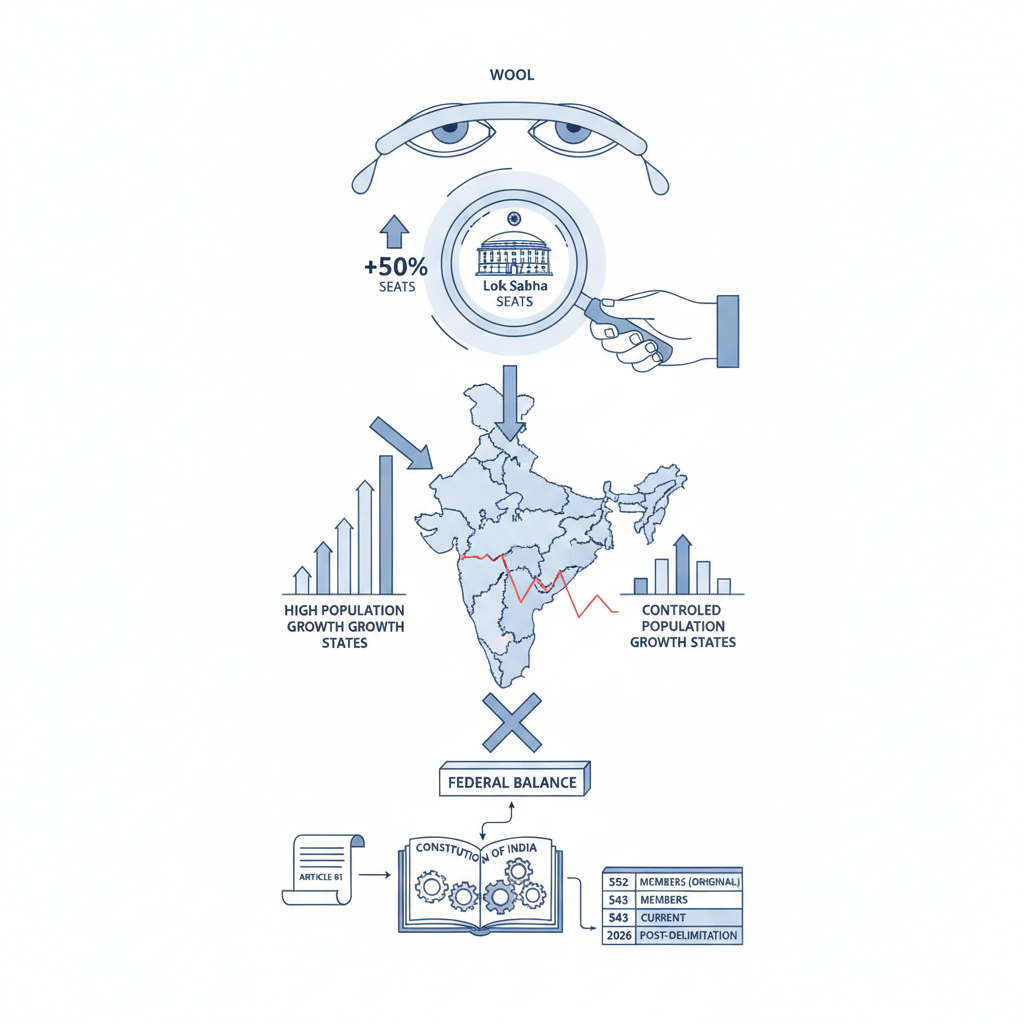
The proposal to uniformly increase the number of Lok Sabha seats by 50% has sparked a debate on the principles of delimitation, representation, and federal equity. Congress MP Praveen Chakravarty has criticised the proposal, arguing that it disproportionately benefits states with higher population growth while penalising states with controlled population growth, thereby altering the federal balance. This discourse intersects with broader discussions on electoral reforms, demographic shifts, and the constitutional framework governing parliamentary representation.
Background
- The Constitution of India, under Article 81, originally envisaged a Lok Sabha with a maximum of 552 members. The current strength is 543 elected members.
- Post-2026, the delimitation process may resume, with proposals suggesting a uniform increase in seats to accommodate population growth while maintaining the total strength of the House.
- States like Tamil Nadu, which have achieved lower population growth rates due to effective family planning, argue that a uniform increase would dilute their representation relative to states with higher growth rates.
- The debate reflects tensions between demographic realities, federal principles, and the need for equitable political representation.
What is the Proposal for Uniform Increase in Lok Sabha Seats?
- The proposal suggests increasing the total number of Lok Sabha seats from 543 by uniformly adding 50% more seats across all states and union territories. This would maintain the current ratio of seats per million population but expand the House’s size.
- Critics argue that a uniform increase ignores the federal principle of equal representation for states, as enshrined in the Constitution’s Fourth Schedule. States with controlled population growth (e.g., Tamil Nadu, Kerala) would see their relative share decline, while states with higher growth (e.g., Uttar Pradesh, Bihar) would gain disproportionately.
- The proposal must be evaluated against the backdrop of India’s federal structure, where states are sovereign entities with equal status, and any change in seat allocation could impact inter-state relations.
UPSC Value Addition
Keywords for Mains Answer-Writing
Delimitation Commission · Lok Sabha seat allocation · One Nation One Election · Representation of the People Act, 1950 · Delimitation Act, 2002 · Federal structure of India · Demographic representation · Constitutional provisions on delimitation · Parliamentary representation · Inter-state seat distribution
Prelims Practice Questions
Q1. Consider the following statements regarding the delimitation of Lok Sabha seats in India:
1. The Delimitation Commission is a statutory body constituted under the Delimitation Act, 2002.
2. The primary objective of delimitation is to ensure equitable representation of all sections of the population.
3. The Constitution mandates that the number of Lok Sabha seats shall remain fixed at 543.
4. The Delimitation Commission can alter the boundaries of parliamentary constituencies without consulting state governments.
How many of the above statements are correct?
- Only one
- Only two
- Only three
- All four
Answer: Only two — Statements 1 and 2 are correct. Statement 3 is incorrect as the number of seats is not fixed constitutionally but is determined by the Delimitation Commission. Statement 4 is incorrect as the Delimitation Commission consults state governments before altering boundaries.
Q2. Assertion (A): The Representation of the People Act, 1950 provides the legal framework for the allocation of seats in the Lok Sabha.
Reason (R): The Act empowers the Election Commission of India to conduct delimitation exercises periodically.
Options:
A. Both A and R are true, and R is the correct explanation of A.
B. Both A and R are true, but R is not the correct explanation of A.
C. A is true, but R is false.
D. A is false, but R is true.
Answer: ? — Assertion (A) is true as the Representation of the People Act, 1950 governs the allocation of seats. However, Reason (R) is false because the Election Commission does not conduct delimitation; the Delimitation Commission does.
Q3. Match the following provisions with their respective legal instruments:
Column I
1. Delimitation of constituencies
2. Allocation of seats to states in Lok Sabha
3. Reservation of seats for Scheduled Castes and Scheduled Tribes
4. Conduct of elections
Column II
A. Representation of the People Act, 1950
B. Delimitation Act, 2002
C. Constitution of India (Article 330 & 332)
D. Election Commission Act, 1991
- 1-B, 2-A, 3-C, 4-D
- 1-A, 2-B, 3-C, 4-D
- 1-B, 2-C, 3-A, 4-D
- 1-D, 2-A, 3-B, 4-C
Answer: 1-B, 2-A, 3-C, 4-D — 1-B (Delimitation of constituencies is under the Delimitation Act, 2002), 2-A (Allocation of seats is under the Representation of the People Act, 1950), 3-C (Reservation is under Articles 330 & 332 of the Constitution), 4-D (Conduct of elections is under the Election Commission Act, 1991).
Mains Practice Question
✍ The proposal to uniformly increase the number of Lok Sabha seats by 50% has been criticised for potentially exacerbating existing imbalances in inter-state representation. Critically examine this proposition in the context of India’s federal structure and the principles of democratic representation. (15 Marks)
Approach: MODEL-ANSWER SKELETON:
1. **Introduction**: Define delimitation and its constitutional basis (Articles 81, 82, 327, 328; Delimitation Acts of 1952, 1972, 2002). State the current Lok Sabha strength (543 seats) and the rationale for periodic delimitation.
2. **Principles of Representation**: Discuss the twin principles of (a) territorial representation and (b) demographic representation. Cite the 42nd Amendment (1976) freezing delimitation until 2000 and the subsequent extension via the 84th Amendment (2001) to 2026.
3. **Federal Structure Implications**: Analyse how uniform seat increases may distort federal balance. Reference the Sarkaria Commission (1988) and the Justice Venkatachaliah Commission (2002) on the need for population-based allocation to prevent over-representation of states with slower demographic growth.
4. **Critique of Uniform Increase**: Examine arguments against uniform increases: (a) penalises states with successful population control (e.g., Tamil Nadu); (b) exacerbates north-south divide in seat distribution; (c) undermines the principle of ‘one person, one vote’.
5. **Counterarguments and Alternatives**: Present counterarguments (e.g., accommodating rising youth population) and alternative models (e.g., phased delimitation, state-specific increases).
6. **Conclusion**: Weigh the need for demographic fairness against federal equity, suggesting a nuanced approach that balances growth with representation.
Source: The Hindu
Generated by AanyaAi for educational purpose.

- Gurugram’s groundwater extraction exceeds limit by 212%; HC seeks ban - October 4, 2026
- स्वतंत्रता सेनानी श्यामजी कृष्ण वर्मा की जन्म जयंती पर पीएम का श्रद्धांजलि - October 4, 2026
- KWML’s Feasibility Reports for Water Metro in 18 Cities: UPSC & PCS Insights - October 3, 2026

No Comments