


17 Aug IISR & Farmers’ Group MoU Boosts Spice Tech for UPSC & PCS Aspirants
Indian Institute of Spices ResearcBio Mountain Farmers Producer Compimproved spice production technoloResearch Advisory Committeesustainable agricultural practices✎ IISR, an ICAR institute, advances spice sector development through technology transfer, FPO collaborations, and sustainable practices, exemplified by its MoU with Bio Mountain FPO and licensing of bio-pesticides and improved…
Subject Relevance — Where This Topic Fits
- GS Paper III — Agriculture: Technology Missions, Extension Services, and Agri-Startups
- Prelims: ICAR, IISR, Farmers Producer Organisations (FPOs), Next-Generation Sequencing (NGS), Cardamom thrips biocontrol, Lecanicillium psalliotae, Black pepper variety ‘Chandra’
- Essay: The Role of Agricultural Research in India’s Rural Transformation, Balancing Productivity and Sustainability in Indian Agriculture
Quick Revision: IISR, an ICAR institute, advances spice sector development through technology transfer, FPO collaborations, and sustainable practices, exemplified by its MoU with Bio Mountain FPO and licensing of bio-pesticides and improved varieties.
Why is this in the news?
The signing of a memorandum of understanding (MoU) between the Indian Institute of Spices Research (IISR), Kozhikode, and Bio Mountain Farmers Producer Company Ltd., Kannur, marks a significant step in bridging the gap between agricultural research and field-level adoption. This collaboration, formalised during the 11th Research Advisory Committee (RAC) meeting of IISR, underscores the institute’s commitment to enhancing spice production through technology dissemination, sustainable practices, and stakeholder engagement. The initiative aligns with broader national objectives of doubling farmer incomes and promoting climate-resilient agriculture.
Background
- The Indian spice sector is a vital component of the agricultural economy, contributing significantly to export earnings and rural livelihoods, particularly in states like Kerala, Karnataka, and Tamil Nadu.
- The Indian Council of Agricultural Research (ICAR), under the Ministry of Agriculture and Farmers’ Welfare, oversees 114 research institutes, including the Indian Institute of Spices Research (IISR), which focuses on spices like black pepper, cardamom, ginger, turmeric, and vanilla.
- Farmer-Producer Organisations (FPOs) have emerged as key institutional mechanisms to aggregate smallholder farmers, enhance bargaining power, and facilitate access to technology, credit, and markets.
- The Government of India’s ‘Mission for Integrated Development of Horticulture’ (MIDH) aims to boost spice production through research, extension, and post-harvest management.
- Biological pest management, including the use of entomopathogenic fungi like *Lecanicillium psalliotae*, is a sustainable alternative to chemical pesticides, reducing environmental degradation and health risks.
- Next-generation sequencing (NGS) technologies enable precise genetic analysis, aiding in crop improvement, disease resistance, and varietal development, but require accessible tools for field-level adoption.
What is the Indian Institute of Spices Research (IISR) and its Role in Spice Sector Development?
- The Indian Institute of Spices Research (IISR), headquartered in Kozhikode, Kerala, is an autonomous institution under the Indian Council of Agricultural Research (ICAR).
- IISR’s mandate includes research on spice crop improvement, pest and disease management, post-harvest technology, and value addition to enhance productivity and quality.
- The institute develops improved varieties (e.g., black pepper ‘Chandra’), bio-pesticides (e.g., *Lecanicillium psalliotae*), and digital tools (e.g., AI-enabled NGS toolkit) to support farmers.
- Technology transfer and outreach are critical components of IISR’s work, facilitated through collaborations with FPOs, agri-startups, and industry partners.
- The Research Advisory Committee (RAC) serves as a governance body to review research progress, technology transfer, and stakeholder engagement, ensuring alignment with national priorities.
- IISR’s initiatives contribute to the ‘Doubling Farmers’ Income’ goal by improving yield, reducing input costs, and enhancing market linkages for spice growers.
- The institute also focuses on climate-resilient agriculture, including drought-resistant varieties and sustainable pest management practices.
- Licensing agreements, such as those with Botagnix Private Ltd., enable commercialisation of IISR-developed technologies, fostering public-private partnerships in agriculture.
Key Features
| Feature | Significance |
|---|---|
| MoU with Bio Mountain Farmers Producer Company Ltd. | Establishes formal collaboration between IISR and farmer-producer organisations to disseminate improved spice production technologies, enhancing field-level adoption and livelihood support. |
| AI-enabled Next-Generation Sequencing (NGS) toolkit | Provides a simplified, high-throughput sequencing data analysis platform for researchers, reducing dependency on advanced bioinformatics expertise and accelerating genomic research in spices. |
| Licensing of Lecanicillium psalliotae formulation | Enables commercial production and marketing of a biocontrol agent for managing cardamom thrips, reducing chemical pesticide use and promoting sustainable pest management. |
| Licensing of IISR Chandra black pepper variety | Facilitates wider cultivation of an improved black pepper variety, enhancing productivity, disease resistance, and market competitiveness of Indian black pepper. |
| 11th Research Advisory Committee (RAC) meeting | Serves as a platform for reviewing IISR’s research, technology transfer, and outreach activities, ensuring alignment with stakeholder needs and policy priorities. |
Why it Matters
Agricultural Productivity and Livelihoods
- Strengthens the linkage between agricultural research institutions and farming communities, ensuring that scientific advancements directly benefit spice producers.
- Promotes sustainable spice production through improved technologies, reducing input costs and environmental degradation while enhancing yield and quality.
- Facilitates the adoption of high-yielding, disease-resistant spice varieties, improving farmer incomes and food security.
- Encourages the use of biocontrol agents and AI-driven tools, reducing reliance on chemical inputs and aligning with global trends in precision agriculture.
Institutional Collaboration and Technology Transfer
- Demonstrates the role of public research institutions (ICAR-IISR) in bridging the gap between lab-based innovations and field-level applications through partnerships with farmer organisations and private enterprises.
- Highlights the importance of formal agreements (MoUs, licensing) in institutionalising technology transfer, ensuring scalability and commercial viability.
- Showcases the integration of digital tools (AI-enabled NGS toolkit) in agricultural research, democratising access to advanced technologies for researchers and farmers.
Policy and Governance
- Reflects the government’s emphasis on promoting research-industry-farmer linkages under the National Agricultural Research System (NARS), as outlined in the National Agricultural Policy and ICAR’s mandate.
- Aligns with the objectives of the National Mission on Sustainable Agriculture (NMSA) by fostering eco-friendly and resource-efficient agricultural practices.
- Supports the implementation of the Pradhan Mantri Kisan Sampada Yojana (PMKSY) by enhancing post-harvest management and value addition in spices.
Economic and Strategic Dimensions
- Enhances the competitiveness of Indian spices in global markets by improving quality, consistency, and traceability through advanced technologies.
- Reduces import dependency for spice seeds and biocontrol agents, strengthening India’s position as a leading spice producer and exporter.
- Contributes to the diversification of agricultural practices, reducing monoculture risks and enhancing climate resilience in spice-growing regions.
Environmental Sustainability
- Promotes the adoption of integrated pest management (IPM) practices, reducing chemical pesticide use and mitigating environmental pollution.
- Encourages the use of biofertilisers and biocontrol agents, aligning with the goals of the National Mission for Sustainable Agriculture (NMSA) and the Sustainable Development Goals (SDGs).
- Supports climate-smart agriculture by developing spice varieties with improved drought and disease resistance.
Challenges
1. Technology Adoption Barriers
- Limited awareness among farmers about new technologies and their benefits, necessitating extensive extension services and training programmes.
- High initial costs of adopting advanced technologies (e.g., AI tools, biocontrol agents) may deter small and marginal farmers from participation.
- Infrastructure gaps in rural areas, including unreliable internet connectivity and limited access to digital tools, hinder the utilisation of AI-enabled platforms.
UPSC Link: GS-III: Agricultural Extension
2. Scalability and Commercialisation Challenges
- Ensuring consistent quality and supply of biocontrol agents and improved seed varieties at scale to meet market demands.
- Addressing regulatory and certification hurdles for commercialising new technologies and products.
- Balancing the interests of public research institutions, private enterprises, and farmers to ensure equitable benefit-sharing.
UPSC Link: GS-III: Technology Missions
3. Climate Change and Pest Management
- Increasing incidence of pests and diseases due to climate change, requiring continuous research and adaptation of pest management strategies.
- Developing climate-resilient spice varieties that can withstand extreme weather events while maintaining productivity.
- Integrating traditional knowledge with modern technologies to enhance pest management and reduce chemical use.
UPSC Link: GS-III: Climate Change
4. Institutional and Governance Issues
- Strengthening coordination between research institutions, farmer organisations, and private sector to ensure seamless technology transfer.
- Addressing funding constraints for agricultural research and extension services, particularly in state-funded institutions.
- Ensuring transparency and accountability in the implementation of MoUs and licensing agreements to prevent misuse or exploitation.
UPSC Link: GS-II: Government Policies and Interventions
5. Market Access and Value Chain Integration
- Improving market linkages for small and marginal farmers to ensure remunerative prices for high-quality spices.
- Enhancing post-harvest management and value addition to reduce losses and increase farmer incomes.
- Promoting organic and sustainable spice production to meet global market demands and certification standards.
UPSC Link: GS-III: Food Processing and Marketing
Challenges — UPSC Perspective
| Issue | Concern |
|---|---|
| Limited farmer awareness | Low adoption of improved technologies due to lack of information and training. |
| High adoption costs | Small farmers may struggle to invest in AI tools, biocontrol agents, or improved seeds. |
| Infrastructure gaps | Poor rural connectivity and digital literacy hinder the use of AI-enabled platforms. |
| Regulatory hurdles | Certification and approval processes may delay commercialisation of new technologies. |
| Climate variability | Increasing pest and disease outbreaks threaten spice production stability. |
| Market access barriers | Small farmers face challenges in linking to high-value markets and value-added chains. |
Way Forward
- Strengthen agricultural extension services to enhance farmer awareness and adoption of improved spice production technologies through on-ground demonstrations and training programmes.
- Develop public-private partnerships to scale up the production and distribution of biocontrol agents, improved seeds, and AI-enabled tools, ensuring affordability for small farmers.
- Invest in rural digital infrastructure, including internet connectivity and training centres, to facilitate the use of AI-driven platforms and other advanced technologies.
- Promote climate-resilient spice varieties and integrated pest management (IPM) practices to mitigate the impact of climate change and pest outbreaks.
- Enhance market linkages by supporting farmer-producer organisations (FPOs) in accessing high-value markets, certification schemes, and export opportunities.
- Encourage interdisciplinary research to integrate traditional knowledge with modern agricultural technologies for sustainable spice production.
- Establish monitoring and evaluation mechanisms to assess the impact of technology transfer initiatives on farmer incomes, productivity, and environmental sustainability.
- Foster collaboration between research institutions, government agencies, and industry to align research priorities with market demands and policy goals.
UPSC Value Addition
Keywords for Mains Answer-Writing
Indian Institute of Spices Research (IISR) · Kozhikode · Bio Mountain Farmers Producer Company · MoU for spice production technologies · technology transfer in agriculture · sustainable spice production · next-generation sequencing (NGS) · Lecanicillium psalliotae · cardamom thrips management · ICAR-IISR · farmer-producer organisations (FPOs) · agricultural research and extension · spice variety IISR Chandra · agricultural biotechnology · post-harvest technology · agricultural innovation ecosystem
Concept Flow
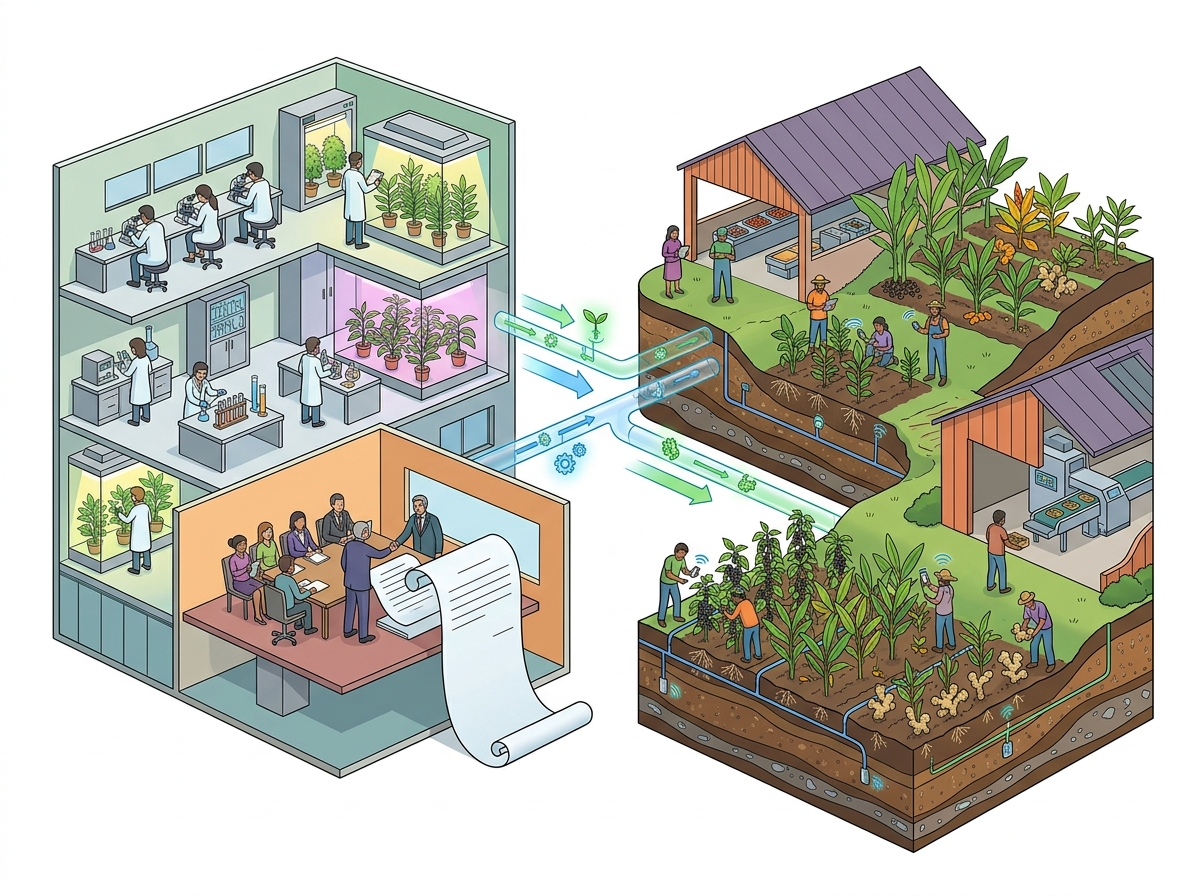
Research and Development (R&D) at ICAR-IISR → Development of improved spice varieties and technologies → → Formal collaboration via MoU with farmer-producer organisations → → Technology transfer through licensing agreements with private enterprises → → Commercialisation and field-level adoption by farmers → → Enhanced productivity, sustainability, and livelihood opportunities → → Contribution to national agricultural policy objectives (e.g., NMSA, PMKSY) → → Strengthening India’s position in global spice markets
Prelims Practice Questions
Q1. Consider the following statements regarding the Indian Institute of Spices Research (IISR):
1. IISR is located in Kozhikode, Kerala.
2. IISR functions under the Indian Council of Agricultural Research (ICAR).
3. IISR has recently signed an MoU with a farmers’ group to promote improved spice production technologies.
4. IISR has developed a granular formulation of Lecanicillium psalliotae for managing cardamom thrips.
How many of the above statements are correct?
- Only one
- Only two
- Only three
- All four
Answer: All four — Statements 1, 2, 3, and 4 are all correct. IISR is indeed located in Kozhikode, Kerala, and operates under ICAR. The recent MoU with a farmers’ group aligns with its mandate of technology transfer, and the granular formulation of Lecanicillium psalliotae is a documented innovation by IISR for pest management in spices.
Q2. Which of the following is NOT a focus area of the MoU signed between IISR and Bio Mountain Farmers Producer Company Ltd.?
- Productivity enhancement in spice cultivation
- Sustainable spice production practices
- Development of next-generation sequencing tools for farmers
- Commercial utilisation of improved black pepper variety IISR Chandra
Answer: Commercial utilisation of improved black pepper variety IISR Chandra — The MoU between IISR and the farmers’ group focuses on productivity enhancement, sustainable practices, and technology transfer, including the commercial utilisation of IISR Chandra. The development of next-generation sequencing tools is an initiative by IISR but is not part of the MoU with the farmers’ group.
Q3. Assertion (A): The Indian Institute of Spices Research (IISR) is primarily engaged in post-harvest technology development for spices.
Reason (R): IISR has recently licensed a granular formulation of Lecanicillium psalliotae for commercial production to manage cardamom thrips.
In the context of the above two statements, which of the following is correct?
- Both A and R are true, and R is the correct explanation of A.
- Both A and R are true, but R is NOT the correct explanation of A.
- A is true, but R is false.
- A is false, but R is true.
Answer: A is true, but R is false. — Statement A is false because IISR is engaged in both pre-harvest and post-harvest research, including spice production technologies. Statement R is true as IISR has indeed licensed a biological control agent for managing cardamom thrips. However, R does not explain A, as IISR’s primary engagement is broader than just post-harvest technology.
Mains Practice Question
✍ Critically examine the role of agricultural research institutions like the Indian Institute of Spices Research (IISR) in enhancing farmer livelihoods through technology transfer and collaborative partnerships. (15 Marks)
Approach: MODEL-ANSWER SKELETON:
1. **Introduction**: Define agricultural research institutions and their constitutional/statutory basis (ICAR under the Ministry of Agriculture and Farmers’ Welfare). Highlight the mandate of IISR as a premier institute under ICAR for spices research.
2. **Technology Transfer Mechanisms**:
– Explain the process of technology transfer from research institutions to farmers (e.g., MoUs, licensing agreements, farmer-producer organisations (FPOs)).
– Discuss the significance of collaborative partnerships (e.g., MoU between IISR and Bio Mountain Farmers Producer Company Ltd.) in scaling innovations.
– Reference the licensing of IISR Chandra (black pepper variety) and Lecanicillium psalliotae (biopesticide) as case studies.
3. **Impact on Farmer Livelihoods**:
– Analyse how improved spice production technologies enhance productivity, sustainability, and market access.
– Discuss the role of digital tools (e.g., AI-enabled NGS toolkit) in democratising access to advanced research for smallholder farmers.
– Highlight the importance of FPOs in aggregating demand and facilitating technology adoption.
4. **Challenges and Criticisms**:
– Examine barriers to technology adoption (e.g., access to credit, awareness, infrastructure).
– Discuss the need for stronger industry linkages to ensure commercial viability of innovations.
– Reference the RAC’s emphasis on partnerships with farmer organisations and industry.
5. **Conclusion**:
– Summarise the transformative potential of agricultural research institutions in rural development.
– Emphasise the need for sustained policy support, funding, and multi-stakeholder collaboration to realise this potential.
Source: The Hindu
Generated by AanyaAi for educational purpose.

- Gurugram’s groundwater extraction exceeds limit by 212%; HC seeks ban - October 4, 2026
- स्वतंत्रता सेनानी श्यामजी कृष्ण वर्मा की जन्म जयंती पर पीएम का श्रद्धांजलि - October 4, 2026
- KWML’s Feasibility Reports for Water Metro in 18 Cities: UPSC & PCS Insights - October 3, 2026

No Comments