


17 Aug 51,720 Social Security Pensions Cancelled in Karnataka: Key Facts for UPSC
✎ Social security pensions in India are governed by the National Social Assistance Programme (NSAP), with eligibility determined by income thresholds and verified through physical checks to ensure accurate targeting and prevent…
Subject Relevance — Where This Topic Fits
- GS Paper II — Governance, Welfare Schemes for Vulnerable Sections of the Population by the Centre and States | GS Paper III — Issues Relating to Poverty and Hunger
- Prelims: Social security pensions, Above Poverty Line (APL) ration cards, Village Administrative Officers, Income ceiling for eligibility, Physical verification of beneficiaries
Quick Revision: Social security pensions in India are governed by the National Social Assistance Programme (NSAP), with eligibility determined by income thresholds and verified through physical checks to ensure accurate targeting and prevent leakages.
Why is this in the news?
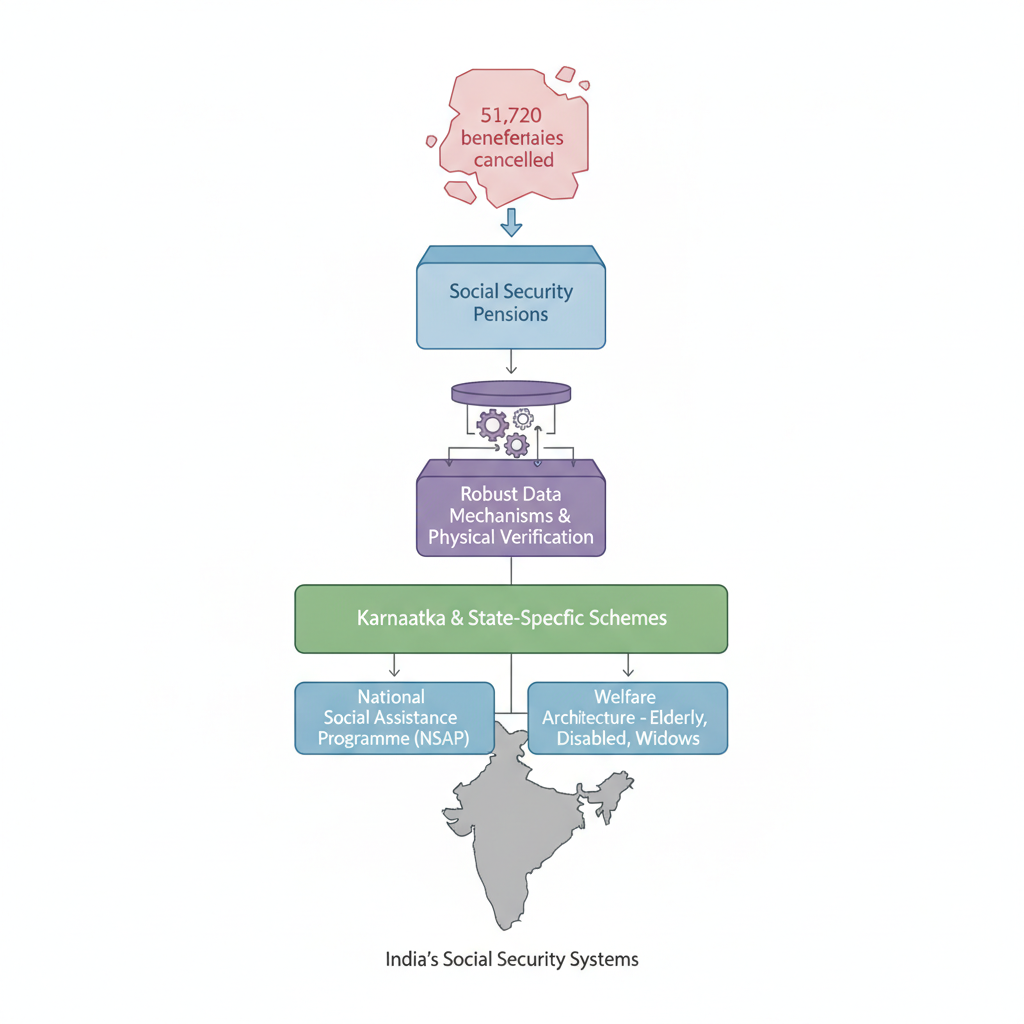
The cancellation of social security pensions for 51,720 beneficiaries in Karnataka due to ineligibility highlights the critical governance challenge of ensuring accurate targeting in welfare schemes. This development underscores the necessity of robust data verification mechanisms and the role of physical verification in maintaining the integrity of social security systems, particularly in states with large beneficiary bases.
Background
- Social security pensions in India are a key component of the welfare architecture, aimed at providing financial assistance to vulnerable sections such as the elderly, disabled, and widows.
- Karnataka, like other states, operates multiple social security pension schemes under the National Social Assistance Programme (NSAP) and its own state-specific schemes.
- The state government’s decision to cancel pensions follows a broader exercise to verify the eligibility of 23,14,544 beneficiaries, indicating systemic issues in data maintenance and beneficiary identification.
- The income ceiling of ₹32,000 per annum for eligibility reflects the state’s policy to prioritise the most economically disadvantaged sections of society.
- Physical verification of beneficiaries, including home visits by Village Administrative Officers, is a standard procedure to prevent leakages and ensure accurate targeting.
- The resumption of payments for eligible beneficiaries post-verification demonstrates the procedural safeguards embedded in the system to balance efficiency with equity.
What are Social Security Pensions in Karnataka?
- Social security pensions in Karnataka are non-contributory cash transfers provided under schemes such as the Indira Gandhi National Old Age Pension Scheme (IGNOAPS).
- These schemes are implemented under the National Social Assistance Programme (NSAP), a centrally sponsored initiative aimed at providing financial assistance to the elderly, widows, and persons with disabilities below the poverty line.
- The state government supplements central funds with additional allocations to enhance pension amounts and expand coverage, as seen in Karnataka’s own schemes like the Sandhya Suraksha Yojana for the elderly.
- Eligibility is determined based on income criteria, with the annual family income limit set at ₹32,000 for inclusion in the social security pension schemes.
- Beneficiaries are identified through ration card records, income tax records, and other official documents to ensure compliance with eligibility norms.
- Physical verification, including doorstep document checks by Village Administrative Officers, is a critical step to authenticate beneficiary claims and prevent fraudulent inclusions.
- The verification process aims to address issues such as ghost beneficiaries, duplicate entries, and incorrect categorisation of beneficiaries based on income or other criteria.
- The resumption of payments for eligible beneficiaries post-verification reflects the iterative nature of welfare administration, where data correction and field verification are essential to maintain programme integrity.
Key Features
| Feature | Significance |
|---|---|
| Verification of 23,14,544 beneficiaries | Ensures fiscal discipline by identifying ineligible claimants, reducing leakage in social security expenditure. |
| Doorstep document verification for old-age and disability pensions | Enhances accessibility and reduces exclusion errors by bringing verification to beneficiaries’ homes. |
| Income threshold of ₹32,000 per annum for eligibility | Aligns with constitutional directive principles for social welfare and targets support to the most economically vulnerable. |
| Suspension followed by resumption upon re-verification | Balances fiscal prudence with safeguards against arbitrary exclusion, ensuring procedural fairness. |
| Use of ration card and income-tax databases for cross-verification | Leverages existing administrative data to improve accuracy and reduce manual errors in eligibility assessment. |
Why it Matters
Fiscal Governance
- Demonstrates commitment to fiscal consolidation by curbing non-meritorious expenditure in social security schemes, crucial for macroeconomic stability.
- Highlights the role of data-driven governance in optimising public resource utilisation without compromising welfare objectives.
- Sets a precedent for periodic audits of welfare schemes to prevent systemic inefficiencies and corruption.
Administrative Efficiency
- Showcases the integration of multiple administrative databases (ration cards, income-tax records) to streamline verification processes.
- Emphasises the importance of field-level verification (e.g., Village Administrative Officers) in reducing exclusion and inclusion errors.
- Illustrates the use of technology and data analytics in public service delivery to enhance transparency and accountability.
Social Justice
- Reaffirms the state’s obligation to target welfare benefits to the most needy, in line with constitutional principles of equity and social security.
- Underscores the need for inclusive governance where marginalised groups (elderly, disabled) are not disproportionately affected by verification processes.
- Demonstrates the balance between fiscal responsibility and social protection, a critical challenge in welfare state design.
Policy Implementation
- Provides a case study in the operationalisation of social security schemes, highlighting practical challenges in beneficiary identification.
- Offers insights into the role of state governments in tailoring central welfare schemes to local contexts and administrative capacities.
- Serves as a reference for other states grappling with similar issues of leakage and exclusion in welfare delivery.
Challenges
1. Exclusion Errors in Verification
- Risk of genuine beneficiaries being excluded due to administrative delays or documentation gaps, particularly among illiterate or elderly populations.
- Dependence on physical verification may lead to delays in resumption of payments, exacerbating financial distress for vulnerable groups.
- Potential for over-reliance on income-tax databases, which may not capture informal or agricultural income accurately.
UPSC Link: GS-II: Welfare Schemes (Poverty and Development)
2. Data Integration Challenges
- Fragmentation of databases across departments (e.g., ration cards, income-tax, land records) complicates seamless verification.
- Lack of real-time data sharing between state and central agencies may lead to inefficiencies in cross-verification.
- Privacy concerns and data protection issues arise from the use of multiple databases for eligibility assessment.
UPSC Link: GS-II: Government Policies and Interventions
3. Operational Bottlenecks
- Logistical constraints in conducting doorstep verifications, especially in remote or hilly regions.
- Manpower shortages among Village Administrative Officers may delay the verification process.
- Inadequate grievance redressal mechanisms for beneficiaries facing suspension of payments.
UPSC Link: GS-II: Development Processes and the Role of Civil Services
4. Balancing Fiscal Prudence and Social Protection
- Risk of over-zealous verification leading to austerity measures that undermine the welfare objectives of the schemes.
- Need to ensure that verification processes do not disproportionately target marginalised communities.
- Challenge of maintaining public trust in welfare schemes while implementing stringent eligibility criteria.
UPSC Link: GS-II: Issues Relating to Poverty and Hunger
5. Legal and Constitutional Compliance
- Ensuring that verification processes comply with constitutional provisions on equality and non-discrimination.
- Addressing potential violations of the Right to Life (Article 21) if suspension of pensions leads to severe hardship.
- Upholding principles of natural justice in the suspension and resumption process.
UPSC Link: GS-II: Fundamental Rights
Challenges — UPSC Perspective
| Issue | Concern |
|---|---|
| Documentation gaps among beneficiaries | Exclusion of eligible individuals due to lack of formal records or literacy barriers. |
| Delays in resumption of payments | Financial distress for beneficiaries awaiting re-verification and reinstatement of pensions. |
| Data privacy and security | Risks associated with the use of multiple databases for cross-verification. |
| Logistical constraints in rural areas | Difficulty in conducting doorstep verifications in remote or inaccessible regions. |
| Grievance redressal mechanisms | Inadequate systems to address complaints from beneficiaries facing suspension. |
| Inter-departmental coordination | Challenges in seamless data sharing between state and central agencies. |
Government Initiatives — Must-Memorise for Prelims
- Indira Gandhi National Old Age Pension Scheme (IGNOAPS)
Way Forward
- Strengthen grievance redressal mechanisms by establishing dedicated helplines and fast-track review committees for suspended beneficiaries.
- Enhance digital literacy among marginalised groups to ensure they can navigate verification processes and access online grievance redressal.
- Invest in capacity-building for Village Administrative Officers to improve efficiency in doorstep verification and documentation collection.
- Develop a unified beneficiary database by integrating ration card, income-tax, and land records systems to streamline verification.
- Introduce real-time monitoring systems to track the progress of verifications and identify bottlenecks in the process.
- Conduct periodic audits of verification processes to assess their accuracy and fairness, with a focus on reducing exclusion errors.
- Expand outreach programmes to educate beneficiaries about eligibility criteria, required documents, and the verification process.
- Collaborate with civil society organisations to sensitise field officials and beneficiaries about the importance of accurate documentation.
UPSC Value Addition
Keywords for Mains Answer-Writing
Social security pensions · Direct Benefit Transfer (DBT) · Aadhaar-enabled Payment System (AePS) · Above Poverty Line (APL) ration cards · Beneficiary identification · Income criteria for welfare schemes · Doorstep delivery of services · Village Administrative Officers (VAOs) · Pension eligibility verification · Fiscal space for welfare · Exclusion errors in welfare delivery · Aadhaar seeding · Public Distribution System (PDS) · Social justice and inclusive growth
Constitutional & Policy Linkages
- Directive Principles of State Policy (Article 38, 39, 41): Emphasise the state’s obligation to provide social security and welfare to the needy.
- Right to Equality (Article 14): Ensures non-discriminatory implementation of welfare schemes.
- Right to Life (Article 21): Protects against arbitrary suspension of pensions that may lead to severe hardship.
Concept Flow
Identification of ineligible beneficiaries through cross-verification with income-tax and ration card databases. → Suspension of pension payments to identified beneficiaries pending re-verification. → Doorstep verification by Village Administrative Officers to collect and validate documents. → Reinstatement of pensions for beneficiaries who furnish valid proof of eligibility. → Continuous monitoring and periodic audits to ensure accuracy and fairness in the verification process. → Feedback loop to improve administrative processes and reduce exclusion errors in future verifications.
Prelims Practice Questions
Q1. Consider the following statements regarding social security pensions in India:
1. Social security pensions are disbursed under the Direct Benefit Transfer (DBT) mechanism.
2. Aadhaar seeding is mandatory for all beneficiaries to receive pension payments.
3. The income criterion for eligibility under the old-age pension scheme is ₹32,000 per annum.
4. Village Administrative Officers (VAOs) are responsible for physical verification of beneficiaries.
How many of the above statements are correct?
- Only one
- Only two
- Only three
- All four
Answer: All four — Statements 1, 3, and 4 are correct. Statement 2 is incorrect as Aadhaar seeding is not mandatory for all beneficiaries; it is used to authenticate identity but not a strict requirement for pension disbursal under all schemes.
Q2. Assertion (A): The cancellation of social security pensions of ineligible beneficiaries is an example of exclusion error in welfare delivery.
Reason (R): Exclusion errors occur when eligible beneficiaries are wrongly denied benefits due to flawed identification processes.
Options:
A. Both A and R are true, and R is the correct explanation of A.
B. Both A and R are true, but R is NOT the correct explanation of A.
C. A is true, but R is false.
D. A is false, but R is true.
Answer: ? — Both A and R are true. The cancellation of pensions for ineligible beneficiaries is an exclusion error, as it denies benefits to those who may be eligible but were wrongly identified as ineligible. R correctly explains A.
Q3. Match the following welfare schemes with their respective eligibility criteria:
Column I (Scheme) Column II (Eligibility Criterion)
A. Indira Gandhi National Old Age Pension Scheme (IGNOAPS) 1. Annual family income ≤ ₹60,000
B. Indira Gandhi National Widow Pension Scheme (IGNWPS) 2. Annual family income ≤ ₹1,20,000
C. Indira Gandhi National Disability Pension Scheme (IGNDPS) 3. Annual family income ≤ ₹32,000
D. National Family Benefit Scheme (NFBS) 4. Annual family income ≤ ₹2,00,000
Options:
A. A-3, B-1, C-2, D-4
B. A-1, B-3, C-2, D-4
C. A-3, B-1, C-4, D-2
D. A-2, B-3, C-1, D-4
- A
- B
- C
- D
Answer: A — Correct matches: A-3 (IGNOAPS: ≤ ₹32,000), B-1 (IGNWPS: ≤ ₹60,000), C-2 (IGNDPS: ≤ ₹1,20,000), D-4 (NFBS: ≤ ₹2,00,000).
Mains Practice Question
✍ The cancellation of social security pensions for 51,720 beneficiaries in Karnataka due to ineligibility raises critical questions about the efficacy of beneficiary identification mechanisms in India’s welfare architecture. Critically examine the challenges in ensuring accurate identification of beneficiaries under social security pension schemes while balancing the need for fiscal prudence and inclusion. (15 Marks)
Approach: MODEL-ANSWER SKELETON:
1. **Introduction**: Define social security pensions and their role in India’s welfare architecture (e.g., IGNOAPS, IGNDPS, IGNWPS). Highlight the significance of accurate beneficiary identification in achieving social justice and fiscal efficiency.
2. **Challenges in Beneficiary Identification**:
– **Data Discrepancies**: Explain issues like outdated income records, Aadhaar seeding gaps, and APL ration card mismatches (cite the Karnataka example: 23,14,544 beneficiaries flagged).
– **Exclusion vs. Inclusion Errors**: Differentiate between Type I (excluding eligible beneficiaries) and Type II (including ineligible beneficiaries) errors. Link to the 51,720 cancellations as an exclusion error.
– **Technological and Administrative Bottlenecks**: Discuss challenges in Aadhaar-enabled Payment System (AePS), Direct Benefit Transfer (DBT), and physical verification by Village Administrative Officers (VAOs).
– **Socio-Economic Heterogeneity**: Explain how informal employment, seasonal income fluctuations, and lack of documentation (e.g., no income tax records) complicate verification.
3. **Policy and Institutional Measures**:
– **Income Criteria**: Discuss the ₹32,000 annual income limit for old-age pensions and its rationale (e.g., targeting the most vulnerable).
– **Aadhaar and DBT**: Explain how Aadhaar seeding and DBT aim to reduce leakages but may also exclude genuine beneficiaries due to biometric failures or data mismatches.
– **Doorstep Delivery and Physical Verification**: Highlight Karnataka’s initiative of VAOs visiting homes for document verification as a best practice.
– **Periodic Re-verification**: Cite the 2026 exercise as an example of dynamic beneficiary identification.
4. **Balancing Fiscal Prudence and Inclusion**:
– **Trade-offs**: Discuss the tension between fiscal discipline (preventing leakages) and inclusive growth (ensuring no deserving beneficiary is excluded).
– **Alternative Approaches**: Suggest measures like community-based verification, use of multiple data sources (e.g., MGNREGA records, PDS data), and grievance redressal mechanisms.
5. **Conclusion**: Summarize the need for a multi-pronged approach—leveraging technology, strengthening administrative capacities, and ensuring periodic reviews—to minimize exclusion errors while maintaining fiscal integrity. Conclude with a balanced view on the Karnataka case as a step toward more robust welfare delivery.
Source: The Hindu
Generated by AanyaAi for educational purpose.

- Gurugram’s groundwater extraction exceeds limit by 212%; HC seeks ban - October 4, 2026
- स्वतंत्रता सेनानी श्यामजी कृष्ण वर्मा की जन्म जयंती पर पीएम का श्रद्धांजलि - October 4, 2026
- KWML’s Feasibility Reports for Water Metro in 18 Cities: UPSC & PCS Insights - October 3, 2026

No Comments