


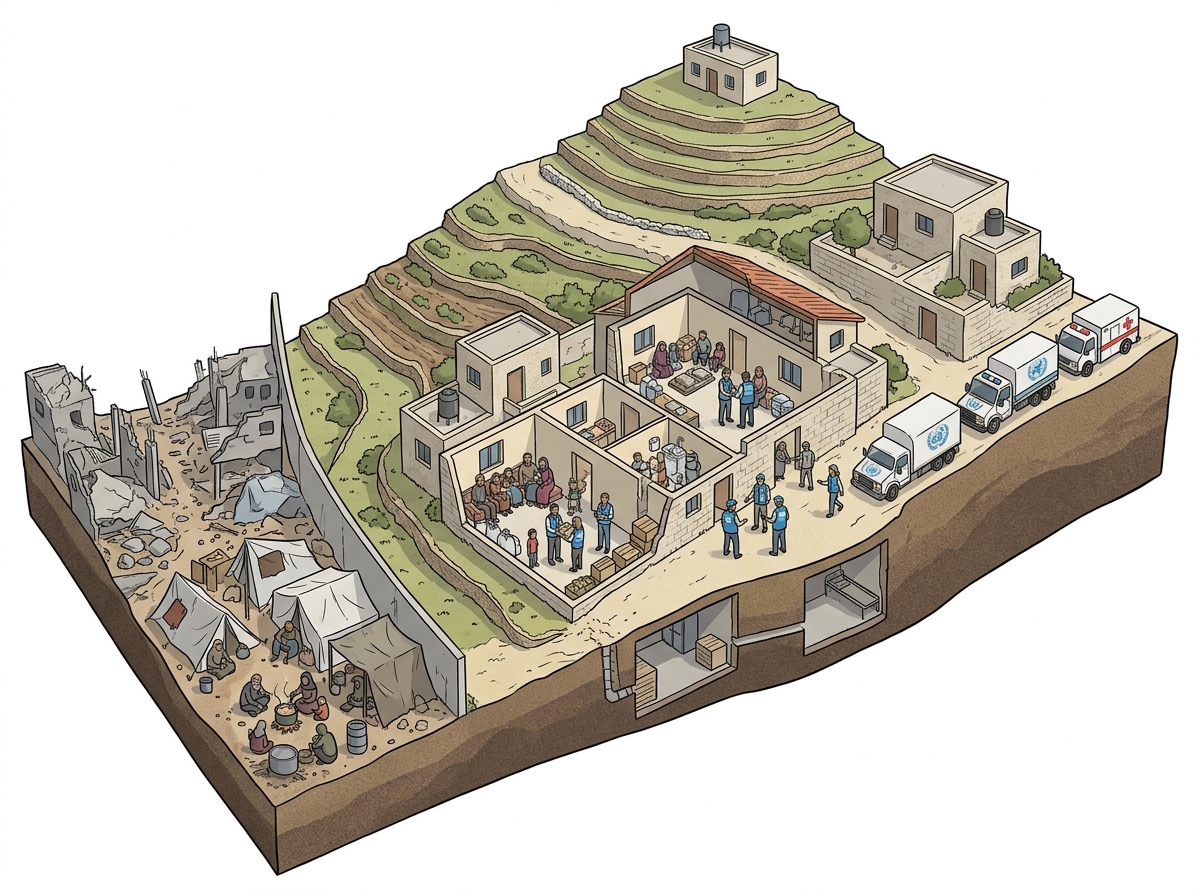
18 Aug UN Relief Reaches Qusra Families Amid West Bank Crisis & Gaza Conflict Escalation
Humanitarian teamsTrapped familiesEssential supplies✎ The humanitarian crisis in the Occupied Palestinian Territories is driven by settler violence in the West Bank and intensified conflict in Gaza, with systemic failures in humanitarian access and civilian protection violating…
Subject Relevance — Where This Topic Fits
- GS Paper II — International Relations — Conflict Resolution, Role of UN and International Organisations
- Prelims: West Bank, Gaza Strip, Israeli settlements, UN OCHA, OHCHR, Yellow Line, humanitarian corridors, settler violence, UNRWA
- Essay: Humanitarian intervention in conflict zones: efficacy and limitations, The role of international organisations in managing protracted conflicts
Quick Revision: The humanitarian crisis in the Occupied Palestinian Territories is driven by settler violence in the West Bank and intensified conflict in Gaza, with systemic failures in humanitarian access and civilian protection violating international law.
Why is this in the news?
The United Nations reported on 17 August 2026 that humanitarian teams had reached Palestinian families trapped in Qusra village in the northern West Bank following an Israeli settler-imposed siege, while the broader humanitarian crisis in Gaza continued to deteriorate due to intensified strikes and severe shortages of essential supplies. This development underscores the escalating civilian protection challenges in the Occupied Palestinian Territories and highlights systemic failures in ensuring humanitarian access amid ongoing conflict.
Background
- The West Bank and Gaza Strip remain under Israeli occupation since 1967, with the Oslo Accords (1993–1995) establishing a framework for Palestinian self-governance in parts of the West Bank, though full sovereignty has not been realised.
- Israeli settlement expansion in the West Bank, deemed illegal under international law by the UN and International Court of Justice, has accelerated in recent decades, leading to frequent clashes between settlers and Palestinian communities.
- The establishment of settlement outposts, often without official Israeli government approval but tacitly supported by some state actors, has intensified tensions, particularly in areas like Qusra, where settler violence has surged since November 2025.
- Gaza has been under a blockade since 2007, restricting the movement of goods and people, and has experienced multiple rounds of conflict, most recently in 2023–2024, leading to widespread destruction and displacement.
- The UN Office for the Coordination of Humanitarian Affairs (OCHA) and the UN Human Rights Office (OHCHR) have repeatedly documented violations of international humanitarian law, including restrictions on humanitarian access, arbitrary detentions, and attacks on civilians.
What is the current humanitarian situation in the Occupied Palestinian Territories?
- Qusra village in the northern West Bank has experienced a siege imposed by Israeli settlers, trapping Palestinian families in their homes with restricted access to water, electricity, and medical supplies, following the establishment of a nearby settlement outpost in November 2025.
- UN teams, including UNICEF, delivered emergency supplies such as food, water, medicines, and hygiene kits to affected families, but three families remained surrounded by Israeli forces and settlers as of 17 August 2026.
- Settler violence in the West Bank has escalated, with reports of attacks on Palestinian workers attempting to repair damaged infrastructure, including water and electricity lines, and the suspension of local factory operations due to Israeli military orders.
- In Gaza, intensified Israeli strikes, shelling, and naval fire have resulted in civilian casualties, with the majority of the population confined to an area covering less than half of the enclave’s former land mass, exacerbating overcrowding and vulnerability.
- Humanitarian partners warn of severe shortages of essential supplies in Gaza, including shelter materials, and durable shelter materials still barred from entry.
- The UN has emphasised the urgent need to protect civilians, safeguard homes and property, and ensure unhindered access to essential services, while calling for an end to the pattern of settler violence and military restrictions that exacerbate the crisis.
- International humanitarian law, including the Fourth Geneva Convention, obligates occupying powers to ensure the welfare of civilians in occupied territories, a principle repeatedly violated in the context of the Israeli-Palestinian conflict.
Key Features
| Feature | Significance |
|---|---|
| Qusra village siege by Israeli settlers | Highlights the vulnerability of Palestinian civilians in the West Bank to settler violence and restricted access to essential services. |
| UN humanitarian intervention in Qusra | Demonstrates the role of international organisations in providing emergency relief and restoring basic utilities under conflict conditions. |
| Escalation of settler violence in Qusra since November 2025 | Illustrates the systemic nature of settler-led displacement and intimidation in the West Bank, linked to the establishment of outposts. |
| Gaza humanitarian crisis: shelter and funding shortages | Exposes the acute shortage of durable shelter materials and funding gaps for winter preparedness, exacerbating civilian suffering. |
| UN OCHA and OHCHR appeals for protection of civilians | Underscores the institutional mechanisms for monitoring and reporting violations of international humanitarian law in occupied territories. |
Why it Matters
Humanitarian and International Law
- The siege of Qusra village and the Gaza crisis exemplify violations of the Fourth Geneva Convention, which mandates protection of civilians in occupied territories and prohibits collective punishment.
- The UN’s intervention underscores the principle of humanitarian access, a cornerstone of international humanitarian law, particularly in conflict zones.
- The pattern of settler violence in the West Bank contravenes Israel’s obligations under international law to protect Palestinian civilians from violence by non-state actors.
Geopolitical and Regional Stability
- Escalating settler violence in the West Bank risks destabilising the already fragile Israeli-Palestinian relations and undermines prospects for a negotiated two-state solution.
- The Gaza crisis, marked by airstrikes and restricted humanitarian access, threatens regional security and fuels cycles of violence and retaliation.
- Humanitarian funding shortfalls for Gaza and the West Bank highlight the international community’s failure to address protracted crises, risking further displacement and radicalisation.
Economic and Social Impact
- Restrictions on Palestinian livelihoods, such as the suspension of factory operations in Qusra, exacerbate economic hardship and unemployment in the West Bank.
- The destruction of water and electricity infrastructure in Qusra and Gaza disrupts essential services, leading to health risks and reduced quality of life for civilians.
- The shortage of durable shelter materials in Gaza, exacerbated by import restrictions, leaves civilians vulnerable to harsh weather conditions, particularly during the rainy season.
Challenges
1. Protection of Civilians in Occupied Territories
- Palestinian civilians in the West Bank and Gaza face systemic risks from settler violence, airstrikes, and restricted access to essential services.
- The inability of international actors to ensure unimpeded humanitarian access undermines the protection of civilians under international law.
- The establishment of Israeli settlement outposts in the West Bank, such as in Qusra, contributes to the displacement and intimidation of Palestinian communities.
UPSC Link: UN Charter, Article 1(3); Fourth Geneva Convention, Articles 27, 47
2. Humanitarian Access and Funding Gaps
- Humanitarian organisations face severe constraints in delivering aid to Gaza and the West Bank due to access restrictions and funding shortages.
- The inability to import durable shelter materials, such as tents and construction supplies, exacerbates civilian vulnerability during the rainy season.
- Less than 40% of the required $4 billion for humanitarian support in Gaza and the West Bank has been secured, limiting the scope of relief operations.
UPSC Link: UN OCHA mandate; Humanitarian Principles of Humanity, Neutrality, Impartiality
3. Settler Violence and Impunity
- Settler violence in the West Bank, including attacks on Palestinian civilians and infrastructure, has escalated since the establishment of outposts.
- The involvement of Israeli forces in detaining Palestinian workers and restricting access to essential services further entrenches the crisis.
- The lack of accountability for settler violence perpetuates a cycle of intimidation and displacement, undermining Palestinian rights and livelihoods.
UPSC Link: Fourth Geneva Convention, Article 49; UNSC Resolution 2334
4. Winter Preparedness and Shelter Shortages in Gaza
- The inability to import durable shelter materials, such as tents and insulation, leaves civilians in Gaza exposed to harsh weather conditions.
- Funding shortfalls and logistical constraints hinder the preparation of shelters ahead of the rainy season, increasing the risk of health crises and displacement.
- Restricted access to Gaza for humanitarian organisations limits the scope of winterisation efforts, exacerbating civilian suffering.
UPSC Link: UN OCHA Winterization Plan; Humanitarian Principles
5. Restoration of Essential Services in Conflict Zones
- Attacks on municipal workers repairing water and electricity infrastructure in Qusra demonstrate the vulnerability of essential services in conflict zones.
- Restrictions on Palestinian livelihoods, such as the suspension of factory operations, further exacerbate economic hardship and social instability.
- The destruction of critical infrastructure in Gaza and the West Bank disrupts access to water, electricity, and healthcare, posing severe health risks.
UPSC Link: International Humanitarian Law; UN OCHA Infrastructure Repair Guidelines
Challenges — UPSC Perspective
| Issue | Concern |
|---|---|
| Settler violence in the West Bank | Systemic intimidation and displacement of Palestinian civilians, often with impunity, exacerbating humanitarian crises. |
| Restricted humanitarian access to Gaza | Limited ability of UN and partner organisations to deliver aid due to airstrikes, border closures, and logistical constraints. |
| Funding shortfalls for humanitarian operations | Insufficient financial resources hinder the provision of essential services, shelter, and winterisation efforts in Gaza and the West Bank. |
| Destruction of essential infrastructure | Attacks on water, electricity, and healthcare facilities disrupt civilian life and exacerbate health risks in conflict zones. |
| Suspension of Palestinian livelihoods | Economic restrictions, such as factory closures, exacerbate unemployment and poverty in the West Bank and Gaza. |
| Winterisation challenges in Gaza | Inability to import durable shelter materials and funding gaps leave civilians vulnerable to harsh weather conditions. |
Way Forward
- Strengthen monitoring and reporting mechanisms by UN OCHA and OHCHR to document violations of international humanitarian law in the West Bank and Gaza.
- Advocate for the immediate lifting of restrictions on the import of durable shelter materials and essential supplies to Gaza.
- Enhance accountability for settler violence and attacks on Palestinian civilians and infrastructure through transparent investigations and legal proceedings.
- Increase funding for humanitarian operations in Gaza and the West Bank to address critical gaps in shelter, healthcare, and essential services.
- Support the restoration of essential services, such as water and electricity, in conflict-affected areas to mitigate civilian suffering.
- Promote dialogue between Israeli and Palestinian authorities to de-escalate tensions and restore access to essential services in the West Bank.
- Encourage international actors to prioritise winterisation efforts in Gaza to mitigate the impact of harsh weather conditions on civilians.
- Strengthen the role of humanitarian corridors to ensure unimpeded access for UN and partner organisations delivering aid in conflict zones.
UPSC Value Addition
Keywords for Mains Answer-Writing
Humanitarian access in conflict zones · Protection of civilians under international humanitarian law · Settler violence in occupied territories · UN Office for the Coordination of Humanitarian Affairs (OCHA) · Protection of essential services in conflict · Humanitarian funding gaps in Gaza · International humanitarian law (IHL) and civilian protection · Access to water and electricity in conflict zones · United Nations humanitarian coordination mechanisms · Protection of children in armed conflict
Concept Flow
Escalation of settler violence in Qusra since November 2025 → Establishment of settlement outposts → Restricted access to essential services and livelihoods → Siege of Palestinian families → UN humanitarian intervention → Continued civilian vulnerability due to funding and access constraints → Airstrikes and shelling in Gaza → Destruction of infrastructure and civilian casualties → Restricted humanitarian access → Winterisation funding shortfalls → Increased civilian suffering → International appeals for protection and aid → Violations of international humanitarian law (Fourth Geneva Convention) → Failure to protect civilians → Escalation of humanitarian crisis → International humanitarian intervention → Persistent funding and access gaps → Protracted displacement and suffering
Prelims Practice Questions
Q1. Consider the following statements regarding the protection of civilians in armed conflict as per International Humanitarian Law (IHL):
1. Parties to a conflict must allow and facilitate rapid and unimpeded passage of humanitarian relief for civilians in need.
2. The destruction of civilian infrastructure such as water and electricity facilities is prohibited unless it serves a clear military purpose.
3. Humanitarian workers enjoy absolute immunity from attack and cannot be detained under any circumstances.
How many of the above statements are correct?
- Only one
- Only two
- All
- None
Answer: Only two — Statements 1 and 2 are correct under IHL (Geneva Conventions and Additional Protocols). Statement 3 is incorrect: humanitarian workers enjoy protection but are not absolutely immune; they may face detention under specific legal conditions.
Q2. Assertion (A): The United Nations Office for the Coordination of Humanitarian Affairs (OCHA) is mandated to lead and coordinate international humanitarian response.
Reason (R): OCHA operates under the authority of the UN Secretary-General and coordinates humanitarian action across UN agencies and NGOs.
Options:
A. Both A and R are true, and R is the correct explanation of A.
B. Both A and R are true, but R is not the correct explanation of A.
C. A is true, but R is false.
D. A is false, but R is true.
Answer: ? — Both A and R are true, and R correctly explains A. OCHA is the UN body responsible for coordinating humanitarian response globally.
Q3. Match the following UN entities with their primary functions in humanitarian crises:
Column I (Entity)
1. UNOCHA
2. UNICEF
3. UNRWA
4. UNHCR
Column II (Function)
A. Provides humanitarian aid and protection to Palestinian refugees
B. Leads and coordinates international humanitarian response
C. Protects and assists refugees globally
D. Delivers humanitarian aid to children and mothers
Options:
1-B, 2-D, 3-A, 4-C
1-A, 2-B, 3-C, 4-D
1-C, 2-A, 3-D, 4-B
1-D, 2-C, 3-B, 4-A
Answer: ? — Correct matching: 1-B (UNOCHA coordinates humanitarian response), 2-D (UNICEF focuses on children), 3-A (UNRWA aids Palestinian refugees), 4-C (UNHCR protects refugees).
Mains Practice Question
✍ The protection of civilians in conflict zones is a fundamental obligation under International Humanitarian Law (IHL). Critically examine the challenges faced by humanitarian actors in ensuring access to essential services such as water and electricity in conflict-affected areas, with particular reference to recent developments in the West Bank and Gaza. (15 Marks)
Approach: MODEL-ANSWER SKELETON:
1. **Legal Framework**:
– Cite key IHL provisions: Geneva Conventions (1949), Additional Protocol I (1977), and customary IHL.
– Highlight Articles 54 (protection of objects indispensable to survival) and 57 (precautions in attack).
– Reference UN Security Council Resolution 2175 (2014) on protection of humanitarian workers.
2. **Challenges in Access to Essential Services**:
– **Deliberate obstruction**: Cite incidents from Qusra (West Bank) where settlers cut water/electricity and Israeli forces restricted repair access.
– **Destruction of infrastructure**: Gaza’s water and electricity systems damaged by strikes; UN reports on funding shortfalls for repairs.
– **Legal and administrative barriers**: Restrictions on entry of durable shelter materials (tents) into Gaza due to blockade policies.
3. **Role of International Actors**:
– **UN OCHA**: Coordination role; cite its mandate to ensure humanitarian access and protection of civilians.
– **UNICEF and UNRWA**: Delivery of aid (water, food, medical supplies) despite impediments.
– **Humanitarian funding gaps**: Less than 40% of $4 billion required for Gaza and West Bank secured; consequences for shelter and essential services.
4. **Balancing Views and Consequences**:
– **State perspective**: Security concerns cited by Israeli authorities for restrictions.
– **Humanitarian perspective**: Proportionality and distinction principles under IHL must guide actions.
– **Consequences**: Prolonged denial of essential services exacerbates civilian suffering, displacement, and long-term instability.
5. **Way Forward**:
– Strengthen accountability mechanisms for violations of IHL.
– Ensure unimpeded humanitarian access under UNSC resolutions.
– Increase funding for early recovery and resilience-building in conflict zones.
Source: news.un.org
Generated by AanyaAi for educational purpose.

- Gurugram’s groundwater extraction exceeds limit by 212%; HC seeks ban - October 4, 2026
- स्वतंत्रता सेनानी श्यामजी कृष्ण वर्मा की जन्म जयंती पर पीएम का श्रद्धांजलि - October 4, 2026
- KWML’s Feasibility Reports for Water Metro in 18 Cities: UPSC & PCS Insights - October 3, 2026

No Comments