


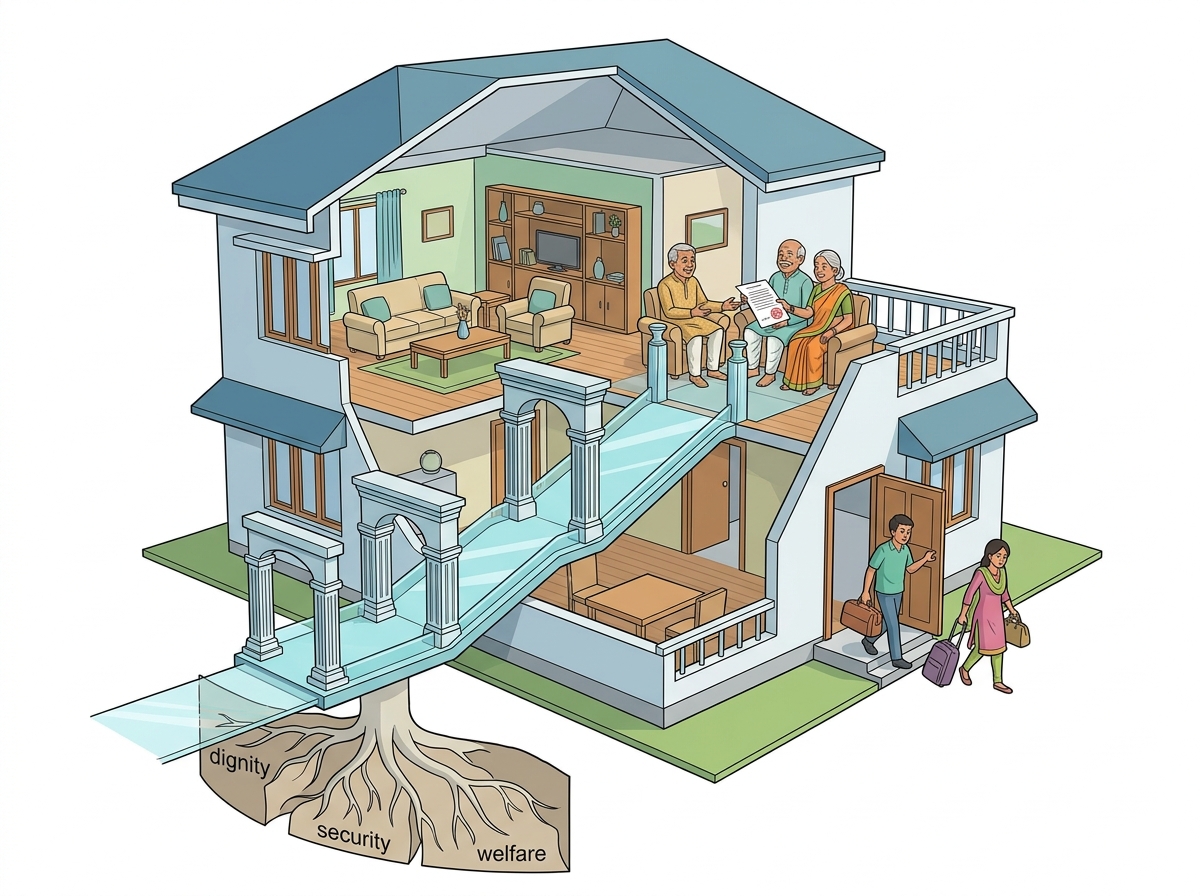
19 Aug Supreme Court: Elderly Can Evict Children from Property for Security
✎ Maintenance Tribunals under the Maintenance and Welfare of Parents and Senior Citizens Act, 2007, possess the authority to order eviction of children or relatives from parental property if their presence obstructs the senior…
Subject Relevance — Where This Topic Fits
- GS Paper II — Fundamental Rights and Directive Principles of State Policy | GS Paper III — Issues relating to Senior Citizens
- Prelims: Maintenance and Welfare of Parents and Senior Citizens Act, 2007, Maintenance Tribunals, Senior Citizens (Maintenance, Care and Protection) Act, Article 41 of the Constitution, Civil Court powers vested in Tribunals
- Essay: Ethical obligations of family and society towards the elderly, Balancing individual property rights with social justice for vulnerable sections
Quick Revision: Maintenance Tribunals under the Maintenance and Welfare of Parents and Senior Citizens Act, 2007, possess the authority to order eviction of children or relatives from parental property if their presence obstructs the senior citizen’s right to maintenance, dignity, or security.
Why is this in the news?
The Supreme Court, in a recent judgment, overturned the Allahabad High Court’s decision and held that Maintenance Tribunals under the Maintenance and Welfare of Parents and Senior Citizens Act, 2007, possess the authority to order eviction of children from parental property if such occupation impedes the senior citizen’s right to maintenance, dignity, or security. This ruling reaffirms the legal framework designed to protect the elderly from neglect and ensures their dignified living, aligning with constitutional principles of welfare and social justice.
Background
- The Maintenance and Welfare of Parents and Senior Citizens Act, 2007, was enacted to address the rising concerns of neglect, abandonment, and insecurity faced by senior citizens in India.
- The Act mandates the establishment of Maintenance Tribunals to adjudicate disputes related to the maintenance and welfare of senior citizens aged 60 years or above.
- The Supreme Court’s decision reinforces the legal safeguards for senior citizens and clarifies the scope of powers vested in Maintenance Tribunals under the Act.
What is the Maintenance and Welfare of Parents and Senior Citizens Act, 2007?
- Enacted in 2007, the Act is a welfare legislation aimed at ensuring the maintenance, care, and protection of senior citizens aged 60 years or above.
- The Act defines ‘maintenance’ to include provisions for food, clothing, residence, medical attendance, and treatment, ensuring a dignified life for senior citizens.
- The Act mandates the establishment of Maintenance Tribunals at the district level to adjudicate disputes related to maintenance and welfare of senior citizens.
- The Act also provides for the establishment of Maintenance Officers to facilitate the implementation of maintenance orders and ensure compliance.
- The Act imposes a duty on children and relatives to provide maintenance to senior citizens, failing which the Tribunal may pass appropriate orders.
- The Act aligns with constitutional provisions such as Article 41 (Right to Public Assistance in certain cases) and Article 39 (Directive Principles of State Policy), which emphasize the state’s responsibility towards vulnerable sections of society.
- The Act also includes provisions for the protection of senior citizens from abuse, neglect, and abandonment, ensuring their holistic welfare.
Key Features
| Feature | Significance |
|---|---|
| Supreme Court ruling on eviction of children by elderly parents | Reinforces the legal protection of senior citizens’ rights to dignity, security, and maintenance within their own property |
| Section 7 of the Maintenance and Welfare of Parents and Senior Citizens Act, 2007 | Establishes Maintenance Tribunals to adjudicate disputes related to the maintenance and welfare of senior citizens |
| Section 8 of the Act | Grants Tribunals powers akin to Civil Courts for enforcing orders, including eviction where necessary |
| Section 27 of the Act | Clarifies the jurisdiction of Tribunals vis-à-vis Civil Courts, ensuring their authority is not undermined |
| SDM and District Magistrate orders in eviction cases | Demonstrates the administrative mechanism for enforcing senior citizens’ rights under the Act |
Why it Matters
Legal and Judicial
- The ruling underscores the judiciary’s commitment to protecting the rights of senior citizens, particularly their right to reside in their own property with dignity and security
- It clarifies the powers of Maintenance Tribunals under the 2007 Act, ensuring they can issue eviction orders when necessary to safeguard the welfare of senior citizens
- The decision harmonises judicial interpretation with the legislative intent of the 2007 Act, reinforcing the legal framework for senior citizens’ welfare
Social and Ethical
- The judgment highlights the societal obligation to treat elderly individuals with respect and security, countering the stigma of aging as a period of vulnerability
- It addresses the ethical dilemma of intergenerational cohabitation where the elderly’s needs for dignity and safety are compromised
- The ruling serves as a deterrent against the neglect or abuse of senior citizens within familial settings
Administrative and Policy
- The decision validates the administrative actions of SDMs and District Magistrates in enforcing eviction orders to protect senior citizens’ rights
- It strengthens the implementation of the 2007 Act by clarifying the role of Tribunals in adjudicating disputes and enforcing orders
- The judgment may prompt state governments to review and strengthen mechanisms for the welfare and protection of senior citizens
Challenges
1. Implementation Gaps in the 2007 Act
- Limited awareness among senior citizens about their rights under the Act, leading to underutilisation of legal protections
- Inadequate infrastructure and staffing of Maintenance Tribunals, resulting in delayed or ineffective adjudication
- Challenges in balancing the rights of senior citizens with the economic and social realities of intergenerational households
UPSC Link: GS-II: Social Justice
2. Cultural and Societal Barriers
- Deep-rooted societal norms that prioritise familial cohabitation, often at the expense of the elderly’s dignity and security
- Stigma associated with institutional care (e.g., old-age homes) discouraging elderly individuals from seeking legal recourse
- Reluctance of families to accept legal interventions in domestic disputes, even when they involve elder abuse or neglect
UPSC Link: GS-I: Indian Society
3. Jurisdictional and Legal Complexities
- Overlapping jurisdictions between Maintenance Tribunals, Civil Courts, and administrative authorities, leading to confusion in enforcement
- Lack of uniformity in the interpretation and application of the 2007 Act across states, creating disparities in protection
- Challenges in proving elder abuse or neglect in legal proceedings, particularly in cases involving emotional or psychological harm
UPSC Link: GS-II: Governance
Challenges — UPSC Perspective
| Issue | Concern |
|---|---|
| Awareness deficit among senior citizens | Limited knowledge of legal rights under the 2007 Act hinders effective utilisation of protections |
| Inadequate tribunal infrastructure | Shortage of staff, resources, and training in Maintenance Tribunals delays justice delivery |
| Cultural resistance to legal interventions | Familial and societal norms discourage elderly individuals from seeking legal recourse against their children |
| Jurisdictional ambiguities | Overlapping roles of Tribunals, Civil Courts, and administrative authorities create confusion in enforcement |
| Proving elder abuse in court | Difficulty in substantiating claims of neglect or abuse, particularly in cases of emotional or psychological harm |
Government Initiatives — Must-Memorise for Prelims
- Maintenance and Welfare of Parents and Senior Citizens Act, 2007
Way Forward
- Conduct nationwide awareness campaigns to educate senior citizens about their rights under the 2007 Act and the legal recourse available to them
- Strengthen the infrastructure of Maintenance Tribunals by increasing staffing, training, and resources to ensure timely adjudication
- Develop state-specific guidelines to harmonise the interpretation and application of the 2007 Act, ensuring uniformity in protection
- Promote intergenerational dialogue and counselling programmes to address cultural barriers and foster mutual respect within families
- Enhance data collection on elder abuse and neglect to identify trends, gaps, and areas requiring targeted interventions
- Encourage the establishment of old-age homes and day-care centres to provide alternative living arrangements for elderly individuals at risk
- Collaborate with civil society organisations to provide legal aid and support to senior citizens navigating the 2007 Act
UPSC Value Addition
Keywords for Mains Answer-Writing
Maintenance and Welfare of Parents and Senior Citizens Act, 2007 · Maintenance Tribunal · Senior Citizen Rights · Property Rights of Elderly · Judicial Discretion in Senior Citizen Cases · SDM and District Magistrate Orders · Supreme Court Judgment on Elderly Rights · Inter-generational Family Disputes · Constitutional Protection of Senior Citizens · Judicial Review of Administrative Orders
Constitutional & Policy Linkages
- Article 14: Right to Equality (ensuring non-discrimination in the protection of senior citizens’ rights)
- Article 21: Right to Life and Personal Liberty (protecting dignity and security of elderly individuals)
Concept Flow
Senior citizens face neglect or abuse within familial settings → Legal recourse under the Maintenance and Welfare of Parents and Senior Citizens Act, 2007 → Maintenance Tribunals adjudicate disputes and issue eviction orders if necessary → Supreme Court ruling clarifies the powers of Tribunals and reinforces the legal framework → Implementation challenges persist due to awareness gaps, cultural barriers, and jurisdictional ambiguities → Way forward involves strengthening infrastructure, awareness, and intergenerational dialogue
Prelims Practice Questions
Q1. Consider the following statements regarding the Maintenance and Welfare of Parents and Senior Citizens Act, 2007:
1. It applies to parents and senior citizens aged 60 years or above.
2. The Act empowers Maintenance Tribunals to pass orders for eviction of children from parental property.
3. The Act does not provide for any legal recourse for senior citizens facing abuse or neglect.
4. The Act mandates the establishment of Maintenance Tribunals by the State Governments.
How many of the above statements are correct?
- Only one
- Only two
- Only three
- All
Answer: Only three — Statements 1, 2, and 4 are correct. Statement 3 is incorrect as the Act provides legal recourse through Maintenance Tribunals and other provisions for senior citizens facing abuse or neglect.
Q2. Assertion (A): The Supreme Court of India has held that Maintenance Tribunals under the Maintenance and Welfare of Parents and Senior Citizens Act, 2007 possess powers akin to Civil Courts for ensuring the protection of senior citizens.
Reason (R): The Act explicitly confers such powers under Section 8, enabling Tribunals to issue necessary orders, including eviction, to safeguard the rights of senior citizens.
In the context of the above two statements, which of the following is correct?
- Both A and R are true, and R is the correct explanation of A.
- Both A and R are true, but R is not the correct explanation of A.
- A is true, but R is false.
- A is false, but R is true.
Answer: Both A and R are true, but R is not the correct explanation of A. — Both the Assertion and Reason are true, and the Reason correctly explains the Assertion as Section 8 of the Act grants Tribunals powers akin to Civil Courts for protecting senior citizens.
Mains Practice Question
✍ Critically examine the constitutional and statutory framework governing the rights of senior citizens in India, with particular reference to their protection against neglect and eviction by family members. Also, analyse the judicial interpretation of these rights in recent Supreme Court judgments. (15 Marks)
Approach: MODEL-ANSWER SKELETON:
1. Constitutional Framework:
– Article 41 (Directive Principles of State Policy) and Article 46 (Promotion of educational and economic interests of weaker sections) as foundational provisions.
– Article 21 (Right to Life and Personal Liberty) interpreted to include dignity and protection from abuse for senior citizens.
– Relevant observations from the Supreme Court in cases like *Ashwani Kumar v. Union of India* (2018) and *S. Vanita v. Deputy Commissioner* (2021).
2. Statutory Framework:
– Maintenance and Welfare of Parents and Senior Citizens Act, 2007: Key provisions including Section 4 (maintenance obligations), Section 7 (establishment of Tribunals), Section 8 (powers of Tribunals), and Section 27 (limitation of Civil Court jurisdiction).
– Role of Maintenance Tribunals: Powers to order eviction, ensure maintenance, and protect property rights of senior citizens.
– State-specific rules and their implementation challenges.
3. Judicial Interpretation:
– Supreme Court’s recent judgment in *Ravi Kant Gupta v. State of Uttar Pradesh* (2025) reversing the High Court’s restrictive interpretation of the Act.
– Emphasis on the duty of the State to ensure dignity and security for senior citizens, as articulated in *S. Vanita* and *Samatola Devi v. State of Uttar Pradesh* (2025).
– Balancing of inter-generational family rights with the constitutional mandate of senior citizen welfare.
4. Challenges and Gaps:
– Implementation gaps: Delay in Tribunal establishment, lack of awareness, and socio-cultural barriers.
– Judicial activism vs. legislative intent: Need for clearer statutory guidelines on eviction orders.
– Role of District Magistrates and SDMs in enforcing orders under the Act.
5. Conclusion:
– Reiterate the constitutional and statutory commitment to senior citizen welfare.
– Highlight the need for proactive measures by the State, including awareness campaigns and streamlined Tribunal processes.
– Balance between family autonomy and state intervention to ensure justice for senior citizens.
Source: bhaskar.com
Generated by AanyaAi for educational purpose.


No Comments