


30 Aug India’s 2026 Economic Rebalancing with US & China: UPSC Key Insights
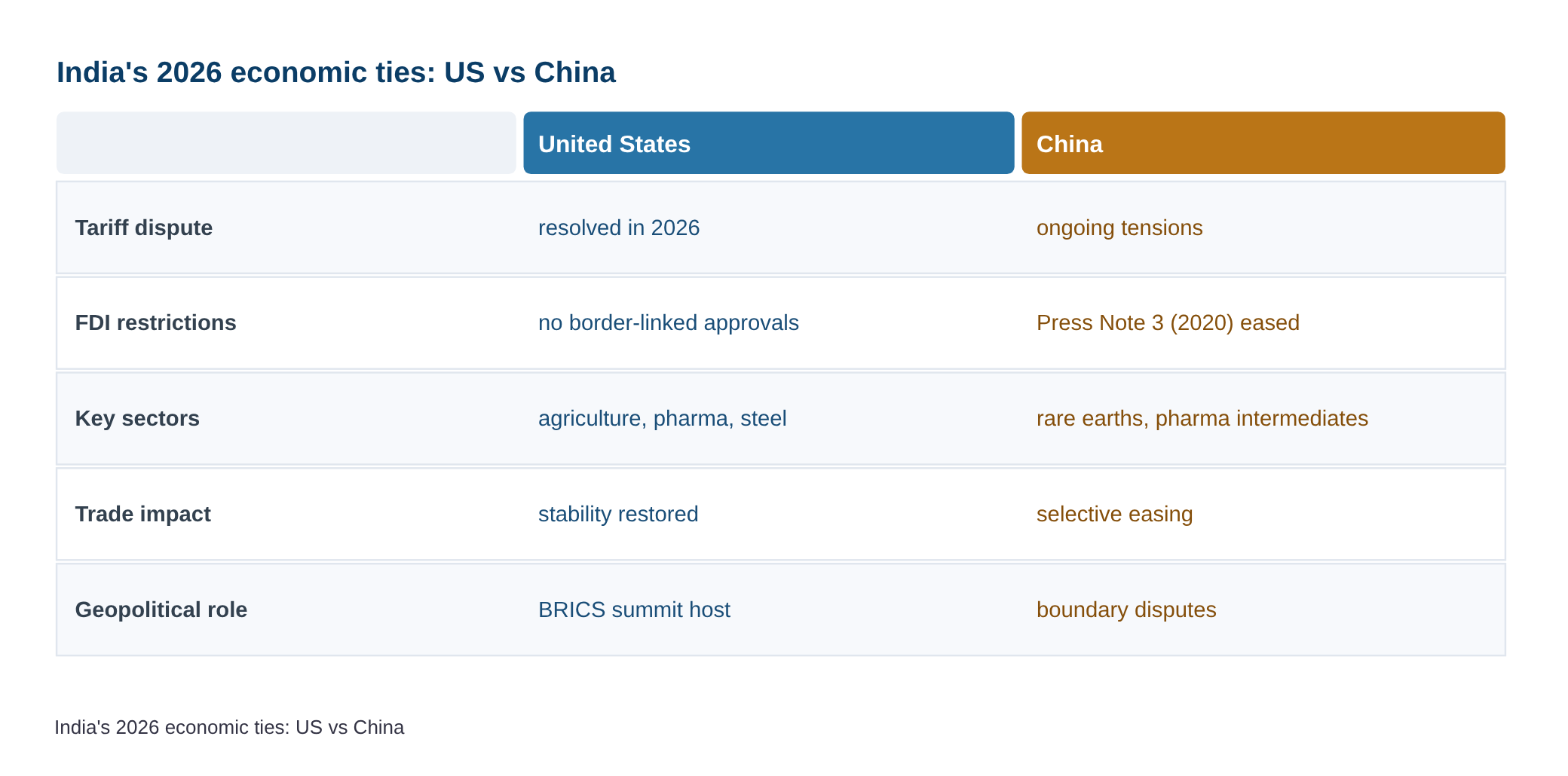
✎ India’s 2026 policy adjustments—reducing US tariffs to 18% and easing FDI norms for non-controlling Chinese ownership below 10%—reflect a strategic recalibration to balance economic growth, national security, and geopolitical…
Subject Relevance — Where This Topic Fits
- GS Paper II — International Relations: Bilateral, Regional and Global Groupings and Agreements involving India and/or affecting India’s interests | GS Paper III — Economy: Foreign Trade, Balance of Payments, Investment Models, Industrial Policy
- Prelims: Tariff dispute resolution mechanisms, Section 301 of the Trade Act of 1974 (US), Press Note 3 (2020) on FDI policy, Rare earth elements, BRICS Summit 2026, Foreign Direct Investment (FDI) routes, Safeguard tariffs, National Security Advisor (NSA), Special Representatives dialogue (India-China)
- Essay: The Imperative of Strategic Autonomy in a Multipolar World, Balancing Economic Growth and National Security: A Case Study of India’s Trade Policy
Quick Revision: India’s 2026 policy adjustments—reducing US tariffs to 18% and easing FDI norms for non-controlling Chinese ownership below 10%—reflect a strategic recalibration to balance economic growth, national security, and geopolitical realities.
Why is this in the news?
The report highlights India’s calibrated recalibration of economic engagements with the United States and China in 2026, marked by a resolution of the tariff dispute with the US and a cautious easing of restrictions on Chinese capital, reflecting a broader strategy of economic diversification amid downward revisions in growth forecasts and geopolitical uncertainties. These adjustments underscore India’s efforts to navigate complex geopolitical and economic challenges while maintaining policy predictability and strategic autonomy.
Background
- India’s trade relationship with the United States has historically been shaped by tariffs, with disputes often arising over market access, subsidies, and trade imbalances, particularly in sectors like agriculture, pharmaceuticals, and steel.
- The imposition of punitive tariffs by the US on Indian goods in 2025, including additional duties tied to Russian oil purchases, escalated trade tensions and necessitated diplomatic negotiations to restore stability.
- India’s foreign direct investment (FDI) policy underwent significant tightening in 2020 following border clashes with China, with Press Note 3 mandating government approval for investments from countries sharing a land border with India, effectively restricting Chinese investment.
- China’s dominance in critical sectors such as rare earth elements, pharmaceutical intermediates, and advanced manufacturing components has made it a key, albeit contentious, economic partner for India.
- The United Nations and S&P’s downward revisions of India’s growth forecasts for 2026 reflect heightened global uncertainties, including geopolitical tensions, supply chain disruptions, and policy volatility, which have impacted investor confidence.
- The BRICS summit hosted by India in 2026 serves as a platform for multilateral engagement, including efforts to address boundary disputes and economic cooperation with China.
What are the key policy adjustments and their implications?
- **Resolution of the US-India Tariff Dispute:** In February 2026, India and the US agreed to reduce reciprocal tariffs on Indian goods to 18%, while eliminating an additional 25% punitive duty linked to Russian oil purchases. This adjustment aims to restore predictability in trade relations and mitigate the impact of Section 301 duties, which impose a 10% tariff on certain imports, though roughly 45 per cent of Indian exports remain outside their scope.
- **Easing of FDI Restrictions on Chinese Capital:** The Union Cabinet amended Press Note 3 in March 2026 to introduce an automatic route for FDI from entities with non-controlling Chinese beneficial ownership below 10%, alongside a 60-day approval timeline for select manufacturing sectors such as capital goods, electronic components, and solar inputs (e.g., polysilicon and ingot-wafer). This represents a calibrated opening rather than a full liberalisation, reflecting concerns over national security and strategic dependencies.
- **Sector-Specific Liberalisation:** The amended policy targets high-technology and strategic sectors, including IT, pharmaceuticals, data centres, and manufacturing, to attract capital while maintaining oversight.
- **China’s Concurrent Easing of Export Controls:** In August last year, China lifted export restrictions on rare earth magnets, fertilisers, and tunnel boring machines, which are critical inputs for India’s defence, agriculture, and infrastructure sectors. This reciprocal gesture aligns with India’s efforts to stabilise bilateral economic ties.
- **Diplomatic Engagement on Boundary Disputes:** The resumption of the Special Representatives dialogue between India and China in 2026, culminating in a meeting between National Security Advisor Ajit Doval and his Chinese counterpart, signals a thaw in relations ahead of the BRICS summit. This dialogue is part of broader confidence-building measures to address longstanding border issues.
- **Growth Forecast Adjustments and Policy Uncertainty:** The downward revision of India’s growth forecast for 2026 underscores the challenges posed by geopolitical tensions and policy uncertainty. These adjustments highlight the need for India to diversify its economic partnerships and reduce vulnerabilities in global supply chains.
- **Strategic Diversification of Trade Partners:** India’s recalibration reflects a broader strategy to reduce dependence on any single economic partner, particularly in the context of US-China trade tensions and supply chain realignments. This approach aligns with India’s pursuit of strategic autonomy and resilience in its economic policies.
- **Predictability and Stability in Trade Regimes:** The adjustments aim to create a more predictable and stable trade environment, which is critical for attracting investment, fostering industrial growth, and maintaining investor confidence amid global economic uncertainties.
Key Features
| Feature | Significance |
|---|---|
| Reciprocal tariff reduction with the US (18% from 25%) | Reduces trade friction, stabilises export competitiveness, and signals policy predictability in bilateral economic relations. |
| Abolition of punitive 25% duty on Indian goods linked to Russian oil purchases | Demonstrates strategic autonomy in trade policy while mitigating collateral damage from geopolitical sanctions. |
| Amendment to Press Note 3 (2020) for Chinese FDI | Creates a calibrated opening for non-controlling Chinese investments (<10% beneficial ownership) in select sectors, balancing economic engagement with national security concerns. |
| Automatic approval route for select manufacturing sectors (capital goods, electronics, solar inputs) | Facilitates targeted FDI inflows while maintaining regulatory oversight, particularly in technology-sensitive industries. |
| Resumption of India-China border talks and diplomatic engagement | Indicates a thaw in bilateral relations, potentially easing trade and investment constraints while addressing long-standing territorial disputes. |
Why it Matters
Economic Diplomacy and Trade Policy
- Demonstrates India’s strategic recalibration of economic partnerships to mitigate over-dependence on any single trading partner, aligning with the principle of ‘diversification of partners’ in foreign trade policy.
- Reflects a pragmatic approach to managing trade-offs between economic growth and geopolitical constraints, particularly in the context of US-China strategic competition.
- Highlights the use of tariff adjustments and FDI policy reforms as instruments of economic statecraft, rather than purely domestic economic measures.
Foreign Direct Investment (FDI) Regulatory Framework
- Illustrates the evolution of India’s FDI policy from blanket restrictions (Press Note 3 of 2020) to a nuanced, sector-specific approach, balancing national security with economic pragmatism.
- Showcases the role of automatic approval routes in attracting capital while maintaining regulatory safeguards, particularly in strategic sectors like electronics and solar manufacturing.
- Underscores the importance of calibrated engagement with China, given its dominance in critical supply chains (e.g., rare earth elements, electronics components).
Geopolitical and Strategic Implications
- Signals India’s attempt to navigate the US-China trade and technology rivalry by maintaining equidistant economic engagement, without aligning exclusively with either power.
- Reflects the interplay between domestic economic priorities (e.g., growth forecasts, FDI inflows) and external geopolitical pressures (e.g., US tariffs, China border tensions).
- Demonstrates the use of diplomatic channels (e.g., border talks, BRICS engagement) to stabilise bilateral relations, which in turn can influence economic outcomes.
Macroeconomic Context
- Occurs against a backdrop of downward revisions in India’s growth forecasts (e.g., UN’s mid-year outlook of 6.6% for 2026), underscoring the need for policy measures to bolster economic resilience.
- Highlights the role of export diversification and FDI inflows as critical levers for sustaining growth amid global uncertainty and geopolitical fragmentation.
Challenges
1. Balancing Economic Engagement with National Security
- Maintaining a delicate equilibrium between attracting FDI (e.g., from China) and safeguarding critical sectors (e.g., defence, electronics, solar) from strategic vulnerabilities.
- Ensuring that tariff adjustments and trade agreements do not inadvertently compromise India’s strategic autonomy in global supply chains.
UPSC Link: GS3: Security challenges and their management
2. Managing Trade-offs in Bilateral Relations
- Navigating the competing demands of the US (e.g., tariff disputes, Section 301 duties) and China (e.g., FDI restrictions, rare earth exports) without alienating either partner.
- Avoiding over-dependence on any single market or supply chain, particularly in critical sectors like semiconductors, pharmaceuticals, and renewable energy.
UPSC Link: GS2: Bilateral, regional and global groupings
3. Policy Predictability and Investor Confidence
- Ensuring that recent policy adjustments (e.g., Press Note 3 amendment, tariff reductions) are perceived as sustainable rather than temporary measures, to attract long-term FDI.
- Addressing concerns about regulatory flip-flops, which can deter investment in sectors requiring significant capital outlays (e.g., electronics manufacturing, data centres).
UPSC Link: GS3: Investment models
4. Geopolitical Risks and Supply Chain Fragmentation
- Mitigating the impact of global trade fragmentation (e.g., US-China decoupling) on India’s export competitiveness and import dependencies (e.g., rare earths, pharmaceutical intermediates).
- Managing the risks of secondary sanctions or trade restrictions arising from India’s engagement with Russia (e.g., oil trade) or China (e.g., FDI in sensitive sectors).
UPSC Link: GS2: Effect of policies of developed and developing countries
5. Domestic Economic Slowdown and Structural Reforms
- Addressing structural bottlenecks (e.g., land acquisition, labour laws, infrastructure) that constrain FDI inflows and export growth, despite policy liberalisation.
- Ensuring that macroeconomic stability (e.g., inflation, fiscal deficit) is maintained to sustain investor confidence and growth momentum.
UPSC Link: GS3: Indian Economy and issues relating to planning
Challenges — UPSC Perspective
| Issue | Concern |
|---|---|
| Over-dependence on China for critical inputs (e.g., rare earths, APIs) | Vulnerability to supply chain disruptions and geopolitical leverage by China. |
| Tariff volatility and Section 301 duties by the US | Erosion of export competitiveness, particularly in labour-intensive sectors like textiles and pharmaceuticals. |
| Regulatory uncertainty in FDI policy | Potential deterrence to long-term capital inflows, especially in capital-intensive sectors. |
| Geopolitical tensions with China (border disputes) | Risk of sudden policy reversals or trade restrictions impacting economic engagement. |
| Downward revision in growth forecasts | Undermines investor confidence and constrains fiscal space for reform implementation. |
Way Forward
- Institutionalise the calibrated easing of FDI norms under Press Note 3 through transparent, sector-specific guidelines to provide long-term predictability for investors.
- Accelerate negotiations on a US-India trade agreement to formalise tariff reductions and address non-tariff barriers, thereby locking in policy gains.
- Diversify export markets by leveraging trade agreements (e.g., RCEP, EU-India FTA) and regional groupings (e.g., IORA, BIMSTEC) to reduce reliance on the US and China.
- Strengthen domestic manufacturing ecosystems (e.g., PLI schemes for electronics, solar) to reduce import dependencies and enhance value addition in critical sectors.
- Enhance diplomatic engagement with China to stabilise bilateral relations, including through confidence-building measures and structured dialogue on border issues.
- Invest in trade facilitation infrastructure (e.g., ports, logistics, digital trade platforms) to reduce transaction costs and improve competitiveness.
- Monitor and mitigate risks from geopolitical fragmentation through scenario planning and contingency measures for supply chain disruptions.
- Promote R&D and innovation in strategic sectors (e.g., semiconductors, renewables) to reduce vulnerabilities in global supply chains.
UPSC Value Addition
Keywords for Mains Answer-Writing
India-US economic relations · India-China economic engagement · Foreign Direct Investment (FDI) policy · Press Note 3 (2020) amendments · Tariff disputes and trade agreements · Section 301 duties of the US · Rare earth minerals and critical inputs · Geopolitical diversification of trade partners · Economic growth and policy uncertainty · Strategic autonomy in foreign policy
Concept Flow
US-China strategic competition → India’s trade policy adjustments (tariff reductions, FDI reforms) → Diversification of economic partners → Mitigation of over-dependence risks → Stabilisation of growth outlook. → Press Note 3 (2020) restrictions → Amendment to allow non-controlling Chinese FDI → Sector-specific automatic approval routes → Incremental FDI inflows → Economic engagement without compromising security. → Border tensions with China → Diplomatic thaw (border talks, BRICS engagement) → Resumption of trade and investment dialogue → Easing of export curbs (rare earths, fertilisers) → Improved bilateral relations. → Downward revision in growth forecasts → Policy measures (tariff cuts, FDI easing) → Attempt to boost investor confidence → Attraction of FDI and export growth → Partial offset of macroeconomic drags. → Section 301 duties by the US → Reciprocal tariff reduction → Mitigation of trade friction → Improved export competitiveness → Diversification of trade partners.
Prelims Practice Questions
Q1. Consider the following statements regarding India’s economic engagement with the United States and China in 2026:
1. The reciprocal tariff on Indian goods was reduced from 25% to 18% as part of a negotiated settlement.
2. The additional 25% punitive duty tied to Russian oil purchases was retained in the final agreement.
3. The Union Cabinet amended Press Note 3 to allow automatic FDI routes for entities with non-controlling Chinese beneficial ownership below 10%.
4. The amendment to Press Note 3 opened direct Chinese investment without prior clearance.
How many of the above statements are correct?
- Only one
- Only two
- Only three
- All
Answer: Only three — Statements 1 and 3 are correct. Statement 2 is incorrect as the additional 25% punitive duty was dropped. Statement 4 is incorrect as direct Chinese investment still requires prior clearance.
Q2. Assertion (A): The amendment to Press Note 3 in 2026 created an automatic route for FDI from entities with non-controlling Chinese beneficial ownership below 10%.
Reason (R): This amendment was aimed at easing restrictions on Chinese capital while maintaining regulatory oversight.
Options:
A. Both A and R are true, and R is the correct explanation of A.
B. Both A and R are true, but R is not the correct explanation of A.
C. A is true, but R is false.
D. A is false, but R is true.
Answer: ? — Both the assertion and reason are true. The amendment did create an automatic route for FDI under the specified conditions, and the reason correctly explains the intent behind the amendment.
Q3. Match the following economic measures with their respective countries:
Column I (Measure) | Column II (Country)
——————-|——————-
A. Reduction of reciprocal tariff to 18% | 1. China
B. Amendment to Press Note 3 for FDI | 2. United States
C. Lifting of export curbs on rare earth magnets | 3. Both
D. Section 301 duties of 10% | 4. Neither
- A-2, B-1, C-1, D-2
- A-2, B-1, C-3, D-2
- A-1, B-2, C-1, D-3
- A-3, B-2, C-1, D-2
Answer: A-2, B-1, C-3, D-2 — The reduction of reciprocal tariff to 18% was agreed with the United States (A-2). The amendment to Press Note 3 pertains to China (B-1). The lifting of export curbs on rare earth magnets was done by China (C-1). Section 301 duties of 10% were imposed by the United States (D-2).
Mains Practice Question
✍ Critically analyse India’s strategy of economic diversification in 2026, focusing on its engagement with the United States and China. How does this strategy reflect the principles of strategic autonomy and economic pragmatism in contemporary Indian foreign policy? (15 Marks)
Approach: MODEL-ANSWER SKELETON:
1. **Introduction**: Define strategic autonomy and economic pragmatism in the context of India’s foreign policy. Briefly outline the 2026 economic engagements with the US and China.
2. **India-US Economic Engagement**:
– Reduction of reciprocal tariff from 25% to 18% and dropping of punitive duties tied to Russian oil.
– Impact of Section 301 duties (10%) and exemptions for 45% of Indian exports.
– Reference to the robustness of the agreement despite the US Supreme Court’s tariff judgment.
3. **India-China Economic Engagement**:
– Amendment to Press Note 3 (2020) to allow automatic FDI routes for entities with non-controlling Chinese beneficial ownership below 10%.
– Selective easing of restrictions in capital goods, electronic components, and solar inputs.
– Lifting of export curbs by China on rare earth magnets, fertilisers, and tunnel boring machines.
– Data: Rs 4,896 crore FDI across 29 projects in sectors like IT, pharmaceuticals, and manufacturing.
4. **Strategic Autonomy**:
– Balancing economic interests with geopolitical realities.
– Diversification of trade partners to mitigate over-dependence on any single economy.
– Maintaining regulatory oversight while engaging with China (e.g., non-controlling ownership clause).
5. **Economic Pragmatism**:
– Lowering tariffs to boost exports and economic growth.
– Selective opening of FDI routes to attract capital without compromising national security.
– Addressing growth forecast revisions (UN mid-year outlook: 6.6% growth in 2026).
6. **Critique and Challenges**:
– Limited scope of FDI liberalisation (narrow opening vs. wide liberalisation).
– Continued restrictions on direct Chinese investment and sectors like defence.
– Geopolitical tensions and policy uncertainty as drags on growth.
7. **Conclusion**:
– India’s strategy reflects a calibrated approach to economic diversification.
– Strategic autonomy is exercised through selective engagement and regulatory safeguards.
– Economic pragmatism is evident in tariff reductions and targeted FDI liberalisation.
Source: orissapost.com
Generated by AanyaAi for educational purpose.
Related guides on our sites
- Current affairs for upsc 2026
- Best PSIR optional coaching for upsc
- Best economics optional coaching for upsc
- Best PSIR optional teacher for upsc

- कस्तूरीरंगन रिपोर्ट लागू करने की मांग: पश्चिमी घाट संरक्षण पर सरकार से अपील - September 20, 2026
- Foundation urges Kasturirangan report implementation for Western Ghats protection - September 20, 2026
- कैट की जम्मू बेंच: सेवा मामलों के निपटारे में देश में सर्वोच्च, जानें पूरा विवरण - September 20, 2026

No Comments