


30 Aug India Rebalances Economic Ties with US & China in 2026: UPSC Analysis
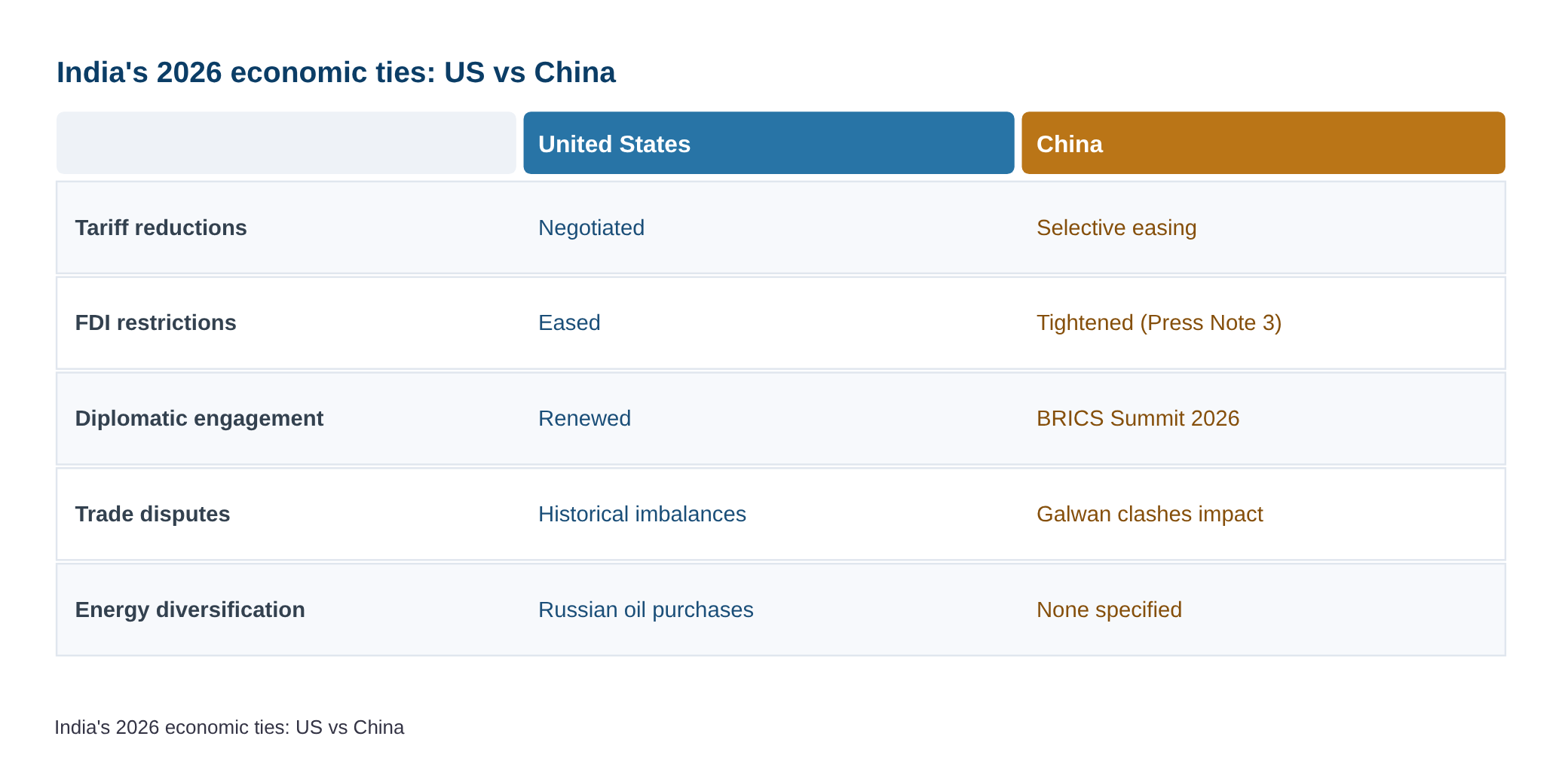
✎ India’s 2026 economic recalibration with the US and China involves negotiated tariff reductions, selective easing of FDI restrictions under Press Note 3, and renewed diplomatic engagement, reflecting a broader strategy of…
Subject Relevance — Where This Topic Fits
- GS Paper II — International Relations: Bilateral and Multilateral Groupings and Agreements Involving India and/or Affecting India’s Interests | GS Paper III — Indian Economy: Issues Relating to Planning, Mobilisation of Resources, Growth, Development and Employment; Effects of Liberalisation on the Economy, Changes in Industrial Policy and their Effects on Industrial Growth | GS Paper II — International Relations: India’s Foreign Policy: Evolution, Determinants and Objectives
- Prelims: Press Note 3 (2020), Section 301 of the US Trade Act, Foreign Direct Investment (FDI) routes in India, Rare earth elements, Safeguard duties, National Security Advisor (NSA), Special Representatives dialogue on boundary dispute, BRICS Summit 2026
- Essay: Geopolitical Realignment and Economic Sovereignty: India’s Strategic Balancing Act in a Multipolar World, The Imperative of Diversification: Reducing Over-Reliance on Single-Partner Economic Engagements
Quick Revision: India’s 2026 economic recalibration with the US and China involves negotiated tariff reductions, selective easing of FDI restrictions under Press Note 3, and renewed diplomatic engagement, reflecting a broader strategy of diversification amid geopolitical and economic uncertainties.
Why is this in the news?
The report highlights India’s calibrated recalibration of economic engagements with the United States and China in 2026, marked by negotiated tariff reductions, selective easing of FDI restrictions, and renewed diplomatic engagement. This development is significant as it reflects India’s strategic response to geopolitical tensions, downward growth forecasts, and the need to diversify economic dependencies amid global uncertainty. The adjustments in trade and investment policies underscore India’s evolving foreign economic policy, balancing domestic priorities with international obligations.
Background
- India’s economic relationship with the United States has historically been shaped by trade imbalances, tariff disputes, and strategic considerations, including the impact of US sanctions on Russian oil imports on Indian trade.
- The 2020 Galwan Valley clashes between India and China led to a significant tightening of FDI regulations for Chinese entities, including the mandatory government-approval route for investments from land-bordering countries via Press Note 3.
- Geopolitical tensions, including the Russia-Ukraine conflict and US-China trade wars, have created a complex environment for India’s trade and investment policies, necessitating strategic recalibrations.
- India’s growth forecasts for 2026 were revised downward by the United Nations (6.6%) and S&P (7.1% for FY27), reflecting global economic slowdowns and policy uncertainties.
- The US-China trade war and broader decoupling trends have compelled India to diversify its economic partnerships to mitigate risks associated with over-reliance on any single partner.
- The BRICS Summit 2026, hosted by India, provides a platform for renewed diplomatic engagement with China, including boundary dispute negotiations through the Special Representatives mechanism.
What is the Strategic Recalibration of India’s Economic Engagements with the US and China?
- India’s 2026 adjustments in economic engagements with the US and China represent a strategic recalibration aimed at reducing vulnerabilities arising from geopolitical tensions and over-dependence on specific partners.
- The easing of FDI regulations under Press Note 3 (2020) allowed automatic route investments from entities with non-controlling Chinese beneficial ownership below 10%, subject to sectoral approvals, particularly in capital goods, electronics, and solar inputs.
- The recalibration reflects India’s broader objective of diversifying its economic partnerships to enhance resilience against global supply chain disruptions and geopolitical risks.
- The policy adjustments are accompanied by renewed diplomatic engagement with China, including the resumption of boundary dispute talks via the Special Representatives dialogue, signaling a cautious thaw in relations.
- The recalibration is situated within the context of India’s growth slowdown, as reflected in downward revisions by international agencies, underscoring the need for policy measures to stimulate economic activity.
- The strategic recalibration is not a reversal of prior policies but a nuanced adjustment, maintaining regulatory safeguards while creating calibrated openings for economic engagement.
Key Features
| Feature | Significance |
|---|---|
| Reciprocal tariff reduction with the US (25% to 18%) | Reduces trade friction and stabilises export-oriented sectors, particularly those reliant on the US market. |
| Removal of punitive duty tied to Russian oil purchases | Alleviates cost pressures on Indian refiners and maintains energy security without compromising strategic autonomy. |
| Amendment to Press Note 3 (2020) | Introduces a calibrated easing of FDI restrictions for non-controlling Chinese beneficial ownership below 10%, signalling a nuanced approach to economic engagement. |
| Automatic route for select manufacturing sectors | Facilitates FDI inflows in capital goods, electronics, and solar inputs, supporting domestic industrial capacity and green energy transitions. |
| Lifting of Chinese export curbs on rare earth magnets, fertilisers, and tunnel boring machines | Eases supply chain bottlenecks for critical industries, including defence, agriculture, and infrastructure development. |
| Resumption of Special Representatives dialogue on the boundary dispute | Reinforces diplomatic engagement to reduce border tensions and create a conducive environment for economic cooperation. |
Why it Matters
Economic Diversification and Resilience
- India’s calibrated rebalancing of economic ties with the US and China reduces over-dependence on a single trade partner, enhancing supply chain resilience.
- The easing of FDI norms for select sectors aligns with the ‘Atmanirbhar Bharat’ vision by attracting capital in critical manufacturing domains.
- Lower tariffs and predictable trade regimes improve export competitiveness, particularly for sectors like pharmaceuticals, IT, and manufacturing.
- Diversification of trade partners mitigates risks from geopolitical volatility, such as sanctions or trade wars, ensuring stable economic growth.
Strategic Autonomy and Geopolitical Leverage
- India maintains strategic autonomy by balancing engagement with both the US and China, avoiding alignment with either bloc.
- The removal of punitive duties on Russian oil purchases underscores India’s policy of diversifying energy sources without compromising sovereignty.
- The resumption of border dialogue with China, alongside economic engagement, signals a multi-track approach to managing bilateral relations.
- India’s role in hosting the BRICS summit and its calibrated diplomacy enhances its global standing as a non-aligned yet influential actor.
Industrial and Technological Modernisation
- Eased FDI norms in capital goods, electronics, and solar inputs support the ‘Make in India’ initiative by attracting high-tech investments.
- Access to rare earth magnets and advanced manufacturing inputs strengthens India’s position in high-growth sectors like renewable energy and defence.
- The reduction in trade barriers for pharmaceuticals and IT services enhances India’s role as a global hub for these industries.
- Policy predictability in trade and investment regimes encourages long-term industrial planning and innovation.
Macroeconomic Stability and Growth
- Lower tariffs and reduced trade friction contribute to macroeconomic stability by supporting export-led growth.
- The easing of FDI restrictions provides a stimulus to domestic investment, particularly in labour-intensive and capital-intensive sectors.
- A more predictable trade environment reduces policy uncertainty, fostering business confidence and investment decisions.
- Despite downward revisions in growth forecasts (6.6% in 2026), these measures aim to mitigate external shocks and sustain economic momentum.
Challenges
1. Geopolitical Tensions and Trade Wars
- Ongoing geopolitical tensions, such as US-China trade disputes and sanctions, create volatility in global supply chains, impacting India’s trade and investment flows.
- Unilateral tariffs and safeguard measures (e.g., 55% tariffs on quartz products) pose risks to specific export sectors, requiring adaptive trade policies.
- The US Supreme Court’s judgment on tariffs introduces legal uncertainty, necessitating contingency planning by Indian exporters.
UPSC Link: GS-II: Effect of policies of developed and developing countries
2. Over-Reliance on Chinese Capital and Technology
- While Press Note 3 amendments ease restrictions, direct Chinese investment remains subject to prior approval, limiting the scope of engagement.
- India’s dependence on Chinese imports for critical inputs (e.g., rare earths, pharmaceutical intermediates) creates vulnerabilities in supply chains.
- Balancing economic engagement with national security concerns requires careful monitoring of foreign investment flows.
UPSC Link: GS-III: Investment models
3. Domestic Industrial Capacity and Competitiveness
- Despite eased FDI norms, India’s manufacturing sector faces challenges in scaling up production to meet global demand.
- The high cost of capital and infrastructure bottlenecks in sectors like electronics and solar inputs may deter investment despite policy changes.
- Competition from subsidised imports (e.g., Chinese goods) threatens the viability of domestic industries, necessitating supportive industrial policies.
UPSC Link: GS-III: Industrial policy
4. Energy Security and Policy Coherence
- The removal of punitive duties on Russian oil purchases addresses immediate energy needs but requires careful alignment with global sanctions regimes.
- Policy coherence between trade, energy, and foreign policy is essential to avoid contradictions that could undermine strategic objectives.
- Fluctuations in global oil prices and geopolitical risks (e.g., Middle East conflicts) pose challenges to India’s energy security strategy.
UPSC Link: GS-III: Energy security
5. Border Disputes and Diplomatic Friction
- The resumption of border talks is a positive step, but unresolved territorial disputes continue to pose risks to bilateral relations.
- China’s assertive posture in the Indo-Pacific region and its military modernisation programmes necessitate vigilance and preparedness.
- Diplomatic engagements must balance economic cooperation with national security imperatives to avoid strategic missteps.
UPSC Link: GS-II: India’s relations with its neighbours
Challenges — UPSC Perspective
| Issue | Concern |
|---|---|
| US-China trade war and unilateral tariffs | Volatility in global trade regimes disrupts export-oriented industries and supply chains. |
| Over-dependence on Chinese imports for critical inputs | Supply chain vulnerabilities in sectors like pharmaceuticals, electronics, and renewable energy. |
| Policy uncertainty due to geopolitical tensions | Legal and regulatory risks for businesses, impacting investment decisions. |
| Infrastructure and cost bottlenecks in manufacturing | Limited industrial capacity to absorb increased FDI and compete globally. |
| Energy security amidst global sanctions regimes | Balancing energy needs with strategic autonomy and international obligations. |
| Unresolved border disputes with China | Persistent risks to bilateral relations and economic cooperation. |
Way Forward
- Strengthen domestic manufacturing through targeted subsidies and PLI schemes in sectors like electronics, pharmaceuticals, and solar inputs.
- Enhance trade infrastructure (e.g., ports, logistics) to reduce transaction costs and improve export competitiveness.
- Diversify energy sources further by investing in renewable energy and exploring new supply agreements with non-traditional partners.
- Develop a robust monitoring mechanism for FDI inflows to balance economic engagement with national security concerns.
- Accelerate border infrastructure projects to improve connectivity and reduce logistical costs in border regions.
- Promote R&D and innovation in critical sectors (e.g., rare earth processing, advanced manufacturing) to reduce import dependence.
- Strengthen diplomatic channels with the US and China to institutionalise trade and investment dialogues, reducing policy uncertainty.
- Implement skill development programmes to align the workforce with the demands of high-tech industries attracting FDI.
UPSC Value Addition
Keywords for Mains Answer-Writing
Foreign Direct Investment (FDI) policy · Press Note 3 of 2020 · Section 301 tariffs · Reciprocal tariffs · China-India economic relations · US-India trade relations · Foreign Portfolio Investment (FPI) · Rare earth minerals · Geopolitical diversification · Economic diplomacy · Tariff dispute resolution · Border dispute resolution mechanisms · BRICS economic engagements · Growth forecast revisions · Global economic uncertainty
Concept Flow
Geopolitical tensions (US-China trade war, border disputes) → Trade and investment policy adjustments by India → Reduction in reciprocal tariffs with the US → Easing of FDI restrictions via Press Note 3 amendment → Increased capital inflows in select sectors → Strengthening of domestic industrial capacity → Diversification of trade partners → Enhanced economic resilience and strategic autonomy.
Prelims Practice Questions
Q1. Consider the following statements regarding India’s foreign direct investment (FDI) policy changes in 2026:
1. Press Note 3 of 2020 was amended to allow automatic FDI approval for entities with non-controlling Chinese beneficial ownership below 10%.
2. The amendment created a 60-day approval timeline for select manufacturing sectors such as capital goods and electronic components.
3. Direct Chinese investment in India no longer requires prior government approval.
How many of the above statements are correct?
- Only one
- Only two
- All three
- None
Answer: Only two — Statement 1 and 2 are correct as per the amendment to Press Note 3 in March 2026. Statement 3 is incorrect because direct Chinese investment still requires prior clearance.
Q2. Assertion (A): The United States and India agreed to reduce reciprocal tariffs from 25% to 18% in 2026.
Reason (R): The reduction was part of a broader trade truce to address geopolitical tensions and ensure predictable tariff regimes.
Options:
A. Both A and R are true, and R is the correct explanation of A.
B. Both A and R are true, but R is not the correct explanation of A.
C. A is true, but R is false.
D. A is false, but R is true.
Answer: ? — Both A and R are true. The reduction in tariffs was indeed part of a trade truce, but the reduction itself (from 25% to 18%) is a standalone fact not directly explained by R.
Q3. Match the following columns regarding India’s economic engagements in 2026:
Column I
1. Section 301 duties
2. Press Note 3 amendment
3. Rare earth minerals
4. BRICS summit
Column II
A. US trade policy tool
B. FDI policy amendment
C. Export curbs lifted by China
D. Multilateral economic forum
- 1-A, 2-B, 3-C, 4-D
- 1-B, 2-A, 3-D, 4-C
- 1-D, 2-C, 3-B, 4-A
- 1-C, 2-D, 3-A, 4-B
Answer: 1-A, 2-B, 3-C, 4-D — Section 301 duties are a US trade policy tool (1-A). Press Note 3 amendment pertains to FDI policy (2-B). Rare earth minerals were subject to export curbs lifted by China (3-C). BRICS is a multilateral economic forum (4-D).
Mains Practice Question
✍ India’s calibrated rebalancing of economic ties with the US and China in 2026 reflects a strategic shift in its foreign economic policy. Critically analyse the implications of this rebalancing for India’s economic diplomacy, growth prospects, and geopolitical positioning. (15 Marks)
Approach: MODEL-ANSWER SKELETON:
1. **Introduction** (2 marks): Define economic diplomacy and its relevance to India’s foreign policy. Mention the 2026 developments: US-India tariff reduction (Press Note 3 amendment) and China’s easing of export curbs on rare earths.
2. **Economic Diplomacy Dimensions** (4 marks):
– **US-India Relations**: Reduction of reciprocal tariffs from 25% to 18%, Section 301 duties, and predictable trade regime. Reference to geopolitical tensions (e.g., Russian oil link) and their resolution.
– **China-India Relations**: Amendment to Press Note 3 (automatic route for FDI with <10% Chinese beneficial ownership), approval timeline (60 days), and sectors (capital goods, electronics, solar inputs). Mention rare earth minerals and export curbs lifted.
– **BRICS Context**: Hosting of BRICS summit and its role in multilateral economic engagements.
3. **Growth Prospects and Challenges** (4 marks):
– **Positive Impacts**: Diversification of trade partners, reduced dependency on a single market, potential FDI inflows (Rs 4,896 crore across 29 projects). Reference to UN mid-year outlook (6.6% growth in 2026).
– **Challenges**: Persistence of safeguard tariffs (e.g., 55% on quartz surface products), policy uncertainty, and global economic drags (geopolitical tensions).
– **Data Integration**: Use of reported FDI figures and growth forecasts to substantiate arguments.
4. **Geopolitical Positioning** (3 marks):
– **Strategic Autonomy**: Balancing ties with US and China to avoid over-dependence. Reference to border talks and Special Representatives dialogue.
– **Multipolar Engagement**: Leveraging BRICS and other forums to assert economic sovereignty.
– **Long-term Vision**: Aligning economic diplomacy with India’s Act East Policy and global supply chain resilience.
5. **Critique and Conclusion** (2 marks):
– **Limited Scope**: Note that the opening to China is narrow (no direct investment route, prior clearance still required).
– **Balanced View**: Acknowledge both opportunities (FDI, trade predictability) and risks (geopolitical volatility, regulatory constraints).
– **Final Assessment**: Conclude that the rebalancing is a pragmatic step but requires sustained policy coherence to yield long-term benefits.
Source: orissapost.com
Generated by AanyaAi for educational purpose.
Related guides on our sites
- Current affairs for upsc 2026
- Best PSIR optional coaching for upsc
- Best economics optional coaching for upsc
- Best PSIR optional teacher for upsc

- कस्तूरीरंगन रिपोर्ट लागू करने की मांग: पश्चिमी घाट संरक्षण पर सरकार से अपील - September 20, 2026
- Foundation urges Kasturirangan report implementation for Western Ghats protection - September 20, 2026
- कैट की जम्मू बेंच: सेवा मामलों के निपटारे में देश में सर्वोच्च, जानें पूरा विवरण - September 20, 2026

No Comments