


31 Aug Kerala’s Human-Elephant Conflict Hotspots: Key Villages & Trends for UPSC
✎ Human-Elephant Conflict in Keralam is driven by habitat fragmentation and anthropogenic pressures, with electrocution being the leading cause of elephant mortality; translocation offers only short-term relief, necessitating…
Subject Relevance — Where This Topic Fits
- GS Paper III — Environment, Biodiversity, and Climate Change | GS Paper III — Disaster Management
- Prelims: Human-Elephant Conflict (HEC), Wildlife Institute of India, elephant mortality, anthropogenic threats, translocation of wildlife, forest divisions of Keralam, electrocution of elephants, retaliatory killings, crop raiding by elephants, Protected Area Network
- Essay: Human-wildlife coexistence: Balancing conservation and livelihood security, Ethical dimensions of wildlife management in densely populated landscapes
Quick Revision: Human-Elephant Conflict in Keralam is driven by habitat fragmentation and anthropogenic pressures, with electrocution being the leading cause of elephant mortality; translocation offers only short-term relief, necessitating long-term, community-inclusive mitigation strategies.
Why is this in the news?
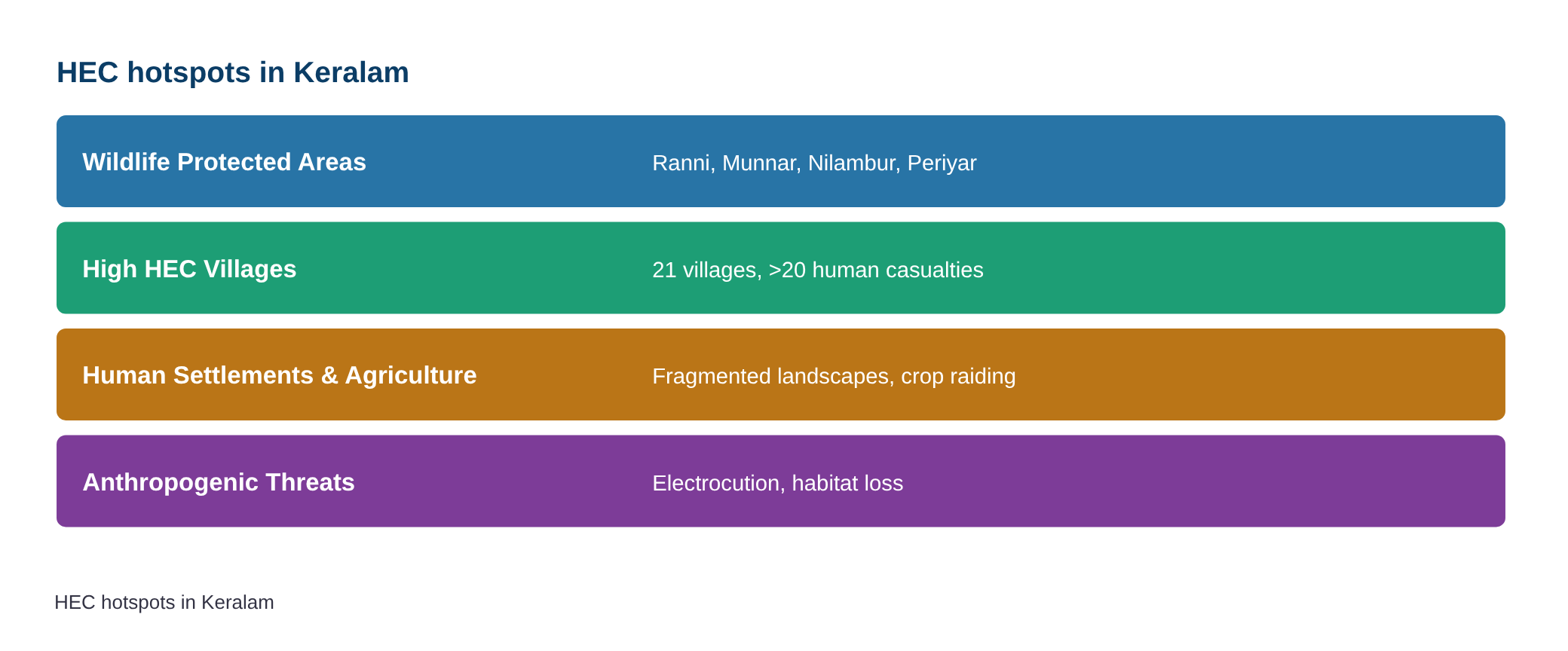
A recent report by the Wildlife Institute of India, titled *HEC in the State of Keralam 2008–2025: Trends, Challenges, and Insights*, has identified persistent hotspots for human-elephant conflict (HEC) and elephant mortality in Keralam. The report highlights 21 villages with high incidence of HEC, where over 20 human casualties were recorded. The findings are critical for policy formulation and implementation in wildlife management, particularly in the context of India’s commitments under the Convention on Biological Diversity and the Wildlife Protection Act, 1972.
Background
- Human-Elephant Conflict (HEC) is a critical conservation challenge in India, where the Asian elephant (*Elephas maximus*) is listed as a Schedule I species under the Wildlife Protection Act, 1972, conferring the highest legal protection.
- Keralam, with its dense human population and fragmented forest landscapes, has historically been a hotspot for HEC, with significant socio-economic and ecological implications.
- The Wildlife Institute of India (WII), an autonomous institution under the Ministry of Environment, Forest and Climate Change (MoEFCC), conducts research on wildlife conservation and human-wildlife interactions.
- The report spans 17 years (2008–2025) and analyses 1,781 HEC incidents, resulting in 581 human deaths and 1,200 injuries, alongside 154 elephant deaths due to anthropogenic factors.
- The Protected Area Network in Keralam includes key divisions such as Ranni, Munnar, Nilambur, and Periyar, which are critical for elephant conservation but also face high anthropogenic pressures.
- India is a signatory to the Convention on Biological Diversity (CBD) and the Sustainable Development Goals (SDGs), which mandate the protection of biodiversity and the mitigation of human-wildlife conflicts.
What is Human-Elephant Conflict (HEC)?
- Human-Elephant Conflict (HEC) refers to the negative interactions between humans and elephants, arising from competition over resources such as food, water, and habitat, often leading to crop raiding, property damage, and loss of human or elephant lives.
- HEC is a complex socio-ecological issue influenced by factors such as habitat fragmentation, agricultural expansion, infrastructure development, and climate change-induced resource scarcity.
- In Keralam, HEC is exacerbated by the state’s high population density, extensive agricultural lands bordering forest areas, and the presence of key elephant corridors that are increasingly encroached upon by human settlements.
- The Asian elephant is an umbrella species, meaning its conservation benefits numerous other species and ecosystems; thus, mitigating HEC is essential for broader biodiversity conservation.
- Anthropogenic threats to elephants include electrocution from live wires, retaliatory killings, poisoning, poaching, and snare traps, all of which contribute to elevated mortality rates.
- The Wildlife Protection Act, 1972, and the National Wildlife Action Plan (2017–2031) provide the legal and policy framework for addressing HEC, emphasizing habitat management, community engagement, and alternative livelihoods.
- Effective HEC mitigation requires an integrated approach combining habitat restoration, early warning systems, compensation mechanisms, and community-based conservation initiatives.
Key Features
| Feature | Significance |
|---|---|
| Hotspots of Human-Elephant Conflict (HEC) | Identification of 21 high-incidence villages and 6 persistent hotspots (e.g., Kanan Devan Hills, Munnar, Nilambur) highlights critical zones requiring targeted mitigation measures. |
| Anthropogenic Causes of Elephant Mortality | Electrocution (154 deaths) and retaliatory killings (11 deaths) dominate causes, indicating infrastructure and human retaliation as primary threats to elephant populations. |
| Solitary Male Elephants as Conflict Drivers | Adult male elephants contribute disproportionately to HEC incidents, particularly crop raiding, necessitating sex-specific management strategies. |
| Translocation Outcomes | Translocation of conflict elephants (e.g., Arikomban) often fails long-term, with individuals returning to conflict zones or relocating to new areas, underscoring the need for alternative solutions. |
| Temporal Trends (2008-2025) | Analysis of 1,781 HEC incidents over 17 years provides a longitudinal dataset to assess policy effectiveness and identify recurring patterns in conflict dynamics. |
Why it Matters
Ecological Stability
- Elephant populations in Keralam are keystone species; their decline disrupts forest ecosystems, seed dispersal, and biodiversity, with cascading effects on forest health and carbon sequestration.
- High mortality rates (e.g., 154 elephants from electrocution) threaten the genetic viability of local populations, risking inbreeding and reduced adaptive resilience.
Human-Wildlife Coexistence
- Persistent HEC erodes community tolerance for wildlife, potentially leading to retaliatory killings and reduced support for conservation policies among local populations.
- Crop raiding by solitary males causes economic losses for farmers, exacerbating rural-urban migration and agrarian distress in conflict-prone regions.
Policy and Governance
- The report provides empirical data to refine the National Wildlife Action Plan (2021-2031) and State Action Plans for Human-Elephant Conflict Mitigation, ensuring evidence-based policymaking.
- Institutional coordination between the Wildlife Institute of India, Kerala Forest Department, and local communities is critical for implementing mitigation strategies effectively.
Infrastructure and Development
- Electrocution risks highlight the need for wildlife-friendly infrastructure (e.g., underground cables, insulated power lines) in elephant habitats to align development with conservation.
- Urban expansion into forest fringes (e.g., Kanan Devan Hills) intensifies HEC, necessitating land-use planning that incorporates wildlife corridors and buffer zones.
Public Health and Safety
- Human casualties (581 deaths, 1,200 injuries) pose significant public health challenges, requiring integrated emergency response systems and community awareness programs.
- Psychosocial impacts on affected communities, including trauma and economic insecurity, demand mental health and livelihood support interventions.
Challenges
1. Anthropogenic Threats to Elephant Populations
- Electrocution from uninsulated power lines remains the leading cause of elephant mortality, requiring urgent retrofitting of infrastructure in high-risk zones.
- Retaliatory killings and poisoning (5 cases) reflect unresolved human-wildlife conflict, necessitating community engagement and alternative livelihood programs.
- Poaching (7 cases) and snare/trap incidents (4 cases) indicate illegal activities in elephant habitats, demanding enhanced anti-poaching measures and habitat monitoring.
UPSC Link: GS3: Environmental Conservation, Wildlife Protection Act 1972
2. Ineffectiveness of Translocation as a Mitigation Strategy
- Translocated elephants often return to conflict zones or relocate to new areas, indicating that translocation fails to address underlying habitat pressures or behavioral patterns.
- Repeated interventions strain resources and may exacerbate conflicts by displacing elephants into new human-dominated landscapes (e.g., Arikomban’s post-translocation movement).
- Lack of post-release monitoring and long-term habitat assessments undermines the success of translocation efforts.
UPSC Link: GS3: Wildlife Management, Project Elephant
3. Fragmentation of Elephant Habitats
- Urbanization and agricultural expansion (e.g., in Nilambur, Palakkad) fragment habitats, increasing HEC by forcing elephants into human settlements in search of food and space.
- Linear infrastructure (roads, railways) acts as barriers, disrupting elephant movement corridors and exacerbating conflicts in fragmented landscapes.
- Climate change-induced shifts in forest composition may further reduce available habitats, intensifying competition with humans.
UPSC Link: GS3: Environmental Pollution, Forest Rights Act 2006
4. Socioeconomic Vulnerabilities in Conflict Zones
- Marginalized communities in high-incidence villages (e.g., tribal groups) bear disproportionate costs of HEC, with limited access to compensation or alternative livelihoods.
- Economic losses from crop raiding (e.g., Nilambur South) perpetuate poverty cycles, reducing community resilience to future conflicts.
- Inadequate compensation mechanisms delay relief, eroding trust in government institutions and fueling resentment toward wildlife.
UPSC Link: GS1: Tribal Communities, Poverty Alleviation
5. Institutional and Policy Gaps
- Fragmented governance between forest departments, local bodies, and line ministries (e.g., Power, Agriculture) hinders cohesive HEC mitigation strategies.
- Lack of standardized data collection across states complicates comparative analysis and the design of region-specific interventions.
- Insufficient funding for research, community engagement, and infrastructure retrofitting limits the scalability of proven mitigation techniques.
UPSC Link: GS2: Centre-State Relations, NITI Aayog
Challenges — UPSC Perspective
| Issue | Concern |
|---|---|
| Electrocution of Elephants | Uninsulated power lines in elephant habitats pose a lethal threat; retrofitting is costly but necessary to reduce mortality. |
| Translocation Failures | Translocated elephants often return to conflict zones or relocate, rendering the strategy ineffective without behavioral and habitat interventions. |
| Habitat Fragmentation | Urbanization and agriculture encroach on elephant ranges, increasing HEC by restricting natural movement and food sources. |
| Community Resentment | Repeated crop raids and human casualties foster hostility toward elephants, undermining conservation efforts and local support. |
| Inadequate Compensation | Delayed or insufficient compensation for losses exacerbates economic hardship in conflict zones, reducing tolerance for wildlife. |
| Data Fragmentation | Inconsistent data collection across regions hinders evidence-based policymaking and the design of targeted interventions. |
Government Initiatives — Must-Memorise for Prelims
- Project Elephant (Central Sector Scheme for Elephant Conservation)
- Wildlife Institute of India’s HEC Mitigation Guidelines
Way Forward
- Prioritize retrofitting of power infrastructure in high-risk zones (e.g., Munnar, Nilambur) with wildlife-friendly designs, including underground cables and insulated lines.
- Develop and implement alternative translocation protocols that include behavioral monitoring, post-release tracking, and habitat assessments to ensure long-term success.
- Design and restore elephant corridors in fragmented landscapes (e.g., Palakkad-Mannarkkad, Periyar) to reconnect habitats and reduce human-wildlife interface incidents.
- Strengthen compensation mechanisms with faster disbursement, higher payouts, and livelihood support programs (e.g., crop insurance, eco-tourism training) for affected communities.
- Launch community-based awareness campaigns to foster coexistence, focusing on early warning systems, crop protection techniques, and non-lethal deterrents.
- Enhance inter-departmental coordination (Forest, Power, Agriculture, Local Government) to align infrastructure development with wildlife conservation needs.
- Invest in research to identify sex-specific behavioral patterns of solitary male elephants and tailor mitigation strategies accordingly.
- Expand habitat monitoring using technology (e.g., camera traps, GPS collars) to track elephant movements and predict conflict hotspots proactively.
UPSC Value Addition
Keywords for Mains Answer-Writing
Human-Elephant Conflict (HEC) · Wildlife Institute of India (WII) · Elephant mortality causes · Translocation of conflict elephants · Habitat fragmentation · Anthropogenic threats to wildlife · Protected Area Network (PAN) · Mitigation strategies for HEC · Wildlife Protection Act, 1972 · Project Elephant · Solitary male elephants · Electrocution of wildlife · Human-wildlife interface · Conservation policy in India
Concept Flow
Expansion of human settlements and agriculture into elephant habitats → Fragmentation of forest corridors → Increased human-wildlife interface → Rise in crop raiding and property damage. → Crop raiding and property damage → Retaliatory killings, poisoning, and electrocution of elephants → Elevated elephant mortality rates → Threat to local populations and genetic diversity. → High elephant mortality and human casualties → Erosion of community tolerance for wildlife → Reduced support for conservation policies → Escalation of conflicts. → Inadequate mitigation strategies (e.g., translocation) → Recurrence of conflicts in new areas → Strain on resources and institutional credibility → Persistent HEC hotspots. → Fragmented governance and policy gaps → Lack of standardized data and coordination → Ineffective interventions → Continued anthropogenic threats to elephants. → Socioeconomic vulnerabilities in conflict zones → Marginalization of affected communities → Limited access to compensation and livelihoods → Reinforcement of poverty-conflict cycles.
Prelims Practice Questions
Q1. Consider the following statements regarding Human-Elephant Conflict (HEC) in India:
1. The Wildlife Institute of India (WII) has identified Kanan Devan Hills, Kuttampuzha, and Chittar in Keralam as persistent hotspots for HEC.
2. Electrocution is the leading anthropogenic cause of elephant mortality in Keralam.
3. Translocation of conflict elephants has been universally successful in reducing HEC in all regions of India.
How many of the above statements are correct?
- Only one
- Only two
- All three
- None
Answer: Only two — Statement 1 is correct as per the report. Statement 2 is correct as electrocution accounts for 154 elephant deaths. Statement 3 is incorrect because translocation has often failed to provide long-term solutions, as noted in the report.
Q2. Assertion (A): The Wildlife Protection Act, 1972, provides the legal framework for the protection of elephants in India.
Reason (R): Project Elephant, launched in 1992, is a centrally sponsored scheme for the conservation of elephants and their habitats.
Options:
A. Both A and R are true, and R is the correct explanation of A.
B. Both A and R are true, but R is not the correct explanation of A.
C. A is true, but R is false.
D. A is false, but R is true.
Answer: ? — Assertion (A) is true as the Wildlife Protection Act, 1972, is the primary legislation for wildlife protection, including elephants. Reason (R) is also true, and Project Elephant operates under the framework of the Act, making R the correct explanation of A.
Q3. Match the following causes of elephant mortality in Keralam with their respective counts as reported in the study:
Column I (Cause) | Column II (Number of deaths)
A. Electrocution | 1. 12
B. Explosive baits | 2. 154
C. Poisoning | 3. 5
D. Poaching | 4. 7
- A-2, B-1, C-3, D-4
- A-1, B-2, C-3, D-4
- A-2, B-4, C-1, D-3
- A-3, B-1, C-2, D-4
Answer: A-2, B-1, C-3, D-4 — Electrocution caused 154 deaths (A-2), explosive baits killed 12 elephants (B-1), poisoning accounted for 5 deaths (C-3), and poaching led to 7 deaths (D-4).
Mains Practice Question
✍ The report titled ‘HEC in the State of Keralam 2008-2025: trends, challenges and insights’ highlights persistent hotspots for human-elephant conflict (HEC) and identifies anthropogenic factors as primary contributors to elephant mortality. Critically examine the causes of HEC and evaluate the efficacy of existing mitigation strategies in India. (15 Marks)
Approach: MODEL-ANSWER SKELETON:
1. Introduction (2 marks): Define HEC and its significance in India, citing the Wildlife Protection Act, 1972, and Project Elephant (1992) as key policy frameworks.
2. Causes of HEC (4 marks):
– Habitat fragmentation and loss due to agricultural expansion and infrastructure development.
– Anthropogenic threats: electrocution (154 deaths), explosive baits (12), poisoning (5), poaching (7), and snare/traps (4).
– Solitary male elephants as primary conflict agents due to crop raiding and property damage.
– Human-wildlife interface and encroachment into forest fringes.
3. Mitigation strategies and their efficacy (5 marks):
– Translocation of conflict elephants: discuss failures (e.g., Arikomban case) and limited long-term success.
– Measures like elephant-proof trenches, solar-powered fences, and community-based early warning systems.
– Role of the Forest Department and local communities in conflict resolution.
– Legal and policy gaps: cite the Wildlife Protection Act, 1972, and the National Wildlife Action Plan (2017-2031).
4. Way forward (4 marks):
– Integrated land-use planning to reduce habitat fragmentation.
– Strengthening of the Protected Area Network (PAN) and corridors.
– Community participation and awareness programs.
– Research and data-driven interventions by institutions like the Wildlife Institute of India (WII).
Balance of views: Present both the successes and limitations of existing strategies, citing data from the report and other studies.
Source: The Hindu
Generated by AanyaAi for educational purpose.
Related guides on our sites
- Current affairs for upsc 2026
- Best PSIR optional coaching for upsc
- Best economics optional coaching for upsc
- Best PSIR optional teacher for upsc

- कस्तूरीरंगन रिपोर्ट लागू करने की मांग: पश्चिमी घाट संरक्षण पर सरकार से अपील - September 20, 2026
- Foundation urges Kasturirangan report implementation for Western Ghats protection - September 20, 2026
- कैट की जम्मू बेंच: सेवा मामलों के निपटारे में देश में सर्वोच्च, जानें पूरा विवरण - September 20, 2026

No Comments