


01 Sep AI-Generated Works: Copyright Office Rules Out AI as Author, UPSC Perspective
✎ Under the Copyright Act, 1957, only human beings can be recognised as authors of copyrightable works; AI systems, even if they generate original content autonomously, cannot claim authorship, though the works themselves may be…
Subject Relevance — Where This Topic Fits
- GS Paper II — Governance, Constitution and Polity (Intellectual Property Rights) | GS Paper III — Science and Technology (Emerging Technologies and IPR Challenges)
- Prelims: Copyright Act, 1957, Intellectual Property Rights (IPR), Artificial Intelligence (AI), Authorship and Originality, Registrar of Copyrights, Delhi High Court, Ministry of Commerce and Industry
- Essay: The Intersection of Technology and Law: Challenges in Regulating Artificial Intelligence, Intellectual Property in the Age of Automation: Balancing Innovation and Rights
Quick Revision: Under the Copyright Act, 1957, only human beings can be recognised as authors of copyrightable works; AI systems, even if they generate original content autonomously, cannot claim authorship, though the works themselves may be protected if they meet the threshold of originality.
Why is this in the news?
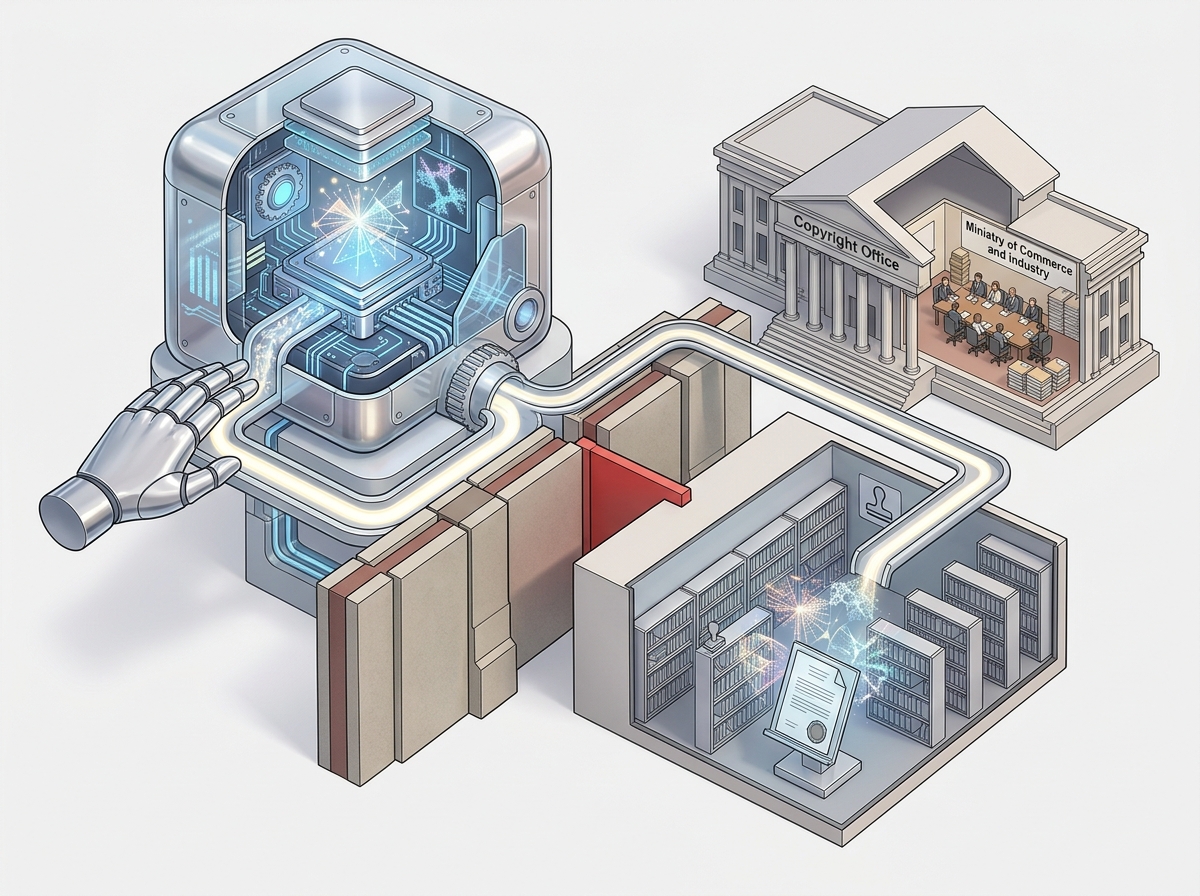
The Copyright Office, under the Ministry of Commerce and Industry, has ruled that an Artificial Intelligence (AI) system cannot be recognised as the author of a work it generates, reaffirming the requirement of human authorship under the Copyright Act, 1957. This decision, arising from a case involving AI-generated artwork by the system DABUS, underscores the legal and constitutional challenges posed by AI to traditional frameworks of intellectual property rights, particularly in determining the locus of authorship and the threshold of originality.
Background
- The Copyright Act, 1957, defines an ‘author’ as a ‘person’ who causes a work to be created, implicitly excluding non-human entities such as AI systems from authorship.
- The case originated from an application filed by US-based researcher Stephen Thaler, seeking copyright registration for an artwork titled ‘A Recent Entrance to Paradise’, generated autonomously by his AI system DABUS (Device for the Autonomous Bootstrapping of Unified Sentience).
- Thaler’s application was rejected by multiple jurisdictions, including the United States, on the grounds that the US Copyright Act requires human authorship, a principle mirrored in India’s Copyright Act.
- The Copyright Office’s decision aligns with global trends, where jurisdictions such as the European Union and the United States have consistently denied AI systems authorship rights, focusing instead on the protection of the work itself rather than the system that produced it.
- The ruling highlights the evolving nature of creative processes in the digital era, where AI systems are increasingly capable of generating original works without direct human intervention, raising questions about the adequacy of existing legal frameworks.
What is the Legal Status of AI-Generated Works Under Copyright Law?
- The Copyright Act, 1957, does not explicitly address AI-generated works, but its definition of ‘author’ as a ‘person’ implies that only human beings can be recognised as authors of copyrightable works.
- An ‘author’ is defined as the individual who causes the work to be created, thereby establishing a direct human link to the act of creation, which is essential for copyright protection.
- The Copyright Office has clarified that while the output of an AI system may qualify as an ‘original work’ if it meets the threshold of independent creation and does not copy pre-existing material, the system itself cannot be the author.
- Originality in copyright law requires that the work be the result of the author’s own intellectual effort and not merely a reproduction of existing material; AI-generated works may satisfy this criterion if the system’s output is not derivative.
- The decision reinforces the principle that copyright protection is vested in the human creator or the person who configures, trains, or directs the AI system, rather than the system itself.
- The ruling does not preclude the possibility of human authorship where a person utilises AI as a tool to create a work, provided the human element in the creative process is demonstrable.
- The Copyright Office’s stance is consistent with the Berne Convention for the Protection of Literary and Artistic Works, which requires authorship to be vested in a human being, a principle adopted by signatory countries including India.
- The decision does not address the question of whether AI systems can hold moral rights or other ancillary rights, leaving this an open area for future legal interpretation.
Key Features
| Feature | Significance |
|---|---|
| Definition of ‘author’ under the Copyright Act | The Copyright Act, 1957, explicitly defines an ‘author’ as a ‘person,’ thereby restricting authorship to human beings. This provision is central to the Copyright Office’s ruling that AI systems cannot be authors. |
| Autonomous generation of creative work by AI | AI systems like DABUS can autonomously generate original creative works, but the legal framework does not recognise such systems as authors. The output remains eligible for copyright protection, but attribution must be to a human. |
| Threshold of originality for AI-generated works | The Copyright Office acknowledged that AI-generated works can possess sufficient independently generated expressive character to meet the threshold of originality, provided they are not copied from pre-existing sources. |
| Role of human configuration and training | While AI systems operate autonomously after configuration, the human involvement in training and setting parameters is critical. The Copyright Office held that this human role remains the basis for authorship attribution. |
| Global jurisprudence on AI authorship | The ruling aligns with decisions in other jurisdictions, such as the US, where courts have refused to recognise AI systems as authors under copyright law, reinforcing a consistent international approach. |
Why it Matters
Legal and Jurisprudential
- Clarifies the legal status of AI-generated works under Indian copyright law, establishing that while such works are protectable, authorship must vest in a human creator.
- Reinforces the anthropocentric foundation of copyright law, which historically centres on human creativity and labour.
- Provides judicial guidance on the interpretation of ‘author’ in the Copyright Act, 1957, resolving ambiguity in the context of emerging technologies.
Technological and Innovation
- Encourages innovation in AI by acknowledging that AI-generated works can be original and protectable, albeit without granting AI systems authorship rights.
- Highlights the need for transparent attribution mechanisms to record the human role in configuring and training AI systems that generate creative outputs.
- Stimulates further debate on the balance between incentivising AI-driven creativity and preserving the human-centric framework of intellectual property law.
Economic and Commercial
- Ensures that businesses and creators investing in AI technologies retain legal protections for their outputs, fostering a stable environment for AI-driven innovation.
- Prevents potential monopolisation of creative works by AI systems, ensuring that human creators and entities remain the primary beneficiaries of copyright protection.
- Supports the growth of the creative industries by providing legal certainty on the ownership and protection of AI-assisted works.
Policy and Governance
- Sets a precedent for future policy decisions on AI and intellectual property, guiding legislative and regulatory frameworks in India.
- Underscores the importance of updating legal definitions and frameworks to accommodate technological advancements while preserving foundational legal principles.
- Promotes international consistency in the treatment of AI-generated works, facilitating cross-border collaboration and legal harmonisation.
Challenges
1. Attribution and Ownership Ambiguity
- Determining the human entity responsible for AI-generated works can be complex, particularly in cases involving multiple stakeholders in the AI’s development and training.
- Lack of clear guidelines on how to attribute authorship when AI systems are used as tools by human creators, leading to potential disputes over ownership.
- Risk of exploitation where AI-generated works are misattributed or claimed by entities not directly involved in the creative process.
UPSC Link: GS Paper 2 (Governance) – Intellectual Property Rights
2. Balancing Innovation and Legal Frameworks
- The rapid advancement of AI technologies outpaces the evolution of legal frameworks, creating gaps in protection and enforcement mechanisms.
- Need to incentivise AI-driven creativity while ensuring that the human-centric principles of copyright law are not eroded.
- Challenge of designing policies that accommodate both traditional and AI-assisted creative processes without stifling innovation.
UPSC Link: GS Paper 3 (Technology) – AI and IPR
3. Enforcement and Jurisdictional Issues
- Difficulty in enforcing copyright protections for AI-generated works across jurisdictions, given varying legal interpretations of authorship.
- Potential for jurisdictional arbitrage, where creators exploit legal loopholes in countries with more permissive frameworks for AI authorship.
- Need for international cooperation to harmonise legal standards and enforcement mechanisms for AI-generated works.
UPSC Link: GS Paper 2 (International Relations) – IPR and Global Governance
4. Ethical and Moral Considerations
- Debate over whether AI systems should be granted any form of legal recognition, such as authorship or rights, despite their lack of consciousness or intent.
- Concerns about the ethical implications of attributing creative works to AI systems, which may undermine the value of human creativity.
- Need to address public perception and acceptance of AI-generated works, particularly in culturally sensitive domains like art and literature.
UPSC Link: GS Paper 4 (Ethics) – AI and Human Values
5. Technical and Operational Challenges
- Difficulty in proving the originality of AI-generated works, particularly when outputs are derived from complex training datasets or algorithms.
- Challenge of documenting the human role in AI-generated works to establish clear lines of attribution and ownership.
- Need for robust technical mechanisms to trace the provenance of AI-generated works, ensuring transparency and accountability.
UPSC Link: GS Paper 3 (Technology) – AI and Data Governance
Challenges — UPSC Perspective
| Issue | Concern |
|---|---|
| Attribution ambiguity | Complexity in identifying the human entity responsible for AI-generated works, leading to potential disputes over ownership. |
| Legal framework gaps | Rapid advancement of AI outpaces the evolution of copyright laws, creating enforcement and protection challenges. |
| Enforcement across jurisdictions | Variability in legal interpretations of authorship across countries complicates cross-border copyright protection. |
| Ethical implications | Debate over whether AI systems should be granted any legal recognition, raising moral and societal concerns. |
| Technical provenance tracking | Difficulty in documenting the human role in AI-generated works and proving originality. |
Way Forward
- Amend the Copyright Act, 1957, to explicitly address the status of AI-generated works, including provisions for attribution and ownership, while preserving human-centric principles.
- Develop guidelines for the registration and protection of AI-generated works, clarifying the roles of human creators, developers, and users in the attribution process.
- Establish a national-level task force comprising legal experts, technologists, and policymakers to study the implications of AI on intellectual property and recommend legislative reforms.
- Promote international collaboration to harmonise legal frameworks for AI-generated works, ensuring consistency and facilitating cross-border enforcement.
- Invest in research and development of technical tools for tracing the provenance of AI-generated works, enhancing transparency and accountability in the creative process.
- Conduct public awareness campaigns to educate creators, businesses, and the public on the legal and ethical implications of AI-generated works and their protection under copyright law.
- Encourage the creative industries to adopt self-regulatory mechanisms for attributing authorship in AI-assisted works, fostering industry-wide standards and best practices.
UPSC Value Addition
Keywords for Mains Answer-Writing
Intellectual Property Rights · Copyright Act 1957 · AI and authorship · Legal personality of AI · Originality in copyright · Registrar of Copyrights · Delhi High Court directives · Autonomous AI systems · Human authorship doctrine · Technological neutrality in IPR · AI-generated works · Ministry of Commerce and Industry · Doctrine of originality · AI governance and regulation
Concept Flow
AI system autonomously generates creative work (e.g., artwork) through computational processes. → Human developer/trainer configures and trains the AI system, setting parameters and objectives. → AI system operates within the defined framework, producing an output that meets the threshold of originality. → Applicant seeks copyright registration, attributing authorship solely to the AI system (e.g., DABUS). → Copyright Office rejects AI authorship, citing the definition of ‘author’ as a ‘person’ under the Copyright Act, 1957. → Copyright protection is granted to the AI-generated work, but authorship is attributed to the human entity responsible for its creation. → Legal and policy implications emerge, prompting discussions on amending laws and developing guidelines for AI-generated works.
Prelims Practice Questions
Q1. Consider the following statements regarding the Copyright Act, 1957 and AI-generated works:
1. The Copyright Act, 1957 recognises an ‘author’ as a ‘person’ exclusively, implying human authorship.
2. AI systems can be granted copyright over works they autonomously generate without human intervention.
3. The Registrar of Copyrights has held that AI-generated works can be considered ‘original’ if they meet the threshold of independent expression.
How many of the above statements are correct?
- Only one
- Only two
- All three
- None
Answer: Only two — Statement 1 is correct as the Copyright Act, 1957 defines ‘author’ as a human being. Statement 2 is incorrect because the Copyright Office has explicitly rejected AI authorship. Statement 3 is correct as the Registrar acknowledged the originality of AI-generated works if they meet the threshold of independent expression.
Q2. Assertion (A): The Copyright Office, under the Ministry of Commerce and Industry, has ruled that AI systems cannot be named as authors of works they generate.
Reason (R): The Copyright Act, 1957 requires human authorship for copyright protection, and autonomy in execution does not equate to authorship.
Options:
A. Both A and R are true, and R is the correct explanation of A.
B. Both A and R are true, but R is not the correct explanation of A.
C. A is true, but R is false.
D. A is false, but R is true.
Answer: ? — Both Assertion (A) and Reason (R) are true, and Reason (R) correctly explains Assertion (A) as the Copyright Act’s definition of ‘author’ as a human being and the rejection of AI authorship.
Q3. Match the following columns regarding the legal framework for AI-generated works:
Column I
1. Copyright Act, 1957
2. Registrar of Copyrights
3. Delhi High Court
4. AI system DABUS
Column II
A. Entity that rejected AI authorship in the case of ‘A Recent Entrance to Paradise’
B. AI system developed by Stephen Thaler
C. Legal instrument governing copyright in India
D. Issued directives to the Copyright Office on AI authorship
Options:
1-A, 2-B, 3-C, 4-D
1-C, 2-A, 3-D, 4-B
1-D, 2-C, 3-B, 4-A
1-B, 2-D, 3-A, 4-C
- 1-C, 2-A, 3-D, 4-B
- 1-A, 2-B, 3-C, 4-D
- 1-D, 2-C, 3-B, 4-A
- 1-B, 2-D, 3-A, 4-C
Answer: 1-C, 2-A, 3-D, 4-B — 1-C (Copyright Act, 1957 governs copyright in India), 2-A (Registrar of Copyrights rejected AI authorship), 3-D (Delhi High Court directed the Copyright Office on AI authorship), 4-B (DABUS is the AI system developed by Stephen Thaler).
Mains Practice Question
✍ The Copyright Act, 1957 does not explicitly address the issue of AI-generated works, yet the Registrar of Copyrights has recently held that AI systems cannot be named as authors of works they generate, while acknowledging the originality of such works. Critically examine this position in the context of the evolving landscape of artificial intelligence and intellectual property rights. (15 Marks)
Approach: MODEL-ANSWER SKELETON:
1. **Legal Framework**: Cite Section 2(d) of the Copyright Act, 1957 defining ‘author’ as a ‘person’ (human being) and Section 13(1) on the subject matter of copyright. Reference the 2026 Copyright Office order in the case of ‘A Recent Entrance to Paradise’ by Stephen Thaler.
2. **Doctrine of Human Authorship**: Explain the historical and legal basis for requiring human authorship in copyright law, citing judicial precedents such as the US case *Thaler v. Vidal* (2022) and the rationale behind it.
3. **Originality Threshold**: Discuss the Registrar’s observation that AI-generated works can be ‘original’ if they meet the threshold of independent expression, linking it to the *Feist Publications v. Rural Telephone Service* (1991) standard of originality.
4. **Global Perspectives**: Contrast India’s position with jurisdictions like the UK (Copyright, Designs and Patents Act, 1988) and the EU (Directive 2019/790), where AI-generated works are protected under specific conditions.
5. **Policy and Ethical Considerations**: Examine the arguments for and against granting AI systems authorship, including transparency, accountability, and the potential stifling of innovation vs. the need for legal clarity.
6. **Way Forward**: Suggest measures such as amending the Copyright Act to explicitly address AI-generated works, or adopting sui generis legislation, while balancing innovation and legal certainty.
KEY CASES/PROVISIONS TO NAME:
– Copyright Act, 1957: Sections 2(d), 13(1)
– *Feist Publications v. Rural Telephone Service* (1991)
– *Thaler v. Vidal* (2022, US)
– Delhi High Court directive (April 2026)
– Registrar of Copyrights order (September 2026)
Source: The Indian Express
Generated by AanyaAi for educational purpose.
Related guides on our sites
- Current affairs for upsc 2026
- Best Law optional coaching for upsc
- Best law optional teacher for upsc
- How to prepare for GS paper 1 for UPSC CSE mains exam

- नासा-इसरो सहयोग: अंतरिक्ष अनुसंधान में नया मोड़, जानिए क्या है अगला कदम? - September 20, 2026
- NASA highlights ISRO partnership for future space missions in UPSC focus - September 20, 2026
- सीजी सरकार की श्रीरामलला दर्शन योजना: धमतरी के 2,176 श्रद्धालुओं को मिला अयोध्या दर्शन का अवसर - September 20, 2026

No Comments