


03 Sep Chouhan-Nageshwar Rao Meet: Key Discussions on Dalhan, Oil Palm & Agri Schemes
✎ The SATHI Portal is a digital public good that ensures end-to-end traceability of seeds, while PM-AASHA provides a safety net for pulses and oilseeds through MSP-backed procurement and deficiency payment mechanisms.
Subject Relevance — Where This Topic Fits
- GS Paper III — Agriculture, Food Processing and Related Issues | GS Paper III — Government Budgeting and Financial Reforms | GS Paper II — Federalism and Centre-State Relations
- Prelims: Minimum Support Price (MSP), Pradhan Mantri Annadata Aay SanraksHan Abhiyan (PM-AASHA), National Mission on Oilseeds and Oil Palm (NMOOP), National Mission on Pulses (NMP), Seed Traceability System, Rashtriya Krishi Vikas Yojana (RKVY), Krishonnati Yojana, SATHI Portal
- Essay: Federalism and cooperative federalism in India: Challenges and opportunities, Digital public infrastructure in agriculture: Transforming farmer welfare
Quick Revision: The SATHI Portal is a digital public good that ensures end-to-end traceability of seeds, while PM-AASHA provides a safety net for pulses and oilseeds through MSP-backed procurement and deficiency payment mechanisms.
Why is this in the news?
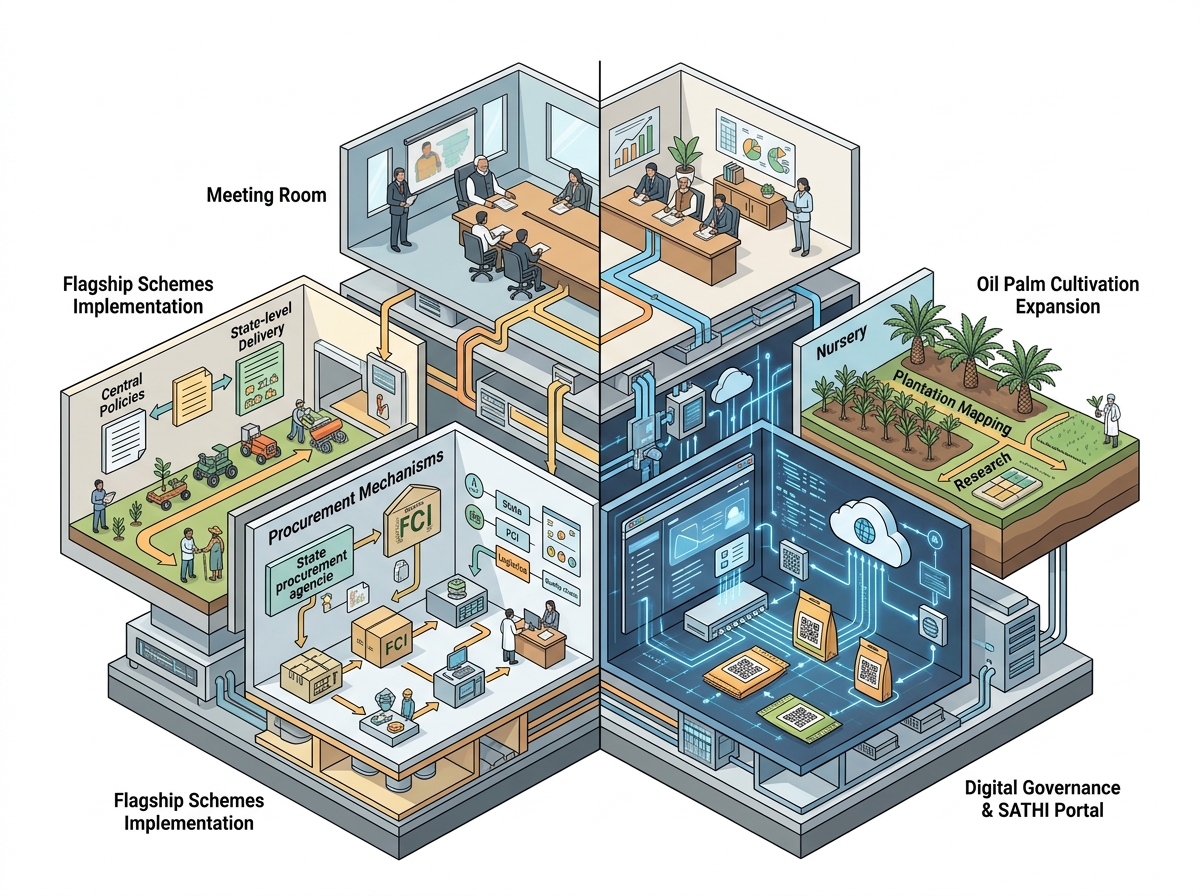
The meeting between the Union Minister of Agriculture and Farmers’ Welfare and the Agriculture Minister of Telangana on 2 September 2026 highlights the Centre-State coordination required for the implementation of flagship agricultural schemes, procurement mechanisms, and digital governance in the seed sector. The discussion underscores the operational challenges in expanding oil palm cultivation, ensuring MSP-backed procurement of pulses, and leveraging digital platforms such as the SATHI Portal for seed traceability. This dialogue reflects the federal structure of agricultural governance and the need for synchronised policy execution to enhance farmer welfare.
Background
- The agricultural sector in India operates under a federal framework where the Centre formulates policies and schemes while states implement them, necessitating regular inter-state and Centre-State consultations.
- Pulses and oilseeds are critical components of India’s food security and nutritional goals, with domestic production often falling short of demand, leading to periodic imports.
- The Minimum Support Price (MSP) mechanism is a key instrument to incentivise production and protect farmers from price volatility, particularly for pulses such as tur (pigeon pea), urad (black gram), and masoor (lentil).
- The Pradhan Mantri Annadata Aay SanraksHan Abhiyan (PM-AASHA) was launched in 2018 to ensure remunerative prices for farmers by enhancing procurement of pulses, oilseeds, and copra.
- Digital transformation in agriculture has gained momentum with initiatives like the SATHI Portal, which integrates the entire seed supply chain from production to certification and distribution.
- The National Mission on Oilseeds and Oil Palm (NMOOP) and the National Food Security Mission (NFSM) are central schemes aimed at increasing domestic production of oilseeds and pulses, respectively.
Key Agricultural Schemes, Mechanisms and Digital Initiatives Discussed in the Meeting
- **Minimum Support Price (MSP) for Pulses**: The Government of India guarantees MSP for tur, urad, and masoor at 100% procurement, while other pulses are procured up to 25% under PM-AASHA to stabilise prices and ensure farmer income security.
- Pradhan Mantri Annadata Aay SanraksHan Abhiyan (PM-AASHA): Launched in 2018, this scheme provides a safety net for farmers by enhancing procurement of pulses, oilseeds, and copra through Price Support Scheme (PSS), Price Deficiency Payment Scheme (PDPS), and Pilot of Private Procurement & Stockist Scheme (PPSS).
- National Mission on Oilseeds and Oil Palm (NMOOP): A centrally sponsored scheme to increase the production of oilseeds and oil palm through area expansion, productivity enhancement, and technology adoption, with a focus on regions such as Telangana.
- Krishonnati Yojana: An umbrella scheme comprising 11 sub-schemes for the holistic development of agriculture, including crop production, horticulture, and agricultural mechanisation, with ₹329 crore released to Telangana.
- SATHI Portal (Seed Traceability, Authentication and Holistic Inventory): A digital platform developed by the Ministry of Agriculture and Farmers’ Welfare to integrate the entire seed supply chain, ensuring traceability from production to certification, licensing, inventory management, and distribution to farmers.
- Federal Policy Coordination: The meeting exemplifies the Centre-State collaborative framework required for the effective implementation of agricultural schemes, where states like Telangana seek support for research stations, MSP for oil palm, and accelerated mission execution.
Key Features
| Feature | Significance |
|---|---|
| Minimum Support Price (MSP) for Pulses | Ensures price stability for farmers by guaranteeing procurement of tur (arhar), urad, and masoor at MSP, protecting them from market volatility and ensuring food security. |
| Pradhan Mantri Annadata Aay SanraksHan Abhiyaan (PM-AASHA) | Provides a safety net for pulse farmers by ensuring 25% procurement of other pulses, thereby stabilizing incomes and reducing distress sales. |
| Oil Palm Cultivation Support | Promotes domestic production of oilseeds to reduce import dependence, aligns with the National Mission on Edible Oils-Oil Palm (NMEO-OP), and supports farmer livelihoods in oil palm-growing regions. |
| National Agricultural Development Scheme (RKVY-RAFTAAR) | Enhances agricultural productivity and infrastructure by providing 100% central assistance to states, fostering inclusive growth in agriculture. |
| Kisan Urja Suraksha evam Utthaan Mahabhiyaan (KUSUM) (indirect linkage) | Supports agricultural modernization through solar-powered irrigation, reducing input costs and enhancing sustainability, though not directly mentioned in the meeting. |
| SATHI Portal for Seed Traceability | Digitizes the entire seed supply chain from production to certification and distribution, ensuring quality control, reducing fraud, and improving farmer access to certified seeds. |
Why it Matters
Economic Implications
- MSP for pulses ensures income security for farmers, particularly small and marginal holders, who dominate pulse cultivation in states like Telangana.
- PM-AASHA’s procurement mechanism stabilizes market prices and reduces post-harvest losses, directly impacting farmer welfare.
- Oil palm cultivation can diversify agricultural income sources in Telangana, where traditional crops face climate and market risks.
- Central funding under RKVY-RAFTAAR accelerates agricultural infrastructure development, bridging regional disparities in farm productivity.
Strategic and Policy Dimensions
- India’s self-reliance in edible oils is a strategic priority, with oil palm identified as a key crop under NMEO-OP to reduce import dependency on palm oil.
- The meeting underscores inter-state coordination in agricultural policy implementation, ensuring uniformity in scheme benefits across regions.
- Digitization of seed supply chains via SATHI Portal aligns with the broader goal of agricultural technology adoption to enhance efficiency and transparency.
- Focus on pulses and oilseeds reflects alignment with the government’s broader food security and nutrition security objectives.
Institutional and Governance Aspects
- Central-state collaboration in agricultural governance ensures equitable distribution of resources and policy benefits, as seen in the 100% release of RKVY funds to Telangana.
- The SATHI Portal exemplifies the use of technology to streamline governance, reduce leakages, and improve service delivery in agriculture.
- State-level initiatives, such as Telangana’s request for an oil palm research station, demonstrate demand-driven agricultural innovation and research.
Challenges
1. Price Volatility in Pulses
- Fluctuations in pulse prices due to supply-demand mismatches can erode farmer incomes despite MSP and procurement guarantees.
- Market distortions from imports or hoarding can undermine the effectiveness of MSP-based procurement mechanisms.
UPSC Link: Agricultural Price Policy
2. Low Productivity of Oil Palm in India
- India’s oil palm yields (4-5 tonnes/hectare) are significantly lower than global averages (20-25 tonnes/hectare), necessitating research and technological interventions.
- Limited availability of suitable high-yielding varieties and lack of large-scale mechanization hinder productivity growth.
UPSC Link: National Mission on Edible Oils-Oil Palm
3. Implementation Gaps in Agricultural Schemes
- Delays in fund disbursement or scheme rollout can reduce the intended impact on farmer welfare and agricultural productivity.
- Bureaucratic hurdles and lack of coordination between central and state agencies may impede the effective implementation of missions like PM-AASHA.
UPSC Link: Institutional Mechanisms for Policy Implementation
4. Seed Quality and Availability
- Substandard or counterfeit seeds reduce farm productivity and increase input costs for farmers, particularly in rainfed regions like Telangana.
- Limited access to certified seeds and poor traceability in the supply chain undermine the benefits of schemes like SATHI Portal.
UPSC Link: Seed Certification and Quality Control
5. Climate Change and Agricultural Resilience
- Increasing frequency of droughts and erratic rainfall in Telangana poses risks to pulse and oil palm cultivation, necessitating climate-resilient agricultural practices.
- Lack of integrated water management strategies can exacerbate water scarcity, impacting crop yields.
UPSC Link: Climate-Smart Agriculture
Challenges — UPSC Perspective
| Issue | Concern |
|---|---|
| Pulse Price Volatility | Market distortions and import dependence can undermine MSP-based procurement, reducing its effectiveness in income stabilization. |
| Oil Palm Productivity | Low yields and technological gaps limit the economic viability of oil palm cultivation in India. |
| Scheme Implementation Delays | Bureaucratic inefficiencies and inter-agency coordination issues may delay fund disbursement and reduce scheme impact. |
| Seed Supply Chain Gaps | Poor traceability and quality control in the seed sector lead to suboptimal farm inputs and reduced productivity. |
| Climate Vulnerability | Increasing climate variability threatens the stability of pulse and oil palm cultivation, necessitating adaptive strategies. |
| Regional Disparities | Uneven agricultural development across states may lead to inequitable access to scheme benefits and resources. |
Government Initiatives — Must-Memorise for Prelims
- Pradhan Mantri Annadata Aay SanraksHan Abhiyaan (PM-AASHA)
- National Mission on Edible Oils-Oil Palm (NMEO-OP)
- Rashtriya Krishi Vikas Yojana (RKVY-RAFTAAR)
- Kisan Urja Suraksha evam Utthaan Mahabhiyaan (KUSUM)
- Sub-Mission on Agricultural Mechanization (SMAM)
- National Food Security Mission (NFSM) – Pulses
- National Mission on Oilseeds and Oil Palm (NMOOP)
Way Forward
- Accelerate the establishment of oil palm research stations in Telangana to address productivity gaps and promote high-yielding varieties.
- Strengthen the SATHI Portal’s integration with state-level agricultural departments to ensure real-time seed traceability and certification.
- Enhance inter-state coordination through regular review meetings to address implementation challenges in PM-AASHA and other schemes.
- Promote climate-resilient agricultural practices, including drought-resistant pulse varieties and water-efficient irrigation for oil palm.
- Expand the coverage of MSP procurement for pulses beyond tur, urad, and masoor to include other high-value pulses, subject to market conditions.
- Increase investment in agricultural research and extension services to bridge the yield gap in oil palm and other oilseeds.
- Ensure timely disbursement of central funds under RKVY-RAFTAAR to states to avoid delays in agricultural infrastructure development.
- Conduct farmer awareness campaigns to educate stakeholders on the benefits of certified seeds and the SATHI Portal’s functionalities.
UPSC Value Addition
Keywords for Mains Answer-Writing
Minimum Support Price (MSP) · Pulses Mission · Oil Palm Mission · National Mission on Oilseeds and Oil Palm (NMOOP) · Pradhan Mantri Annadata Aay SanraksHan Abhiyaan (PM-AASHA) · National Agricultural Development Scheme (RKVY-RAFTAAR) · KisanSATHI Portal · Seed Traceability System · Agricultural Marketing and Farmer Welfare · Institutional Coordination in Agriculture · Research and Development in Oil Palm · Agricultural Infrastructure and Policy · Digital Agriculture · State-Level Agricultural Policy Coordination
Concept Flow
Central-State Policy Coordination → Implementation of Agricultural Schemes (PM-AASHA, RKVY-RAFTAAR) → Farmer Income Stabilization → Agricultural Productivity Enhancement → Food and Nutrition Security → MSP for Pulses → Procurement Under PM-AASHA → Market Price Stabilization → Farmer Welfare → Rural Economic Growth → Oil Palm Cultivation → Research Station Establishment → High-Yielding Varieties Adoption → Productivity Increase → Import Substitution → SATHI Portal Deployment → Seed Supply Chain Digitization → Quality Control → Farmer Access to Certified Seeds → Yield Improvement → Climate Change Impacts → Need for Climate-Resilient Crops → Research and Extension Services → Adaptive Agricultural Practices → Sustainable Farming
Prelims Practice Questions
Q1. Consider the following statements regarding the Pradhan Mantri Annadata Aay SanraksHan Abhiyaan (PM-AASHA):
1. PM-AASHA aims to ensure minimum support price (MSP) for pulses, oilseeds, and copra.
2. Under PM-AASHA, the government procures 100% of the produce of tur (arhar), urad, and masoor at MSP.
3. The scheme includes a Price Deficiency Payment System (PDPS) to compensate farmers for market price fluctuations.
How many of the above statements are correct?
- Only one
- Only two
- All
- None
Answer: All — Statements 1 and 3 are correct. Statement 2 is incorrect as the government procures 100% of tur, urad, and masoor at MSP under the Price Support Scheme (PSS), not PM-AASHA, which includes PDPS for other pulses and oilseeds.
Q2. Assertion (A): The KisanSATHI Portal is designed to integrate the entire seed supply chain from production to certification and sale to farmers.
Reason (R): The portal ensures seed traceability and automates processes to enhance transparency and efficiency in the seed sector.
Options:
A. Both A and R are true, and R is the correct explanation of A.
B. Both A and R are true, but R is not the correct explanation of A.
C. A is true, but R is false.
D. A is false, but R is true.
Answer: ? — Both Assertion (A) and Reason (R) are true, and Reason (R) correctly explains Assertion (A). The KisanSATHI Portal integrates the seed supply chain and ensures traceability through digital and automated processes.
Q3. Which of the following schemes is NOT directly related to the procurement of agricultural produce at Minimum Support Price (MSP)?
A. Price Support Scheme (PSS)
B. Price Deficiency Payment Scheme (PDPS)
C. Market Intervention Scheme (MIS)
D. National Mission on Sustainable Agriculture (NMSA)
- A
- B
- C
- D
Answer: D — The National Mission on Sustainable Agriculture (NMSA) focuses on sustainable agriculture practices and does not involve procurement of produce at MSP. The other options (PSS, PDPS, MIS) are directly related to MSP and procurement mechanisms.
Mains Practice Question
✍ The coordination between the Union and State governments is critical for the effective implementation of agricultural policies and schemes. In this context, critically examine the role of institutional mechanisms such as the KisanSATHI Portal, PM-AASHA, and the National Agricultural Development Scheme (RKVY-RAFTAAR) in ensuring farmer welfare and agricultural growth. (15 Marks)
Approach: MODEL-ANSWER SKELETON:
1. **Introduction (2 Marks)**: Briefly define institutional coordination in agriculture and its importance for policy implementation. Mention the constitutional provisions (Article 246 and 248) and the role of cooperative federalism in agriculture.
2. **KisanSATHI Portal (4 Marks)**:
– Explain the portal’s objective: integrating the seed supply chain (production, certification, licensing, inventory, and sale).
– Discuss its features: digitalization, automation, and traceability of seeds.
– Highlight its relevance for farmer welfare: ensuring quality seeds and reducing malpractices.
3. **PM-AASHA (4 Marks)**:
– Explain the scheme’s components: Price Support Scheme (PSS), Price Deficiency Payment Scheme (PDPS), and Market Intervention Scheme (MIS).
– Discuss its role in ensuring MSP for pulses, oilseeds, and copra.
– Critically examine its effectiveness: challenges in procurement, coverage, and market price fluctuations.
4. **RKVY-RAFTAAR (3 Marks)**:
– Explain the scheme’s objective: incentivizing states to enhance agricultural infrastructure and productivity.
– Discuss its financial outlay and implementation mechanism.
– Critically examine its impact: states’ performance, fund utilization, and outcomes for farmer welfare.
5. **Conclusion (2 Marks)**:
– Summarize the importance of institutional coordination in agriculture.
– Suggest measures to strengthen coordination: capacity building, data sharing, and technology adoption. Provide a balanced view on the effectiveness of these mechanisms.
Source: PIB (Press Information Bureau)
Telangana PCS (TGPSC (TSPSC)) — State PCS Practice
Prelims: Which of the following initiatives was discussed between Telangana’s Agriculture Minister T. Nageshwar Rao and Union Agriculture Minister Shivraj Singh Chouhan during their recent meeting in New Delhi?
- A. Promotion of natural farming under the ‘Bharatiya Prakritik Krishi Padhati (BPKP)’ scheme
- B. Implementation of the ‘Telangana Millet Mission’ for climate-resilient agriculture
- C. Expansion of the ‘Rythu Bandhu’ scheme to include horticulture crops
- D. Launch of a joint venture for exporting basmati rice to European markets
Answer: B. Implementation of the ‘Telangana Millet Mission’ for climate-resilient agriculture — The meeting focused on Telangana’s ‘Telangana Millet Mission,’ a flagship initiative to promote climate-resilient millet cultivation, aligning with national priorities for sustainable agriculture.
Mains: Discuss the significance of the ‘Telangana Millet Mission’ in the context of the state’s agricultural diversification and climate change mitigation strategies. Highlight its potential impact on farmer incomes and food security in Telangana.
Generated by AanyaAi for educational purpose.
Related guides on our sites
- Current affairs for upsc 2026
- How to prepare for GS paper 1 for UPSC CSE mains exam
- Best UPSC coaching for IFOS exam
- Best agriculture optional coaching

- India-Australia AUSTRAHIND 2026 Exercise: Key Highlights for UPSC & State PCS - October 22, 2026
- एससीओ बैठक में भारत का आतंकवाद विरोध: क्षेत्रीय सहयोग पर जोर - October 22, 2026
- SEC Directs Strict SC Order Compliance for Andhra ULB Polls - October 22, 2026

No Comments