


03 Sep Assam Speaker Meets Union Minister Dr. Jitendra Singh: Key Discussions on State’s Rapid Development
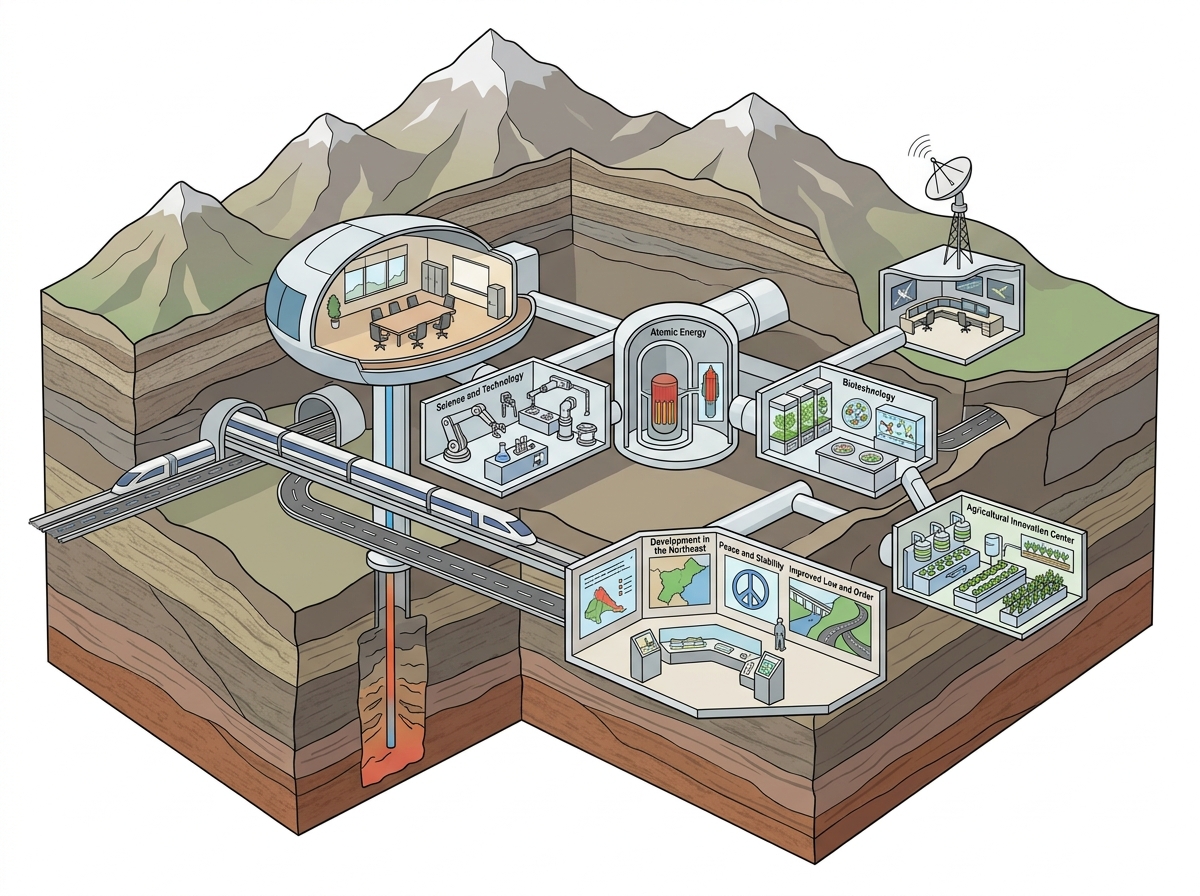
✎ Assam’s transformation from a conflict-affected state to a development-driven entity is facilitated by Centre-state collaborations in science, technology, and innovation, with institutions like DST, DBT, DoS, and DAE playing…
Subject Relevance — Where This Topic Fits
- GS Paper II — Polity and Governance (State-Centre Relations, Inter-State Council) | GS Paper III — Science and Technology (Government Initiatives, Space and Atomic Energy Applications) | GS Paper III — Economic Development (Regional Development, Infrastructure and Innovation)
- Prelims: Assam Legislative Assembly Speaker, Ministry of Science and Technology, Department of Space (DoS), Department of Atomic Energy (DAE), Department of Biotechnology (DBT), Department of Science and Technology (DST), Geospatial Technology, Northeast Region (NER) Development, Assam Accord, Look East Policy, Act East Policy
- Essay: Regional Development and National Integration: The Case of Assam, Science and Technology as Catalysts for Socio-Economic Transformation
Quick Revision: Assam’s transformation from a conflict-affected state to a development-driven entity is facilitated by Centre-state collaborations in science, technology, and innovation, with institutions like DST, DBT, DoS, and DAE playing pivotal roles in leveraging geospatial, space, and atomic energy technologies for regional growth.
Why is this in the news?
The meeting between the Speaker of the Assam Legislative Assembly and the Union Minister of State (Independent Charge) for Science and Technology, Dr. Jitendra Singh, highlights Assam’s evolving governance landscape and its integration into India’s development trajectory through science, technology, and innovation-driven policies. This interaction underscores the Centre’s strategic focus on leveraging Assam’s potential in space, atomic energy, and biotechnology to address developmental challenges in the Northeast, particularly in remote and hilly regions.
Background
- Assam, historically a focal point of insurgency and socio-political unrest, has undergone significant transformation over the past decade, marked by improved law and order, peace accords, and accelerated development.
- Assam’s geographical location, with extensive river systems and hilly terrains, necessitates innovative solutions in disaster management, agriculture, and connectivity, where geospatial and space technologies play a critical role.
- The Department of Space (DoS) and the Department of Atomic Energy (DAE) have been deploying satellite-based applications and atomic energy projects to enhance governance, agriculture, and energy security in remote regions.
Institutional and Policy Frameworks Enabling Assam’s Technological Development
- **Department of Science and Technology (DST)**: DST implements schemes such as the Technology Development Board (TDB) to promote innovation and technology adoption in states like Assam. These initiatives align with Assam’s focus on startups and scientific research.
- **Department of Biotechnology (DBT)**: DBT’s programmes, including the Biotechnology Industry Partnership Programme (BIPP) and the North East Biodiversity Programme, aim to harness Assam’s rich biodiversity for economic and environmental benefits, particularly in healthcare and agriculture.
- **Department of Space (DoS)**: DoS operates satellite-based services like the Indian Remote Sensing (IRS) satellites and the Indian Regional Navigation Satellite System (IRNSS) to support disaster management, agriculture, and infrastructure development in Assam’s remote areas.
- **Department of Atomic Energy (DAE)**: DAE’s projects, such as the Kaiga Atomic Power Station in Karnataka and research reactors, provide a model for leveraging atomic energy in energy-deficient regions. Assam’s integration into such initiatives could enhance its energy security and industrial growth.
- **Geospatial Technology**: Geospatial tools, including GIS and remote sensing, are critical for Assam’s flood management, land-use planning, and infrastructure monitoring. The National Geospatial Policy (2022) facilitates the use of such technologies for governance and development.
- **State-Centre Coordination**: The interaction between Assam’s Legislative Assembly Speaker and the Union Minister exemplifies the constitutional mechanism of inter-governmental dialogue, ensuring policy alignment between the Centre and the state for inclusive development.
- **Assam’s Startup Ecosystem**: Assam’s emerging startup ecosystem, supported by state-level initiatives, focuses on agri-tech, clean energy, and digital solutions, aligning with the Centre’s ‘Startup India’ mission.
- **Disaster Resilience**: Assam’s vulnerability to floods and landslides necessitates the integration of space-based monitoring and early warning systems, as envisaged under the National Disaster Management Authority (NDMA) guidelines.
Key Features
| Feature | Significance |
|---|---|
| Technology-driven development in Assam | Leveraging science, space and biotechnology for rapid socio-economic transformation in the northeastern state. |
| Integration of remote and hilly regions | Use of geospatial technology, space and atomic energy applications for development planning, disaster management and agricultural productivity. |
| Expansion of science and technology infrastructure | Strengthening R&D facilities, start-up ecosystems and innovation hubs to foster local entrepreneurship and youth engagement. |
| Decadal peace and stability in Assam | Restoration of law and order enabling sustained development, integration with national mainstream and reduced insurgency-related disruptions. |
| Central government’s proactive role | Direct oversight by the Prime Minister’s Office ensuring timely execution of projects and policy interventions in Assam. |
Why it Matters
Economic Transformation
- Assam’s shift from conflict-prone to growth-oriented economy, unlocking investment potential in agriculture, industry and services.
- Integration with national supply chains and markets, reducing logistical bottlenecks through improved connectivity and infrastructure.
- Emergence of Assam as a key node in India’s Act East Policy and North-East connectivity corridors.
Strategic Importance
- Enhanced territorial integrity and stability in the northeastern region, reducing external security vulnerabilities.
- Strengthening India’s presence in the Bay of Bengal region through improved infrastructure and connectivity.
- Leveraging Assam’s geographical position for energy security and trade facilitation with South-East Asia.
Scientific and Technological Advancement
- Acceleration of R&D in biotechnology, space and atomic energy, aligning with national missions like Atal Innovation Mission and National Mission on Interdisciplinary Cyber-Physical Systems.
- Development of local talent pools through STEM education initiatives and incubation centres.
- Application of space-based technologies for natural resource mapping, disaster risk reduction and precision agriculture.
Social Development
- Improved human development indices through better healthcare, education and livelihood opportunities.
- Reduction in poverty and inequality via targeted welfare schemes and inclusive growth policies.
- Enhanced social cohesion and reduced insurgency-related displacements, fostering community resilience.
Challenges
1. Infrastructure Deficit in Remote Areas
- Limited access to reliable power, digital connectivity and transportation in hilly and tribal regions.
- High cost of last-mile connectivity projects due to difficult terrain and environmental constraints.
UPSC Link: GS3: Infrastructure
2. Skill Mismatch and Youth Unemployment
- Low employability of local youth despite increasing educational attainment, due to mismatch with industry requirements.
- Need for vocational training and upskilling aligned with emerging sectors like biotechnology and space technology.
UPSC Link: GS3: Employment
3. Climate Vulnerability and Disaster Risk
- High exposure to floods, landslides and earthquakes, exacerbated by climate change and unplanned urbanisation.
- Limited institutional capacity for early warning systems and resilient infrastructure development.
UPSC Link: GS3: Disaster Management
4. Regional Disparities within Assam
- Concentration of development in urban centres like Guwahati, leaving rural and tribal areas underdeveloped.
- Need for equitable resource allocation and participatory governance to address intra-state inequalities.
UPSC Link: GS2: Governance
5. Sustainable Resource Management
- Pressure on natural resources due to rapid industrialisation and agricultural expansion, risking ecological degradation.
- Balancing economic growth with conservation goals, particularly in biodiversity-rich regions like Kaziranga and Manas.
UPSC Link: GS3: Environment
Challenges — UPSC Perspective
| Issue | Concern |
|---|---|
| Limited STEM education penetration | Low awareness and participation in science and technology programmes among rural and tribal youth. |
| Dependence on external expertise | Over-reliance on non-local professionals for high-tech projects, limiting local capacity building. |
| Policy implementation gaps | Delays in approvals and land acquisition for infrastructure projects, affecting timelines and cost-efficiency. |
| Climate-induced migration | Increased displacement due to extreme weather events, straining urban infrastructure and social services. |
| Digital divide | Uneven access to broadband and digital platforms, hindering e-governance and remote learning initiatives. |
Way Forward
- Accelerate the establishment of Assam Science and Technology Parks in collaboration with IITs, IISc and private sector to foster innovation ecosystems.
- Expand the reach of STEM education through mobile labs, digital classrooms and teacher training programmes in rural and tribal districts.
- Strengthen disaster resilience by integrating geospatial technology with local governance for real-time monitoring and early warning systems.
- Promote public-private partnerships for last-mile connectivity projects, leveraging space and atomic energy applications for remote areas.
- Enhance skill development initiatives under the Skill India Mission, aligning curricula with emerging sectors like biotechnology and space technology.
- Implement integrated watershed management programmes to address climate vulnerability and improve agricultural productivity.
- Establish a dedicated Assam Innovation Fund to support grassroots startups and entrepreneurs in science and technology domains.
- Develop a state-level innovation index to benchmark Assam’s progress and identify areas for targeted intervention.
UPSC Value Addition
Keywords for Mains Answer-Writing
Assam’s developmental trajectory · Science and Technology interventions in North-East · Role of central ministries in regional development · Geospatial technology for disaster management · Biotechnology and start-up ecosystems in Assam · Atomic and space technology applications in remote regions · Integration of North-Eastern states in India’s development narrative · Peace and development linkages in Assam · Department of Science and Technology (DST) programmes · Department of Biotechnology (DBT) initiatives
Concept Flow
Historical insurgency and underdevelopment in Assam → Restoration of peace and stability through central and state interventions → Shift towards development-centric governance → Integration with national mainstream and Act East Policy → Leveraging science and technology for rapid transformation → Expansion of infrastructure and innovation ecosystems → Emergence of Assam as a key growth engine in the northeastern region → Sustained socio-economic progress and global competitiveness.
Prelims Practice Questions
Q1. Consider the following statements regarding the Department of Science and Technology (DST) and its initiatives in the North-Eastern region of India:
1. DST administers the National Innovation Foundation (NIF) to promote grassroots innovations.
2. The DST’s ‘North East Centre for Technology Application and Reach (NECTAR)’ focuses on leveraging technology for societal applications in the region.
3. The DST’s ‘Young Scientist Programme’ exclusively targets students from the North-Eastern states.
How many of the above statements are correct?
- Only one
- Only two
- All three
- None
Answer: Only two — Statement 1 is correct: NIF is an autonomous body under DST. Statement 2 is correct: NECTAR is a DST initiative for technology application in the North-East. Statement 3 is incorrect: The Young Scientist Programme is open to all Indian students, not exclusively to those from the North-East.
Q2. Assertion (A): The Department of Biotechnology (DBT) under the Ministry of Science and Technology has launched the ‘Biotech Ignition Grant (BIG) Scheme’ to support early-stage biotechnology start-ups.
Reason (R): The BIG Scheme aims to foster innovation and entrepreneurship in biotechnology by providing financial and mentorship support to eligible start-ups.
In the context of the above two statements, which one of the following is correct?
- Both A and R are true, and R is the correct explanation of A.
- Both A and R are true, but R is not the correct explanation of A.
- A is true, but R is false.
- A is false, but R is true.
Answer: Both A and R are true, and R is the correct explanation of A. — Both the Assertion and Reason are true, and the Reason correctly explains the Assertion. The BIG Scheme is indeed a DBT initiative to support biotechnology start-ups with funding and mentorship.
Q3. Which of the following departments under the Government of India is primarily responsible for the development and promotion of space technology applications for societal benefits in remote and mountainous regions?
- Department of Space (DoS)
- Indian Space Research Organisation (ISRO)
- Department of Science and Technology (DST)
- Ministry of Earth Sciences
Answer: Department of Space (DoS) — The Department of Space (DoS) is the nodal agency for space technology applications in India, including initiatives for remote and mountainous regions. ISRO is the operational arm under DoS.
Mains Practice Question
✍ Assam’s rapid transformation from a region associated with insurgency and underdevelopment to a hub of technological advancement and economic integration reflects a broader shift in India’s developmental paradigm. Critically examine the role of science and technology (S&T) interventions in driving this transformation, with particular reference to the initiatives discussed in the recent interaction between the Assam Legislative Assembly Speaker and the Union Minister of State (Independent Charge) for Science and Technology. Also, assess the potential of such interventions to address the unique challenges of North-Eastern states. (15 Marks)
Approach: MODEL-ANSWER SKELETON:
1. **Introduction (2 marks)**
– Briefly outline Assam’s developmental trajectory over the past decade, highlighting the shift from conflict to stability and growth.
– State the centrality of S&T interventions in this transformation, as highlighted in the interaction.
2. **Key S&T Interventions in Assam (5 marks)**
– **Department of Science and Technology (DST):** Role of NECTAR (North East Centre for Technology Application and Reach) in leveraging technology for societal applications, including disaster management and agricultural productivity.
– **Department of Biotechnology (DBT):** Initiatives like the Biotech Ignition Grant (BIG) Scheme to foster biotechnology start-ups and innovation ecosystems.
– **Department of Space (DoS) and ISRO:** Application of geospatial technology, satellite data, and remote sensing for mapping, disaster preparedness, and resource management in remote regions.
– **Atomic Energy Department:** Use of nuclear technologies for healthcare, agriculture, and energy in remote areas.
– **Start-up and Innovation Ecosystems:** Promotion of entrepreneurship through incubators, accelerators, and funding schemes.
3. **Challenges Addressed by S&T Interventions (4 marks)**
– **Geographical Challenges:** Hilly and remote terrain, connectivity issues, and vulnerability to natural disasters.
– **Economic Challenges:** Low industrial base, limited access to markets, and high unemployment.
– **Social Challenges:** Bridging the digital divide, improving healthcare access, and promoting inclusive growth.
– **Institutional Challenges:** Strengthening local governance, capacity building, and ensuring equitable distribution of benefits.
4. **Critical Assessment (3 marks)**
– **Successes:** Highlight tangible outcomes such as improved disaster management, increased agricultural productivity, and growth in start-ups.
– **Limitations:** Discuss challenges like limited funding, bureaucratic hurdles, lack of awareness, and the need for greater private sector participation.
– **Sustainability:** Evaluate the long-term viability of these interventions, including the role of public-private partnerships and community engagement.
5. **Conclusion (1 mark)**
– Summarize the transformative potential of S&T interventions in Assam and the North-East.
– Emphasize the need for a holistic, inclusive, and sustainable approach to ensure that the benefits of development reach all sections of society.
Source: PIB (Press Information Bureau)
Assam PCS (APSC) — State PCS Practice
Prelims: Who is the current Speaker of the Assam Legislative Assembly as of 2024, who recently met Union Minister Dr. Jitendra Singh?
- Biswajit Daimary
- Phani Bhushan Choudhury
- Ranjit Kumar Dass
- Nandita Das
Answer: Phani Bhushan Choudhury — Phani Bhushan Choudhury is the incumbent Speaker of the Assam Legislative Assembly, who met Union Minister Dr. Jitendra Singh to discuss developmental projects in Assam.
Mains: Discuss the constitutional role and functions of the Speaker of the Assam Legislative Assembly. How does this role contribute to the smooth functioning of the state legislature? Provide relevant examples from recent legislative activities in Assam.
Generated by AanyaAi for educational purpose.
Related guides on our sites
- Current affairs for upsc 2026
- How to prepare for GS paper 1 for UPSC CSE mains exam
- Best UPSC coaching for IFOS exam
- Best mentorship programme for upsc


No Comments