


03 Sep Mission Samarthya: Smart Classrooms Transform Rural Rajasthan’s Baran
✎ Mission Samarthya exemplifies how district-level governance and CSR-funded public-private partnerships can operationalise the Right to Education Act’s mandate for equitable access to quality digital education in rural India.
Subject Relevance — Where This Topic Fits
- GS Paper II — Governance, Transparency and Accountability | GS Paper III — Human Resource Development and Education
- Prelims: Smart classrooms, Digital infrastructure in education, NITI Aayog’s Aspirational Districts Programme, Rashtriya Madhyamik Shiksha Abhiyan (RMSA), NTPC’s CSR initiatives in education
- Essay: The role of public-private partnerships in bridging rural-urban educational divides, Technology as an enabler of inclusive development in India
Quick Revision: Mission Samarthya exemplifies how district-level governance and CSR-funded public-private partnerships can operationalise the Right to Education Act’s mandate for equitable access to quality digital education in rural India.
Why is this in the news?
The initiative has been highlighted as a model for integrating smart learning technologies in government schools in rural districts, demonstrating how district-level administration and public-sector enterprises can collaborate to enhance educational equity. The deployment of smart classrooms in 11 Samarthya Kendras across Baran district underscores the potential of digital infrastructure to reduce dependency on urban coaching hubs and mitigate educational migration from rural areas.
Background
- The Rashtriya Madhyamik Shiksha Abhiyan (RMSA), launched in 2009, aims to enhance access to secondary education and improve its quality across India, particularly in rural and underserved regions.
- The NITI Aayog’s Aspirational Districts Programme (ADP), initiated in 2018, focuses on improving socio-economic indicators in 112 most backward districts, including Baran in Rajasthan, through targeted interventions in health, education, and infrastructure.
- Public-private partnerships (PPPs) have emerged as a key strategy in India’s education sector, with corporate social responsibility (CSR) funds being utilised to bridge gaps in digital and physical infrastructure, especially in rural areas.
- The Right to Education (RTE) Act, 2009, mandates equitable access to quality education, including provisions for digital learning resources in government schools.
- Rajasthan’s state education policy emphasises the integration of technology in classrooms to address disparities between rural and urban educational outcomes.
What is Mission Samarthya?
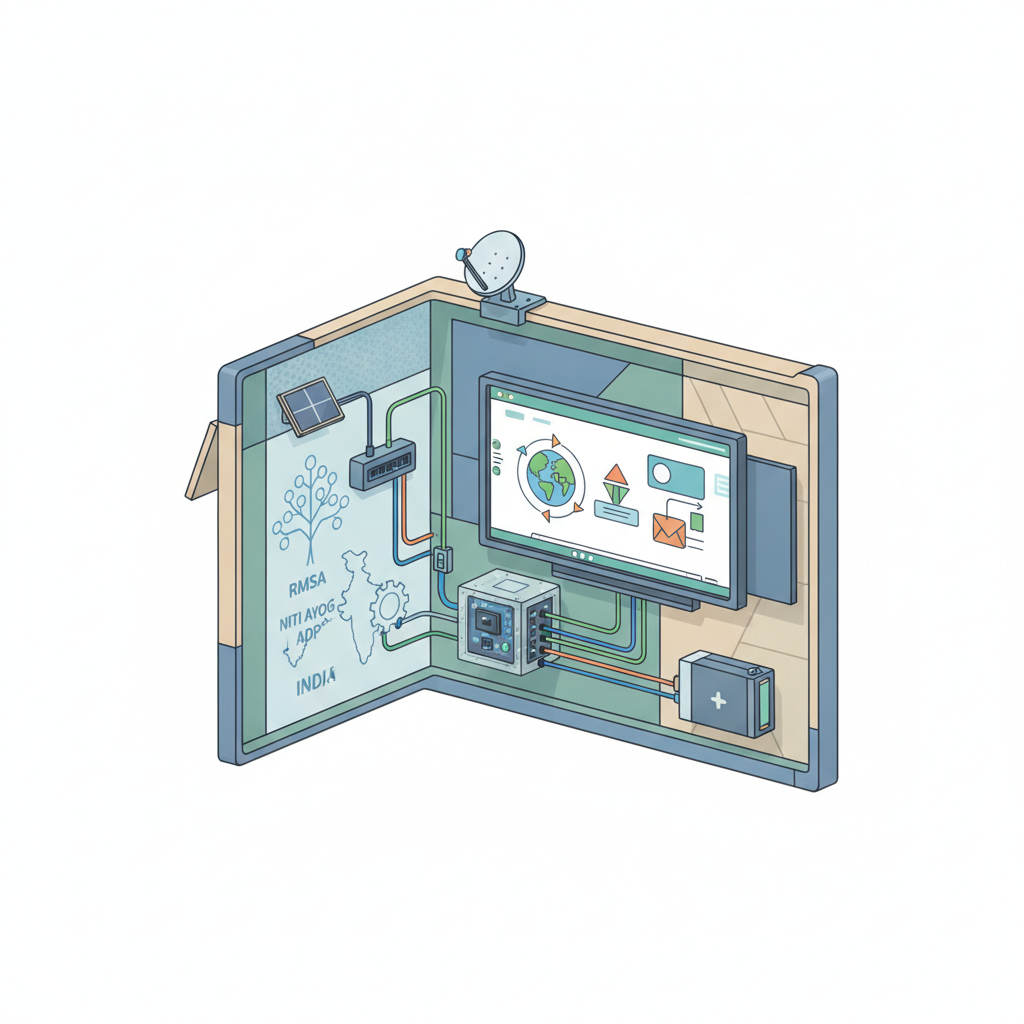
- Mission Samarthya is a district-level initiative in Baran, Rajasthan, aimed at transforming 11 senior secondary government schools into ‘Samarthya Kendras’ equipped with smart classrooms and digital learning infrastructure.
- The programme is a collaborative effort between the Baran district administration and the National Thermal Power Corporation (NTPC), leveraging NTPC’s CSR funds for infrastructure development and capacity building.
- Smart classrooms under the initiative include interactive whiteboards, high-speed internet connectivity, digital content repositories, and teacher training modules to facilitate modern pedagogical practices.
- The primary objective is to provide urban-grade educational resources in rural settings, thereby reducing the need for students to migrate to urban coaching hubs for competitive examinations or advanced studies.
- The initiative aligns with the broader goals of the Rashtriya Madhyamik Shiksha Abhiyan (RMSA) and the NITI Aayog’s Aspirational Districts Programme, targeting educational equity and quality improvement in backward districts.
- Digital learning resources are curated to align with the state and national curriculum, ensuring relevance and compliance with educational standards.
- The programme includes periodic assessments and feedback mechanisms to monitor the effectiveness of smart classrooms and address implementation challenges.
- By fostering a culture of self-learning and digital literacy, the initiative aims to empower rural students to compete on par with their urban counterparts in academic and competitive examinations.
UPSC Value Addition
Keywords for Mains Answer-Writing
Mission Samarthya · smart classrooms · rural education infrastructure · NTPC-CSR initiatives · digital learning in government schools · Baran district Rajasthan · public-private partnership in education · coaching hub migration · Samarthya Kendras · NEP 2020 digital education · equity in education · school transformation · ICT in education · district administration-led education reforms
Prelims Practice Questions
Q1. Consider the following statements about ‘Mission Samarthya’ in Rajasthan:
1. It is a joint initiative by the Baran district administration and the NTPC.
2. The programme converts senior secondary schools into Samarthya Kendras.
3. It aims to eliminate the need for rural students to migrate to coaching hubs.
4. The initiative is funded entirely by the State Government of Rajasthan.
How many of the above statements are correct?
- Only one
- Only two
- Only three
- All
Answer: Only three — Statements 1, 2, and 3 are correct. Statement 4 is incorrect as the programme involves the NTPC, indicating a public-private partnership funding model.
Q2. Assertion (A): ‘Mission Samarthya’ aligns with the National Education Policy 2020’s vision for digital education.
Reason (R): The initiative introduces smart learning setups in government schools to enhance educational infrastructure.
Options:
A. Both A and R are true, and R is the correct explanation of A.
B. Both A and R are true, but R is not the correct explanation of A.
C. A is true, but R is false.
D. A is false, but R is true.
Answer: ? — Both Assertion (A) and Reason (R) are true. The introduction of smart learning setups in government schools is a direct implementation of NEP 2020’s emphasis on digital education and equitable access to quality learning resources.
Q3. Match the following initiatives with their respective objectives:
Column I (Initiative) | Column II (Objective)
1. Mission Samarthya | A. Providing smart classrooms in rural government schools
2. DIKSHA Platform | B. Offering digital infrastructure to government schools
3. PM eVIDYA | C. Facilitating online and on-air education for classes 1-12
4. Sarva Shiksha Abhiyan | D. Universalising elementary education
Options:
A. 1-A, 2-B, 3-C, 4-D
B. 1-B, 2-A, 3-C, 4-D
C. 1-A, 2-C, 3-B, 4-D
D. 1-A, 2-B, 3-D, 4-C
Answer: ? — The correct match is: 1-A (Mission Samarthya aims to provide smart classrooms in rural government schools), 2-B (DIKSHA Platform offers digital infrastructure), 3-C (PM eVIDYA facilitates online and on-air education), and 4-D (Sarva Shiksha Abhiyan focuses on universalising elementary education).
Mains Practice Question
✍ The introduction of smart learning infrastructures in rural government schools through initiatives like ‘Mission Samarthya’ represents a paradigm shift in India’s approach to educational equity. Critically examine the potential of such initiatives to bridge the urban-rural divide in education, with reference to the National Education Policy 2020 and recent government schemes. (15 Marks)
Approach: MODEL-ANSWER SKELETON:
1. **Context and Objective**: Define ‘Mission Samarthya’ and its goal of eliminating the need for rural students to migrate to coaching hubs by providing urban-grade educational infrastructure in rural schools.
2. **NEP 2020 Alignment**: Discuss how the initiative aligns with NEP 2020’s emphasis on equitable access to quality education, digital learning, and the integration of technology in classrooms (e.g., DIKSHA Platform, PM eVIDYA).
3. **Government Schemes and Frameworks**: Reference the broader ecosystem of schemes such as the Samagra Shiksha Abhiyan, which aims to improve school infrastructure, and the National Digital Education Architecture (NDEAR) for digital governance in education.
4. **Challenges and Criticisms**:
– **Implementation Gaps**: Highlight issues like uneven digital infrastructure, teacher training deficits, and the digital divide in rural areas.
– **Sustainability**: Discuss the long-term viability of such initiatives, including funding models (e.g., CSR contributions from NTPC) and the need for state-level commitment.
– **Equity vs. Quality Trade-off**: Examine whether the focus on smart classrooms risks overshadowing foundational literacy and numeracy, especially in early grades.
5. **Comparative Perspective**: Briefly compare India’s approach with global models, such as UNESCO’s ‘Global Education Coalition’ or Finland’s equity-focused education reforms, to contextualise the initiative.
6. **Way Forward**: Propose measures to enhance the effectiveness of such initiatives, including:
– Strengthening teacher capacity through targeted training programs.
– Ensuring last-mile connectivity and device availability in rural schools.
– Integrating community participation and local governance (e.g., Panchayati Raj Institutions) for grassroots ownership.
7. **Conclusion**: Summarise that while ‘Mission Samarthya’ is a commendable step toward reducing urban-rural disparities, its success hinges on addressing systemic challenges and ensuring inclusive implementation.
Source: Hindustan Times
Rajasthan PCS (RPSC / RAS) — State PCS Practice
Prelims: Under the ‘Mission Samarthya’ initiative, which district of Rajasthan has been selected to introduce smart learning in rural classrooms?
- A. Jaipur
- B. Baran
- C. Jodhpur
- D. Udaipur
Answer: B. Baran — ‘Mission Samarthya’ is specifically implemented in rural classrooms of Baran district to enhance smart learning.
Mains: Discuss the significance of ‘Mission Samarthya’ in bridging the digital divide in rural education in Rajasthan, with special reference to Baran district. Highlight its objectives, implementation strategies, and potential impact on students’ learning outcomes.
Generated by AanyaAi for educational purpose.
Related guides on our sites
- Current affairs for upsc 2026
- Best PSIR optional coaching for upsc
- Best PSIR optional teacher for upsc
- Best teacher of PSIR optional for upsc


No Comments