


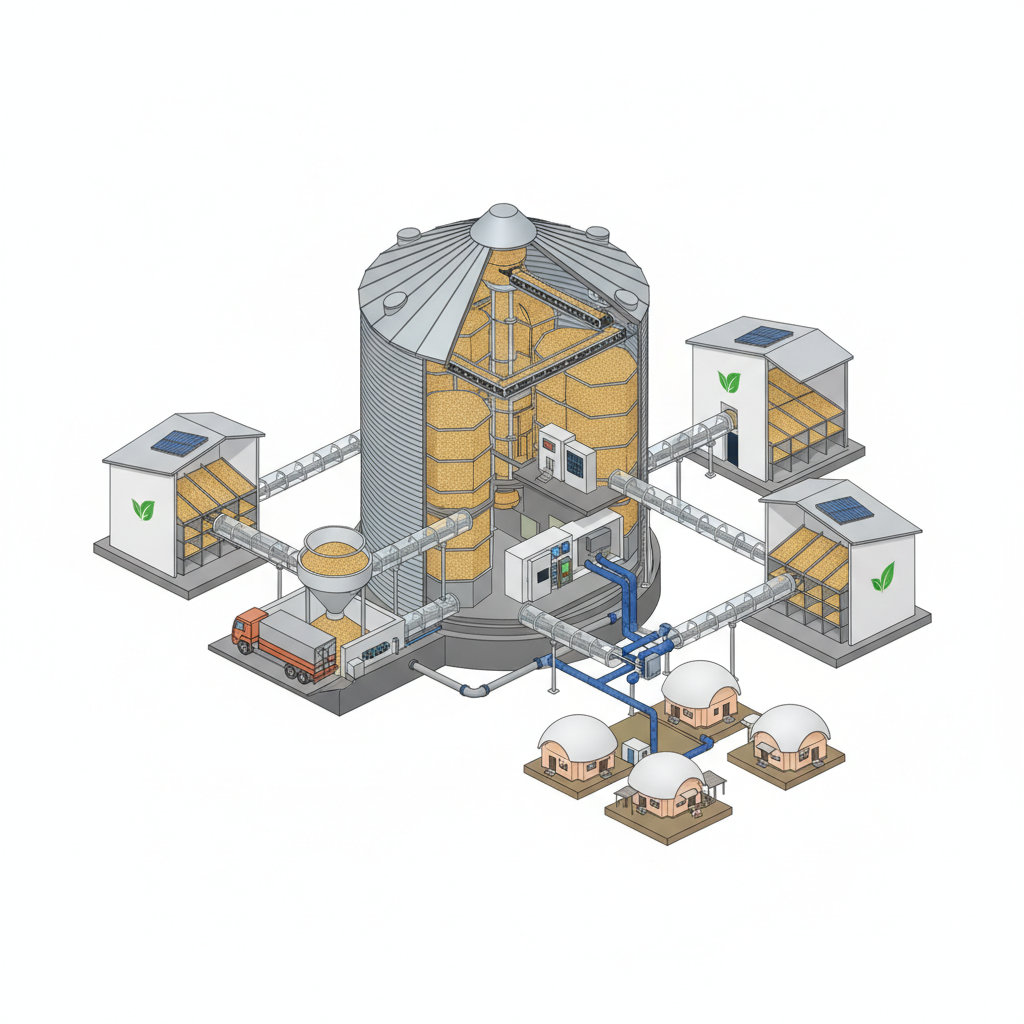
03 Sep UPSC Focus: Decentralized Grain Storage Scheme for Food Security
✎ The Decentralised Grain Storage Scheme integrates existing central schemes—AIF, AMI, SMAM, and PMFME—into a cooperative-driven framework to build 1.80 lakh metric tonnes of storage capacity at PACS levels by July 2026, aiming to…
Subject Relevance — Where This Topic Fits
- GS Paper II — Governance, Administration and Challenges (Decentralised Public Delivery Systems) | GS Paper III — Agriculture (Post-Harvest Management, Food Processing and Storage Infrastructure)
- Prelims: Food Corporation of India (FCI), National Food Security Act, 2013, Agricultural Infrastructure Fund (AIF), Agricultural Marketing Infrastructure Scheme (AMI), State Warehousing Corporations, Primary Agricultural Credit Societies (PACS), Silos, Minimum Support Price (MSP), Food Processing Industries (FPI)
- Essay: Decentralisation as a Governance Imperative: Balancing Scale and Inclusion in Public Policy, Sustainable Agricultural Development: The Role of Infrastructure and Institutional Synergy
Quick Revision: The Decentralised Grain Storage Scheme integrates existing central schemes—AIF, AMI, SMAM, and PMFME—into a cooperative-driven framework to build 1.80 lakh metric tonnes of storage capacity at PACS levels by July 2026, aiming to reduce post-harvest losses and enhance food security.
Why is this in the news?
The initiative to strengthen decentralised grain storage through the cooperative sector has gained prominence as India’s agricultural production continues to rise, with the third advance estimates for 2025-26 projecting total foodgrain output at 376.563 million tonnes—a 5.3% increase over the previous year. This growth underscores the need for a robust, decentralised storage network to reduce post-harvest losses, enhance food security, and optimise supply chains, particularly in rural and peri-urban areas where Primary Agricultural Credit Societies (PACS) serve as critical nodal institutions.
Background
- India’s foodgrain production has grown to an estimated 376.563 million tonnes in 2025-26, with the previous year’s production at 357.732 million tonnes, reflecting sustained agricultural growth.
- The National Food Security Act (NFSA), 2013, covers approximately 80 crore beneficiaries, making food security a policy priority.
- Traditional storage methods—such as mud vessels, underground pits, and lime-plastered structures—remain prevalent but are increasingly supplemented by modern silos and warehouse infrastructure.
- Centralised storage infrastructure managed by the Food Corporation of India (FCI) and state agencies plays a pivotal role in buffer stock management and public distribution.
- Decentralised storage at the local level reduces transportation costs, minimises grain wastage, and empowers farmers to retain produce for better market timing.
- The Union Ministry of Cooperation has identified PACS as key institutions for decentralised storage, leveraging their grassroots presence and financial intermediation capabilities.
What is the Decentralised Grain Storage Scheme in the Cooperative Sector?
- A scheme launched on 31 May 2023 as a pilot project to strengthen decentralised grain storage through Primary Agricultural Credit Societies (PACS).
- Aims to integrate existing government schemes—such as the Agricultural Infrastructure Fund (AIF), Agricultural Marketing Infrastructure Scheme (AMI), Sub-Mission on Agricultural Mechanisation (SMAM), and PM Formalisation of Micro Food Processing Enterprises Scheme (PMFME)—into a unified, cooperative-driven framework.
- Focuses on constructing warehouses and silos at PACS levels to enhance storage capacity, with an emphasis on quality standards, transparency, and operational viability.
- Seeks to reduce post-harvest losses, improve food security, and enable farmers to secure better prices by avoiding distress sales.
- Expands the role of PACS beyond credit provision to include storage, processing, procurement, and distribution functions, thereby diversifying rural livelihoods.
- Leverages financial instruments such as interest subsidies (AIF) and capital grants (AMI) to make storage infrastructure economically viable for cooperatives.
- Targets 11 states in its pilot phase, with initial storage capacity of 9,750 metric tonnes, later scaled to 1.80 lakh metric tonnes across 313 PACS by July 2026.
- Aligns with the broader goal of doubling farmers’ income by promoting value addition and reducing market inefficiencies through decentralised infrastructure.
Key Features
| Feature | Significance |
|---|---|
| Decentralised Storage Infrastructure | Reduces post-harvest losses by establishing local storage facilities near production centres, enhancing food security. |
| Cooperative Framework (PACS) | Leverages existing Primary Agricultural Credit Societies for efficient storage, procurement, and distribution, ensuring grassroots participation. |
| Integrated Policy Convergence | Merges multiple schemes (AIF, AMI, PMFME) to create a unified, multi-pronged approach for storage and value addition. |
| Quality and Transparency Standards | Emphasises adherence to scientific storage norms, reducing contamination and ensuring fair pricing for farmers. |
| Transport Cost Reduction | Minimises logistical expenses by decentralising storage, enabling direct procurement from nearby centres. |
Why it Matters
Economic
- Enhances farmer income by enabling staggered sales, reducing distress sales during peak harvest seasons.
- Lowers storage and transport costs for government procurement agencies, improving fiscal efficiency in food security operations.
- Stimulates rural employment through cooperative-led storage, processing, and marketing activities.
Strategic
- Strengthens India’s food security by decentralising storage, reducing dependency on centralised silos vulnerable to logistical disruptions.
- Supports climate-resilient agriculture by integrating modern storage with traditional methods to mitigate spoilage risks.
- Aligns with global best practices in post-harvest management, positioning India as a model for sustainable food systems.
Institutional
- Reinforces the role of PACS as multi-functional rural institutions, extending beyond credit to include storage, processing, and market linkages.
- Fosters cooperative federalism by enabling state-level agencies and central schemes to collaborate seamlessly.
- Promotes transparency and accountability in food distribution through standardised storage and procurement protocols.
Agricultural
- Facilitates diversification of agricultural activities by integrating storage with processing and marketing, enhancing value addition.
- Reduces post-harvest losses, which currently account for 6-18% of total production, directly boosting food availability.
- Supports climate-smart agriculture by enabling better handling of perishable produce in high-temperature regions.
Challenges
1. Land and Infrastructure Constraints
- Limited availability of suitable land for warehouse construction in densely populated agricultural regions.
- High capital costs for setting up modern storage facilities, including silos and cold chains, in remote areas.
- Regulatory hurdles in land acquisition and zoning for cooperative-led storage projects.
UPSC Link: GS3: Agricultural Marketing & Infrastructure
2. Financial Viability of PACS
- Many PACS lack technical and managerial capacity to operate large-scale storage facilities efficiently.
- Dependence on government subsidies creates sustainability challenges post-implementation.
- Limited access to credit for PACS to invest in storage infrastructure and technology upgrades.
UPSC Link: GS3: Cooperative Societies & Rural Credit
3. Technological Adoption
- Low penetration of modern storage technologies (e.g., aeration systems, moisture control) in rural cooperatives.
- Resistance to adopting digital platforms for inventory management and market linkages among traditional PACS.
- Lack of standardised training programs for cooperative staff on modern storage practices.
UPSC Link: GS3: Technology in Agriculture
4. Market Linkages and Procurement
- Fragmented procurement policies across states create inefficiencies in decentralised storage utilisation.
- Inadequate integration between storage facilities and government procurement agencies (e.g., FCI, state agencies).
- Price volatility and lack of assured markets discourage farmers from utilising storage facilities.
UPSC Link: GS3: Agricultural Marketing & Price Support
5. Climate and Environmental Risks
- Increased vulnerability to extreme weather events (e.g., floods, heatwaves) threatening storage infrastructure.
- Energy-intensive storage methods (e.g., cold storage) contribute to higher operational costs and carbon footprint.
- Traditional storage methods (e.g., mud bins) may become inadequate under changing climate patterns.
UPSC Link: GS3: Climate Change & Agriculture
Challenges — UPSC Perspective
| Issue | Concern |
|---|---|
| Land Acquisition | Legal and administrative delays in securing land for warehouse construction. |
| Financial Sustainability | Over-reliance on government subsidies may hinder long-term viability of PACS-led storage. |
| Technological Lag | Low adoption of modern storage technologies due to high costs and lack of awareness. |
| Procurement Inefficiencies | Fragmented state-level procurement policies limit the utilisation of decentralised storage. |
| Climate Vulnerability | Extreme weather events pose risks to storage infrastructure and food safety. |
| Capacity Building | Inadequate training for cooperative staff on modern storage and management practices. |
Government Initiatives — Must-Memorise for Prelims
- Agri Infrastructure Fund (AIF)
- Agricultural Marketing Infrastructure (AMI) Scheme
- Sub-Mission on Agricultural Mechanisation (SMAM)
- Pradhan Mantri Formalisation of Micro Food Processing Enterprises (PMFME) Scheme
Way Forward
- Strengthen land acquisition frameworks for cooperative-led storage projects, including faster approvals and incentives for land donation.
- Enhance financial sustainability of PACS by linking storage facilities to value-added services (e.g., food processing, agro-tourism).
- Expand training programs for cooperative staff on modern storage technologies, digital inventory management, and market linkages.
- Integrate decentralised storage facilities with government procurement systems (e.g., e-NAM) to ensure seamless utilisation.
- Promote climate-resilient storage solutions (e.g., solar-powered warehouses, improved ventilation) to mitigate environmental risks.
- Develop state-level policies to harmonise procurement and storage norms, reducing inefficiencies in inter-state operations.
- Encourage public-private partnerships (PPPs) for large-scale storage projects, leveraging private sector expertise and investment.
- Establish a national-level monitoring framework to track the performance of decentralised storage facilities and address bottlenecks.
UPSC Value Addition
Keywords for Mains Answer-Writing
Cooperative sector · Decentralised grain storage · Primary Agricultural Credit Societies (PACS) · Food security · Agricultural Infrastructure Fund (AIF) · Agricultural Marketing Infrastructure Scheme (AMI) · PM Formalisation of Micro Food Processing Enterprises Scheme (PMFME) · Post-harvest infrastructure · Food Corporation of India (FCI) · National Food Security Act 2013 · Agricultural production trends · Rural credit institutions · Sustainable agricultural practices
Concept Flow
Rising agricultural production → Increased need for decentralised storage → Launch of the scheme to strengthen PACS-led infrastructure → Scheme convergence (AIF, AMI, PMFME) → Integrated storage and processing framework at PACS level → Reduced post-harvest losses → Enhanced food security and farmer income → Strengthened rural economy → Modern storage adoption → Improved market linkages → Diversification of agricultural activities → Climate-resilient storage solutions → Mitigation of environmental risks → Sustainable food systems → Policy harmonisation across states → Efficient procurement and distribution → Reduced logistical costs
Prelims Practice Questions
Q1. Consider the following statements regarding the decentralised grain storage scheme in the cooperative sector:
1. The scheme is implemented through Primary Agricultural Credit Societies (PACS).
2. It aims to reduce transportation costs between procurement centres and warehouses.
3. The scheme is entirely funded by the state governments without any central assistance.
4. It includes provisions for modern storage infrastructure such as silos and warehouses.
How many of the above statements are correct?
- Only one
- Only two
- Only three
- All
Answer: All — Statements 1, 2, and 4 are correct. The scheme is implemented through PACS, aims to reduce transportation costs, and includes modern storage infrastructure. Statement 3 is incorrect as the scheme receives institutional coordination and financial support from both central and state governments.
Q2. Assertion (A): The decentralised grain storage scheme in the cooperative sector is designed to strengthen food security by reducing food grain wastage.
Reason (R): The scheme promotes the establishment of storage facilities closer to production centres, thereby minimising post-harvest losses.
Options:
A. Both A and R are true, and R is the correct explanation of A.
B. Both A and R are true, but R is not the correct explanation of A.
C. A is true, but R is false.
D. A is false, but R is true.
Answer: ? — Both the assertion and reason are true. The scheme aims to reduce food grain wastage by establishing storage facilities closer to production centres, thereby addressing post-harvest losses and enhancing food security.
Q3. Match the following schemes with their primary objectives:
Column I (Scheme) — Column II (Objective)
A. Agricultural Infrastructure Fund (AIF) — 1. Provides capital subsidy for construction of food grain storage facilities
B. Agricultural Marketing Infrastructure Scheme (AMI) — 2. Facilitates financing and interest subsidies for post-harvest infrastructure
C. PM Formalisation of Micro Food Processing Enterprises Scheme (PMFME) — 3. Promotes formalisation and development of micro food processing units
D. Sub-Mission on Agricultural Mechanisation (SMAM) — 4. Establishes custom hiring centres and improves access to agricultural machinery
Options for matching:
A-1, B-2, C-3, D-4
A-2, B-1, C-3, D-4
A-3, B-2, C-1, D-4
A-4, B-1, C-3, D-2
- A-2, B-1, C-3, D-4
- A-1, B-2, C-3, D-4
- A-3, B-2, C-1, D-4
- A-4, B-1, C-3, D-2
Answer: A-2, B-1, C-3, D-4 — The correct matching is: A (AIF) — 2 (facilitates financing and interest subsidies for post-harvest infrastructure), B (AMI) — 1 (provides capital subsidy for construction of food grain storage facilities), C (PMFME) — 3 (promotes formalisation and development of micro food processing units), D (SMAM) — 4 (establishes custom hiring centres and improves access to agricultural machinery).
Mains Practice Question
✍ Critically examine the role of the decentralised grain storage scheme in the cooperative sector in enhancing food security and reducing post-harvest losses in India. Also, analyse how this scheme complements the existing centralised storage infrastructure managed by the Food Corporation of India (FCI) and state agencies. (15 Marks)
Approach: MODEL-ANSWER SKELETON:
1. **Introduction (2 Marks)**
– Define decentralised grain storage and its significance in the context of India’s agricultural economy.
– Mention the National Food Security Act 2013 and its coverage (~80 crore people).
– State the recent growth in agricultural production (376.563 million tonnes in 2025-26, up 5.3% from previous year).
2. **Role in Enhancing Food Security (4 Marks)**
– Reduction in post-harvest losses: Cite data on food grain wastage in traditional storage systems (e.g., 6-10% loss in cereals).
– Proximity to production centres: Lower transportation costs, faster procurement, and reduced market gluts.
– Integration with PACS: Strengthening rural credit institutions and providing farmers with better price realization.
– Support to PMFME and AMI schemes: Enhancing value addition and marketing infrastructure.
3. **Complementarity with FCI and State Agencies (4 Marks)**
– FCI’s role: Centralised procurement, buffer stock management, and PDS distribution.
– Decentralised scheme’s role: Localised storage, reducing pressure on FCI warehouses, and faster response to regional demand.
– Synergy: Combined approach ensures both macro-level food security (FCI) and micro-level resilience (decentralised storage).
– Example: States like Punjab and Haryana utilise decentralised storage for local distribution, reducing FCI’s logistical burden.
4. **Challenges and Limitations (3 Marks)**
– Infrastructure gaps: Inadequate storage capacity in some regions despite expansion (1.80 lakh metric tonnes across 313 PACS).
– Financial constraints: Reliance on institutional support (AIF, AMI) and need for sustained funding.
– Quality control: Ensuring adherence to storage standards (e.g., moisture levels, pest control).
– Cooperative governance: Ensuring transparency and efficiency in PACS management.
5. **Conclusion (2 Marks)**
– Reiterate the scheme’s potential to revolutionise India’s food security architecture.
– Emphasise the need for a balanced approach combining centralised and decentralised systems.
– Highlight the role of technology (e.g., IoT-enabled silos) and farmer awareness in maximising benefits.
Source: PIB (Press Information Bureau)
Generated by AanyaAi for educational purpose.
Related guides on our sites
- Best PSIR optional coaching for upsc
- Best PSIR optional teacher for upsc
- Best teacher of PSIR optional for upsc
- Best PSIR optional coaching in delhi for UPSC


No Comments