


03 Sep Karnataka HC questions ECI over appointing anganwadi workers as BLOs
✎ The appointment of anganwadi workers as Booth Level Officers (BLOs) is governed by the ECI’s 2025 guidelines, which restrict such appointments to exceptional circumstances and require a non-availability certificate, to prevent…
Subject Relevance — Where This Topic Fits
- GS Paper II — Constitutional and Statutory Bodies (Election Commission of India) | GS Paper II — Functions and Responsibilities of the Union and the States (Centre-State Relations) | GS Paper IV — Ethical Governance (Conflict of Interest, Public Service Delivery)
- Prelims: Booth Level Officer (BLO), Anganwadi Worker, Election Commission of India (ECI), Model Code of Conduct, Electoral Rolls, Group C Employees, Constitutional Provisions on Elections, Article 324, Article 325, Article 326
- Essay: The tension between administrative convenience and constitutional mandates in public service delivery, Ethical governance: Balancing efficiency with the protection of core public welfare functions
Quick Revision: The appointment of anganwadi workers as Booth Level Officers (BLOs) is governed by the ECI’s 2025 guidelines, which restrict such appointments to exceptional circumstances and require a non-availability certificate, to prevent diversion of workers from their core welfare duties and ensure the integrity of electoral rolls.
Why is this in the news?
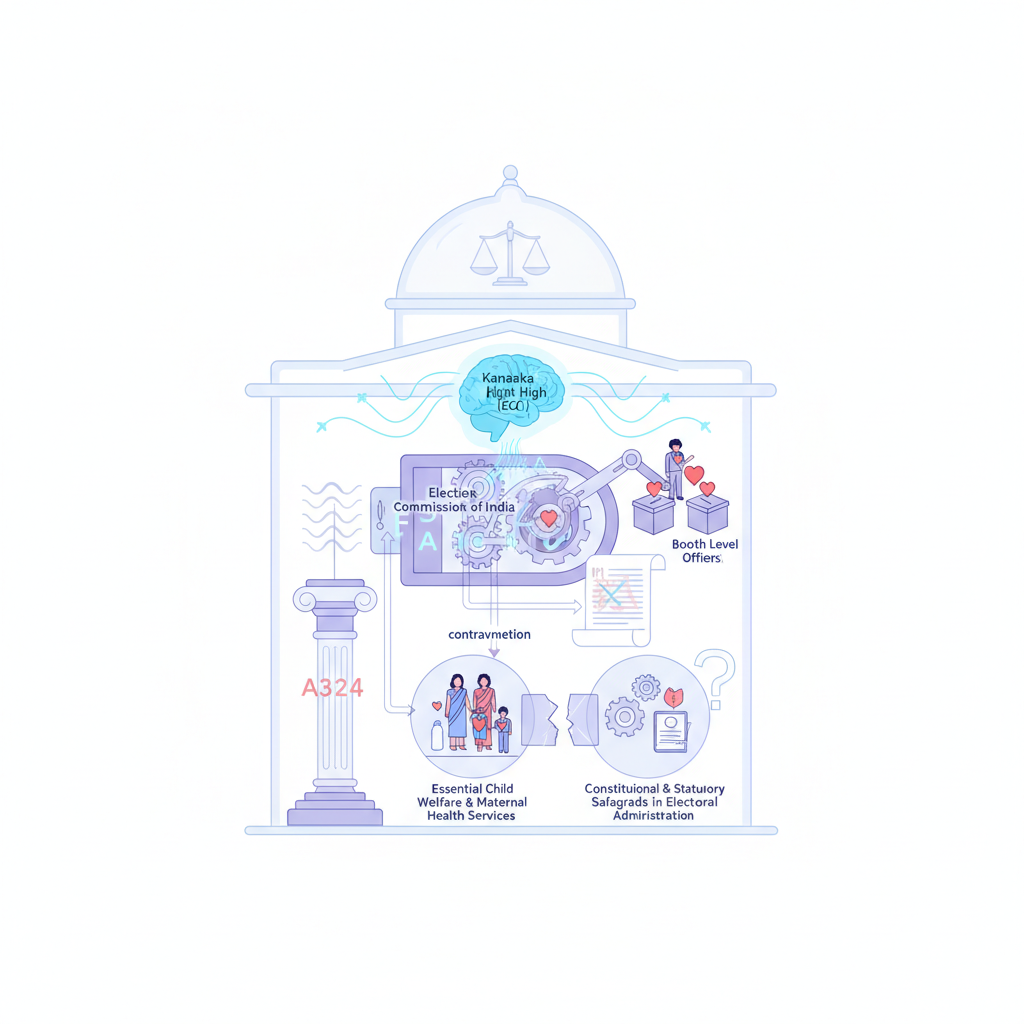
The Karnataka High Court has sought a response from the Election Commission of India (ECI) on a Public Interest Litigation (PIL) challenging the routine appointment of anganwadi workers as Booth Level Officers (BLOs). The petition argues that such appointments contravene the ECI’s 2025 guidelines, which permit the use of anganwadi workers only in the absence of regular state or local body employees of ‘Group C’ and above category, and that this practice undermines the delivery of essential child welfare and maternal health services. The case raises critical questions about the institutional capacity of anganwadi workers to perform election-related duties and the adherence to constitutional and statutory safeguards in electoral administration.
Background
- The Election Commission of India (ECI), established under Article 324 of the Constitution, is vested with the superintendence, direction, and control of elections in India, including the preparation and revision of electoral rolls.
- Booth Level Officers (BLOs) are grassroots-level functionaries appointed by the ECI to assist in the preparation, updating, and verification of electoral rolls at the polling booth level.
- Anganwadi workers are frontline workers under the Integrated Child Development Services (ICDS) scheme, responsible for delivering nutrition, pre-school education, and maternal health services to vulnerable populations, particularly children under six years and pregnant women.
- The ECI issued revised guidelines on June 5, 2025, restricting the appointment of BLOs to regular state or local body employees of ‘Group C’ and above category, with anganwadi workers to be considered only in exceptional circumstances and upon issuance of a non-availability certificate.
- The Department of Women and Child Development, Karnataka, had formally requested the Chief Electoral Officer in March 2022 to refrain from deploying anganwadi workers for election duties, citing their pre-existing workload and lack of training for election-related tasks.
- The petition highlights the increasing complexity of BLO duties, particularly with the digitisation of electoral processes, which now require technical competence in app-based verification and data handling.
What are Booth Level Officers (BLOs) and the ECI’s Guidelines on their Appointment?
- Booth Level Officers (BLOs) are grassroots-level functionaries appointed by the Election Commission of India (ECI) to assist in the preparation, updating, and verification of electoral rolls at the polling booth level.
- BLOs play a pivotal role in ensuring the fidelity of electoral rolls by conducting house-to-house verification, resolving discrepancies, and facilitating the inclusion or deletion of names as per statutory provisions under the Representation of the People Act, 1950, and the Conduct of Elections Rules, 1961.
- The ECI’s 2025 guidelines stipulate that BLOs should primarily be appointed from regular state or local body employees of the ‘Group C’ and above category, ensuring a minimum level of institutional capacity and training.
- The guidelines permit the appointment of anganwadi workers as BLOs only in exceptional circumstances, subject to the issuance of a non-availability certificate signed by the Electoral Registration Officer and countersigned by the District Election Officer, certifying the unavailability of regular staff of the specified category.
- The guidelines underscore the need for BLOs to possess adequate training in electoral processes, including digitised verification systems, to maintain the integrity of electoral rolls and prevent errors that could disenfranchise eligible voters.
- The appointment of anganwadi workers as BLOs is not merely a matter of administrative convenience but has constitutional and statutory implications, as it may divert them from their primary mandate under the Integrated Child Development Services (ICDS) scheme.
- The ECI’s guidelines are framed within the broader constitutional framework of Article 324, which vests the Commission with the authority to regulate the conduct of elections and ensure free and fair electoral processes.
- The guidelines also align with the principles of ethical governance, as they seek to prevent conflicts of interest and ensure that public servants are not overburdened with duties outside their core functional domains.
Key Features
| Feature | Significance |
|---|---|
| Appointment of BLOs from ‘Group C’ and above | Ensures that election-related duties are assigned to trained and regularly employed staff, maintaining institutional capacity and reducing conflicts of interest. |
| Exception clause for anganwadi workers | Permits their appointment only when no regular staff are available, with mandatory non-availability certificates to prevent routine bypassing. |
| App-based digitisation of BLO duties | Introduces technical and data-intensive responsibilities, requiring specialised training that anganwadi workers may lack. |
| Pre-existing duties of anganwadi workers | Includes Early Childhood Care and Education, nutrition services, maternal welfare, and home visits, which are time-sensitive and resource-intensive. |
| ECI Guidelines (2025) | Provide a structured framework for BLO appointments, balancing electoral efficiency with service delivery integrity. |
Why it Matters
Electoral Integrity
- Ensures the accuracy and reliability of electoral rolls through assignment of trained personnel to BLO roles.
- Prevents dilution of BLO functions due to conflicting primary responsibilities of anganwadi workers.
Public Service Delivery
- Protects the welfare services provided by anganwadi workers, which are critical for maternal and child health under the Integrated Child Development Services (ICDS) scheme.
- Prevents diversion of human resources from essential social sector functions to election-related tasks.
Institutional Capacity
- Highlights the need for specialised training for BLOs, particularly in the context of digital verification and data management.
- Underscores the importance of adhering to prescribed appointment guidelines to maintain institutional efficiency.
Governance and Accountability
- Reinforces the principle of non-deviation from established administrative norms unless justified by exceptional circumstances.
- Promotes transparency in the appointment process through mandatory documentation (non-availability certificates).
Challenges
1. Conflict of Roles
- Routine assignment of anganwadi workers as BLOs creates a direct conflict between their primary welfare duties and election-related responsibilities.
- May lead to compromised performance in either or both roles due to resource constraints.
UPSC Link: Public Service Delivery – Role Conflict
2. Lack of Specialised Training
- Anganwadi workers are not equipped with the technical skills required for app-based electoral data verification and management.
- Increased risk of errors in electoral roll maintenance, potentially affecting voter registration and participation.
UPSC Link: Election Commission of India – Capacity Building
3. Bypassing of ECI Guidelines
- Systematic deviation from ECI’s 2025 guidelines undermines the credibility of the appointment process.
- Raises concerns about the consistency and fairness of electoral administration across states.
UPSC Link: Constitutional Bodies – ECI Guidelines
4. Resource Strain in Social Sector
- Diversion of anganwadi workers to election duties exacerbates the strain on India’s social sector workforce.
- May lead to long-term deterioration in the quality of maternal and child welfare services.
UPSC Link: Social Sector – Resource Allocation
5. Digital Divide in Electoral Processes
- Rapid digitisation of BLO duties outpaces the training and capacity-building efforts for grassroots workers.
- Exposes systemic gaps in integrating technology with traditional public service delivery mechanisms.
UPSC Link: Digital Governance – Capacity Gaps
Challenges — UPSC Perspective
| Issue | Concern |
|---|---|
| Role Conflict | Anganwadi workers face competing demands between welfare services and election duties. |
| Training Gaps | Insufficient preparation for app-based verification and data management among anganwadi workers. |
| Guideline Deviation | Routine bypassing of ECI’s 2025 appointment norms reduces administrative credibility. |
| Social Sector Impact | Strain on welfare services due to diversion of critical human resources. |
| Digital Governance | Lack of synchronisation between digital electoral processes and grassroots capacity. |
Government Initiatives — Must-Memorise for Prelims
- Integrated Child Development Services (ICDS)
Way Forward
- Enforce strict adherence to ECI’s 2025 guidelines on BLO appointments, with periodic audits to prevent routine deviations.
- Conduct capacity-building programmes for anganwadi workers to equip them with basic digital literacy for electoral duties, if required.
- Strengthen inter-departmental coordination between the Election Commission, Women and Child Development Department, and local bodies to align priorities.
- Develop a transparent mechanism for issuing non-availability certificates, ensuring accountability at the District and Electoral Registration Officer levels.
- Explore the creation of a dedicated cadre of election support staff to handle BLO duties, reducing reliance on social sector workers.
- Enhance monitoring of anganwadi worker deployment to ensure their primary welfare functions are not compromised.
- Promote awareness among stakeholders about the legal and operational implications of diverting anganwadi workers for election work.
UPSC Value Addition
Keywords for Mains Answer-Writing
Booth Level Officer (BLO) · Election Commission of India (ECI) · Anganwadi workers · Model Code of Conduct · Electoral roll integrity · Constitutional provisions on elections · Election duties of government servants · Early Childhood Care and Education (ECCE) · Nutrition services for children and pregnant women · Electoral Reforms in India · Role of High Courts in electoral governance · Group C and above employees · Non-availability certificate for BLO appointments · Digitisation of electoral rolls · Judicial review of administrative decisions
Constitutional & Policy Linkages
- Article 324 – Powers and functions of the Election Commission of India.
Concept Flow
ECI issues guidelines (2025) restricting BLO appointments to ‘Group C’ and above staff, with exceptions for anganwadi workers. → State governments and local bodies routinely appoint anganwadi workers as BLOs despite the guidelines. → Anganwadi workers’ primary duties under ICDS are compromised due to additional election-related responsibilities. → Petition filed by Karnataka State Anganwadi Workers and Helpers Union highlights the conflict and seeks intervention. → Karnataka High Court questions ECI on the practice, citing adverse impact on electoral integrity and welfare services. → Court seeks response from ECI, raising questions about adherence to guidelines and institutional capacity. → Potential outcomes include stricter enforcement of guidelines, capacity-building measures, or structural reforms in BLO appointment processes.
Prelims Practice Questions
Q1. Consider the following statements regarding the appointment of Booth Level Officers (BLOs) in India:
1. The ECI mandates that BLOs must primarily be appointed from ‘Group C’ and above category employees of the State government or local bodies.
2. Anganwadi workers may be considered for BLO roles only if a non-availability certificate is issued by the Electoral Registration Officer and countersigned by the District Election Officer.
3. The appointment of anganwadi workers as BLOs is a routine practice across all states and Union Territories.
4. BLO duties involve house-to-house verification and data handling critical to maintaining the integrity of the electoral roll.
How many of the above statements are correct?
- Only one
- Only two
- Only three
- All
Answer: Only three — Statements 1, 2, and 4 are correct as per the ECI guidelines and the context provided. Statement 3 is incorrect because the appointment of anganwadi workers as BLOs is not a routine practice but an exception subject to strict conditions.
Q2. Assertion (A): The Election Commission of India (ECI) has issued guidelines restricting the appointment of anganwadi workers as Booth Level Officers (BLOs) to exceptional circumstances.
Reason (R): Anganwadi workers are primarily responsible for delivering nutrition services, pre-school education, and maternal welfare, and their diversion to BLO duties may adversely affect these essential services.
In the context of the above two statements, which one of the following is correct?
- Both A and R are true, and R is the correct explanation of A
- Both A and R are true, but R is not the correct explanation of A
- A is true, but R is false
- A is false, but R is true
Answer: Both A and R are true, and R is the correct explanation of A — Both the assertion and reason are true, and the reason correctly explains the assertion. The ECI’s guidelines explicitly restrict the appointment of anganwadi workers as BLOs to exceptional circumstances to prevent adverse impacts on their primary duties.
Mains Practice Question
✍ The Election Commission of India (ECI) has framed guidelines to regulate the appointment of Booth Level Officers (BLOs) with a view to maintaining the integrity of the electoral roll while balancing administrative efficiency. Critically examine the constitutional and administrative rationale behind these guidelines, particularly in the context of the recent judicial scrutiny over the appointment of anganwadi workers as BLOs in Karnataka. (15 Marks)
Approach: MODEL-ANSWER SKELETON:
1. **Constitutional and Statutory Basis:**
– Article 324 of the Constitution vests the ECI with the superintendence, direction, and control of elections.
– The Representation of the People Act, 1950, and the Conduct of Elections Rules, 1961, empower the ECI to regulate electoral processes, including the appointment of BLOs.
– The ECI’s guidelines are issued under these statutory and constitutional provisions to ensure fairness, transparency, and efficiency in electoral administration.
2. **Rationale for Restricting BLO Appointments:**
– **Administrative Efficiency:** BLOs play a critical role in maintaining the accuracy of electoral rolls through house-to-house verification and data collection. Regular government employees (Group C and above) are better equipped with institutional support and training for these tasks.
– **Conflict of Interest:** Anganwadi workers are already burdened with responsibilities under the Integrated Child Development Services (ICDS) Scheme, including nutrition delivery, pre-school education, and maternal health services. Their diversion to BLO duties may compromise these essential services.
– **Technical Competence:** The digitisation of electoral rolls and app-based verification require specialised skills. Regular employees are more likely to possess the necessary training and institutional capacity.
3. **Judicial Scrutiny and Administrative Compliance:**
– The Karnataka High Court’s intervention highlights the need for strict adherence to the ECI’s guidelines. The court’s questioning reflects judicial concern over the routine bypassing of these norms, which could undermine the integrity of electoral processes.
– The petition by the Karnataka State Anganwadi Workers and Helpers Union underscores the adverse impact on child welfare services when anganwadi workers are diverted to election duties.
4. **Balancing Electoral Integrity and Social Welfare:**
– The ECI’s guidelines strike a balance between electoral efficiency and social welfare objectives. The provision for non-availability certificates ensures that exceptions are made only when absolutely necessary, and regular employees are unavailable.
– This approach aligns with the principles of good governance, ensuring that no critical service is compromised for electoral convenience.
5. **Conclusion:**
– The ECI’s guidelines are a necessary safeguard to maintain the integrity of the electoral roll while respecting the administrative and constitutional framework. The judicial scrutiny reinforces the need for strict compliance with these norms to uphold the credibility of India’s electoral processes.
Source: The Hindu
Karnataka PCS (KPSC) — State PCS Practice
Prelims: The Karnataka High Court recently sought clarification from the Election Commission of India (ECI) regarding the appointment of Anganwadi workers as Block Level Officers (BLOs). Which constitutional or legal provision primarily governs the appointment of BLOs in Karnataka?
- A. Article 324 of the Constitution of India
- B. Representation of the People Act, 1951
- C. Karnataka Panchayat Raj Act, 1993
- D. National Food Security Act, 2013
Answer: B. Representation of the People Act, 1951 — The appointment of Block Level Officers (BLOs) is governed by the Representation of the People Act, 1951, which empowers the Election Commission of India to appoint such officials for electoral roll preparation and revision.
Mains: Critically analyze the implications of appointing Anganwadi workers as Block Level Officers (BLOs) in Karnataka, considering their dual roles in child welfare and electoral duties. Discuss the potential conflicts of interest and suggest measures to ensure transparency and efficiency in their functioning.
Generated by AanyaAi for educational purpose.
Related guides on our sites
- Current affairs for upsc 2026
- Best PSIR optional coaching for upsc
- Best PSIR optional teacher for upsc
- Best teacher of PSIR optional for upsc

- India-Australia AUSTRAHIND 2026 Exercise: Key Highlights for UPSC & State PCS - October 22, 2026
- एससीओ बैठक में भारत का आतंकवाद विरोध: क्षेत्रीय सहयोग पर जोर - October 22, 2026
- SEC Directs Strict SC Order Compliance for Andhra ULB Polls - October 22, 2026

No Comments