


06 Sep Indore Metro Priority Corridor-2 Inauguration: Key Facts for UPSC & State PCS
✎ The Indore Metro Priority Corridor-2 enhances urban connectivity, reduces pollution, and exemplifies the implementation of the Metro Rail Policy 2017 through a state-led SPV model.
Subject Relevance — Where This Topic Fits
- GS Paper II — Governance, Constitution, Polity, Social Justice and International Relations (Urban Governance, Public Service Delivery) | GS Paper III — Infrastructure, Economic Development, Environment and Ecology (Urban Transport, Sustainable Mobility, Climate Change Mitigation)
- Prelims: Metro Rail Policy 2017, Atal Mission for Rejuvenation and Urban Transformation (AMRUT), National Urban Transport Policy (NUTP) 2014, Public Private Partnership (PPP) in Urban Infrastructure, Urban Transport Fund (UTF), Smart Cities Mission, Jawaharlal Nehru National Urban Renewal Mission (JNNURM), Metro Rail Act, 2002, National Urban Transport Policy (NUTP) 2014, Urban Local Bodies (ULBs), Special Purpose Vehicle (SPV) for Metro Projects
- Essay: Urbanisation and Sustainable Development: The Role of Public Transport Infrastructure, Governance Challenges in Urban Infrastructure Development: Balancing Speed, Equity and Sustainability
Quick Revision: The Indore Metro Priority Corridor-2 enhances urban connectivity, reduces pollution, and exemplifies the implementation of the Metro Rail Policy 2017 through a state-led SPV model.
Why is this in the news?
The inauguration of Indore Metro Priority Corridor-2 marks a significant milestone in India’s urban transport sector, thereby enhancing connectivity between residential, commercial, and employment hubs. This development underscores the central government’s emphasis on sustainable urban mobility, integrated urban planning, and climate-resilient infrastructure, aligning with national policies such as the Metro Rail Policy 2017 and the National Urban Transport Policy 2014.
Background
- Urban transport infrastructure in India has historically been dominated by road-based systems, leading to congestion, air pollution, and inefficiencies in public service delivery.
- The Metro Rail Policy, 2017, introduced by the Ministry of Housing and Urban Affairs, provides a strategic framework for the development of metro rail systems across Indian cities, emphasizing financial sustainability, multimodal integration, and last-mile connectivity.
- Indore, a rapidly growing urban agglomeration in Central India, faces challenges of urban sprawl, traffic congestion, and environmental degradation, necessitating a shift towards high-capacity public transport systems.
- The Smart Cities Mission, launched in 2015, prioritises sustainable urban mobility solutions, including metro rail, as a key component of urban transformation strategies.
- Public-Private Partnership (PPP) models have been increasingly adopted for metro projects to leverage private sector efficiency while ensuring public accountability and service quality.
- The National Urban Transport Policy (NUTP) 2014 advocates for a balanced approach to urban transport planning, integrating land-use planning with transport infrastructure to promote equitable access and environmental sustainability.
What is the Indore Metro Priority Corridor-2?
- The project is implemented under the aegis of the Madhya Pradesh Metro Rail Corporation Limited (MPMRCL), a Special Purpose Vehicle (SPV) established for the development and operation of the Indore Metro system.
- The total estimated project cost for the Indore Metro network is approximately ₹4,370 crore, with the Phase-I (Reach-II) extension alone costing around ₹2,850 crore, reflecting the scale and financial commitment involved in urban transport infrastructure development.
- The corridor is designed to enhance connectivity between key urban nodes, including residential areas, commercial centres, and employment hubs, thereby facilitating economic integration and reducing intra-city travel time.
- The project aligns with the Metro Rail Policy 2017, which mandates financial viability, environmental sustainability, and integration with other modes of public transport for metro projects.
- The expansion is expected to reduce traffic congestion, fuel consumption, and vehicular emissions, contributing to climate change mitigation and improved air quality in the city.
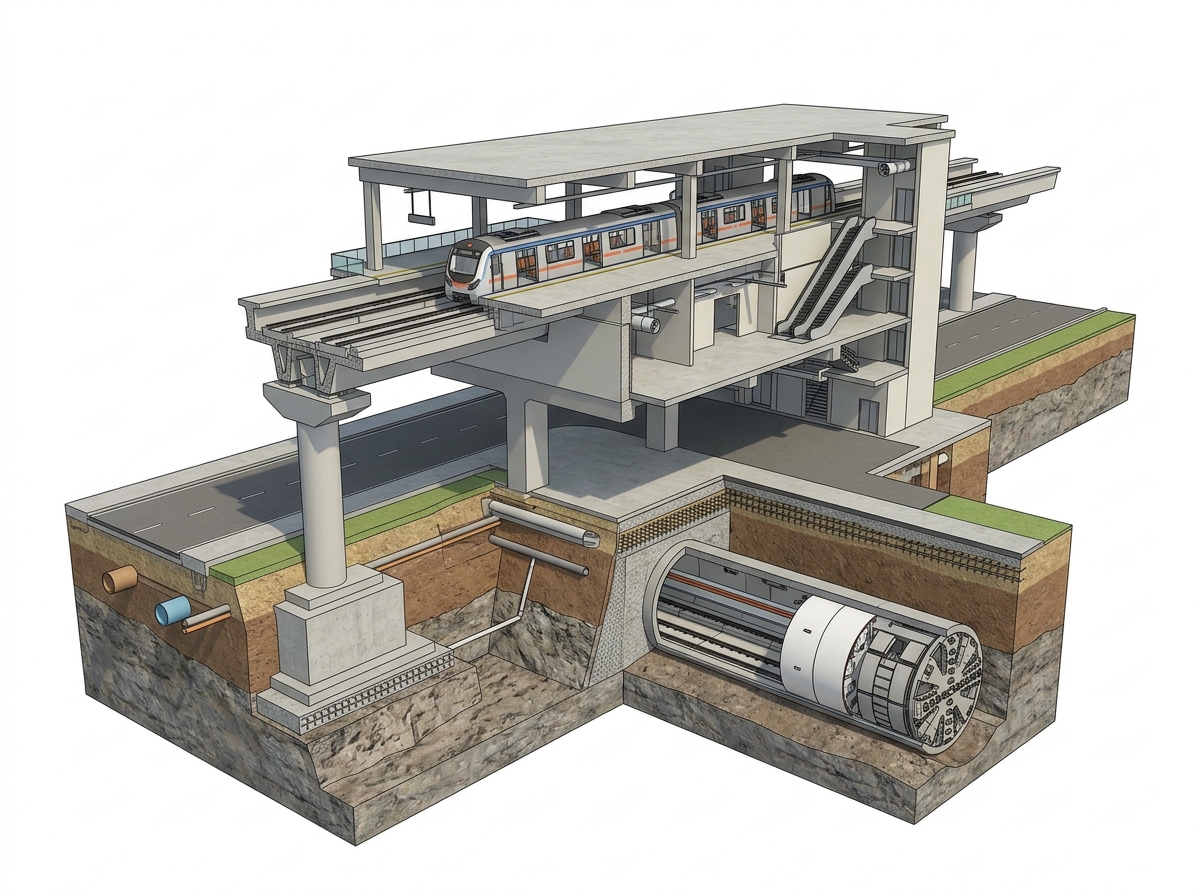
- The corridor is equipped with modern amenities, including escalators, elevators, and digital signage, to ensure accessibility and user convenience, in line with the Rights of Persons with Disabilities Act, 2016.
- The project exemplifies the role of Special Purpose Vehicles (SPVs) in urban infrastructure development, where state governments, central ministries, and private stakeholders collaborate to deliver large-scale public goods efficiently.
Key Features
| Feature | Significance |
|---|---|
| Total Network Length | Expands to ~17 km, enhancing intra-city connectivity across residential, commercial, and employment hubs. |
| Number of Stations | Increases to 16 operational stations, improving accessibility and reducing last-mile travel time. |
| Project Cost | Total investment of ₹4,370 crore, demonstrating commitment to sustainable urban infrastructure development. |
| Corridor Type | Priority Corridor-2 (Phase-I Reach-II) integrates with Super Corridor-3, optimizing transit efficiency. |
| Operational Efficiency | Designed for speed, safety, comfort, and reliability, reducing dependence on private vehicles. |
Why it Matters
Urban Mobility & Infrastructure
- Reduces traffic congestion by providing a high-capacity, rapid transit alternative to road transport.
- Enhances last-mile connectivity, particularly in densely populated urban corridors.
- Supports transit-oriented development (TOD) by linking residential, commercial, and employment zones.
Economic Development
- Stimulates local economies through increased accessibility to markets, services, and employment centers.
- Attracts private investment in real estate, retail, and commercial projects along the corridor.
- Generates employment opportunities in construction, operations, and ancillary sectors.
Environmental Sustainability
- Promotes public transport use, reducing vehicular emissions and fossil fuel consumption.
- Contributes to India’s climate commitments under the Paris Agreement by lowering carbon intensity.
- Mitigates urban heat island effect through reduced road traffic and greener infrastructure.
Social Inclusion
- Provides equitable access to mobility for all socio-economic groups, including women, elderly, and differently-abled.
- Reduces socio-economic disparities by improving connectivity to peripheral urban areas.
- Encourages inclusive urban planning by integrating marginalized communities into the city’s economic fabric.
Governance & Institutional Capacity
- Demonstrates effective inter-governmental collaboration between Centre, state, and urban local bodies.
- Highlights the role of Special Purpose Vehicles (SPVs) like MPMRCL in executing large-scale infrastructure projects.
- Sets a precedent for future metro expansions in tier-2 cities, leveraging lessons from existing networks.
Challenges
1. Land Acquisition & Right-of-Way
- Urban corridors face delays due to fragmented land ownership and compensation disputes.
- Requires robust legal frameworks and stakeholder consultations to ensure timely execution.
UPSC Link: Land Acquisition Act 2013
2. Cost Overruns & Funding Gaps
- Metro projects are capital-intensive; reliance on central/state budgets may lead to funding constraints.
- Need for innovative financing models (e.g., PPP, municipal bonds) to sustain long-term viability.
UPSC Link: Public-Private Partnerships
3. Operational Integration
- Ensuring seamless connectivity with existing and future transit systems (buses, suburban rail).
- Requires integrated ticketing systems and multimodal hubs for user convenience.
UPSC Link: Urban Transport Planning
4. Technological & Safety Standards
- Adopting global best practices for safety, energy efficiency, and disaster resilience.
- Addressing cybersecurity risks in automated systems and real-time monitoring.
UPSC Link: Smart Cities Mission
5. Public Acceptance & Behavioral Change
- Encouraging shift from private vehicles to public transport through awareness campaigns.
- Addressing perceptions of overcrowding, delays, or safety concerns among commuters.
UPSC Link: Behavioral Economics
Challenges — UPSC Perspective
| Issue | Concern |
|---|---|
| Land Fragmentation | Delays in securing right-of-way due to multiple stakeholders and legal hurdles. |
| Funding Model | High capital costs may strain state finances; reliance on central grants is unsustainable. |
| Inter-Modal Integration | Lack of seamless connectivity with other transit modes reduces efficiency. |
| Safety Protocols | Need for stringent maintenance and emergency response systems to prevent accidents. |
| User Adoption | Low initial ridership due to habit inertia or perceived inconvenience. |
Way Forward
- Institutionalize a multi-stakeholder coordination mechanism for land acquisition and project execution.
- Explore blended financing models (e.g., viability gap funding, green bonds) to reduce fiscal burden.
- Develop integrated transit plans aligning metro corridors with bus rapid transit (BRT) and suburban rail.
- Implement real-time passenger information systems and smart card-based ticketing for user convenience.
- Conduct periodic safety audits and public awareness campaigns to build trust and ridership.
- Leverage digital technologies (AI, IoT) for predictive maintenance and energy optimization.
- Establish a dedicated urban transport fund to ensure sustainable revenue streams for operations.
- Promote transit-oriented development (TOD) policies to maximize economic and social benefits.
UPSC Value Addition
Keywords for Mains Answer-Writing
Urban mobility infrastructure · Metro rail expansion · Public transport governance · Urban transport policy · Sustainable urban development · Multi-modal connectivity · Urbanisation and infrastructure · Public-Private Partnership (PPP) in transport · National Urban Transport Policy (NUTP) 2006 · Smart Cities Mission · Urban governance and service delivery · Economic impact of metro rail · Environmental sustainability in urban transport
Constitutional & Policy Linkages
- Article 243W – Municipalities’ role in urban planning and infrastructure development.
- Article 243ZE – Metropolitan planning committees for coordinated urban growth.
Concept Flow
Urbanization → Increased demand for mobility → Congestion and pollution → Need for sustainable transit systems → Policy intervention (Smart Cities Mission, AMRUT) → Metro rail as a strategic solution → Project formulation (Detailed Project Report, SPV model) → Land acquisition and funding → Construction and technology integration → Operational readiness and safety protocols → Public adoption and ridership growth → Economic multiplier effects and urban transformation
Prelims Practice Questions
Q1. Consider the following statements regarding the Indore Metro Priority Corridor-2:
1. The corridor is part of Phase-I (Reach-II) of the Indore Metro project.
2. The total length of the corridor is approximately 17 kilometres with 16 operational stations.
3. The project cost is estimated at ₹4,370 crore.
4. The corridor connects residential, commercial, and employment centres.
How many of the above statements are correct?
- Only one
- Only two
- Only three
- All
Answer: All — Statements 1, 3, and 4 are correct. Statement 2 is incorrect as the total length of the operational network is approximately 17 kilometres, not the corridor itself.
Q2. Assertion (A): Metro rail projects are primarily aimed at reducing traffic congestion and air pollution in urban areas.
Reason (R): Public transport systems like metro rail contribute to lower fuel consumption and greenhouse gas emissions by encouraging modal shift from private vehicles.
Options:
A. Both A and R are true, and R is the correct explanation of A.
B. Both A and R are true, but R is not the correct explanation of A.
C. A is true, but R is false.
D. A is false, but R is true.
Answer: ? — Both the assertion and reason are true, and the reason correctly explains the assertion. Metro rail projects are designed to enhance urban mobility while reducing environmental impact.
Q3. Match the following urban transport initiatives with their respective objectives:
Column I (Initiative) | Column II (Objective)
1. National Urban Transport Policy (NUTP) 2006 | A. Promote sustainable urban mobility through integrated land-use and transport planning
2. Smart Cities Mission | B. Develop 100 smart cities with focus on sustainable and inclusive development
3. Atal Mission for Rejuvenation and Urban Transformation (AMRUT) | C. Enhance basic urban infrastructure and service delivery
4. Metro Rail Policy 2017 | D. Provide a framework for planning and implementing urban transport projects
Options:
A. 1-A, 2-B, 3-C, 4-D
B. 1-D, 2-A, 3-B, 4-C
C. 1-B, 2-D, 3-A, 4-C
D. 1-C, 2-B, 3-D, 4-A
Answer: ? — 1 matches with A (NUTP 2006 aims for integrated planning), 2 matches with B (Smart Cities Mission), 3 matches with C (AMRUT focuses on basic infrastructure), and 4 matches with D (Metro Rail Policy 2017 provides a framework for metro projects).
Mains Practice Question
✍ The expansion of metro rail networks in Indian cities represents a paradigm shift in urban transport governance, moving beyond mere mobility solutions to catalyse economic growth and environmental sustainability. Critically examine this statement with reference to the Indore Metro Priority Corridor-2 and the broader policy framework governing urban transport in India. (15 Marks)
Approach: MODEL-ANSWER SKELETON:
1. **Introduction (2 marks)**: Define metro rail as a component of sustainable urban transport infrastructure. Briefly introduce the Indore Metro Priority Corridor-2 (17 km, 16 stations, ₹4,370 crore) and its significance in the context of urbanisation in India.
2. **Metro Rail as a Catalyst for Economic Growth (4 marks)**:
– Discuss the economic multiplier effect of metro projects (e.g., job creation, real estate development, and business expansion).
– Reference the Indore Metro’s alignment connecting residential, commercial, and employment hubs.
– Cite the National Urban Transport Policy (NUTP) 2006 and its emphasis on integrated land-use and transport planning.
– Mention the role of Public-Private Partnerships (PPP) in financing such projects.
3. **Environmental and Social Sustainability (4 marks)**:
– Explain how metro rail reduces traffic congestion, fuel consumption, and air pollution (reference to Indore’s environmental goals).
– Discuss social inclusion aspects (affordability, accessibility for differently-abled, and last-mile connectivity).
– Reference the Smart Cities Mission and its focus on sustainable urban mobility.
4. **Policy and Governance Challenges (3 marks)**:
– Highlight governance issues: land acquisition, cost overruns, and inter-agency coordination (e.g., state vs. central roles).
– Discuss the Metro Rail Policy 2017’s provisions for standardisation and financial sustainability.
– Mention the role of institutions like the Ministry of Housing and Urban Affairs (MoHUA) and state-level bodies (e.g., Madhya Pradesh Metro Rail Corporation Limited).
5. **Conclusion (2 marks)**: Balance the transformative potential of metro rail with the need for holistic urban planning. Emphasise the role of data-driven policy and citizen participation in ensuring long-term success.
Source: PIB (Press Information Bureau)
Madhya Pradesh PCS (MPPSC) — State PCS Practice
Prelims: Recently, the Chief Minister of Madhya Pradesh inaugurated the ‘Indore Metro Priority Corridor-2’. Which of the following is the primary objective of this corridor?
- To connect the airport with the city center for faster commute
- To reduce traffic congestion in the central business district
- To provide metro connectivity to industrial hubs in Indore
- To enhance metro coverage in rural areas of Indore district
Answer: To connect the airport with the city center for faster commute — The Priority Corridor-2 of Indore Metro primarily aims to connect the airport with the city center, facilitating faster and more efficient commute for passengers.
Mains: Discuss the significance of the Indore Metro Priority Corridor-2 in the context of urban transportation development in Madhya Pradesh. Highlight its potential impact on economic growth, urban mobility, and environmental sustainability.
Generated by AanyaAi for educational purpose.
Related guides on our sites
- Current affairs for upsc 2026
- How to prepare for GS paper 1 for UPSC CSE mains exam
- Best UPSC coaching for IFOS exam
- Best mentorship programme for upsc


No Comments